Search This Blog

Tuesday, August 18, 2015

Bruce Springsteen: In Concert/MTV Plugged

BRUCE SPRINGSTEEN: IN CONCERT/MTV PLUGGED (1993)

1) Red Headed Woman; 2) Better Days; 3) Atlantic City; 4) Darkness On The Edge Of Town; 5) Man's Job; 6) Human Touch; 7) Lucky Town; 8) I Wish I Were Blind; 9) Thunder Road; 10) Light Of Day; 11) If I Should Fall Behind; 12) Living Proof; 13) My Beautiful Reward.

Considering the veritable ocean of live Springsteen releases that were freed from the vaults in the past decade, there really is not one single reason in the world why anybody but the most diehard completist could want this one in the collection. Sure, it was different in 1993: MTV's «Unplug­ged» series were all the rage (at least, in the mainstream world), and the only officially available live album from the Boss was the 1975-85 boxset that could be intimidating even to the serious fan, not to mention the serious fan's wallet. But even in 1993, few people went bananas for the Bruce-MTV combination, and it is easy to see why.

First, the man's involvement with the franchise occurred at the wrong time — he'd recently dis­banded The E Street Band, and was touring with what was jokingly called «The Other Band», where only Roy Bittan was retained from the veterans, and everybody else was just... professional, with little of the common enthusiastic spirit that had carried the Boss and his players through the previous two decades. Second, he was touring in support of Human Touch and Lucky Town — as we have already seen, not altogether godawful records, but certainly formulaic and «safe» ones, and definitely undeserving to overshadow the man's classic catalog; yet 8 out of 13 songs here are all from Human Touch and Lucky Town, and «The Other Band» is not hurrying up to make them come much more alive on stage than they were in the studio.

Third, as is already obvious from the record's title, the album is not un-plugged — the only acou­s­tic performance is the opening ʽRed Headed Womanʼ, a somewhat tongue-in-cheek folk-blues serenade to Patti Scialfa that is really more of a cute musical/lyrical joke than anything else. Once it is over, it's "let's ROCK it!" time, as if Bruce and his new pals were performing some incredible feat of bravery by defying MTV's scenario and turning the tables on them. Bruce later explained that, apparently, acoustic versions of these songs «did not work» when he tried them out with the band, and indeed I can believe that — the only way they could have worked would be for Bruce to just perform all of them solo, and that would have been Nebraska Live, but with generally worse songs, so maybe it's a good thing they brought those cables.

In the end, though, what we have is just a regular audio equivalent of a generic Bruce concert circa 1993 — with most of the classic stuff left off, but lots and lots of «okay» songs that, truth be told, do not differ all that much from the studio versions. The stripped-down rendition of ʽThun­der Roadʼ will not overwhelm the equally stripped-down version on 1975-85; the anthemic rock­ing version of ʽAtlantic Cityʼ is best heard with The E Street Band; and the lengthy, aggrandized rocker / jam / sermon ʽLight Of Dayʼ, to tell the truth, is a strange choice for an «epic» — it's a bit of aggressive roughneck fun as a rocker, but why it is this song in particular that deserves a foam-at-the-mouth New Jersey gospel interlude in the middle sort of beats me. Besides, didn't he originally give the song to Joan Jett? Her version actually has more silly-funny aggression in it than Bruce's own take — he adds too much masculine brutality, killing some of the fun cells.

Ultimately, this is not a bad performance; it simply has too many factors working against it, and it really has no deeply hidden redeeming arguments — such as interesting rearrangements, obscure brilliant rarities, or even original stories, much as I am mistrustful of these when they are driven by the man's populist ego. And while I am not as dismissive of the entire MTV series as some (it did produce its fair share of intimate gems), going plugged on the series really just sucks all sense out of the idea. Next time, let's rock it in a different setting and with a different band, okay, Boss? This one's sort of a misfire.

Monday, August 17, 2015

Brian Wilson: No Pier Pressure

BRIAN WILSON: NO PIER PRESSURE (2015)

1) This Beautiful Day; 2) Runaway Dancer; 3) Whatever Happened; 4) On The Island; 5) Half Moon Bay; 6) Our Special Love; 7) The Right Time; 8) Guess You Had To Be There; 9) Don't Worry; 10) Tell Me Why; 11) Sail Away; 12) Somewhere Quiet; 13) I'm Feeling Sad; 14) One Kind Of Love; 15) Saturday Night; 16) The Last Song.

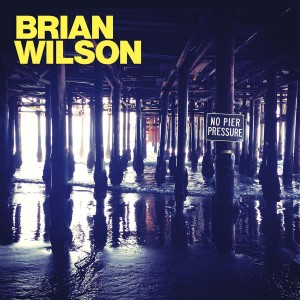
I am sorry to say this, but here it comes: for the first time in his solo career, and, in fact, for the first time in his overall career — discounting those Beach Boys albums for which he was really not responsible — Brian Wilson has come out with a blatantly bad record. Not just «so-so», not «mediocre» — no, this here is something much worse: a dishonest album, which pretends to be a Brian Wilson piece of art in name, but has about as much real Brian Wilson in it as a surimi crab stick has real crab in it. Fake throughout, starting with the silly pun of the title: No Peer Pressure would imply that the album is 100% Brian, which it is not, and No Pier Pressure would imply... crap, I don't even know what it would imply. It's just a stupid pun.

Objective reason #1 for the miserability of this failure: Brian falls back on collaboration with Joe Thomas, the guy responsible for the bad production of Imagination, and, for some reason, also co-writes most of the songs with the guy. Additionally, joining the club of «old geezers embra­cing new faces», he brings in a swarm of musical guests — which wouldn't be much of a problem if it were the right kind of guests, like, say, Andrew Bird or the girl from Beach House, but Kacey Musgraves? Zooey Deschanel? Are you kidding me? Nate Ruess? I have no idea who that guy is, but I do know that he sounds like a boring version of Robin Gibb, and for that reason ʽSaturday Nightʼ sounds like bad late period Bee Gees. Rumor has it that Brian also wanted Lana del Rey, but that she backed out of the project at the last minute — not that her presence would have made this pile of shit any less artificial than it already is, but yeah, I'd like to have her here, just to drive in the last nail of proving my point.

There is not a single good song here, nowhere in sight. ʽThis Beautiful Dayʼ is a pretty enough piano-and-harmonies introduction, tastily adorned with cello and trombone, and it lures you in with a fake promise of the usual, if a little too predictable and derivative, baroque bliss. But that is it — everything that follows broadly falls into two categories: (a) crappy mush and (b) mushy crap (to make this judgement more precise, let us assume that mushy crap has steady danceable rhythm and crappy mush is more of the ballad variety).

Theoretically, I have nothing against Brian Wilson going techno — I have outlived that prejudice a long time ago, and if you genuinely believe your melody needs a good house beat, well, so be it. But ʽRunaway Dancerʼ is just a stupid sounding song — the singing guy has a stupid voice, the lyrics are stupid, the melody is stupid, and what exactly here is Brian Wilson, anyway? This is the kind of stuff you can get on any cheap contemporary dance music radio station. Is it merely to prove a point, that Grandpa can crank it up as good as the young 'uns? If so, it does not prove that point — please, Grandpa, could you return to your usual self, which is something the young 'uns actually cannot imitate, no matter how they try?

Or maybe not, because after that dreadful experiment, Grandpa does try to fall back on the old formula, and the results are comparably pathetic. ʽWhatever Happenedʼ is a good title — because whatever happened to Brian's ability to pen a decent melody? We are not asking for another Pet Sounds — I mean, another Lucky Old Sun would have been quite enough. But this is just mush after mush after mush. Pretty harmonies on autopilot; safe, basic, bland instrumentation; not a single challenging or unpredictable vocal move anywhere. When exactly did lush baroque pop degenerate into smooth background muzak? Lounge instrumentals like ʽHalf Moon Bayʼ, instant­ly forgettable country pop like ʽGuess You Had To Be Thereʼ, and, worst of all, would-be-Beach Boy pastiches like ʽSail Awayʼ, which surreptitiously quotes ʽSloop John Bʼ and nicks some of its instrumentation and vibe, too, but hardly offers a tenth part of its catchiness.

The presence of Al Jardine (and even David Marks) on a few of the tracks adds to the illusion of another Beach Boys reincarnation (indeed, at one time Brian thought this would be a new Beach Boys project), but other than Al's well recognizable voice, songs like ʽThe Right Timeʼ are just more of the same elevator muzak. However, the biggest disappointment is probably ʽThe Last Songʼ — what could at least be an epic, heartbreaking conclusion ends up being a limp, strugg­ling ballad that is one hundred percent atmosphere, sappy, sentimental, and completely free of spiritual depth. Once again, I have no problems about Brian being a big baby: I do have problems when his music sounds like it comes from a little baby, without any signs of the astute psycholo­gism that it once had (not that it doesn't happen to a lot of people as they age — Ray Davies, for instance, seems to have suffered from the same problem).

Overall, for an artist of lesser stature a record like this would have been just boring, but for Brian this is downright awful. One can only hope that his songwriting instincts have been temporarily derailed and buried under the layers of misguided production and ridiculous ambitions of «hip­ness», and that he still has time to dig himself out and at least return to Lucky Old Sun levels of quality. Then again, it is perfectly possible that Joe Thomas isn't quite as responsible as we'd like him to be, and that it is simply old age catching up — after all, not everybody can expect to pre­serve compositional genius for more than five decades. Whatever be, I am actually glad to see that the album has largely garnered negative (or «cautiously positive», so as to not seem offensive to the Elder Statesman) reviews, and I do hope that Brian reads at least some of them. Really, I mean, it is not that hard to understand that something went terribly wrong here. And if you want to help out, I suggest you begin bombarding Brian's mailbox with ideas of what sort of collabora­tors could actually help rather than hurt his legacy — let us insure, after all, that his next project does not involve Zooey Deschanel at least, because he might eventually end up with Katy Perry, and that would just totally blow Grandpa's integrity to pieces. Thumbs down.

Sunday, August 16, 2015

Barenaked Ladies: Silverball

BARENAKED LADIES: SILVERBALL (2015)

1) Get Back Up; 2) Here Before; 3) Matter Of Time; 4) Duct Tape Heart; 5) Say What You Want; 6) Passcode; 7) Hold My Hand; 8) Narrow Streets; 9) Toe To Toe; 10) Piece Of Cake; 11) Globetrot; 12) Silverball; 13) Tired Of Fighting With You.

Honestly, by the time the Pageless Barenaked Ladies released their third album, I have forgotten everything about every single note off the previous two — so either I have become a softie over the last two years, or Silverball is actually a slight improvement, because this time around, I would not describe the record as a «languid, go-nowhere crust of mediocrity». It is a bit languid, sure, and it is somewhat mediocre, but it also seems as if Robertson finally got his head out of that «maturity oven» and started paying a little attention to hooks — which, really, should be your first concern if what you are making is an album of pop songs, and Silverball sure as heck ain't cosmic psychedelia or ambitious symph-rock.

I have no idea why they decided to kick-start the record with a Blue Öyster Cult-style hard rock riff, when in reality ʽGet Back Upʼ is just a mainstream pop-rock song in the style of pre-slutty era Miley Cyrus — a program song, in which Robertson asserts his right to solid mediocrity ("not everything is sink or swim") while at the same time, perhaps, admitting that things had indeed taken a turn for the worse over the previous years ("I'm a little bit worse for wear"). Well, okay, if a tepidly produced hard rock bridge section helps you get back up, so be it — the question is, can the rest of the album actually satisfy the pledge?

Well, if you accept that for the Ladies, «up» really means «rocking back and forth in a cozy rocking chair by the fireplace», then it does. Most of these songs are predictably cuddly, but they are also bouncy, fast-paced, and focused on catchy choruses — a type of unassuming domesticity that I could see as successful, sort of like a tribute album to ʽWhen I'm Sixty Fourʼ, even if none of the band members are even close to that age border at the moment. Regardless of whether the song in question is electric power-pop with an anthemic refrain (ʽHere Beforeʼ), soft toe-tappy country-pop with a cute electronic lining (ʽMatter Of Timeʼ), or a nostalgic throwback to Eighties synth-pop à la ABC or Duran Duran (ʽDuct Tape Heartʼ), they all share two things — soft intro­spective sentimentality-vulnerability and a genuinely singalong chorus, sometimes supported with strategically placed harmonies (like the woo-woos on ʽDuct Tape Heartʼ).

This does not cure the music of its main illness — complete lack of teeth, particularly deep biters that could tear a serious hole in your soul. This is indie on the level of, say, Badly Drawn Boy, more appropriate for a second-rate Pixar movie soundtrack or some other family entertainment franchise than for anyone who wants to experience the true power of music. But, surprisingly, song after song they succeed in populating the melodies with hooks — either a fun keyboard line, or a nice vocal twist, or an odd retro move (like that flourish at the start of ʽPiece Of Cakeʼ that seems to have been borrowed out of some ambitious disco piece circa 1978), and as they accu­mulate, it slowly leads me to the inevitable conclusion: Silverball is an album that at least has a right and reason to exist, unlike its two predecessors. As George Harrison once wrote — "When your teeth drop out / You'll get by even without taking a bite", a perfect sentence to be used as a tagline for this album and this stage of the band's career in general.

And the best song on the album? As much as Kevin Hearn's ʽDaydreamin'ʼ was a bore, ʽTired Of Fighting With Youʼ is a touch of humble beauty; it helps to know that the song was written during his latest bout with the freshly returned leukemia, but even without that knowledge the vocals, the lyrics, the gently descending waves of melody cut straight to the heart this time. The title of the song and the way it is stretched over the chorus might trigger faraway associations with the Kinks' ʽTired Of Waiting For Youʼ, with which the tune also shares its aura of tender melancholy, but not its subject matter — actually, I guess this might be one of the tenderest songs about a lethal illness ever written.

Anyway, I would like to advance the record its thumbs up: even if there is very little here that would make me want to return to the album now, I do feel like I could easily return here as I ad­vance in age — the whole thing is so homely and cuddly and insists on tackling serious problems and issues in the softest, politest, gentlest ways possible that it would make the perfect soundtrack for nursing homes. And many of us will eventually end up in nursing homes, so it's always wise to stack up a little something for future use.

Saturday, August 15, 2015

The Brian Jonestown Massacre: Who Killed Sgt. Pepper?

THE BRIAN JONESTOWN MASSACRE: WHO KILLED SGT. PEPPER? (2010)

1) Tempo 116.7 (Reaching For Dangerous Levels Of Sobriety); 2) Þungur Hnífur; 3) Let's Go Fucking Mental; 4) White Music; 5) This Is The First Of Your Last Warnings; 6) This Is The One Thing We Did Not Want To Have Happen; 7) The One; 8) Someplace Else Unknown; 9) Detka! Detka! Detka!; 10) Super Fucked; 11) Our Time; 12) Feel It (Of Course We Fucking Do); 13) Felt Tipped-Pen Pictures Of UFOs.

Judging by the album cover, one might conclude that it was either Jesus who killed Sgt. Pepper, perhaps in retaliation for John Lennon's blasphemy, or, even more shockingly, that Jesus was Sgt. Pepper, in which case lines like "Sgt. Pepper taught the band to play" would take on a whole new light — in fact, the whole Sgt. Pepper would be actually a concept album about the life of Jesus, who'd love to turn you on with a little help from his friends (St. Peter, St. James, etc.), especially since it's getting better all the time, and she's leaving home to meet a man from the motor trade (shouldn't that be carpenter trade?), and ʽWhen I'm Sixty Fourʼ is, of course, about The Last Temptation Of Christ, and...

...sorry, well, at least that's one fine direction of thought that came from this BJM album without me hearing even one note of it. However, I am sad to say that this direction of thought has no­thing whatsoever to do with the album itself — which, incidentally, happens to be the weirdest offering from Newcombe in almost twenty years, and even if it rarely works on gut level (you'd have to have your guts made out of nylon for that), the very fact of its existence is somewhat of a consolation, since psychedelic musical surprises come so rarely these days.

We will proceed from the basic assumption that this album is total crap, which will make things easier for us. As usual, Newcombe dispenses his ideas with extreme frugality — hardly more than one per track — and, as usual, the album runs over seventy minutes. As usual, he appropriates and assimilates rather than invents. And he seems to have almost completely finalized the shift from «song-based» to «jam-based» music: the absolute majority of these tracks are just vamps, and if there are any words, they are repetitive mantras (as in, "let's go fuckin' mental, let's go fu­ckin' mental, la la la la, la la la la...") rather than verse-chorus constructions. And it probably took half an hour to figure out most of the album's melodic moves.

But the album lives, further expanding and polishing the new style of My Bloody Underground, now with twenty percent extra black venom as deep-cutting bass lines, metalic fuzz, and hard-whacking drum machines completely take over and turn the album into an endless journey through a series of harmless, but intimidating musical black holes. The band that once epitomized sonic narcolepsy has truly awoken — or, rather, entered a period of hyperactivity while still in a somnambulant state, like a narcoleptic on heavy amphetamines. And I find myself as puzzled as anybody, but much of the time it works.

The main part of the ride begins with the second track (the one with the Icelandic title), which is the closest Anton ever got to reproducing the classic Hawkwind vibe — a dark, brutal psycho-boogie with all sorts of astral effects, cymbal-heavy percussion, and an ugly nasal-vocal accom­paniment that we could all do without. ʽLet's Go Fucking Mentalʼ is designed as some sort of a trippy carousel ride around a dirty-sounding R'n'B guitar-and-harmonica groove with a nasty, not-give-a-damn attitude, rather than any intentions of having a good time, to it. ʽThis Is The First...ʼ has probably the best bass line on the album, emphasized with foamy-bubbly electronic effects and ridiculously pseudo-passionate Icelandic vocals, all the while chugging along at a relatively fast, very much danceable tempo — post-disco meets post-rock, or at least catches a brief envy­ing glimpse of it from a distance.

The real attraction of the record, though, is that it actually gets weirder and weirder as time goes by. ʽThis Is The One Thingʼ is a collage of two Joy Division songs (the "we were strangers" cho­rus from ʽI Remember Nothingʼ and the rhythm section of ʽShe's Lost Controlʼ), with additional lyrics and guitar grooves from Anton himself — the resulting atmosphere is nothing like the intimate bleakness of Joy Division, but it borrows nicely from that bleakness to add to the general «self-induced angry madness» of the album. Joy Division influence blips one more time later, on ʽSomeplace Else Unknownʼ (whose vocal melody and lyrics borrow from ʽInterzoneʼ), but the peak of the weirdness is reached on ʽDetka! Detka!ʼ (ʽBaby, Babyʼ) — an odd ska groove here with the entire song delivered in Russian, apparently by some guy from the completely unknown Russian band «Amazing Electronic Talking Cave». Absolutely no idea how they got in touch with Newcombe or why he thought that a little bit of Russian rock infusion would be a meaning­ful addition to his legacy, but there it is — for the record, the repetitive bridge section literally translates from Russian as "I will love you only after I die", which is a very Russian thing to mention in the context of a pop song, but few will ever know about that... and now you're one of those happy few who do know.

The final track here is neither a song nor even a groove — it is a simple ambient piece with just one soothing keyboard phrase, over which Newcombe first overdubs John Lennon's famous in­terview in which he apologizes for the "Beatles are bigger than Jesus" thing, and then some Bri­tish girl's lengthy, raving, and frantic denouncement of Lennon as a phony. This is, the way I gather, not so much a musical piece as another one of Newcombe's naughty keep-music-evil statements — as much as he clearly loves the Beatles (and who doesn't?), he finds it his duty to treat them as at least whippable, if not slayable, sacred cows, because, you know, otherwise he'll look like a fanboy rather than a respectable artist, and what will remain of The Brian Jonestown Massacre if they stop looking like respectable artists? Just monotonous grooves without a cause. The Committee To Keep Music Evil cannot allow that. Besides, if there is one single track on this album that can really drop you a clue as to who actually killed Sgt. Pepper, it is surely this one.

Despite some of these rather easily disclosed and predictable moves, on the whole I think that the album deserves its thumbs up — I mean, it nurtures and develops the curious direction of My Bloody Underground with extra care, so how could it be different? Maybe it is not half as «evil» as it positions itself to be, but that is still twice as «evil» as, say, your average cartoonish death metal album or whatever else passes for «evil» these days. Driven by a general unified purpose, monotonous in structure, but diverse and unpredictable in ideas, and, above all, kicking some ass in terms of sheer execution — that is at least something that should be encouraged, so let us be forgiving in details and encouraging on the general scale.

Friday, August 14, 2015

Boris: Asia

BORIS: ASIA (2015)

1) Terracotta Warrior; 2) Ant Hill; 3) Talkative Lord Vs. Silence Master.

And here comes the third and, fortunately, last installment of the trilogy, of which the less said, the better, so here is a quick runthrough. ʽTerracotta Warriorʼ is a twenty-minute long noise ho­mage to the deeply buried unknown soldier of China's first emperor, beginning in the form of the whistling wind in the deep underground chamber and gradually layering feedback that probably represents the modern day excavators trying to get through. ʽAnt Hillʼ is ten minutes of crackling electronic pulse (how may times have we heard that already?), an allegory for the ant hill which is itself an allegory for the endless run of silly humans around their daily tasks. ʽTalkative Lord Vs. Silence Masterʼ is ten more minutes of feedback crackle, radio static-style.

That's all, folks. No, really. I am packing my bags now and embarking on the quest to find seven people who actually «enjoy» and «get» this album. Together, we will find a way to break the laws of gravity and quantum mechanics and advance humanity to the... next state of advancement, whatever that is. Watch out for the latest news from The Boris Samurai — until then, thumbs down, but I promise you, once we finally rule the world, that is bound to change.

Thursday, August 13, 2015

Billy Bragg: Workers Playtime

BILLY BRAGG: WORKERS PLAYTIME (1988)

1) She's Got A New Spell; 2) Must I Paint You A Picture?; 3) Tender Comrade; 4) The Price I Pay; 5) Little Time Bomb; 6) Rotting On Remand; 7) Valentine Day's Over; 8) Life With The Lions; 9) The Only One; 10) The Short Answer; 11) Waiting For The Great Leap Forward.

If you were a mathematical model, you'd be alarmed by now — we go from just one Billy Bragg on Life's A Riot to three additional musicians on Brewing Up to a whoppin' eleven backup sin­gers and musicians on Talking With The Taxman to, finally, an amazing nineteen people offer­ing their support (and Party mandates) to somebody who, deep in his heart, still remains the same old scruffy electro-busker and does not really need anybody in particular; yet wouldn't it be strange for a union-loving leftist to just keep on doing it all alone? I mean, what sort of example would he set for society? Solitary singer-songwriters, after all, are more like Ayn Rand fodder, when you come to think about it. If you're asking for proletarians all over the world to unite, well, at least get yourself a fuckin' rhythm section to deliver the message.

Then again, despite the album title and the general artistic reputation, one need not forget that only three out of eleven songs here are political — the other eight, predictably, are about how hard it is, in a million different hard ways, to forge out comfortable relations between a male and a female spirit. Ironically, the political songs are the weakest of the lot: ʽTender Comradeʼ is an accappella piece where Billy has to struggle so hard to keep in tune, he does not have much strength left to worry about emotional resonance (and the anti-war lyrics aren't that great, either), and ʽRotting On Remandʼ is just a generic prison ballad where even the lyrics do not advance that much in comparison to your average Woody Guthrie.

There are, however, quite a few songwriting mini-gems in the love story department, where we should probably single out ʽThe Price I Payʼ, built on a lovely piano swirl with a tinge of sweet sorrow and a catchy, if a little too repetitive, vocal hook; the uptempo ʽLife With The Lionsʼ, saved from its underdone-country fate with a playful, inspired, poppy piano part from new band member Cara Tivey (she gives the whole thing a bit of a New Orleans vibe, which is always cool to have); and, uh, I guess ʽMust I Paint You A Pictureʼ, opening with a guitar line that seems like somebody'd spent way too much time listening to Hendrix's ʽLittle Wingʼ, also has a certain subtle charm nested somewhere in between guitar, piano, and vocals, though I am still in the pro­cess of trying to come up with an adequate description for it (the charm, that is).

The big problem is that, as a love poet, Billy still has a huge problem coming up with his own unique perspective on things — other than the occasional melodic invention and the occasional astute or cool-sounding lyrical twist such as "between Marx and marzipan in the dictionary there was Mary", he still does not do anything here that hadn't already been done by Elvis Costello, that is, the «intellectual-psycholo­gical love ballad with poppy overtones, non-professionally sung with some half-charming, half-irritating British accent». And therefore, each time he writes (or, rather, «under-writes») a song whose hookpower is anything less than obvious, it is instantaneously for­gettable — no free, freshly painted memory cells to accommodate these unremarkable new lod­gers. Sometimes they get a very nice, very tasteful chamber-pop sound going on (ʽThe Only Oneʼ, with a lonely viola dueting with the acoustic guitar), but nothing in the song rises above mildly pleasant — the pain is only hinted at, never properly conveyed by the instrumentation.

In the end, love and politics come together once again, and at least do a good double job of pro­viding a satisfactory final note with the tragicomic ʽWaiting For The Great Leap Forwardʼ, the closest thing this record has to an anthem, but an ironic one: "Join the struggle while you may / The revolution is just a T-shirt away", Billy says, either urging you to dive inside a Che Guevara tricotage shell, or making fun of you for doing so — you go ahead and try to determine his level of intellectual penetration yourself. The song is bouncy, catchy, has a group chorus romp sort of thing to it, enough to forgive the album for its frequent moments of boredom and ultimately may­be even try and issue it a faint thumbs up, just because, you know, it is at least Billy's first tho­rough attempt at an actual pop-rock album, and it deserves some way of recognition.

Wednesday, August 12, 2015

Brian Eno (w. David Byrne): My Life In The Bush Of Ghosts

BRIAN ENO: MY LIFE IN THE BUSH OF GHOSTS (w. David Byrne) (1981)

1) America Is Waiting; 2) Mea Culpa; 3) Regiment; 4) Help Me Somebody; 5) The Jezebel Spirit; 6) Very, Very Hungry; 7) Moonlight In Glory; 8) The Carrier; 9) A Secret Life; 10) Come With Us; 11) Mountain Of Needles.

This album is frequently hailed as a milestone in the history of sampling — the first ever LP to employ sampling techniques on a regular basis, as a fundamental element of the music, as oppo­sed to sporadic earlier experiments by other people; all the more fascinating from our modern perspective in that everything here was still recorded on analogue equipment, and apparently it took a lot of fuss to synchronize the samples with the beats (but must have been fun, though). But as nice as it is to know that, I don't really give a damn: use of samples is not a blessing per se, no matter how many mediocre hip-hop artists might think so, and unless it serves some bigger pur­pose than «coolness», it's just an additional layer of sound.

Actually, from that perspective My Life In The Bush Of Ghosts is not really an Eno album, and should probably be discussed under «David Byrne» — but we will take the easy way out and decide that, since it is credited to «Brian Eno — David Byrne» and not vice versa, Brian is recog­nized as senior leading partner (or, at least, as someone whose first name starts with a B rather than a D). In reality, though, the majority of the instrumental tracks here sound very, very close to the Talking Heads sound of Remain In Light — hardly surprising, since they were actually re­corded in between Eno's work with the band on Fear Of Music and Remain In Light itself; it is only because of additional legal problems with getting permission to use all the samples that the release of the record was delayed, by which time Remain In Light had already come out and changed the face of popular music.

That said, things wouldn't change much if the release order were reversed, because My Life is by no means a «popular» album — its tracks, though definitely musical and even danceable, relay on weird samples for vocal content, and have nothing that would even vaguely resemble a singalong chorus. The samples themselves are usually of two varieties: either Near Eastern singers or Ame­rican radio evangelists, exorcists, and politicians — which might be understood as a symbolic indication that the spiritual values of traditional and (post-)industrial societies are not as far removed from each other as could be thought. Or maybe Eno just randomly selected stuff that appealed to him on a (sub-)sonic level, and then left it open for anybody's interpretation. In any case, the final product was obviously and arrogantly «bizarre», and the impression was only further magnified with its title (taken from a 1954 novel by Amos Tutuola about the adventures of a West African boy that neither of the artists had even read) and its abstract painting on the front sleeve (which was actually taken from a video monitor, so that's probably the most digital part of the whole thing).

But it is a «visionary» kind of bizarre, all right, and I just can't see any fan of Remain In Light remaining in the darkness concerning this record, which really looks a bit like its older, slightly less gifted, but maybe even more eccentric brother. Eno used to refer to it as a «psychedelic visi­on of Africa», yet I think he was kind of selling his own product short: African rhythms and Afri­can instrumentation play as big a part in this as they did on Remain In Light, but the record itself is not about Africa as such — and certainly you wouldn't get that impression based on the very first track, whose main sample goes "America is waiting for a message of some sort or another". With all these evangelists, exorcists, and radio hosts walking all over the funky rhythms, My Life is the busiest album to have ever been released with Eno's name on it — a staggering contrast with all these hush-hush ambient records — and if it is a psychedelic vision of anything, it is more likely a psychedelic allegory for life on the streets of a big modern city, where African rhythms and polyrhythms just illustrate the general hustle and bustle. In fact, you could choose a good half, if not more, of these tracks to accompany some mad police chase scene in Miami Vice or anything similar — whereas the other half could be a good soundtrack for crowded bar scenes. The album does sort of quiet down towards the second half, with subtler, slower, more suspense­ful soundscapes, but you could argue that it simply reflects the passage of time, Side A taking place in broad daylight and Side B taking you on a trip into the shadows of night.

Individual highlights do not exist on this record: it really exists as a single conceptual piece with multiple movements. The grooves do not struggle for memorability: ʽThe Jezebel Spiritʼ, for in­stance, is very close in texture to the fast danceable numbers of Remain In Light, but has no central super-memorable riff or lead line, just a paranoid bass pulse and recurrent machine-gun rounds from various guitars and keyboards that are either too brief or too simple to imprint them­selves in memory — and the same applies to most other tracks, but that's OK: My Life is suppo­sed to produce a general overwhelming impression, not a set of particular small ones. In reality, no two tracks really sound the same, be it the rhythmic base, the musical overdubs, or the used samples, but the basic gut reaction from each one is the same — «fussy». Which is a perfectly normal state of being for Byrne, but not usually for Eno: the last time he got that fussy was on the first side of Before And After Science (whose own funky rhythms, by the way, are a direct pre­decessor to some of these tracks here).

And yes, returning to the samples, the samples do work. Arguably the best example would be the exorcist in ʽJezebel Spiritʼ, who just blends in so well with all that funk (and I am fairly sure the whole track must have been an influence on King Crimson's monstruous masterpiece ʽThela Hun Ginjeetʼ, released later in the year), but Reverend Paul Morton hardly lags behind on ʽHelp Me Somebodyʼ (I have no idea how they could secure the rights to that piece of sermoning, unless they somehow convinced the Reverend that, you know, God moves in mysterious ways), and Dunya Yusin is especially haunting on the creepy ʽRegimentʼ, whose syncopated bass line and Frippertronics (yes, Robert was there too) create quite an ominous atmosphere by themselves, but it never hurts to reinforce the atmospherics with the aid of a Lebanese mountain singer.

Fun fact: the first track on Side B on the original release was ʽQur'anʼ, for which Brian and David sampled the chanted recital of The Holy Book by a bunch of Algerian Muslims — only to have it removed and replaced with ʽVery, Very Hungryʼ (formerly the B-side of ʽJezebel Spiritʼ) at a later date due to the insistence of the Islamic Council of Great Britain, "in deference to some­body's religion", Byrne said later. Hey, we understand — nobody wants not to wake up one mor­ning with Yusuf Islam's dagger sticking out of your back, guys, even if those were not exactly the Je suis Charlie times. You can still listen to the finished track on Youtube these days, though (for now) — there is really nothing offensive about the way the recital is sampled, what with the groove itself having a distinct near-Eastern flavor, but of course the «protests» were issued more on general principle than any particular gripes.

Anyway, just forget about the alleged historical importance — sampling is such a poorly under­stood and clumsily theoretized business (like a lot of developments in modern art) that singling out its «revolutionaries» and «torch-bearers» is like dancing without a floor. The best way to get into this album is just to adapt yourself to the groove and then mentally transfer yourself to some imaginary setting — and then understand that setting as an actual metaphor for your own every­day life, particularly if you're a big city dweller that just keeps on running. Adopt this perspective, and thumbs up are guaranteed. Renounce it, and the whole thing will just be a weirder, but more boring imitation of Remain In Light. I know which one I choose. 

Tuesday, August 11, 2015

Bruce Springsteen: Live 1975-86

BRUCE SPRINGSTEEN: LIVE 1975-85 (1986)

1) Thunder Road; 2) Adam Raised A Cain; 3) Spirit In The Night; 4) 4th Of July, Asbury Park (Sandy); 5) Paradise By The "C"; 6) Fire; 7) Growin' Up; 8) It's Hard To Be A Saint In The City; 9) Backstreets; 10) Rosalita (Come Out Tonight); 11) Raise Your Hand; 12) Hungry Heart; 13) Two Hearts; 14) Cadillac Ranch; 15) You Can Look (But You Better Not Touch); 16) Independence Day; 17) Badlands; 18) Because The Night; 19) Candy's Room; 20) Dark­ness On The Edge Of Town; 21) Racing In The Street; 22) This Land Is Your Land; 23) Nebraska; 24) Johnny 99; 25) Reason To Believe; 26) Born In The USA; 27) Seeds; 28) The River; 29) War; 30) Darlington County; 31) Working On The Highway; 32) The Promised Land; 33) Cover Me; 34) I'm On Fire; 35) Bobby Jean; 36) My Hometown; 37) Born To Run; 38) No Surrender; 39) Tenth Avenue Freeze-Out; 40) Jersey Girl.

Nothing but the biggest for The Boss! Unless I'm very wrong, this was the first ever live album to be released not on two or even three LPs (that did happen in the prog-rock era), but on five. And of course, it is a live retrospective that spans a whole decade, but even so, I don't think even the Grateful Dead had the gall to put out anything like that in 1986. Bruce did have a certain excuse, though — he had established his reputation as a major kick-ass live performer already at the time of his first studio records, yet somehow even after the major success of Born To Run live albums did not appear on the horizon. Modesty? Laziness? Lack of interest?

Well, whatever. Live 1975-85, released as a sort of major summarization of Bruce's live career, is neither modest nor lazy, and, judging by its careful construction, shows somebody who is very interested in establishing a memory of himself as one of the greatest live players in his generation, so we should assume that this is just Bruce catching up. (We could assume that he intentionally waited all this time, so he could accumulate enough material and market the biggest live album ever made — but then, rock musicians don't usually plan that far ahead). The downside, of course, is that the album is so goddamn sprawling, there probably are very few people in the world, bar complete Springsteen nutsos, who sat through it more than once — and I, too, have to confess that I am writing about it after only just one listen. It was a good listen, though, and I might find myself coming back to at least parts of the monster at later dates.

The title is actually a bit misleading, because only one song here, out of a whoppin' 40, really goes back to 1975 — the opening ʽThunder Roadʼ, presented here in its stripped-down, totally non-thunderous rendition (just piano, chimes, and harmonica). To listen to Bruce in all his early bearded glory, loyal bootleg-hating citizens would have to wait for another twenty years, until the archival re­lease of Hammersmith Odeon '75. The real bulk of this album, though, begins July 7, 1978, at the Roxy Theatre, and takes us through three consecutive sections: the 1978 tour, the 1980-81 River tour, and the largest and the most recent section, occupying almost half of the set — the 1984-85 Born In The USA tour. Understandably, most of the sections focus seriously on contemporary material, but, also understandably, the first section dips heavily into the man's early catalog, so, all in all, all of his seven studio albums up to that date are well represented (Neb­raska suffers the most, but it would also be the least reasonable source of material for live per­formances, unless Bruce started doing all those acoustic songs in full E Street Band arrangements or something. Which he would later do, but not in 1984).

Unless you are of the utterly cynical persuasion, it makes no sense to insist that the tremendous energetics that has always been the norm for Bruce's shows is somehow not felt on this collection: it is, all the way through. Regardless of the «inherent» quality of the song being played, it is al­ways played at the top level — admittedly, maybe the man could have occasional weaker nights, but that is what the selection process is there for (though I guess that tracks were shuffled from different shows largely because of varying sound quality). As the E Street Band kicks in with full force into ʽAdam Raised A Cainʼ (great choice for a lead-in track), you understand that this live rendition from The Roxy is every bit as powerful as its studio counterpart, and the studio counter­part was one of Bruce's most powerful moments in the studio, ever. Later on in his career he would, unfortunately, begin to slur and speed up the words, disrupting the perfect flow of the song, but back in 1978, when it was still fresh, he just made sure that his demons were properly exorcised in front of the population, night after night.

Most of the other songs also stay true to their studio versions, with just a few variations (ʽCover Meʼ gets a pathetic-dramatic introduction, with Patti Scialfa wailing "nowhere to run!" and her future husband calling back drama-pop-metal fashion — totally unnecessary, I'd say, but appa­rently Bruce thought back in 1984 that the song needed something to «cover» it up. Some great soloing from Lofgren and the Boss himself, though). Nothing really needs to be reinvented, though, as long as the songs come to an extra life on stage due to the raw passion of all the play­ers involved. Stuff like ʽRosalitaʼ would be the perfect example, but for some reason I am really digging this version of ʽCadillac Ranchʼ — a song that never jumped out at me that much when it was on The River, but here, it is just admirable how great a song consisting of 16 simplistic bars can be if you just give it your all (unfortunately, it also means that these bars have become so permanently lodged in my head that it will take quite a few days to get it out — I guess I have The Big Man to thank for that. By the way, if you check some of the old live videos for that song, Bruce does some really hilarious dance moves at the end).

It is somewhat different about the stories, though — an integral and indisputable element of each of the man's shows, but every time he starts out with some recollection of how he was abused by his parents (ʽGrowin' Upʼ) or of his girlfriend troubles (ʽThe Riverʼ, naturally), some red light comes up in my mind: «man, you're overdoing it». The music is heartfelt enough; do we really need that additional element of intimacy? Granted, we are spared here from his foam-at-the-mouth impersonations of an Afro-American preacher, all set to baptize you in the alleged name of rock'n'roll, that would become the norm at later concerts — but those nasty jabs at his folks that accompany ʽGrowin' Upʼ are really just as irritating. This is where Bruce the musician, in my opi­nion, becomes completely overshadowed by Bruce the populist, and I don't really buy it that the two are inseparable — after all, these stories were not present on the studio recordings, were they? At least if they were improvised and spontaneous, that'd be an excuse, but clearly they were just as well rehearsed as the songs themselves. Not good at all.

Fortunately, that's just three or four spoilt tracks out of forty, and for compensation, you have a bunch of tracks that were (back then) unavailable anywhere else — such as Bruce's own rendition of ʽBecause The Nightʼ (he did right to give the song to Patti Smith, who sings it better, but she never had the full power of the E Street Band behind her, alas); ʽFireʼ, which ended up as a huge hit single for The Pointer Sisters, but is actually done better by Bruce (less pop, more feeling); ʽSeedsʼ, a surprisingly tough and gritty blues-rocker from the Born In The USA era that may have been left off the album due to being too heavy (bad synths, though); and a couple of R'n'B covers like ʽRaise Your Handʼ and ʽWarʼ, to which the man's hoarse roaring voice is ideally suited. Oh, and just so that you do not forget where the roots are, the record ends with a cover of Tom Waits' ʽJersey Girlʼ (whose lyrics Bruce doctored a little bit, replacing "whores" with "girls" so that, you know, Jersey people would feel less confused about their homeplace).

Because this monster is so big, this makes it really hard to get into any of the tracks in major de­tail — and it probably isn't the point anyway. The point is that the monster is big, big, B-I-G, American size big, and whether you like it or whether you don't just don't matter, because it is simply an objective fact. Tons of songs, top volume, top energy, most dedicated people in the business, and sooner or later, the atmosphere becomes contagious. Despite the length, at no par­ticular point does the record become boring (maybe only a little bit during the Nebraska section, but it also has its place as a «breath-catcher» in between all the high energy jolts), and, well, it's just three and a half hours long in the end — the approximate length of a single Springsteen live show, as it were. Thumbs up

Monday, August 10, 2015

Brian Wilson: In The Key Of Disney

BRIAN WILSON: IN THE KEY OF DISNEY (2011)

1) You've Got A Friend; 2) The Bare Necessities; 3) Baby Mine; 4) Kiss The Girl; 5) Colors Of The Wind; 6) Can You Feel The Love Tonight; 7) We Belong Together; 8) I Just Can't Wait To Be King; 9) Stay Awake; 10) Heigh-Ho/Whistle While You Work/Yo Ho (A Pirate's Life For Me); 11) When You Wish Upon A Star.

According to the Disney people, In The Key Of Disney was «the album that marries the vision of two men who shaped the image of modern California». That may be so, but it still does not exactly explain who on Earth came up with the romantic idea of having Brian Wilson record a bunch of Disney movie songs, and why on Earth had the decision been approved by Walt Disney Records. Were they that out of touch with reality? Did they think it could have any chance to be­come a strong seller? Or could it be true that somebody on top there was really enchanted by what it would be like to have Brian sing ʽCan You Feel The Love Tonightʼ — and damn the tor­pedoes and all? So many silly questions, so few answers.

Anyway, one thing and one thing only is for sure: in terms of musical arrangements, all these songs are better than their movie counterparts (well, maybe except the two Randy Newman ditties from Toy Story 1 and 3, because, well, Randy is Randy). Either Brian took the job seriously, or by now he and his band are just doing this automatically, but most of the songs are dutifully Wil­sonized to the same extent that Gershwin was — with harmonies, chimes, baroque atmospheres, indeed, it has to be stated that there is far more Wilson vision here than Disney vision. And yes, some of these songs were quite decent in the first place, but it is Brian that performs here the te­dious, but rewarding task of «de-cloying» them.

The selection, as you can see, leans heavily towards the «Disney Renaissance» era, probably be­cause it is these songs that 21st century listeners would seem to relate to rather than the old stuff, but then one shouldn't also forget that Brian himself grew to some of those cartoons, and it may be assumed that at least ʽBaby Mineʼ from Dumbo and ʽWhen You Wish Upon A Starʼ meant something to the man long before he became a star in his own right (in fact, ʽWhen You Wishʼ, according to Brian's own confession, had influenced ʽSurfer Girlʼ to some degree). And out of ʽBaby Mineʼ, at least, he managed to make a minor Wilson classic — now it is a lush, but totally non-sappy Beach Boyish waltz with perfect harmonies. If they ever remake Dumbo, I do hope this version will make it to the soundtrack, especially since there will probably be nothing else worth re­membering about such a remake anyway.

Another really pleasant surprise for me was the cover of ʽColors Of The Windʼ from Pocahontas, which probably has the single finest vocal delivery from Brian and puts the awfully and predic­tably overwrought vegasey version by Vanessa Williams to sleep — and the quiet organ, electric guitar, and flute arrangement is as much an epitome of good taste as the usual Disney arrange­ments are the epitome of cheese-a-rama. Brian's magical talents are not quite sufficient to salvage every wreck: ʽCan You Feel The Love Tonightʼ, unfortunately, retains its pompous power ballad core, and ʽWhen You Wishʼ... well, people don't like tampering with that song any more than they like tampering with ʽYesterdayʼ, and that makes the cover fairly useless.

But the major weakness of the album, and the one which makes it hard to recommend it to any­body except as a curio, is that there is really no point in having Brian sing all these songs. One or two could have been nice, but they are all character impersonations, and Brian was never much good at character impersonation. When he can really get into it just because he knows, deep in his heart, what that song's mood is all about (ʽBaby Mineʼ is definitely up his alley, and I guess the naïve environmentalism of ʽColors Of The Windʼ was also something he could heartily relate to), it works; but ʽI Just Can't Wait To Be Kingʼ? ʽKiss That Girlʼ? ʽHeigh-Ho, To Work We Goʼ? These are comical numbers that call for «getting into character», and it is predictable that Brian can't do it and won't do it, so why bother? And even if he might empathize with the message in ʽThe Bare Necessitiesʼ (not to mention that he does look a little Baloo-like these days), the bare necessity of that song is to deliver the message with comic precision and timing.

So, despite my sincere amazement at the intelligent and tasteful transformation of some of the songs, the idea on the whole does not work: there is just not enough of Disney's musical legacy for one Brian Wilson to absolve it all. It is not quite as absurd, pointless, or sacrilegious (the latter depending on whether you'd think Wilson desecrates Disney, or Disney desecrates Wilson) as it may seem, but it ain't no thirty-minute miracle, either. What could be a miracle would be a Dis­ney (or, preferably, Pixar) cartoon about Brian Wilson, with a Brian Wilson soundtrack — given that Brian, particularly at this point, somewhat resembles a cartoon character himself. Come to think of it, a cartoon about The Beach Boys could very well qualify as «family entertainment», especially if they remember to focus on drugs, wild sex, Charlie Manson, and Mike Love's wife-beating escapades all the way through.

Sunday, August 9, 2015

Ash: Kablammo!

ASH: KABLAMMO! (2015)

1) Cocoon; 2) Let's Ride; 3) Machinery; 4) Free; 5) Go! Fight! Win!; 6) Moondust; 7) Evil Knievel; 8) Hedonism; 9) Dispatch; 10) Shutdown; 11) For Eternity; 12) Bring Back The Summer.

Well, it looks as if the LP is here to stay, after all: after all these years of rationalizing about how the format has outlived itself, and how they are going to stick to the single-song routine from now on, Tim Wheeler surreptitiously returns to the tried and true — a monolithic collection of twelve new songs, tied together with a comic-book-derived title that suggests... huge impact? Well, you wish. According to the world at large, Ash had had their three-five-ten seconds of fame twenty years ago, and you might just as well be listening to Gilles Binchois these days — in fact, I am fairly certain that early medieval composers have a more loyal fanbase today than slowly aging alt-rockers from the 1990s. Had they had the most wittily composed and memorable melodies in a decade, even then this record would hardly cause a ripple. Yes, if you accumulate enough im­pulse, like the Stones or Madonna, you're pretty much set for life — but if you just had a small bunch of alt-rock radio hits twenty years ago, who gives a damn? You're not even yesterday's news, pal, you're more like an unknown quantum state.

Why am I bitching about this? Because, believe it or not, I get the feeling that with Kablammo!, Wheeler and Co. have produced their finest album in... oh wait... maybe, like, ever. It was curious how that A-Z run of singles actually helped Wheeler pay more attention to his melodies and avoid too much filler, but it seems as if the long-term effects, too, have been beneficial, and these days, Ash just go on writing good songs — not great, earth-shattering, innovative songs, but just regular power-pop and art-pop songs that sound... nice. No big pretense, no attempts to change the world, just half an hour of emotionally charged music.

The lead single and the opening track is ʽCocoonʼ, and you will not fail to notice that it consists almost exclusively of clichés — opening with the ʽHard Day's Nightʼ power chord, then laun­ching into the introduction with some powerhouse Blondie-style drumming, then superimposing simple falsetto chorus harmonies over chainsaw guitar riffage (Ramones or My Bloody Valen­tine?), but it all works out, and there is even an uplifting, high-pitched power-pop lead line pop­ping up from time to time if you needed an extra hook. The lyrics? They have no significance, it's just fun to sing along with "cocoo-oo-waa-oon, cocoo-oo-waa-oon", especially if you have no problem hitting the falsetto range. Cool song, me likey.

Then comes song number two, which wasn't even a single: ʽLet's Rideʼ. Guitar fanfare for the announcement, drum bash, a jagged glam-style guitar riff... the chorus could perhaps use less reliance on grumbly power chords, but then they rectify things with an added hard rock melody for the bridge (that's what, two different riffs in a 2015 pop song? what a reckless waste of mate­rial!) and an ecstatic blubbering solo. No complaining from me.

Okay, that's a little too much Smiths influence at the beginning of track three, ʽMachineryʼ. But then the Smiths usually favored slower tempos, and anyway, Wheeler is neither a master of true guitar jangle nor a fan of theatrical vocal deliveries, so by the time they rise to the top of that cho­rus, everything is forgiven. Again, good song. But now comes the big quest — a ballad! With ʽFreeʼ, you still have a relatively fast rhythm, echoey psychedelic guitar tones, and another catchy chorus, quietly burning with longing, yearning, whatever it takes to justify the song title, and then towards the end you get a restrained, but focused intrusion from some strings and cellos: another nice touch that was completely unnecessary, but it feels so good to have it here.

And now comes the really odd part: it's all more or less like that right to the very end. Nicely constructed, pleasantly executed songs of love, hope, frustration, and a little nostalgia, one after another. Nothing is particularly awe-inspiring, but nothing is particularly stupid, either. The two big orchestrated ballads (ʽMoondustʼ and ʽFor Eternityʼ) echo John Lennon, Elton John, and ELO rather than Eighties' and post-Eighties power ballads, with more emphasis on cellos and acoustic guitars than violins and electric guitars (that's always a good sign); the instrumental ʽEvil Knie­velʼ is like a joint tribute to James Bond themes, spaghetti-western overtures, and Ritchie Black­more at the same time; and ʽBring Back The Summerʼ finishes the album on a Beach Boyish note, so endearing that we can even forget them the inscrutable decision to use a drum machine. Maybe drum machines are well known for their ability to bring back the summer.

To put an unnecessarily long story short, Kablammo! keeps it short, simple, but smart, and I sup­pose that might just be the only way to go about it in an era where 99% of conscious attempts to «innovate» just pathetically end up reinventing the wheel. At any rate, I wouldn't be surprised if it ultimately turned out to be one of the best rock albums of 2015 — at least, I certainly wouldn't object to this becoming a reality. Congratulations, Mr. Wheeler, all you really had to do was open your mind to as many clichés as possible — not just Nineties clichés, but all the way to the Se­venties and Six­ties — and then your mind was able to reshuffle and recombine them in such a surprisingly refreshing manner. If this is mediocrity, well, gimme more; for now, just a very grate­ful thumbs up, because it is albums like these that show how my obsession with complete discographies is not always a total OCD-related waste.

Saturday, August 8, 2015

The Brian Jonestown Massacre: My Bloody Underground

THE BRIAN JONESTOWN MASSACRE: MY BLOODY UNDERGROUND (2008)

1) Bring Me The Head Of Paul McCartney On Heather Mill's Wooden Peg (Dropping Bombs On The White House); 2) Infinite Wisdom Tooth / My Last Night In Bed With You; 3) Who's Fucking Pissed In My Well?; 4) We Are The Niggers Of The World; 5) Who Cares Why; 6) Yeah Yeah; 7) Golden Frost; 8) Just Like Kicking Jesus; 9) Ljósmyndir; 10) Auto-Matic-Faggot For The People; 11) Dark-Wave-Driver / Big Drill Car; 12) Monkey Powder; 13) Black Hole Symphony.

Finally, a significant detour — it took almost five years to complete it, but this is probably the most major stylistic shift for Newcombe ever since he'd abandoned shoegaze and contemporary dance rhythms in favor of recreating the hypothetical mindset of post-pool era Brian Jones. The album title itself is indicative of the change: My Bloody Valentine were a larger influence on the BJM circa Methodrone rather than in the past decade, and The Velvet Underground were always a huge influence, but more formally than substantially — «drone» being a major link and all, yet up to now Newcombe had largely bypassed the Velvets' penchant for reckless, abrazive experi­mentation, «ugliness», and «nastiness».

Time for rethinking that abstinence. For years now, Newcombe has had his own record label, titled The Committee To Keep Music Evil, and yet neither of his previous two albums seemed like they were perfectly in touch with that name. Now, armed with some particularly hard drugs and additional stipulations (like no talking whatsoever in the studio), Newcombe seems bent on finally bringing his music in line with that name — or at least, the song titles, the first one of which alone could have earned him a wanted poster from millions of Beatle fans, had he at least a one thousandth share of recognition of Heather Mills' husband. Not that the song title has any­thing to do with the song's lyrics or the song's music — it's just a gratuitous swipe, you know, to keep the music evil.

Of course, the basic BJM principles have not really changed. The main modus operandi remains as simple as it used to be: one midtempo musical idea per song, looped and whipped mercilessly unto self-extinction. But now the focus is on making these ideas nasty and funky, rather than limp and somnambulant. Suddenly the junkie flips a switch, and his vibes are no longer wasted and dis­sipated somewhere in outer space, but sharpened, poisoned, and directed right at you. This still does not excuse the album's awful length (almost 80 minutes in total), but somehow it makes it easier to sit through it without swallowing your tongue or locking your eyelids than through quite a few of BJM's much shorter records.

The «meat» of the album lies in its dark, distorted, grumbly, repetitive epics: ʽWho Cares Whyʼ, ʽAuto-Matic-Faggot For The Peopleʼ (oh, that title), ʽDark Wave Driverʼ, and especially ʽMon­key Powderʼ with its particularly eerie rising-and-falling bass groove. If you think they sound like a cross between classic Hawkwind and classic Sonic Youth, you are most likely right: and unlike either of these bands, Newcombe is perfectly willing to disallow even minor bits of variation as the groove grooves along, what with his well-known aversion to «musical development» within any given musical track. Yet somehow, this «dark ambience» seems more tolerable and even more sensible than the «limp ambience» of past albums — maybe because of the relative fresh­ness of the approach, or maybe because the deep bass riffs of the grooves make deeper impres­sions and make you feel like you're walking along a treacherous, creepy, but vaguely exciting path, rather than just making your way through an endless irritating field of hemp.

Naturally, even this does not last forever: the album has its fair share of obvious missteps, such as the solo piano piece ʽWe Are The Niggers Of The Worldʼ, whose fairly strong title should at least suggest depths of sorrow or heights of anger — instead, it sounds like somebody trying to ape one of Keith Jarrett's improvisation styles (and not doing a complete suckjob, actually, but some­thing tells me this piece was far from improvised, which makes all the difference). And while the concluding piece, ʽBlack Hole Symphonyʼ, shows that Newcombe has progressed far enough in his mastery of electronics to be able to produce at least one awesome sonic loop that does remind you of black holes, looping it for ten minutes really means that he is aware that you can shut it off any second. And the funniest thing is, regardless of the outcome, Newcombe wins — if you shut it off prematurely, he has manipulated you into getting angry, and if you do not, he has manipu­lated you into getting stupid.

But I am still closing my eyes on this and giving the album a thumbs up, if only for one of the most genuinely weird tracks produced in the decade — by accident, no doubt, yet even so ʽLjós­myndirʼ (ʽPhotographsʼ in Icelandic) is as simple as it is baffling: a minimalistic soundscape of cold ambient synthesizers, over which are scattered echoey pieces of Icelandic babble. It does look silly on paper, yet for some reason I find it strangely more enchanting than your average BJM limp-groove, and if it is some sort of Newcombe-tribute to the magic island that gave us Björk, Sigur Rós, and Eyjafjallajökull, the man has captured its essence in one stroke. Which only makes it so much more frustrating to realize how much of that natural talent he has wasted over intellectual conceptualization and, let us be frank, conceptual castration of his ideas. Yes, the man got talent to burn — but then most of it gets burned over drugs or over intentional creative lazi­ness that gets presented as the next step in artistic vision. Go figure.

Friday, August 7, 2015

Boris: Warpath

BORIS: WARPATH (2015)

1) Midgard Schlange; 2) Dreamy Eyed Panjandrum; 3) Behind The Owl; 4) Voo-Vah.

ʽMidgard Schlangeʼ: 11 minutes that probably depict the daily activities of Jörmungandr, the World Serpent. Since the Twilight of the Gods has not yet arrived, these activities seem limited to breathing, snoring, and farting, all of which are depicted in a bravely monotonous form by Boris who are well-known for their stern realism in portraying the daily activities of supernatural be­ings. If you do not lose your patience midway through, there's actually a semi-cool crescendo of electronic noises that begins around the sixth minute — hey, you could imagine yourself crawling deeper and deeper into the primordial cave as you trail the serpent's length. I hate to say it, but it is far from the worst spooky, tension-building track they've ever produced.

ʽDreamy Eyed Panjandrumʼ: I do admit, freely and of my own will, that I had no idea of what the word "panjandrum" meant prior to hearing this track. Now that I do know, I seriously doubt that anybody in Boris knows, either, because this track is eight minutes of evenly annoying static against which somebody is playing some antiquated version of Arkanoid. That ain't my idea of a panjandrum, and that ain't my idea of spending quality time, either. Awful, not to mention mea­ningless, unless one likes handing out meanings as if they were snot balls.

ʽBehind The Owlʼ: What owl? What is behind the owl? Why can't I hear anything? Is it some sort of racist (actually, ornithist) hint at the alleged deafness of owls? Well, we might as well turn the volume all the way up, and guess what... more static and wind in the wires. «Psychedelic» does not even begin to describe this. Oh well, I'll just pretend that these were nine minutes of silence, so they were just covering Cage or something. Move on.

ʽVoo-Vahʼ: Who knows, maybe this is the first thing that Jörmungandr says when he wakes up and decides it's time to trash the world. Problem is, before he begins, he has to thrash his tail fifty times and give twenty deep yawns. That takes him ten and a half minutes, and by the time he's ready to really kick ass... hey, the record's over. Too bad, I was just getting in the mood.

I have no idea why they are doing this. It's not even like they were behaving like little children, discovering the joys of the studio for the first time in their life — there's nothing here that has not been done earlier, by themselves or by millions of other artists. The first track at least shows some signs of work — the other three might just as well have been recorded by the instruments without any input on the musicians' part. Yes I know, it's all «limited edition for hardcore fans only», but really, how hard does your core have to be to allow them to dick around with you to such an extreme? And even if they're just dicking around, it's not that original, either: nobody beats Lou Reed at that game. Thumbs down, obviously.

Thursday, August 6, 2015

Billy Bragg: Talking With The Taxman About Poetry

BILLY BRAGG: TALKING WITH THE TAXMAN ABOUT POETRY (1986)

1) Greetings To The New Brunette; 2) Train Train; 3) The Marriage; 4) Ideology; 5) Levi Stubbs' Tears; 6) Honey, I'm A Big Boy Now; 7) There Is Power In A Union; 8) Help Save The Youth Of America; 9) Wishing The Days Away; 10) The Passion; 11) The Warmest Room; 12) The Home Front.

Finally, after years of hardcore studio busking, Billy Bragg relents upon us — if only a little bit. There is still a lot of minimalistic electro-busking here, but on many of the tunes, Billy agrees to use additional musicians, sometimes even including a rhythm session, with John Porter playing bass and several different percussionists, one of which happened to be Kenney Jones himself (ex-Small Faces and ex-Who), who also took upon himself the production duties. Ken Craddock on organ, Dave Woodhead on trumpet, and even Johnny Marr on guitar also make appearances, continuing their relations with Billy from where they left off on the previous album.

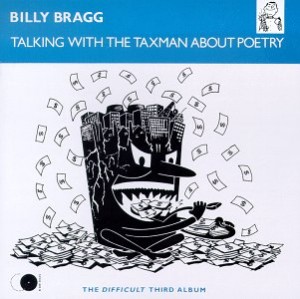
Concerning the album title, I was all set to make some clumsy joke around it when I fortunately discovered that it was actually the translation of the title of a Russian poem by Vladimir Maya­kovsky (something I would never have guessed on my own because the Russian original has the convoluted financial inspector rather than taxman — the poem was published in 1926, when the USSR had no «taxmen» to speak of) — the main idea of the poem being «defense of poet's ho­nor», stating that the profession of a poet is a legitimate occupation even in the new world, ruled with the iron fist of the proletariat dictature. Honestly, I am not quite sure how that point is to be applied to this Billy record — other than implying that he is somehow justifying himself for not working in the coal mines, back to back with The People, but rather sitting his ass off in a warm recording studio, because, well, if The People want their champion, they have no choice but to let him sit his ass off in Livingston Studios, London. I mean, he probably could take his guitar and his tape recorder and record these songs right in the coal mine, but then they'd sound... dusty. No chance of getting any hit singles that way.

In any case, the album seems better constructed than Brewing Up: lyrically and musically, there are more nuances here, and the record does not immediately come off as this unnatural, clumsily constructed «now I'm singing about people's rights» — «and now I'm singing about bitches» — «and now I'm singing about people's rights again» — «and now I'm singing about bitches again» monstrosity. Mind you, he is still mostly singing about people's rights and bitches, but the song titles, the melodies, the lyrical imagery become more diversified, and in fact, you know what? in the very first song, he actually combines the two aspects: "Shirley, your sexual politics left me all in a muddle / Shirley, we are joined in the ideological cuddle... Politics and pregnancy / Are de­bated as we empty our glasses...".

Unfortunately, even though there are more pianos, trumpets, and bass guitars on the album as be­fore, I also have to state that this comes at the expense of interesting melodies. The most obvious case is ʽIdeologiesʼ — which is simply a cover of Dylan's ʽChimes Of Freedomʼ with new, «up­dated» lyrics by Billy, and even if he is not stealing it, but honestly indicating Dylan as a co-au­thor in the credits, this is somewhat symbolic: lyrics and pure passion have completely overridden his pop writer instincts. This is not a crime — in fact, it may be a deliberate and rational decision, because the man would hate to be labeled as a «pop artist» anyway — but it still makes me sad. Intelligent political statements set to pop hooks give you so much more than just intelligent poli­tical statements (even if intelligent political statements by pop artists are by themselves much preferable to any political statements by politicians).

The most musically interesting songs here are the subtlest and most psychological ones: ʽThe Marriageʼ, a seemingly weak protest against the ties of society ("marriage is when we admit our parents were right", the chorus goes), is set to an interesting mish-mash of choppy jazz chords, blues lines, and flamboyant trumpets that has no direct analogy in the past — and ʽThe Passionʼ, symmetrically disposed on the second side of the album, also has a wonderful gliding waltz melody, not as original, but with a very deep and tender-sounding weave of two guitars sliding in and out of each other, as if symbolizing the now agreeing, now discordant relations between kids and parents that forms one of the lyrical topics of the song. There's also ʽLevi Stubbs' Tearsʼ, a mildly haunting portrait of an outcast whose only source of permanent comfort are The Four Tops (and suchlike) — a good example of the man's busking technique where he alternates between throttling/choking his guitar and letting it wail free: again, not particularly original, but very well suited for the character he is singing about.

Political stuff like ʽPower In The Unionʼ and ʽHelp Save The Youth Of Americaʼ (I do hope there was some sort of a plan to spread the song in the States — I mean, who really needed it in the UK?) is of passable interest because of the lyrics and little else. The Randy Newman-esque ʽHoney, I'm A Big Boy Nowʼ, with its shambly tack piano and nonchalant country attitude, also shows that this kind of music should better be left to musicians across the other side of the ocean; and ditto for ʽWishing The Days Awayʼ, which may be a parody on the Nashville style for all I know, but it hardly works even as a parody — more like a pack of people that decided, for no reason at all, to record a country song despite having had no experience whatsoever. Or maybe they're intentionally «deconstructing» it, I don't think it works anyway. On the other hand, ʽThe Warmest Roomʼ is an almost accomplished pop song — all it needs is a nice, memorable lead line, and this would be as close as the album comes to a potential hit (not that there was ever any thought about releasing it as a single: that honor fell to the somber ʽLevi Stubbs' Tearsʼ).

It would be almost impossible to say that the focal point of the albums are not its lyrics — for Billy, the meaning of what is sung is clearly more important than the manner in which it is sung (which is why serious comparisons with Dylan would be out of question), and it is good to know that, once again, his idea of «championing the people» is not so much to throw shit at The System as it is to try and pull the people themselves out of their somnambulant state, which is why we have all these character portraits of disenchanted lovers, disillusioned housewives, Mother and Father and Grandma, presented with just as much psychologism (sometimes more — after all, we're standing on the shoulders of giants and all that) as in any poem by Ray Davies or (early) Tom Waits. Still, now that the original novel shock at the sight of «electro-busking» has passed, Taxman comes across as a somewhat hesitant, and not very interesting transitional record: even all these extra musicians still do not feel like they have been properly integrated with Bragg's original solitary vision. A few nice songs, but nothing spectacular.