Search This Blog

Showing posts with label Bonnie Raitt. Show all posts

Saturday, August 13, 2016

Bonnie Raitt: Dig In Deep

BONNIE RAITT: DIG IN DEEP (2016)

1) Unintended Consequence Of Love; 2) Need You Tonight; 3) I Knew; 4) All Alone With Something To Say; 5) What You're Doin' To Me; 6) Shakin' Shakin' Shakes; 7) Undone; 8) If You Need Somebody; 9) Gypsy In Me; 10) The Comin' Round Is Going Through; 11) You've Changed My Mind; 12) The Ones We Couldn't Be.

The unimaginativeness of those album covers is beginning to get me down, but then again, it does fit in very well with the music. So here we are now — another four years, another album that shows Bonnie doing her thing, not giving a damn, getting rave reviews from mainstream critics for doing her thing and not giving a damn, and pretty much ignored by the world at large and probably to be forgotten at the precise moment that she releases her next one, despite all the rave reviews and despite doing her thing and despite not giving a damn.

Is there anything particularly unpredictable here? Well, she covers Los Lobos (ʽShakin' Shakin' Shakesʼ), which is sort of a first, and INXS (ʽNeed You Tonightʼ), which is a complete surprise, but then ʽNeed You Tonightʼ is one of the band's most rocking tunes, and it's cool to see Bonnie's band redo it in the manner of a Stones' rocker (incidentally, the Stones themselves had already recycled the song's trademark trilling riff on ʽLook What The Cat Dragged Inʼ ten years before). For that matter, a lot of stuff here sounds like Stones-lite — Bonnie's second guitarist George Marinelli suddenly decides to go all Keith Richards on tracks like ʽThe Comin' Round Is Going Throughʼ, while Bonnie's slide lead wraps around him like a Ronnie Wood solo.

Not that I mind — in fact, at this time I don't mind at all whatever she is doing, because neither the Stonesy rockers nor the country ballads sound annoying or distasteful: there are no objections I could raise against the arrangement and production values of the tunes, or against the professio­nalism or even against Bonnie's vocals: now, after all those years, she finally reaps the fruits, with a vocal delivery every bit as strong and technically perfect as it was forty-five years ago, when her vocals were considered emotionally and technically mediocre compared to so many of her peers... and where are her peers now? But if you want a nuanced opinion, I'd say that Dig In Deep is a little weaker than Slipstream, because it sounds more like a bunch of bluesy jams re­corded for fun in the studio rather than a record with an attitude.

That's about all I can say before I turn into Thom Jurek of the All-Music Guide and start pepper­ing you with enticing, but meaningless phrases like "her earthy singing voice is more disciplined and holds more emotional authority than ever before". Isn't "disciplined" sort of the opposite of "emotional"? And, anyway, if what he is trying to say is that Bonnie Raitt only gets better as she gets older, wouldn't that be somewhat underselling her early records? As far as I can tell, she's just stuck in a formula, and all she can do is polish that formula to professional perfection, and the only reason why this stuff is preferable to the Nick Of Time era (and it is) is because it avoids the pitfalls of hollow, soulless production. And that's about it.

PS. I actually enjoyed listening to this album, and even toe-tapped and played air guitar on a couple of tracks. Honestly, I did. I'm just jotting this down because I will most likely never ever hear it again, so check: "In 2016, I did truly and verily enjoy Bonnie Raitt's Dig In Deep". Let posterity be the judge.

Wednesday, April 8, 2015

Bonnie Raitt: Slipstream

BONNIE RAITT: SLIPSTREAM (2012)

1) Used To Rule The World; 2) Right Down The Line; 3) Million Miles; 4) You Can't Fail Me Now; 5) Down To You; 6) Take My Love With You; 7) Not Cause I Wanted To; 8) Ain't Gonna Let You Go; 9) Marriage Made In Hollywood; 10) Split Decision; 11) Standing In The Doorway; 12) God Only Knows.

Odd, but I like this album. It isn't altogether different from any other Bonnie Raitt album, but I like it more than anything she's offered us in... let's see here... scroll up... scroll up... scroll... scroll... more scroll... okay, Green Light was the last time I gave her a thumbs up, wasn't it? well, looks like the most sympathetic (cautiously refraining from using the word «best») record she gave us in thirty years. Quite a record, that.

Good choice of co-producer in Joe Henry (never mind that the guy is married to Madonna's sister: his production credits include veterans like Mose Allison, Ramblin' Jack Elliott, and Solomon Burke, as well as Aimee Mann's The Forgotten Arm, so he's cool by me). Relatively small band mostly consisting of Bonnie regulars (the Hutchinson-Fataar rhythm section, etc.) and some sur­prising guests like experimental guitar guru Bill Frisell. Very few signs of adult contemporary. But most importantly — there's a touch of sharpness here throughout, chasing out the flabbiness and genericity whose shadow haunted Bonnie's work since Nick Of Time (and some acid-ton­gued folks would say, since she first stepped into the studio).

It is something on which you cannot put a finger at all — just a pinch of crispness in the vocals, bitterness in the playing, a slightly grumblier tone for the electric rhythm guitar, a basic instinc­tive feeling that is slowly generated out of a hundred tiny nuances. It may have something to do with the lady's age: as she hops over the 60-year barrier and feels that two thirds, or maybe more than two thirds of the way have passed by, a sniff of the imminent scythe (cynically speaking) sometimes works wonders for the artist. Hardly a coincidence, wouldn't you say, that she covers here not one, but two songs from Dylan's Time Out Of Mind — probably the most quintessential «death harbinger» album from a rock veteran? None of the two are ʽNot Dark Yetʼ, but that would have been way too obvious.

However, Slipstream on the whole is not a slow, moody, soft-textured record. ʽUsed To Rule The Worldʼ is not a particularly optimistic title for the album's opening song — indeed, written once again by Randall Bramblett, it is a set of bitter thoughts on the failed illusions of the baby-boomer generation — but in its own restrained way, it rocks, and Raitt spits out the angry sum­marizations ("Your life had come and gone / Now you're mystified / Standing with the rest of us / Who used to rule the world") as if the blame were to be placed on the baby boomers themselves (and maybe that is exactly where it is to be placed), as well as delivers her fieriest slide work in ages, both here and on several other of the rocking tracks. (Actually, her best slide work on the album is on ʽSplit Decisionʼ, a humorous «boxing» song full of lyrical double entendres, written by guitarist Al Anderson who also figuratively duels with Bonnie on the solo parts — this is as close as a Bonnie Raitt song ever gets to «fun» and «exciting»).

The Dylan covers are done really well, and I mean musically, not merely in a «Bonnie sings them credibly» manner, which would be dull, because she sings almost everything credibly (dull). But on ʽMillion Milesʼ, there is a mean, swampy, overtone-loaded slide solo, and on ʽStanding In The Doorwayʼ, there are some really exquisite slide licks that remind me better than anything else how she can turn the instrument from slithering snake to high-hoppin' singin' bird in a single moment. And, no doubt, this all has to do with the fact that these are just the right songs selected by her at exactly the right time — in fact, I am sure that the album could have been even better had she simply decided to donate 70% of the space to appropriately selected Dylan covers. Hey, the man has written gazillions of songs on death and despair — each of them more gripping than anything Gerry Rafferty or Kelly Price could offer.

Slipstream is Raitt's first album of original material since 2005 — seven years between albums is the longest break she ever took, and while there is no evidence whatsoever that it might be her last record, it does look as if now, at her age, she were still interested in regularly expectorating new stuff like clockwork, which is good, because it gives more opportunities for a meaningful statement on something fundamental every now and then. Perhaps my scent has been misled by the seductive Dylan covers, or by too much theorizing, but what the heck, just one more thumbs up will not hurt anybody. We will even overlook the fact that the quasi-obligatory boring piano ballad at the end has the nerve to be titled the same way as Paul McCartney's favorite song in the world, despite not being worthy to kiss its footprints.

Two things annoy me the most about Ms. Raitt — her way-too-tight in­tegration in the formulaic roots-rock industry, and her courteous self-restraint and «politeness». Slipstream may still be well integrated and much too gallant for its own good, but at least this time around, it doesn't exactly make a cult of these values, and we'll take it as a positive sign. And if it does happen to be the last Bonnie Raitt album, we'll take it as an even more positive sign — as decent as it is on the whole, I seriously doubt that she will be ever able to top it.

Wednesday, April 1, 2015

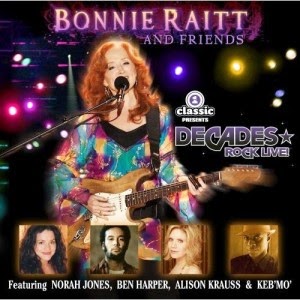
Bonnie Raitt: Bonnie Raitt And Friends

BONNIE RAITT: BONNIE RAITT AND FRIENDS (2006)

1) Introduction; 2) Unnecessarily Mercenary; 3) I Will Not Be Broken; 4) God Was In The Water; 5) Gnawin' On It; 6) You; 7) Love Letter; 8) Two Lights In The Nighttime; 9) Well, Well, Well; 10) Something To Talk About; 11) I Don't Want Anything To Change; 12) Love Sneakin' Up On You.

Once again, this significantly shortened version of the show is objectively inferior to the complete DVD release — not because more Bonnie Raitt (and friends) is better Bonnie Raitt (and friends), but because watching the lady perform is somehow always a more satisfactory experience than hearing the lady perform, even if for this particular evening (September 30, 2005, at the Trump Taj Mahal in Atlantic City) it seems as if she slightly overdid it with the «amazing technicolor dreamcoat», in Tim Rice's words. Fortunately, no jealous brothers of Joseph stuck around long enough to tear that outfit to bits after the show.

The actual guests include Wolfman, Dracula and his son... that is, I meant to say, there is Keb' Mo', Ben Harper, Alison Krauss, and Norah Jones — four major professionals with impeccable taste, four «keepers of the flame» who keep it relatively low, but firm and steady, and, just like Bonnie herself, each of them could be accused of being frequently bland and even more frequent­ly boring, but not of not knowing their craft. Consequently and predictably, the album is even, well-combed, tastefully sensitive, and instantaneously forgettable.

A large part of the problem is the setlist, though: I was actually hoping that with a supporting pool like that, Bonnie had a chance of actually going back to the roots of the roots and doing stuff like, well, for instance, a whole bunch of cover versions of old urban blues and country blues numbers — recuperate some Sippie Wallace and/or Memphis Minnie obscurities, for instance. Alas, six out of twelve numbers included here are taken directly from her latest album, and most of the others do not go back further than Nick Of Time, either. So what's the big deal?

As it happens, Keb' Mo' is pretty much wasted on ʽLove Letterʼ (he does play better lead guitar than on the studio original, but the solos are too short and non-flashy to notice that). Norah Jones duets with Bonnie on ʽI Don't Want Anything To Changeʼ, a limp, all-atmosphere ballad from the latest album that hardly gains anything from the addition of Norah's «affected» singing style (for some reason, that little «wheeze» of hers really irritates me, direct predecessor as it is to the even more atrocious «husky» style of such glossily packaged femme-fatales as Lana del Rey). Much better is the duet with Krauss on ʽYouʼ — a good idea to bring in an additional spoonful of vocal beauty to a song that was already quite pretty in the first place.

But arguably the major highlight is the duet between Bonnie and Ben Harper on ʽWell, Well, Wellʼ, an old-timey blues tune with new lyrics (by Dylan himself) but that old Blind Willie Johnson spirit. They tear it up on the acoustic and slide guitars so fabulously (well, maybe «tear» is not quite the right word) that, once again, I have no idea why so much of that other space had to be wasted on the adult contemporary crap or faithful renditions of decent tunes like ʽUnneces­sary Mercenaryʼ and ʽGod Was In The Waterʼ that simply sound like identical twins of their studio counterparts. Yes, it is still «smooth» and «safe», but I'd rather see Bonnie Raitt go on car­rying a time-honored tradition than engaging in a time-dishonored one.

Ultimately, if you want to interpret «Bonnie Raitt and Friends» as «Bonnie Raitt gets together with some mighty fine blues musicians and dabbles in old-time fun with the lot of 'em», do not. Really, this is mostly just Bonnie Raitt promoting her latest album in a non-totally-dull fashion. That album was not among her worst, and the friends do provide some extra amusement, and the live CD goes down well (and the live DVD even better), but ain't nothing to write home about even if you are in the habit of writing home about Bonnie Raitt, in which case you must be a pretty weird specimen of H.S.S.

Wednesday, March 25, 2015

Bonnie Raitt: Souls Alike

BONNIE RAITT: SOULS ALIKE (2005)

1) I Will Not Be Broken; 2) God Was In The Water; 3) Love On One Condition; 4) So Close; 5) Trinkets; 6) Crooked Crown; 7) Unnecessarily Mercenary; 8) I Don't Want Anything To Change; 9) Deep Water; 10) Two Lights In The Nighttime; 11) The Bed I Made.

There's a little less tepid funk and wishy-washy adult contemporary on Souls Alike than on Sil­ver Lining — and a little bit more blues and jazz; consequently, it marks a (at least temporary) return to Dullsville from Offensivetown. There might even be a small handful of relatively decent songs for those who normally despise all forms of «soft rock». The problem is, 2005 is not the kind of year where anybody could have a «change of heart» concerning anything that might be done by the likes of Bonnie Raitt, and a detailed discussion of any such album could only be of interest to hardcore fans with a penchant for distinguishing between the «fifty shades of grey».

Not addressing that category, we shall keep it very brief here. Randall Bramblett's ʽGod Was In The Waterʼ is a pretty good song — dark, unsettling country-blues, well adorned here with bitter­ly, but rather unsentimentally weeping organs, wah-wahs, and swampy slides, and even the lyrics are good, finding a fresh angle for the old perspective: "God was in the water that day... / Castin' out a line to the darkness / Castin' out a line but no one's biting". And Bonnie's bitterish vocal tone is practically perfect for this particular setting.

Emory Joseph's ʽTrinketsʼ is another standout: introspective nostalgia without the obligatory sappiness, sort of a «talking blues» (at times, coming close to «rapping blues») with a bit of musi­cal muscle, not particularly catchy, but each of Bonnie's bitter dry "when I was a kid..." verses has a whiff of intrigue. I mean, with a little bit of imagination you could see Lou Reed doing a song like this, and it's a rare Bonnie Raitt song that allows you to cast such a projection. Nicely fluent piano and slide dialog in the outro, too.

Finally, there is Jon Cleary's ʽUnnecessarily Mercenaryʼ, a sly, but big-hearted New Orleanian romp that could actually benefit from a brass section — but the well-worded chorus remains memorable even without any extra support. Cleary himself plays the piano solo, and he pretty much owns the song (as well as any other song here where he is prominent enough), being a well schooled disciple of the Professor Longhair / Dr. John school of Mardi Gras Keyboards. As usual, just a tad more energy and wildness couldn't have hurt, but it's still fun.

The rest is hardly worth a mention — blues and ballads, gently rippling through the air without generating much excitement. The trip-hop beats on ʽDeep Waterʼ are an intentional «modernis­tic» nod that fails for that exact reason (do it because it's good, not because it's a special gesture that puts a chronological seal on the album). The final number, ʽThe Bed I Madeʼ, is a moody jazz ballad written by David Batteau where Bonnie tries to be Madeleine Peyroux, but she doesn't have the voice or the knack for it — so at least there's more going on here than on ʽWounded Heartʼ, but it is still a very (appropriately) sleepy conclusion for an overall sleepy album. So just borrow ʽGod Was In The Waterʼ for your «Contemporary Roots-Rock Nuggets» compilation and ʽUnnecessarily Mercenaryʼ for your «New Orleans Lives!» compilation and feel free to forget the rest if you feel like forgetting the rest.

Wednesday, March 18, 2015

Bonnie Raitt: Silver Lining

BONNIE RAITT: SILVER LINING (2002)

1) Fools Game; 2) I Can't Help You Now; 3) Silver Lining; 4) Time Of Our Lives; 5) Gnawin' On It; 6) Monkey Business; 7) Wherever You May Be; 8) Valley Of Pain; 9) Hear Me Lord; 10) No Gettin' Over You; 11) Back Around; 12) Wounded Heart.

«Raitt's singing has never been more finely tuned, especially on... the final track, ʽWounded Heartʼ, a breathtaking duet recorded in one take with keyboardist Benmont Tench; after nailing it, Raitt reportedly fled the studio, moved to tears; any second attempt proved both undoable and unnecessary» (Robert L. Doerschuk, All-Music Guide; I have not been able to find additional confirmation, but no clear reason to disbelieve the story).

This pretty much tells us all we need to know, because ʽWounded Heartʼ, a piano ballad written by contemporary singer-songwriter Jude Johnstone (who also included it on her own debut album which came out twenty days after Silver Lining), is the very definition of «trivial»: the entire song rides on exactly one endlessly repeated and not particularly fresh (to say the least) musical phrase, and the lyrics go like this: "If you listen you can hear the angels' wings / Up above our heads so near they are hovering / Waiting to reach out for love when it falls apart / When it can­not rise above a wounded heart". You could pardon bad wording if it were set to glorious music, or you could pardon the boring music if it were accompanying brilliantly stringed verbal phrasing, but damn, this is bad — generic, corny singer-songwriter fluff that doesn't even begin to ap­proach the level of some of Bonnie's old ballads like ʽLouiseʼ, let alone any really high standards of ballad writing. ʽWounded Heartʼ? More like ʽWooden Heartʼ if you ask me.

In other words, the relative «comeback» that she had with Fundamental has pretty much ended, as we see Ms. Raitt return to the comfortable territory of soft-rock / adult contemporary. The entire album consists of bland ballads, limp rockers with a funky underbelly but no energy what­soever, and somnambulant folk-pop, completely devoid of hooks, fresh ideas, or individuality. The miriad of players and contributing songwriters are completely unrecognizable to me — seeing as how I have little interest in this particular marketline — and not a single song here stimulates me into getting to know any one of them better (I did skim through a couple tracks off that debut album by Jude Johnston — my bad).

In the middle of it all, though, unexpectedly comes ʽGnawin' On Itʼ, a blues-rocker with a dirty, distorted rhythm track reminiscent of Paul Burlison's playing in the Johnny Burnette trio — in other words, a real good sound as compared to everything else on this flaccid affair, and in order to match it, Bonnie digs deep and recovers some of her trademark gritty huskiness. The slide work on the track is also good and merges fine with Steve Berlin's sax — what I'm a-guessin' is that Los Lobos had their hand here, as well as Roy Rogers, a fine guitar player who had first made his name with John Lee Hooker in the 1980s... well, all right, some people with a sense of taste actually were involved in the making of this record. Too bad they only made one track sound like it had a decent pair of musical balls attached.

Do not get me wrong: softness, tenderness, emotionality, sensitivity, vulnerability are all very much welcome on a Bonnie Raitt record, or on anybody else's record — as long as they go hand in hand with some melodic or vocal move that is at least remotely interesting, unlike the dissipa­ted atmospheric phrasing of, say, the title track, which combines a hell of a lot of different string, keyboard, and percussion ins­truments into a melting pot where they never come together into anything coherent or more-than-superficially-pretty. Worse still, many of these songs try to rock (ʽFools Gameʼ, ʽMonkey Businessʼ) — but why would you want to listen to Bonnie Raitt going middle-of-the-road funky, when you can listen to, say, Prince going all the way? What would you be — afraid to enjoy somebody going all the way? Maybe that is what «adult contemporary» is all about — people too scared to turn their emotional stove up all the way, or it might, you know, blow up and hurt somebody.

Total thumbs down — and I am not taking that pun-based hint from the match between the album title and the «silver lining» foxily flashing out of the ongoing general redness of the lady's hair. If this is her way of communicating to us that one need not be afraid of aging, and that aging only brings on more wisdom and a sharpened sense of responsibility (towards one's fans, for in­stance), I'll opt for a whole load of irresponsible stupidity instead.

Wednesday, March 11, 2015

Bonnie Raitt: Fundamental

BONNIE RAITT: FUNDAMENTAL (1998)

1) The Fundamental Things; 2) Cure For Love; 3) Round & Round; 4) Spit Of Love; 5) Lover's Will; 6) Blue For No Reason; 7) Meet Me Half Way; 8) I'm On Your Side; 9) Fearless Love; 10) I Need Love; 11) One Belief Away.

You can probably already guess without scrolling that Fundamental will be anything but. "Let's get back to the fundamental things", the first track incites us, but if so, what's up with the produc­tion? Its «moaning» guitar hook may have a certain primal potential, but everything else is just the same old cozily packaged gloss, as overseen by Bonnie herself, her new co-producers Tchad Blake and Mitchell Froom, and her latest big bunch of assistant songwriters, too numerous to mention — loaded with songwriting and playing regalia to boot, but boring.

Perhaps what they really want to say is that Fundamental takes a sharp turn from the primarily commercial sound of the previous albums back into blues territory. Or, more precisely, just «takes a turn» — the word ʽsharpʼ is better not used in any descriptive Bonnie Rait chronology. Maybe so: the album feels bluesier on the whole, with no adult contemporary ballads on it and only one cod-reggaeified number to close out the proceedings (ʽOne Belief Awayʼ). If that is an achievement, feel free to rate Fundamental much higher than Nick Of Time and its offspring. If you do not care all that much for the way Bonnie Raitt plays the blues (in the studio, at least), feel free to pass up on it like on everything else.

The closest that the record actually comes to some real fire is probably on ʽSpit Of Loveʼ, a self-written song that talks about the «aggressive» side of love business and tries to create a suitable atmosphere, with deep dark basslines, threatening electric piano, and «howling» lead guitar parts which are probably the most experimental thing that Raitt had done on guitar in God-knows-how-many years. Towards the end, when she adds some playful vocal howling as well, it almost manages to sound spooky for a little bit. And even so, there is always that hard-to-define some­thing that prevents the song from crossing the threshold of greatness. What is it? Why is the simi­larly styled ʽRun Through The Jungleʼ a Fogerty masterpiece and this one just one of the more decent Bonnie Raitt tracks? No idea. Just intuition.

Still, on a scale of A and B, where B = «awfully bland, spoiled by too much sentimentality and production gloss» and A = «listenable, mildly tasteful, instantly forgettable», which seems to pretty much exhaust the range of Bonnie Raitt in her post-alcohol days, Fundamental is a bona fide A all the way. The Los Lobos cover ʽCure For Loveʼ has some Chicago-style shrill electric guitar soloing; the Willie Dixon cover ʽRound & Roundʼ is friendly acoustic dance-blues (those soporific "round and round and round..." vocal harmonies really have to go, though); John Hiatt's ʽLovers Willʼ has probably the best pure slide guitar solo on the album, one of those reminders that the lady has to do an instrumental album dedicated to the art of slide playing before she goes; and ʽI Need Loveʼ, by Joey Spampinato, is kinda funny, set as it is to the ʽGet Backʼ rhythm and featuring a fairly unorthodox approach to soloing for a Bonnie Raitt song (as if somebody were messing with a harpsichord from the inside of the instrument for a few bars).

This is still not really enough for a proper thumbs up, but at least the quality curve perks up a little bit — at the same time as Raitt's commercial potential began to drop down again, what with the album only going to No. 17 (it still managed to reach platinum status, but not multi-platinum as its predecessors): apparently, a large subset of Bonnie's admirers was not too pleased about the lack of plasticine-heavenly ballads, so they all went to buy Eric Clapton's Pilgrim instead. Which does remind me that, as tepid as these Raitt albums are, I'd rather have her retro attitude all the way than the horrendous attempts to «modernize» one's roots-rock sound like the one that pretty much cut the throat of Clapton's recording career with Pilgrim.

Wednesday, March 4, 2015

Bonnie Raitt: Road Tested

BONNIE RAITT: ROAD TESTED (1995)

1) Thing Called Love; 2) Three Time Loser; 3) Love Letter; 4) Never Make Your Move Too Soon; 5) Something To Talk About; 6) Matters Of The Heart; 7) Shake A Little; 8) Have A Heart; 9) Love Me Like A Man; 10) The Kokomo Medley; 11) Louise; 12) Dimming Of The Day; 13) Longing In Their Hearts; 14) Come To Me; 15) Love Sneakin' Up On You; 16) Burning Down The House; 17) I Can't Make You Love Me; 18) Feeling Of Falling; 19) I Believe I'm In Love With You; 20) Rock Steady; 21) My Opening Farewell; 22) Angel From Montgomery.

From a logical perspective, live Bonnie Raitt should always be better than studio Bonnie Raitt — less gloss, more energy, better opportunities to let herself really go on that slide, in short, every­thing to celebrate the spirit rather than worship the form. Which, of course, begs for the question: why wait so long? Surely a live recording from the old «drunken days» would have captured a little more fire, not to mention a little higher percentage of good songs?..

The answer is that in the 1970s, Bonnie Raitt was not as much «part of the machine» as she be­came with Nick Of Time, and since she did not sell that much, nobody, herself least of all, pro­bably thought that a live album could help raise any serious extra cash. But now, with three commer­cially successful albums in a row under her belt, a live follow-up would seem like the most ob­vious thing. Precautions were taken, however — Bonnie Raitt on her own could hardly have sold as much as Bonnie Raitt and Friends. And if old-timers like Jackson Browne and R&B veterans Ruth and Charles Brown are not necessarily going to cut it, then relatively recent chart toppers like Bruce Hornsby and Bryan Adams sure will.

Even the setlist has been constructed with almost mathematical precision. Four songs from her latest, for promotional reasons. Three songs each from Nick Of Time and Luck Of The Draw — her biggest commercial successes to date. Three more songs from Sweet Forgiveness, the only album from her past that could be called commercially successful, to a degree (odd enough, no ʽRunawayʼ, though). And a small bunch of songs, usually one per album, from her earliest period when she was still interesting as an individual artist, so that nobody could accuse Road Tested of not presenting an accurate chronological portrait of Bonnie Raitt, all the accents dutifully lodged in their right places.

Big surprise of the day involves the band offering a lively take on Talking Heads' ʽBurning Down The Houseʼ, even though none of the Heads is guesting on the recording (which, by the way, was made on July 11-19, 1995, at the Paramount Theater in Oakland). The groove is lifted reasonably well, but Bonnie Raitt replacing David Byrne is a bit like Al Gore replacing Woody Allen — to­tally different personalities, and if you take the vocal atmosphere of irony and paranoia away from the song, the song becomes pointless. And, with all due respect, you couldn't find an artist less capable of playing absurd character roles than the totally straightforward Bonnie Raitt. In all honesty, I'd rather see her doing ʽClose To The Edgeʼ than this.

Anyway, getting right to the bottom of it, the big deal about Road Tested is that you get more spontaneity and more slide guitar solos, with ʽKokomoʼ, for me, being the obvious high point of the show — but honestly, just about every song from these last three albums is enhanced when you don't have your engineer diligently smoothing out all the sharp edges. This is never good enough to make me fall in love with any of these songs (and no spontaneity can save ʽHave A Heartʼ), but good enough to make me forget for an occasional moment or so just how much Bonnie Raitt had become the walking/sliding symbol of adult contemporary. Unfortunately, as soon as Bryan Adams walks out on stage to duet with the lady on their collectively written ʽRock Steadyʼ, that old nasty feeling kicks back with all its might. And just how many songs titled ʽRock Steadyʼ does the world need, I wonder?..

One final moment, though: if you want to try a bite of this anyway, try to lay your hands on the DVD edition rather than the one-disc or two-disc CD edition. Somehow, Bonnie's self-assured strut­ting, mighty red hair, sexy black outfit, and visual slide technique all seem much, much more cool than whatever you get from just the audio channels. Much of that visual image is in common with certain female country music superstars, of course, but she is still on the bluesier side of things, and at least there ain't no flag-waving or anything like that. It's also fascinating how her less-than-stunning looks circa 1972 had paid off so splendidly, as she hardly looks one day older in 1995 than she did more than twenty years earlier. Totally stable mediocrity can be worth some re­spect, too — although in a better world, Bonnie Raitt might have become the female equivalent of a Rory Gallagher, and earn herself much more respect than that. Less money, though. 

Wednesday, February 25, 2015

Bonnie Raitt: Longing In Their Hearts

BONNIE RAITT: LONGING IN THEIR HEARTS (1994)

1) Love Sneakin' Up On You; 2) Longing In Their Hearts; 3) You; 4) Cool, Clear Water; 5) Circle Dance; 6) I Sho Do; 7) Dimming Of The Day; 8) Feeling Of Falling; 9) Steal Your Heart Away; 10) Storm Warning; 11) Hell To Pay; 12) Shadow Of Doubt.

By the mid-1990s, Bonnie's sound gradually returned into the river bed of «straight» country-blues and blues-rock, cleaned up from the excesses of «synthetic» production. In fact, the only song on Longing In Their Hearts, her third album with Don Was, that would adequately fit the bill of «adult contemporary» is ʽYouʼ — for some reason, her biggest hit in the UK. Silky jazz-fusion bass and a hazy screen of synthesizers are responsible for this, even though the song would have sounded much better if things were kept down to just the acoustic guitar and accordeon; as a matter of fact, it does have quite a lovely vocal part, with Bonnie dropping her trademark rasp on the chorus and showing that she could have become quite an impressive falsetto crooner, had she wanted to. Fortunately, she did not, but nobody minds a little bit of falsetto.

Everything else is kept clean, tasteful, professional, and as for excitement, well, you now know very well what you are going to get. Surprisingly, it is not the fully arranged, rhythmic, «ener­getic-aggressive» blues-rockers this time that attract most of the attention, but the stripped-down balladeering stuff: as Bonnie ages, her vocal style becomes more and more sensitive and even sensual on the tender songs, whereas the «don't-mess-around-with-me» schtick gets less and less convincing. The best track on the album is arguably her cover of Richard Thompson's ʽDimming Of The Dayʼ — just a couple of acoustic guitars (some keyboards still make their way into the song midway through, but are kept down), some backing vocals, and wonderfully dramatic modulation throughout. The second best track is the swamp-blues ʽShadow Of Doubtʼ that closes the record — nothing extraordinary, but a nice enough synchronization of her voice with the slide guitar and harmonica overtones.

As soon as the band steps in, though, the whole thing becomes just another routine country-rock experience, the kind that you can get plenty of in just about any big or small American town that can allow itself to wine and dine some well-trained musicians. The title track; ʽI Sho Doʼ; ʽHell To Payʼ; and the record's biggest hit, ʽLove Sneakin' Up On Youʼ, all follow the same formula. ʽLoveʼ has the catchiest chorus of 'em all, but "it ain't nothing new", and, worse than that, it ain't nothing particularly credible. Everybody sounds professional, nobody sounds particularly in­spired — the message is delivered with the tone of a very boring college professor, completely disinterested in explaining a potentially exciting subject.

As usual, most of the mainstream reviews raved on about this one, though — and I guess that if you're in business for this kind of album, it would be hard to think of a better one. Everything is so perfectly in its right place and so perfectly «normal», one is either bound to love this silly or be bored to death. As much as certain people hate the solo career of Eric Clapton, at least that guy had it somehow going up and falling down, switching from relatively exciting highs to abysmal lows: with Bonnie, we have this technically unimpeachable formula where, at a certain point, you actually begin secretly wishing for an embarrassment — a techno beat with Autotune? a lengthy rap interlude? a duet with Montserrat Caballé? anything, just to keep the boredom away. Then you come back to your senses, of course, but that does not make the record any friendlier. Or, rather, it is already way too friendly to be any good.

Wednesday, February 18, 2015

Bonnie Raitt: Luck Of The Draw

BONNIE RAITT: LUCK OF THE DRAW (1991)

1) Something To Talk About; 2) Good Man, Good Woman; 3) I Can't Make You Love Me; 4) Tangled And Dark; 5) Come To Me; 6) No Business; 7) One Part Be My Lover; 8) Not The Only One; 9) Papa Come Quick; 10) Slow Ride; 11) Luck Of The Draw; 12) All At Once.

I will wholeheartedly admit that Luck Of The Draw, building up on the commercial success of Nick Of Time and managing to sell even more copies (as more and more baby boomers passed a certain age limit?), is a better album, and probably holds up a little better after all this time. How­ever, the only reason for this is us passing into the next decade — gradually wringing ourselves out of the clutches of truly bad, suffocating production. This time, everything is handled more smoothly, and has a much more «natural»-looking superficial flavor. Whether this lack of obvious ugliness makes for extra depth, not to mention entertainment, is a different thing.

I will even admit that ʽI Can't Make You Love Meʼ, one of those pillars of adult contemporary (yet also a song fully and completely rooted in early 1970s soft-rock / country-pop / whatever), is a song that operates efficiently on gut level. As much as I perversely expect, every single time, her to rhyme the line "here in the dark, in these final hours" with something ending in "golden showers" (admit it, it's such a natural rhyme, isn't it?), there is a real tug there on the "I can't make you love me" bit that Bonnie nails just right. She does have a knack for capturing that entire "two meters away from happiness, but no way we're gonna make it" vibe, and if only a little bit more effort went into the music...

...the problem, of course, being that the music is completely uninteresting. Blues, ballads, full arrangements, sparse arrangements, fast tempos, slow tempos — there is not a single guitar lick or piano chord to be found here that would step one inch out of the ordinary. Not one inch! As in, you know, you just don't want to mess up a good formula — no need to upset your potential audience. Consequently, the best track on the album is probably the one where little upsetting could be done in the first place, due to format limitations — the little acoustic ditty ʽPapa Come Quickʼ, with a New Orleanian accordeon overdub for company, sounding like something out of The Band's Cahoots stage, though less ambitious. It's traditional, predictable, enjoyable, forget­table, and unregrettable — everybody does just what they can do. In almost every case, much more could be done. But wasn't.

Where it can still get offensive is in the «message» area. For instance, ʽSomething To Talk Aboutʼ, written by Canadian songwriter Shirley Eikhard, is about — imagine that! — two repre­sentatives of the opposite sex wrongly assumed to be having an affair by the outside world and wishing to — you don't say! — capitalize on this. This almost TITILLATING, nearly ADULTE­ROUS subject should have probably been set to a nasty, sleazy, Stonesy soundtrack, but instead, all we get is some bland keyboards, some weak soul harmonies, and a shamefully lazy slide gui­tar solo that probably took three minutes to figure out. Not convincing!

A bit of atmosphere is injected in Bonnie's own ʽTangled And Darkʼ, although both the melody and the atmosphere have triggered an association with The Grateful Dead's ʽWest L. A. Fade­awayʼ in my mind — and probably not just in mine. (One thing that is special to this track is a set of brass overdubs that give it extra nocturnal, slightly spooky flavor.) On the other hand, the mix of «jello-wobble keyboards» and «ethnic» whistles on ʽOne Part Be My Loverʼ feels like an at­tempt to ride that New Age wave — not something that can, or should, be ever done in a half-assed manner: if you want to be Enya, you should go all the way and farther than that, or else you're simply channelling a new route for boredom and an inferiority complex.

In short, as we get to the title track, written by Paul Brady, there's a nagging suspicion that she means it: "Forget those movies you saw / It's in the luck of the draw / The natural law". That this album and its predecessor managed to enjoy such a huge success — out of literally hundreds of such releases — has very much to do with «the luck of the draw», and I am not even beginning to search for any scientific explanation. At the same time, if it's really luck and not well-program­med calculation, I guess that this eliminates the need to plant seeds of hatred for either Bonnie or her producer. Except for some of the really slow ballads and that whole inescapable sensation of «why-the-heck-am-I-listening-to-this-when-I-could-be-Superman», Luck Of The Draw is com­pletely inoffensive and perfectly listenable for all those who appreciate clean, smooth, professio­nal roots-rock, sometimes bordering on «adult contemporary». Comestible enough circa 1991, but who really wants to drag it along into the next century?

Except for Adele, perhaps, who has frequently covered ʽI Can't Make You Love Meʼ in live performance. But then again, with all due respect, Adele and her voice could make Bonnie Raitt's diary come alive, let alone one of her glossy ballads that does accidentally feature a pre-set wor­king hook from the very beginning. 

Wednesday, February 11, 2015

Bonnie Raitt: Nick Of Time

BONNIE RAITT: NICK OF TIME (1989)

1) Nick Of Time; 2) Thing Called Love; 3) Love Letter; 4) Cry On My Shoulder; 5) Real Man; 6) Nobody's Girl; 7) Have A Heart; 8) Too Soon To Tell; 9) I Will Not Be Denied; 10) I Ain't Gonna Let You Break My Heart Again; 11) The Road's My Middle Name.

Unlike Nine Lives, Nick Of Time could hardly be accused of «not being Bonnie Raitt». No, that's her all right — a balanced mix of «tough» blues and «soft» ballads, not exploring any weirdly unfamiliar territories, played by the usual army of professional roots-rock sidemen, and feeling as sincere as they come. So how to explain, in plain simple words of the English language, why it sucks so much that I'd rather have Nine Lives?..

Put it this way: there's something tremendously wrong in the air when a record like this tops the Billboard charts, sells five million copies, and gets all the Grammies. We can admit that in 1971-1973, back when Bonnie Raitt made her only records that are still worth relistening to on a con­stant basis, competition was way more tough, and what seemed like a mere blip on the radar then could aggrandize itself into something much more impressive in 1989, at least in the antiquated world of «traditional» rock'n'roll. But even then, there were so many «traditional rock'n'roll» albums in 1989 that could have made the same grade — why Nick Of Time?

Admittedly, the record gave Bonnie Raitt a new face. The singles mostly charted as «adult con­temporary», and the whole thing was strongly marketed as an emotionally charged record for aging baby-boomers — no way any of the kids could get interested in these songs. In a couple of years, the same strategy would work with Eric Clapton's Unplugged: calm, steady, «wise» music for those old rockers who had no wish to pretend they were young any more, and preferred the quiet, slow-burning sounds of Clapton and Bonnie Raitt to the «eternally young» sounds of the Rolling Stones, perceived as fake and strained. There must have been a strong demand for this among the elders who were too tired to keep on searching — «nick of time» indeed.

But this lack of innovation, this desire to settle down and do something simple and honest, this «graceful acceptance of age» — who ever said it all had to come with such poor packaging? Pro­ducer Don Was, who would soon become a major provider for rock veterans (the Stones, Dylan, Ringo Starr, Joe Cocker, etc.), gives Raitt the slickest production she ever had — yes, he is a magnificent master of sound, polishing, scrubbing, and disinfecting each note until it glitters like fake gold on a piece of pseudo-antique furniture. The keyboards, which dominate all the ballads and even some of the blues-rock numbers, are those modern (well, for 1989) synthesizers and electric pianos that never had any soul to begin with, glossy and boring like everything else; the guitars, always kept in strict check, give the impression of being pre-programmed; and the voice... well, the thing about Bonnie's voice, which has changed very little since the early days, is that most of the time it blended into the surroundings, and usually sounded exactly as good as the non-vocal instrumentation. Nick Of Time is no exception.

These songs aren't even «bad» per se — except maybe for the biggest hit, ʽHave A Heartʼ, whose robotic reggae rhythms are only the second worst thing after the chorus (each time she sings "hey, hey, have a heart!", I cannot instinctively understand if we are being implored for human mercy or if we are being offered a delicacy in a brand new restaurant opened up by cannibals). Some are even catchy, although that catchiness never ventures beyond the safe walls of predictable blues patterns, and the blues-and-ballads formula is strictly observed, the two main-and-only mottos being «don't mess around with tough mamas» and «tough mamas have broken hearts, too». Lack of taste, good sense, or adequacy is no good grounds for whipping out a subpoena — taken to court, Nick Of Time would have you roasted in return and paying all expenses.

But oh man, is it ever simply boring. «Lifeless» — no. There is plenty of life in that voice, it's just that it is an altogether uninteresting life, and I have no idea who could be emotionally en­tangled in it. These arrangements, where you have musicians forcefully restraining themselves so as not to break out of the «easy listening» mold — yes, songs like ʽI Will Not Be Deniedʼ and ʽReal Manʼ could have turned the spark into flame, if they'd let the former develop some instru­mental fury and the latter a sloppy-drunk aura, but no: word of the day is «sterilized», or there'd be no chance for a Grammy.

Even as somebody who is inevitably drifting closer to mid-age, and has an open attitude towards many records that may have seemed dull and plodding at 20, but take on new life as we get older, I cannot see myself ever cherishing an album like Nick Of Time, not even on any sort of death­bed. Clapton's Unplugged was really a different thing — a successful attempt to pour out some soul in a masterful series of acoustic reinventions, and it worked. Nick Of Time brings nothing new to the table except for gloss, calculation, and uninspired smoothness that tries to pass itself off as «experience».

Unfortunately, its commercial success, surpassing Bonnie's wildest expec­tations and making her into a household name after two decades of hanging on the fringes, would guarantee, iron will and all, that she'd pretty much spend the rest of her career trying to remake this album, over and over and over again. No, it is not the worst fate imaginable — Rod Stewart or even Clapton himself, with embarrassing attempts at «modernization» like Pilgrim, would produce plenty of «unlistenable» stuff — but sometimes you wonder what is really worse: go for total stiff «preservation», or try and change with the flow, even if this is done for obviously com­mercial purposes. As far as ratings are concerned, though, this is a fickle opposition: all things are equal in a thumbs down judgement.

Wednesday, February 4, 2015

Bonnie Raitt: Nine Lives

BONNIE RAITT: NINE LIVES (1986)

1) No Way To Treat A Lady; 2) Runnin' Back To Me; 3) Who But A Fool (Thief Into Paradise); 4) Crime Of Passion; 5) All Day, All Night; 6) Stand Up To The Night; 7) Excited; 8) Freezin' (For A Little Human Love); 9) True Love Is Hard To Find; 10) Angel.

I find it a little bit funny — and a little ominous — that the title of this album would ten years later be appropriated by Aerosmith, because this here is the beginning of the «Aerosmith-ization» of Bonnie Raitt. Of course, she'd never exactly been a symbol of «artistic independence» as such, but up to 1986, there was very little evidence for branding her a «tool of the industry», either. However, in 1983, already in those early stages of the «adjust-or-perish» period, Warner Bros. showed her who really is the boss by rejecting a completed album for lacking commercial po­tential, and only after two years of nervous bickering, finally allowed her to put out an alternative, recutting and rearranging most of the tracks.

Nine Lives is far from the worst album I have ever heard (I mean, every time we get exposed to this kind of stuff, remember Rod Stewart in the Eighties to be brought back to senses), but it is certainly a record that could be cut by anybody — completely faceless and robotic even for the standards of Bonnie Raitt, who isn't exactly Ms. Inimitable Personality herself. It's a big band affair (once again, the number of people credited in the liner notes is skyrocketing to ridiculous heights), molded as a very generic, sterilized pop-rock record, heavy on synthesizers, electronic drums, processed guitar sounds, and corporate songwriting. Revealing moment: the first song, ʽNo Way To Treat A Ladyʼ, was written by Bryan Adams and Jim Vallance, and was released in the same year, 1986, by still another Bonnie — Tyler! And it is fairly hard to decide whose ver­sion is more pompous, overproduced, and deadly dull.

The entire album is full of cringeworthy moments. Synthesized horns on ʽRunnin' Back To Meʼ, with all these trumpet players in the studio? Why? Muscular-metal guitar on the steroid power ballad ʽStand Up To The Nightʼ — who the hell could see Bonnie Raitt competing for space with Heart and Cher in the Eighties? The simplistic electro-pop groove on ʽFreezin'ʼ — who the hell could see Bonnie Raitt competing for space with Prince, or associate her with «music for the body» as such? And then there's the lyrics disease — as corporate songwriting sinks to new de­grees of lowness, we get lines like "my body is the only place where we meet anymore" (!!!!!). Good job, Danny Ironstone and Mary Unobsky, whoever and wherever you may be, for saddling a formerly reputable performer with ʽCrime Of Passionʼ, arguably one of the most embarrassing entries in her entire catalog.

In an ultimate bout of irony, ʽTrue Love Is Hard To Findʼ, a bland cod-reggae offering, features none other than the 88-year old Sippie Wallace herself on background vocals — Bonnie's per­sonal idol finally got a chance to back up her disciple something like a few months prior to her demise on November 1, 1986. Shame it had to happen on this particular track, in this particular setting and epoch — about twelve or fourteen years too late for the move to have any serious meaning. For the record, her cracked vocals, in those few moments when she can actually be heard above the production din, have more personality here than everything else put together — but then they are quickly washed away by the coda, a dull piano-based blues ballad written by Bonnie's old friend Eric Kaz and sporting the title ʽAngelʼ. The following year, a power ballad called ʽAngelʼ would be released by Aerosmith for Permanent Vacation, their first album to mark the transition from living human beings into automated mannequins. Coincidence? Yes. And no, if you think of certain deeper reasons. Thumbs down.

Wednesday, January 28, 2015

Bonnie Raitt: Green Light

BONNIE RAITT: GREEN LIGHT (1982)

1) Keep This Heart In Mind; 2) River Of Tears; 3) Can't Get Enough; 4) Willya Wontcha; 5) Let's Keep It Between Us; 6) Me And The Boys; 7) I Can't Help Myself; 8) Baby Come Back; 9) Talk To Me; 10) Green Lights.

Another interesting change of pace here — reflecting the end of the Seventies and, in a way, the end of the singer-songwriter era, Green Light is a simple, ballsy, and ever so slightly New Wave-influenced rock'n'roll album. Once again, the entire songwriting and recording team has been shifted. The new producer is Rob Fraboni, best known for working on various roots-rock projects of the previous decade (such as The Band's Last Waltz and Eric Clapton's No Reason To Cry; not coincidentally, The Band's own Richard Manuel gets credited in the liner notes for background vocals), and the most notorious instrumentalist on the album is Faces' veteran Ian McLagan, who, I think, is chiefly responsible for the somewhat nonchalant, barroom-boogie attitude that rules on Green Light.

For all of Bonnie's «excesses» of that era, brought about by heavy drinking, and for all of her desire to let it all hang down for a bit, the record is still quite reserved and delicately polished — no use expecting sloppiness or high levels of distortion and fuzz from the lady. However, as you can easily see from the title track, she is not above allowing modern production techniques (in­cluding a little bit of electronic treatment), so that today, ʽGreen Lightsʼ is quite easily datable back to the early 1980s. This is not a problem, though — the whole album pretends to little more than casual lightweight entertainment, for which aims the production is adequate.

There are almost no ballads on the album: the closest thing is probably ʽRiver Of Tearsʼ, contri­buted by long-term partner Eric Kaz, but even that song's melodic base is blues-rockish — in fact, the opening guitar lines sound like they were lifted directly off some alternate version of ʽHonky Tonk Womenʼ, open G-tuning and all; it is only the overall broken-hearted sentimentality of the lyrics and the slight whiff of angry tragedy in Raitt's vocals that would allow to classify the song as a «heartstring-puller», if there were any need for such a classification. Everything else just ranges from straightahead rock'n'roll to dynamic Motown-style R&B (ʽI Can't Help Myselfʼ).

Interestingly, one of the exceptions from that formula, ʽLet's Keep It Between Usʼ is a Bob Dylan reject that he occasionally performed in concert but never recorded in the studio — no idea if he could be able to flesh it out into some­thing more exciting than the slow 12-bar blues on this album, but before I took a look at the liner notes, I had not the smallest inkling to associate the song with Bob: clearly, Bonnie is much better at capturing the spirit of pre-war black female blues singers than nailing the Zimmerman essence (it may be a good thing, after all, that they never got her involved in the 30th anniversary show in 1992 even if, on the surface, she'd make a far more natural choice than Sinead O'Connor). It's just boring.

The speedy numbers, though, like ʽMe And The Boysʼ or ʽTalk To Meʼ, are catchy, harmless fun. Curiously, ʽTalk To Meʼ, opening with a couple of chords nicked from Blondie's ʽOne Way Or Anotherʼ and then quickly turning into a «post-disco dance-rock» number, was written by Jerry Lynn Williams, the same guy who wrote hit songs for Clapton in the mid-1980s (ʽForever Manʼ, ʽPretendingʼ, ʽRunning On Faithʼ — the latter one was actually quite good), but ʽTalk To Meʼ sounds most closely to the one song that Williams did not write for Clapton, namely, ʽTearing Us Apartʼ, from which I conclude that Williams not only wrote songs for Clapton, but also inspired Clapton to write songs in the style of Williams. It's a pretty complicated network out there in the world of show-biz, as you can tell.

Considering that the band behind Bonnie's back is competent and tasteful, and that Bonnie's own vocal style is perfectly compatible with barroom rock (strictly reserved to those barrooms that do not let their clients throw up on the counter and pass out on the floor), I have no problems about a friendly thumbs up for the album, despite its expectable problems — the four lines from ʽMe And The Boysʼ pretty much sum up everything about what's right and what's wrong here: "Me and my buddies just like to go / We'll have fun, everybody knows / We don't fuss and we never cry / We just groove, taking in the sights". No fuss and no crying, indeed. Very cautious groove, too, but some new sights are definitely taken in. And — no doubt about it — any relations with the boys are restricted to the purely platonic sphere. But then, you don't always have to imitate Lemmy in order to play good rock'n'roll.

Wednesday, January 21, 2015

Bonnie Raitt: The Glow

BONNIE RAITT: THE GLOW (1979)

1) I Thank You; 2) Your Good Thing (Is About To End); 3) Standin' By The Same Old Love; 4) Sleep's Dark And Silent Gate; 5) The Glow; 6) Bye Bye Baby; 7) The Boy Can't Help It; 8) (I Could Have Been Your) Best Old Friend; 9) You're Gonna Get What's Coming; 10) (Goin') Wild For You Baby.

Whenever we are dealing with more than one stage in the career of the illustrious Bonnie Raitt, we are dealing with nuances within nuances and subtleties within subtleties — but speaking in terms of nuanced nuances and subtle subtleties, I think I like The Glow one subtle nuance more than I like Sweet Forgiveness. Perhaps because it's got a bit more of that «sandpaper» edge to it. Or maybe the leading lady just got me covered and trapped with that reproaching stare on the front cover — looking every bit the same at thirty as she'd later look at sixty, and communicating a «what the heck do you want from me, anyway?» kind of message, as if I ever wanted anything from her in the first place — or anybody else, for that matter.

A more serious reason might be a better playlist: unlike Sweet Forgiveness, The Glow tempora­rily returns us to a better balance between contemporary songwriting and the old classics — no, no Victoria Spivey covers, but some good old-fashioned soul, rock'n'roll, and Motown pop here, nestled among the obligatory James Taylorisms (actually, Jackson Brownisms and Robert Palmerisms, to be much more precise). Still another factor may be a near-complete change of the playing team — trimmed down to about 12 people (that ain't much for Bonnie) and consisting almost entirely of first-rate players on the market: Danny Kortchmar and Waddy Wachtel on guitars, Paul Butterfield on harmonica, guys from Little Feat, and even David Sanborn comes along to contribute a sax solo or two.

There are only three ballads out of ten, and all three are decent. Browne's ʽSleep's Dark And Silent Gateʼ begins to redeem itself already with its title and ends with an inspired, tasteful and highly lyrical guitar break from I don't-know-who (Danny? Waddy? Diddy Wah Diddy?). The lengthy title track, dealing with the perils of drinking (all too actual for Bonnie at the time) is nothing to really write home about in ecstasy, but it is nice that they arrange it as smooth mid­night jazz rather than orchestrated schlock, so that the most prominent thing about the song are its wobbly basslines — always a cool thing in ballads. And the closing ʽWild For You Babyʼ, as poor as it is as an original composition, has that slightly distorted guitar lead improvising various figures around Bonnie's croon, again, adding some much-needed «earthiness».

The punchy stuff includes a quirky gender twist as Bonnie remakes ʽThe Girl Can't Help Itʼ into ʽThe Boy Can't Help Itʼ, grinning at her male audience with sarcastic slide guitar runs ("you know the boy can't help it, he was born to please" must have been particularly humiliating for all them male chauvinists), but overall, the punchy stuff is there just to be punchy — with the ope­ning drum roll for the old Sam & Dave hit ʽI Thank Youʼ, Raitt springs immediately into action, and this «cut the crap, let's get right down to business» attitude is well felt throughout the record, whether she is putting the 1970s rock stamp on Mary Wells' ʽBye Bye Babyʼ or asserting some lean 'n' mean personality on ʽBest Old Friendʼ. Most importantly, she is now milking that slide guitar sound with a tight grip, and adjusting her own singing voice to it — together, they form a very natural-sounding sneery duo, much better united than anytime in the past.

On the whole, this one earns a much more assured thumbs up from me than its predecessor, but, of course, far be it from me to fool anybody: The Glow is not a «great» album by any means, just as fine a record as it ever gets in the vicinity of the middle of the road, and only really recommen­dable if you are a big sucker for that clean, smoothly engineered, technically precise and humbly soulful roots-rock sound of the 1970s. It is somewhat of a miracle, though, in a way, how they manage to be so completely dismissive of all the musical and technological innovations of the New Wave era — so get it if you are a certified conservative in life, too.

Wednesday, January 14, 2015

Bonnie Raitt: Sweet Forgiveness

BONNIE RAITT: SWEET FORGIVENESS (1977)

1) About To Make Me Leave Home; 2) Runaway; 3) Two Lives; 4) Louise; 5) Gamblin' Man; 6) Sweet Forgive­ness; 7) My Opening Farewell; 8) Three Time Loser; 9) Takin' My Time; 10) Home.

Produced by Rothchild once again, this one marked Raitt's first and lesser commercial peak, climbing all the way up to No. 25 on the charts and even yielding a modest hit single — her cover of Del Shannon's ʽRunawayʼ, a great song that, like most of the old hits back in 1977, was con­temporarily out of vogue and could certainly use some twitching to get upgraded to the basic standards of commercial music in the 1970s. Right?

Well, maybe, but this harder-rocking arrangement is surprisingly soulless: neither the music nor Bonnie's «powerhouse» singing convey the light melancholy of the original that was its greatest asset — its essence, in fact. Melody-wise, ʽRunawayʼ is finely constructed, and that construction is dutifully preserved and just a little bit tweaked on this album, but on an emotional level, it does not really work as a loud «rock-and-soul» number: as it opens with a harsh distorted chugging riff and a swampy harmonica blast, your senses prepare for something dark and apocalyptic rather than something tender and personal. Bonnie's vocal work is technically great, but makes little sense — strong enough to make people sit up and notice and buy the single, though.

On the whole, Sweet Forgiveness is more «rock» than anything she previously offered us — perhaps the idea was to try and recast her a little bit in the vein of successful sentimental arena-rockers like Foreigner. The session musicians have largely been sacked — there's only about 15 different people credited on the record, which is really a miserable number (normally, there'd be about twice as many) for a Bonnie Raitt album, and even so, most of the instrumental parts were simply played by the members of her regular touring band, so the album on the whole is tighter, tenser, and rockier than it used to be. This is neither good nor bad in itself, but it does guarantee that there is no going back — the spirit of Sippie Wallace is no longer hovering over the studio in any of its forms.

The sheer strength of Raitt's voice means that she is perfectly capable of putting out a regular hard rock record — the only problem is that this particular hard rock record cannot boast great songwriting, and refuses to take any chances whatsoever when it comes to laying down the tracks. Something like ʽGamblin' Manʼ, for instance, is just standard-fare mid-tempo blues-rock, with neither the rhythm guitar nor the lead guitar nor any other part ever rising above the «we get paid for this, we're doing our job as honestly as the contract requires» level.

Composition-wise, the title track, written by songwriter Daniel Moore, is probably the most unusual thing here, spliced together from several different parts (a funky rocking part and a gos­pel-tinged uptempo ballad part) — even so, both parts are so tepid on their own that it is only the sharp contrast between the two, as Bonnie hops forward and backward from «aggressive» to «forgiving», that makes the final result worthwhile. Musical and emotional restraint, sometimes useful because implying certain things works better than saying them out loud, work against Raitt because there is really nothing implied here anyway. Slick and clean, ʽSweet Forgivenessʼ is a technically decent product that does not make me too angry or too forgiving.

Still, while the album is on, it's generally okay. The ballads have their little tugs (ʽTwo Livesʼ is kinda sad, though the Carpenters would probably have made it lovelier; ʽLouiseʼ is kinda sym­pathetic, though Joan Baez would probably have made it sharper and shriller), the rockers are superficially fun (ʽThree Time Loserʼ has an expressively flowing slide guitar part), and even slow «grand» roots-rock numbers like ʽTakin' My Timeʼ have a generally tasteful sound, decora­ted with pianos, organs, and battling guitars. The atmosphere of the whole thing, in any case, is much superior to the general arena-rock atmosphere, because nobody is trying to be too flashy, to lay down that old soul as if it were the biggest, fattest, most monumental soul of all time.

This is why, in spite of all the complaints, I'm still giving this a thumbs up — as I am usually doing with all «high quality mediocre albums». Do not, however, make the mistake of forming an opinion here based only on ʽRunawayʼ: it may be typical of the general style of arrangements on Sweet Forgiveness, but it is not typical of the general style of songwriting, and, most importantly, it will almost inevitably set your mind on the path of comparisons between Bonnie Raitt and Del Shannon, which is not at all what anybody had in mind for Sweet Forgiveness, I'm sure.

Wednesday, January 7, 2015

Bonnie Raitt: Home Plate

BONNIE RAITT: HOME PLATE (1975)

1) What Do You Want The Boy To Do; 2) Good Enough; 3) Run Like A Thief; 4) Fool Yourself; 5) My First Night Alone Without You; 6) Walk Out The Front Door; 7) Sugar Mama; 8) Pleasin' Each Other; 9) I'm Blowin' Away; 10) Your Sweet And Shiny Eyes.

All right, so even if «something» had truly died forever with the transition from Bonnie's first three albums to Streetlights, that does not necessarily mean she would not be able to still turn in a decent record from time to time. In the place of Jerry Ragovoy we now see Paul Rothchild, the legendary producer for The Doors — and, incidentally, also for the last Janis Joplin album; per­haps the Warner executives were secretly aspiring for the man to be able to dress Ms. Raitt up as a legitimate successor to Janis?

Well, not even the most astute producer could handle such a task, I guess, but one thing that was done right was to pull Bonnie out of that «introspective singer-non-songwriter» mode and get her to play a little rock'n'roll instead. Once again, there are no originals, and once again, most of the songs represent contemporary material, but the arrangements are more energetic and electric this time, and the album sounds more like a bawdy roots rock party than an intimate confession ses­sion, which is a good thing with Bonnie Raitt: as a bawdy roots-rocker, she is more interesting and involving than she is as a lonesome sensitive soul.

One noticeable thing about the album is how heavy it is on backing vocals (with at least a dozen supporting singers, including such luminosities as Emmylou Harris and — no shit! — Tom Waits himself listed in the credits, although back in 1975, I guess that his voice was still usable for «regular» backup purposes). This gives many of its blues-rock compositions a bit of a gospel/soul feel: indeed, the main hook of Bill Payne's ʽPleasin' Each Otherʼ, multiplied by the choral har­mony approach, sounds like a rip-off of Leon Russell's ʽSpace Captainʼ as done by Joe Cocker (with the "pleasin' each other, pleasin' each other can't be wrong" refrain replacing the original "learning to live together, learning to live together 'til we die"). But it is done very well all the same — Bonnie is not trying to compete with Cocker, entrancing her audience in the same sha­manistic-possessed manner, she is putting more emphasis on melody and build-up, and there is a nice balance between strength and tenderness in the end.

She even manages to «tame» those proto-disco rhythms: ʽGood Enoughʼ, with a bouncy groove and a funky Stevie Wonder-like clavinet line, is a tremendous improvement over ʽYou Got To Be Ready For Loveʼ — no strings, a tightly coordinated performance, and a vocal that asserts strong personality over sentimental cliché. But even this one does not hold a candle to material on which the lady gets to play slide guitar: ʽSugar Mamaʼ (a gender-based remake of Texas blues rocker Glen Clark's ʽSugar Daddyʼ) is a delicious slab of blues-rock feminism — if she does not do «proper» female urban blues no more, at least this contemporary revision still hearkens back to that old independent spirit, and with a deliciously aggressive slide tone to boot.

There is even a touching ballad here: I heartily recommend J. D. Souther's ʽRun Like A Thiefʼ, which starts out quite generically, but then delves into one of those tugging vocal hooks that you either fall for (and subsequently become vulnerable to at least some of the songs by Linda Ronstadt and/or the Eagles) or stay immune to ­— I confess to liking the notes she holds on the "run in the night, run in the night, run in the night like a thief" chorus, or, at least, feeling like mentioning them, which is already a big plus when you're talking generic country-rock balladry. Unfortunately, the same cannot be said about ʽMy First Night Alone Without Youʼ and ʽI'm Blowin' Awayʼ (was the latter responsible for the silly album cover, or was that Bonnie Raitt's idea of how «going over the rainbow» would look like?) — those sound exactly like all the in­stantly forgettable, wishy-washy stuff on Streetlights.

Still, even with all the filler, there are enough quality performances here to merit a weak thumbs up — most importantly, the album feels more loyal to the true essence of Bonnie Raitt than its predecessor, including the important component of having fun, of which she had so much on her first three records. I'd like to see more of that fun coming back, but I guess we have to be grate­ful for what there is, and give out special thanks to Rothchild. For all we know, they could have cut the budget and limit the sessions to just Bonnie and her acoustic guitar, and for all her charms, she ain't no Nick Drake, let alone Syd Barrett.