Search This Blog

Showing posts with label Al Stewart. Show all posts

Wednesday, September 29, 2010

Al Stewart: Uncorked


AL STEWART: UNCORKED (2009)

1) Last Days Of The Century / Constantinople; 2) Coldest Winter; 3) Warren Harding; 4) News From Spain; 5) Bedsitter Images; 6) Midas Shadow; 7) Running Man; 8) Palace Of Versailles; 9) Auctioning Dave (story); 10) Princess Olivia; 11) Life In Dark Water; 12) Carol; 13) Old Admirals.

Stewart's penchant for guitar-sparring as a major artistic incentive continues with a new twist: at the end of the first decade of the century, after Peter White and Lawrence Juber, his new partner is Dave Nachmanoff, a somewhat obscure, but critically respected folk musician / singer / song­writer with a PhD in philosophy and, most likely, numerous other fine qualities that remain hid­den from the general public.

The newly-formed duo's first joint appearance on record is with Uncorked (another transparent allusion to Al's wine cellars which, judging by all sorts of merry jokes the two engage in on this album, have been strongly tampered with) — an all-acoustic live album that repeats the ex­pe­ri­ence of Rhymes In Rooms, but to even better effect.

First and foremost, because, as fine as Pe­ter White was on guitar, Nachmanoff is an even stronger player. If you are afraid of or usually bored with «unplugged»-type concerts, Uncorked may change your attitude — Dave can shift from lan­guid and subtle to loud and brutal in the wink of an eye, and his technique seems sometimes to be specifically geared towards proving that there really are no things you can do with an electric guitar that cannot be reproduced, or at least ef­ficiently substituted on an acoustic. for instance, as they launch into 'News From Spain', Al re­marks that "Dave has the unenviable task of trying to cover Rick Wakeman's piano solos on the guitar", but actually, Dave rises to the challenge, and even if it is not really possible to completely reinstate the turbulent sea storm atmosphere that Stewart, Wakeman, and others created on the ori­ginal, they still come very, very close — with nothing but one acoustic rhythm guitar and one acoustic lead. And it's not merely «impressive» — it's overwhelming if you play it loud enough.

Second, the set list is anything but trivial; since the album is obviously geared towards a small group of hardcore fans — most of the outside world already has trouble remembering who wrote 'Year Of The Cat', let alone anything else — the track selection firmly excludes all of Al's «big­gies», with the arguable exception of (a much shortened version of) 'Old Admirals', and is almost completely unpredictable; and yet, most of the songs are so pretty that no neophyte, accidentally discovering Stewart through this concert, would ever want to think of the man as a «one-hit won­der» or «singles artist».

Personal favorites include 'Bedsitter Images', bringing us all the way back into 1967, with Nach­manoff perfectly nailing that admirable piano / strings ascending melody; 'Life In Dark Water', stripped down and consequently restored to the status of a melancholic Al Stewart ballad from that of an ice cold Alan Parsons prog-pop epic; the already mentioned 'News From Spain' (Al doing a number from Orange? Unbelievable!); and the happiness of 'Princess Olivia', with its 'Ode To Joy' quote at the beginning unforgotten.

But really, it's all good; even the two songs from Last Days Of The Century, which, come to think of it, really needed this sort of re-recording to redeem them from the production excesses of Al's worst period. And, despite the obligatory humbleness of it all, Uncorked may, all the same, be the most dynamic live album in Al's career, if only because it is so transparently clear that these two guys are simply going for the fun of it, not out of some troublesome «rock star obliga­tion» to the fans and managers, or out of financial reasons. Add to this that the clarity and youth­fulness of Al's voice in 'Bedsitter Images' makes it sound like it could have well been recorded in 1967, and Uncorked completes its transformation from a cute late-period curio from a folk rock veteran into a near-must-have recording not just for grizzled Al Stewart fans, but for everyone who appreciates clever songwriting, pretty singing, and masterful guitar playing as such. Thus — yet another thumbs up for the running man. The only bad news is that there is no accompanying DVD release.


Check "Uncorked" (CD) on Amazon
Check "Uncorked" (MP3) on Amazon

Wednesday, September 22, 2010

Al Stewart: Sparks Of Ancient Light


AL STEWART: SPARKS OF ANCIENT LIGHT (2008)

1) Lord Salisbury; 2) (A Child's View Of) The Eisenhower Years; 3) The Ear Of The Night; 4) Hanno The Navigator; 5) Shah Of Shahs; 6) Angry Bird; 7) The Loneliest Place On The Map; 8) Sleepwalking; 9) Football Hero; 10) Elvis At The Wheel; 11) Sil­ver Kettle; 12) Like William McKinley.

And another modestly perfect album; they just keep comin'. At such a pace, with such a steady mindset, Stewart could probably go on like that for another twenty years or so. A major asset is his unyielding vocal power: realize that on Sparks, a 63-year old Al sounds exactly like the 22-year old Al sounded on Bedsitter Images, and I mean it — not a single note betrays the aging (come to think of it, he looks pretty great for his age, too, except for the hair).

Of course, he did not exactly start out with the most powerful or wide-ranged voice of them all, but that is the com­mon benefit — break out your superhuman voice in your twenties and you will be eating dust by the time you hit fifty; stay cool, calm, and collected when you're young and your singing life will be lengthy and healthy. The miracle of Al Stewart, then, is that the story of his voice is basically the same as the story of his songwriting. Here we sit listening to early peri­od albums like Love Chronicles, classic years' albums like Year Of The Cat, and recent offer­ings like this record — and, for the life of me, I cannot figure out which ones are the «highlights» and which ones the «lowlights».

Focus on Sparks Of Ancient Light. Topics covered include: the Islamic revolution in Iran ('Shah Of Shahs'), the golden days of British imperialism ('Lord Salisbury'), America in the Fifties ('The Eisenhower Years'), ancient Phoenician naval expeditions to Africa ('Hanno The Navigator'), glo­ries and pitfalls of professional sports ('Football Hero'), and a bizarre story about Elvis seeing the face of Stalin in the clouds on an Arizona trip in 1964 ('Elvis At The Wheel'). Plus a healthy dose of not-so-lyrically-specific tunes, of course, to ensure that the album will be likable by more than just history buffs.

Musically, Al's stern conservatism keeps up its rule: all the arrangements, by Al and long-term colleague Laurence Juber, follow the standard formulae. But, as usual, it is impossible to accuse the man of direct self-copying: as much as the melodies sound familiar, there are no obvious re­writes to be found. The expected hooks expectedly keep coming: catchy singalong choruses to 'Lord Salisbury' ("look away, look away, look away for our survival..."), 'Hanno' (with the char­ming line "when my sailing days are done, I'll see Poseidon's daughter"), 'Sleepwalking', and more. The expected acoustic instrumental is confined to the first half of 'Ear Of The Night', with Al giving us another of his simple, unassuming, but lovable folk interludes. The rock'n'roll, which Stewart never abandons, is represented by 'Angry Bird' and, to a lesser extent, by 'Eisenhower Years' — neither of the two «kicks ass», but Stewart is still one of the few veterans who can make a song «rock» while exercising restraint and cutting out dirty distorted guitar tones.

In short, it is exactly what is to be expected these days in the guise of the next Al Stewart album, and solid proof that the powers of melodic folk-rock, although drained, are still far from being completely spent. As I write this, Sparks is Stewart's last original studio album to-date, but there is truly not a shadow of doubt in my mind that he still has something like a dozen more records of the same quality in him, and that the longer he lasts, the more of an awesome example he can set for generations to come — doing for British folk-rock more or less the same that, say, a J. J. Cale does for American blues-rock. And he knows it well himself, the cunning old fox, or else he wouldn't end the album with the following refrain: "I'll sit on my porch like William McKinley / And I'll let the world come to me / And if it's too busy I really won't mind / And there's no place I want to be". Well, we can only hope that the world will continue to leave Al alone — not too dif­ficult — since it would benefit no one see him end like William McKinley. Thumbs up, even de­spite the ill-omened nature of that one simile.


Check "Sparks Of Ancient Light" (CD) on Amazon
Check "Sparks Of Ancient Light" (MP3) on Amazon

Wednesday, September 15, 2010

Al Stewart: A Beach Full Of Shells


AL STEWART: A BEACH FULL OF SHELLS (2005)

1) The Immelman Turn; 2) Mr. Lear; 3) Royal Courtship; 4) Rain Barrel; 5) Somewhere In England; 6) Katherine Of Oregon; 7) Mona Lisa Talking; 8) Class Of '58; 9) Out In The Snow; 10) My Egyptian Couch; 11) Gina In The Kings Road; 12) Beacon Street; 13) Anniversary.

Down In The Cellar gave us an Al Stewart that was cozily settling in. And for an artist that did not really make too many wild, unexpected, dangerously experimental moves even at his youthful peak, «settling in» means providing precious little food for us reviewers. Pleasant, but never over­whelming melodies, intelligent, but never unpredictable lyrical subjects and flourishes, good sense of taste so steady it's almost boring — what is there to say?

In Al's case, this means thirteen more folk-rock tunes that grow, although slowly, upon each en­suing listen, and more of his little stories, sometimes fantasies, sometimes nostalgia pieces. And, as usual, although the acoustic-based arrangements are generally similar, there is enough mood diversity to sit through the entire thing if not in an enthralled, then at least in a cutely satisfied manner. Every once in a while, Al's «modest perfection» may really get to you in all of its perfect modesty, and all of that accumulated NICENESS may make you want to throw up in disgust and reach out for your collection of hardcore classics — but in 2005, everyone who puts on a new Al Stewart album is either supposed to know what to expect, or is completely crazy and throws up on a regular basis all the same.

For the record, this particular issue of «Where In The World Is [W]Al[do] Stewart?» covers such topics as limerick father Edward Lear; David Lean's Brief Encounter; American barnstorm fliers of the 1920s; one of the wives of Henry VIII subtly transplanted into a personal fantasy; and far more obscure subjects that I am unable to decipher at all (what the hell is 'Rain Barrel' about, and who the hell is Mr. Williams? Perhaps Al should consider having his albums come packaged in news­paper clippings, à la Thick As A Brick?).

Also for the record, rumors state that the entire thing was originally thought to be centered around a thirteen-minute version of 'Class Of '58', with Al's inevitable nostalgic impulse targeted at gray-haired rock'n'roll grandaddies of his generation. The full version, it is said, has seen single release, but it is hard to see why this fun, but insignificant retro-rockabilly stomp should have been any longer than four, which it is here.

And for the final record, my personal favourite song is easily definable here as 'Mona Lisa Tal­king' — not because Al pretends to have found a simple, but most probably wrong decipherment of the most famous smile in history, but because he has actually found a gorgeous musical/vocal hook to go along with the decipherment: the "go home, pretty baby..." is one of those subtle heart-tugs that I so like to collect in relatively obscure locations and strongly recommend to all the other heart-tug connoisseurs out there.

Oh, and thumbs up, of course. These particular shells on the beach are hardly worth a million, but all are fairly solid, and it's not that easy these days to fall upon a solitary beach with thirteen solid shells. This one's definitely not for the tourists. Odd coincidence of the day: Why does the Middle Eastern-ish strings riff that introduces 'Rain Barrel' sound so much like the opening riff of ABBA's disco hit 'Voulez-Vous'? Either the two must have a common source, or Al Stewart has a really sick subconscious.


Check "A Beach Full Of Shells" (CD) on Amazon
Check "A Beach Full Of Shells" (MP3) on Amazon

Wednesday, September 8, 2010

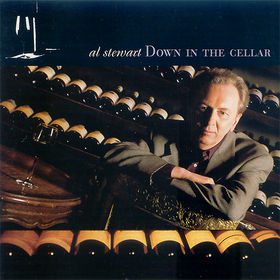
Al Stewart: Down In The Cellar


AL STEWART: DOWN IN THE CELLAR (2000)

1) Waiting For Margaux; 2) Tasting History; 3) Down In The Cellars; 4) Turning It Into Water; 5) Soho; 6) The Night That The Band Got The Wine; 7) Millie Brown; 8) Stained Moon; 9) Franklin's Table; 10) House Of Clocks; 11) Sergio; 12) Toutes Les Etoiles; 13) The Shiraz Shuffle.

It is hard to imagine anybody other than al Stewart, in the whole wide world, recording an entire album of songs about wine — and, more or less, getting away with it. That Al is a seasoned con­naisseur, is no sin of his. That he is capable of writing a nice, friendly tune about taking a sip, there is hardly any doubt. But surely a whole concept album drawing on his love for wine would be overkill? Boring at best, kitschy novelty at worst?

Well... it is not the best Al Stewart album ever, that one is for sure. Some songs work well and some not quite so. He did overestimate the power of inspiration evaporating from that cellar; and, what's worse, there is a quaint, uncomfortable aroma of snobbery. There is no reason to doubt the man's noble and innocent intentions (heck, he just loves all sorts of wine, what's wrong with that? Not everyone is supposed to inherit the tastes of John Lee Hooker) — but somehow I, for one, feel it easier to fall under Al's enchantment when he is reminding me of Josephine Baker and Charles Lindbergh rather than extolling the virtues of Margaux and Shiraz.

So, as a sprawling, many-faced ode to wine, Down In The Cellar is ambiguous, not only because a rock LP praising wine is suspicious per se, but also because the songs themselves are not all that reminiscent of alcohol-related environment, if you know what I mean. A note from a listener I once fell upon read something like, "I hate wine, but I liked this record" — meaning that Al es­sen­tially failed in his task. If this were a good record about wine, it would have been hated by all strong wine-haters — or it would have converted the weak ones. Instead, this is just a good record. Forget about the wine.

Since there are no production excesses (everything is kept in strict accordance with Al's no-extra-ornaments folk-rock formula: acoustic essence, minimalistic rhythm section, occasional electric guitar, occasional pianos, occasional chamber strings arrangement), and since there are no excu­ses for genre-hopping and experimentation such as provided by the topical matters of Between The Wars, the melodies do not require description; as usual, they are, uh, melodic — simple, mo­ving, and memorable. Humble, too: only 'The Night That The Band Got The Wine', with its lengthy epic title, six-minute running length, and increased levels of loudness, pretends to epic status, but is actually underpinned by its pretense; I'd rather look for the meaning of life in the rococo strings of 'Franklin's Table' (apparently, Ben was a big fan of the spirits, too), the dense medieval drone of 'Soho', and the echo-laden lonesome howling-wolf electric solos of 'Stained Moon'. Beautiful tunes, these.

Unfortunately, Down In The Cellar suffered doubly because of lack of promotion (the Miramar label that was supposed to take care of the album in the States went bankrupt before it managed to release it), and because of being tagged as some sort of «special interest» item. Not to worry: it is a perfectly normal, regular Al Stewart album reflecting his normal, regular skills at writing, singing, and playing. And who really gives a damn about the wine? Thumbs up.

Wednesday, September 1, 2010

Al Stewart: Seemed Like A Good Idea At The Time


AL STEWART: SEEMED LIKE A GOOD IDEA AT THE TIME (1996)

1) Where Are They Now; 2) Fields Of France; 3) Soho (Needless To Say); 4) In Red Square; 5) A Sense Of Déjà Vu; 6) How Does It Happen; 7) Coolest Winter In Memory; 8) Candy Came Back; 9) Jackdaw; 10) The Bear Farmers Of Birnam; 11) In The Dark; 12) Blow Your Mansion Down; 13) Willie The King; 14) Merry Monks; 15) Ghostly Horses Of The Plain; 16) Mixed Blessing.

This collection of outtakes and rarities was only available for a limited period through a fan club distribution in the mid-1990s, and, for the most part, has been made obsolete since then by the re­cent CD re-releases of Al's catalog, through dismemberment and dispersal of most tracks as bo­nuses for the corresponding chronological periods.

Nevertheless, it still exists — in the form of a used item on Ebay, a low-quality download on the local torrent site, or a discography memento graced with a slightly corny photo. And it has its use as a one-time sixty-minute listen, too, being fully on the level. Not every artist can boast an out­take collection that is almost as entertaining as an original, semi-coherent LP; Al, in terms of qua­lity if not recognition, joins the league of Dylan and Nick Drake.

The time period covered spans pretty much all of Stewart's pre-1996 career, the earliest track be­ing 'Jackdaw' from the late Sixties, the latest — several tracks from the Between The Wars ses­sions; and most are just as melodic and moving as the typically best stuff from the guy, someti­mes even more. 'Jackdaw' gives us the early innocent Stewart with pastoral flutes and starry eyes, spoiled somewhat by cooky backing vocals; but already the tracks dating back to the Parsons ye­ars are magnificently serious folk-rock, particularly 'A Sense Of Déjà Vu', worthy of the stateli­ness of a George Harrison classic, and 'Willie The King', a bleak, depressing cross between a bar­room blues and a prog-rock epic.

Later numbers are a 'Mixed Blessing' indeed — some, like this particular song, are hopelessly overwhelmed by crap-Eighties production, but generally they match the standards of the corres­ponding LPs: 'In Red Square', for instance, would have made a decent addition to Russians & Ame­ricans, but was, perhaps, excised for way too many references to Russian history targeted at audiences who might not have too pleasant a time refreshing their memories on Khrushchev. The New Wave trimmings of 'Candy Came Back' will please fans of 24 Carrots; the synth-pop lea­nings of 'How Does It Happen' will probably please no one, though — lines like "An original thought can be such a rush, why do they feed you on a diet of man-made mush?" do not sound all that convincing when they are set to man-made mush. Then the mood will be set right with the light humor of 'The Bear Farmers Of Birnam' ("...oftentimes the girls reject you — a bear won't treat you so; you're satisfied to know, when he chews you up, he still respects you"), the cheery medievalism of 'Merry Monks', and what may be the grandest and gorgeous-est entry of 'em all, 'In The Dark', from not-exactly-sure-when with a beautiful piano melody played by not-exactly-sure-whom.

All in all, a great collection — thumbs up, and way too bad if some of the best tracks happen to get lost in the process of dismemberment — but the tormenting question is: who the hell thought it was a good idea to start things off with two tracks from Last Days Of The Century? Fanclub releases seem to have their own unexplicated bits of weirdness.

Wednesday, August 25, 2010

Al Stewart: Between The Wars


AL STEWART: BETWEEN THE WARS (1995)

1) Night Train To Munich; 2) The Age Of Rhythm; 3) Sampan; 4) Lindy Comes To Town; 5) Three Mules; 6) A League Of Notions; 7) Life Between The Wars; 8) Betty Boop’s Birthday; 9) Marion The Chatelaine; 10) Joe The Georgian; 11) Always The Cause; 12) Laughing Into 1939; 13) The Black Danube.

Another minor gem, alas, too limited in ambition and too humble in execution to become any­thing higher than a cult classic (and, so far, it has not become even that). This time, in collabora­tion with guitarist Laurence Juber, and, apparently, feeling more free than a bird, Al fully gives in to his historical passion — dedicating an entire album to songs dealing with one and one only historical period, arguably his favourite one: remember “...I was born too late to see Josephine Baker dan­cing in a Paris cabaret"? Well, at least he was born not too late to be enthralled by the 1920s and the 1930s, enough to offer such a cute little recreation of those happy/awful times.

The recreation is not actually musical: apart from the first two fast-paced songs, Al does not of­fer a regular «retro» exercise, which might have been judged as too posh and fanciful, and heard as too fake and devoid of credibility (think Christina Aguilera). Most of the songs are written the way he usually writes them — not terribly inventive folk-pop melodies — but the spirit is clearly invigorated by the subject, which he explores from all sides, with humor, tragedy, melancholy, and excitement permeating all the motives.

The track names mostly speak for themselves — unless you come from a long line of village idi­ots, you will be able to understand at least fifty or more percent of Al’s sources from the titles, although there may be one or two you will have trouble with even if you’re a history buff your­self, since Mr. Stewart touches upon political, social, and cultural issues of the two decades, sti­cking references to just about everything that existed back in the day, from Dorothy Parker to Hedy Lamarr to Zinoviev and Kamenev.

To waste space on description of the individual songs would be downplaying the point. All are sparsely produced, completely acoustic with an occasional accordeon, piano, or quiet orchestral arrangement thrown in. Each de­livers a hummable chorus; some, in addition to that, offer the de­light of a flapper’s dance (‘The Age Of Rhythm’, ‘When Lindy Comes To Town’), while others prefer to delve the mines of doom and gloom (‘Laughing Into 1939’). Lyrically, some are hilarious (all the spy references in ‘Night Train To Munich’), some knowledgeably sarcastic (‘League Of Notions’), a few down­right silly (‘Joe The Georgian’, about how Stalin’s victims are impatiently waiting for him to join them in Hell). And some represent implicit edutainment — ‘Betty Boop’s Birthday’ may make one want to check out those old cartoons.

But the point is, of course, to weave a specific projection of the epoch out of these bits and pieces, and, from that point of view, the album is a success. Pedantically minded ones may complain about Stewart’s vision being too shallow and unprofessional, but he is no historian, after all, and Between The Wars is not a PhD thesis, merely a loving tribute from a talented, intelligent aficio­nado. If it does not charm you at least a little, you’re either hopelessly hung up, or a disgruntled victim of Are You Smarter Than A Third Grader. And what better excuse is needed to rewatch that old Carol Reed classic? Thumbs up, of course.

Wednesday, August 18, 2010

Al Stewart: Famous Last Words


AL STEWART: FAMOUS LAST WORDS (1993)

1) Feel Like; 2) Angel Of Mercy; 3) Don't Forget Me; 4) Peter On The White Sea; 5) Genie On A Table Top; 6) Trespasser; 7) Trains; 8) Necromancer; 9) Charlotte Corday; 10) Hipposong; 11) Night Rolls In.

Wonderful return to form. Fueled, perhaps, by all the joy that was synthesized on the acoustic duo tour, Stewart finds the strength to ditch most of the production excesses — and delivers a lively, strong, charismatic record, more consistent than anything he's done in years. Almost everything is strictly acoustic-based, with rhythm sections, electric guitar solos and keyboard backdrops swea­ring complete loyalty to wood, nylon, and human voice. This may add an unwanted whiff of mo­notonousness to the proceedings, but surely monotonousness is at least preferable to the dozen varieties of excremental sonic effects on Last Days.

Although the album is formally dedicated to the memory of the recently deceased keyboardist Peter Wood (Stewart's co-author on 'Year Of The Cat'), it contains two of the most joyous, life-asserting songs Al ever wrote, totally irresistible in their optimistic swirl: 'Feel Like' and 'Genie On A Table Top'. Coming up with hosts of lyrical metaphors to describe his elated spirits — replacing each other in a whirlwind so rapid it is almost impossible to separate the time-tested clichés from brilliant on-the-spot inventions — he infects the backing band with his cheerfulness, and each single musician, from the percussionist to organ and guitar guys taking solo spots, do their best to match him in this celebration of life. After all the chilly, morose panoramas of Last Days, it is the perfect antidote — even though there is no telling as to whatever it really was that made Al feel so wond'rous. The death of Peter Wood?..

These two I-feel-good anthems are the obvious highlights, but Al's sense of melody and taste seems to have picked up on quite a few other occasions as well. 'Angel Of Mercy' is eloquently vicious, staking it all on Al's duet with the ominous violin part (reminiscent somewhat of Dylan's mid-Seventies conversations with Scarlett Rivera's instrument). The inescapable history lesson of 'Charlotte Corday' is a collabora­tion with Tori Amos that most Tori Amos detractors will like — because she is not singing, merely playing piano, and because the lyrics are his rather than hers. The chorus of 'Trespasser' — "you see him in your dreams, but I seem to see him all the time" — is technically unforgettable, although the song may have used a bit less generic Spanish guitar (what can you do, Al loves the stuff).

Even the two-minute kiddie throwaway of 'Hippopotamus Song', which may turn off deadly se­rious listeners whose sense of humor had been gradually wiped off with a series of Rush concerts, is funny fun in its capriciousness; besides, who else but Al Stewart would flaunt the etymologi­cally correct plural form of the word 'hippopotamus' — and then make it rhyme?

Against all this surge of the spirit, the record's few flaws seem even fewer. The gracious, nostal­gic folk-rocker 'Trains' has no real reason to drag on for eight minutes; four would have been quite enough — it is certainly no 'Roads To Moscow'. And a couple of the tracks still carry ves­tiges of crappy Eighties' production — 'Don't Forget Me' still gets pigeonholed as glossy, suffo­cating adult contemporary, and 'Necromancer' abuses echo effects and electronic percussion in order to remind us that true evil does exist. Yet the tone of the album is still set by 'Feel Like', and a small amount of inertia-based blunders cannot misdirect it. Thumbs up for a record that may brighten up many a day if one so desires, or, perhaps, already has.

Wednesday, August 11, 2010

Al Stewart: Rhymes In Rooms


AL STEWART: RHYMES IN ROOMS (1992)

1) Flying Sorcery; 2) Soho (Needless To Say); 3) Time Passages; 4) Josephine Baker; 5) On The Border; 6) Nostradamus; 7) Fields Of France; 8) Clifton In The Rain / Small Fruit Song; 9) Broadway Hotel; 10) Leave It; 11) Year Of The Cat.

Nice, humble little album, strictly for the fans but real quality stuff for the fans. In the midst of a local industry crisis that left Al without a recording label, he and Peter White undertook a short inexpensive tour with just the two of them onstage, both playing acoustic guitars (with White oc­casionally switching to accordeon or piano). Come to think of it, it is actually strange how long it took Stewart to come up with an «unplugged» album — many fans must have been secretly ho­ping for one since 1967 at least, yet the man steadily refused to budge, on the contrary, pumping more and more layers of production onto his simple melodies until it all exploded with the stink­fest of Last Days Of The Century.

Not that Stewart is really to blame — without all the extra arrangements, reduced to bare-bones acoustic strum, the songs lose quite a bit of pizzazz; if Stewart's entire career sounded like Rhy­mes In Rooms, he'd be even more of a cult taste than he is today. But after the suffocation of Last Days, just about the only way to remedy it was to roll back all the way and give the depres­sed fans just the opposite of «overproduced», so the record really came in at the right time.

With the surprise exception of the 'Clifton In The Rain / Small Fruit Song' medley, hearkening back to the old days of obscurity, the tracklist is predictable: hits and classics ranging from Past, Present & Future to Time Passages. But it is interesting to learn whether all these Parsons-era classics still have anything to say with the Parsonage taken away from them — and yes, 'Time Passages' works well without the underwater keyboards, and 'Year Of The Cat' does not wither away and die without the saxophone solo, partly because of Peter White's highly technical, but pleasant solos (somehow complex solos played on an acoustic guitar tend to come across as soul­ful even when the same solos, played on an electric, would seem ugly — go figure), partly be­cause, yes, they were expertly written and heartfelt tunes from the very beginning; it only took Parsons to make the average layman notice that.

Needless to say — no, not Soho, but just that the two tunes off Last Days sound much better than the originals, particularly 'Fields Of France' (although I miss the flute solos, they did make the song way too reminiscent of late-period Jethro Tull). Overall, the acoustic duo worked so well that Stewart even went on to replicate the experience several times (most recently, with Dave Nachmanoff) — not really necessary, in my opinion, but certainly money-saving. Thumbs up as a one-time experience, but it is quite friendly on Al's part that he did not go on to abuse the acou­stic-only principle.