Search This Blog

Showing posts with label Alanis Morissette. Show all posts

Saturday, November 17, 2012

Alanis Morissette: Havoc And Bright Lights


ALANIS MORISSETTE: HAVOC AND BRIGHT LIGHTS (2012)

1) Guardian; 2) Woman Down; 3) 'Til You; 4) Celebrity; 5) Empathy; 6) Lens; 7) Spiral; 8) Numb; 9) Havoc; 10) Win And Win; 11) Receive; 12) Edge Of Evolution; 13*) Big Sur; 14*) Guru; 15*) Permission.

We all usually prefer to snobbishly dismiss sales figures as irrelevant to what we like and what we hate, but «irrelevant» is not quite the same as «meaningless». Look at Alanis and the curve of her US sales, for instance: Jagged Little Pill — over 14 mln. copies sold; Junkie — less than 3 mln.; Under Rug Swept — around 1 mln.; So-Called Chaos — less than 500,000; Flavors Of Entanglement — approximately 230,000; Havoc And Bright Lights — 54,000 copies so far. Look up «exponential behavior» in any mathematical encyclopaedia, and you will probably see a picture of Alanis grinning at you in one of her trademark toothy styles.

What is really funny, though, is that I actually relistened to Jagged Little Pill right before taking a plunge into Alanis' latest «commercial dwarf», just for a quick memory refresh, and God help me, I just can't hear the crucial difference. Yes, a lot of anger, tension, paranoia has been lost, dissipated, scattered over the years, which is only natural after seventeen years. But come now, haven't all those fans from 1995 — people for whom Jagged Little Pill mattered so much, all these 14 million Americans and 20 more million people worldwide? — haven't  they, too, grown older, so that they could follow their teenage idol through all of her phases and stages, breaking down when she breaks down, straightening up when she straightens up? What's up with loyalty and fidelity these days, anyway?

Not only that, but Havoc And Bright Lights mostly received disparaging critical reviews — seems even worse than Flavors Of Entanglement — with people complaining about almost everything. Too hookless, too happy, too overproduced, too archaic, too boring, something that I just don't get — it's as if «she used to be fine and now she sucks», when in reality there has never been any insurmountable gap between any of her albums. Screw the whole Zeitgeist thing: Alanis is not a very good artist, but she is an artist, want it or not, not just some helpless carrier of the supernatural spirit of 1995, randomly selected in some heavenly lottery.

And there are some good songs on this album, no more and no less than on the previous one. To be honest, the production does not bother me at all. She retains her producer from Flavors (Guy Sigsworth), but they go a little bit easier on the electronics and a little heavier on the guitars this time, and although the album doth suffer from overcompression, the sonic textures are at least varied — some of the arrangements lean towards traditional grungy alt-rock, some have ringing folk-rock patterns, some are electronically processed, some are acoustic, basically, I just don't mind: in any case, the instrumental backdrops, as usual, only serve as backgrounds for Alanis' vocal hooks, and these particular ones, at the very least, aren't annoying.

And what about these hooks? Well, I don't see why long-time fans of Alanis should turn away from them. Something like ʽGuardianʼ is very much Alanis — quiet soulful beginning, exploding into loud ecstasy as the chorus is being hammered into your brain, only this time, it is a little con­fusing because there is no hateful madness attached: now, screaming "I'll be your keeper for life as your guardian", she is just giving a lively oath of faith, not cursing the hell out of us all. Yes, this might disappoint those who'd rather see her rail and rant. But it's a good chorus all the same, or maybe I'm just growing old.

In fact, the tendency seems to be this: the more she tries to whip herself up into an aggressive posture, the more embarrassing it looks, and vice versa. ʽWoman Downʼ positions itself as a fe­minist anthem, but not only does it have some of the silliest «feminist» lyrics ever committed to tape by, er, a formerly major artist ("calling all woman haters, we've lowered the bar on the beha­vior that we will take" — what's that supposed to mean?), it is also set to an equally silly, jumpy pattern punctuated by merry synth whoops, in a befuddling nod to those early dance pop days when "I wanna feel your love!" was about as deep as this lady would go. Lesson not learned: you don't combine serious (if clumsily stated) messaging with this kind of music.

Another flat pancake is ʽCelebrityʼ, where the lyrics are a bit more coherent and, perhaps, could even — in theory — touch the senses of all the "tattooed sexy dancing monkeys" to whom it is addressed, but the spark is just not there: try as she might, she cannot reach the proper level of hatred or derision for all the "wheels, heels and vintage Gucci"... which might, after all, have something to do with the fact that the lady is not above a vintage Gucci herself (just google «Ala­nis Morrissette and Gucci» and look at all the nice, fine images). Hmm, hmm.

Anyway, cut to the chase: when she is being who she is on this record — a settled down family lady with a small kid and a happy home in Los Angeles — there are no big problems. ʽTil Youʼ is an old-school adult contemporary ballad with pretty voice modulation, soulfulness, and humi­lity; it had me even thinking of late-period ABBA for a moment out there, which may not be a coin­cidence because, for instance, the double-tracked vocals on the chorus of ʽLensʼ also sound sus­piciously Swedish in origin. ʽSpiralʼ is speedy, optimistic and catchy, even if its ringing guitars and swirling synths sort of cancel out each other in an overcompression bout — but after a couple of listens, the chorus gets head-stuck anyway.

And on and on and on, these songs are surprisingly even — there are very few of her «Eastern Darkness» trademarks (although ʽNumbʼ, with some of that modality and an atmospheric violin part to boot, is at least as good as anything on Junkie), for the most part it's this very even, not too pretentious semi-alt-, semi-folk-pop with stable emotions, credible sentimentality and occa­sional hooks. Not too clever — remember who we are dealing with — not too dumb. Little to love, but absolutely nothing to hate. Plus, her voice seems to be improving in clarity and range as the years go by — some of the notes hit on ʽTil Youʼ are downright gorgeous.

After some consideration, I go with a thumbs up, as I'd go with any not-untalented person being relatively honest with herself and her listeners (we'll agree to overlook the Gucci fiasco for once). Essentially, these days Alanis Morissette just sounds more basically human, so who the heck cares about a stale old Zeitgeist from almost two decades ago, anyway? Good for you, 54,000 loyal fans who bought this album — it is hardly likely that I will ever want to revisit it, but I cer­tainly don't regret the time spent on trying to understand why I never got around to hating it, or to getting bored out of my skull with it.

Check "Havoc And Bright Lights" (CD) on Amazon
Check "Havoc And Bright Lights" (MP3) on Amazon

Saturday, January 23, 2010

Alanis Morissette: Flavors Of Entanglement


ALANIS MORISSETTE: FLAVORS OF ENTANGLEMENT (2008)

1) Citizen Of The Planet; 2) Underneath; 3) Straitjacket; 4) Versions Of Violence; 5) Not As We; 6) In Praise Of The Vulnerable Man; 7) Moratorium; 8) Torch; 9) Giggling Again For No Reason; 10) Tapes; 11) Incomplete; 12*) Or­chid; 13*) The Guy Who Leaves; 14*) Madness; 15*) Limbo No More; 16*) On The Tequila.

After a four-year, relatively secluded, break, only interrupted by the release of Jagged Little Pill Acoustic in 2005 (which is more or less what it is, an unplugged revision of her fading moment of glory, and hardly deserves a special review), Alanis has returned to the studio in an attempt to update and polish her image. With an entirely new team of musicians, led by producer Guy Sigs­worth and «programmer guitarist» Andy Page, she is ready to strive for hipness once again.

Her team's understanding of hipness, however, means basically one thing: make the album a tech­nophile's dream. Half, if not more, of the songs are stuffed with «look at us, we are so sci-fi» electronic farts, and some are driven by mid-tempo techno beats — all of a sudden, Alanis decla­res that she actually loves to dance (yes, we know, Ms. Morissette, we did see you in those com­promising videos from 1992) and that no dance fan will be disappointed with her new record.

On paper, a combination of pretentious lyrics, confessional attitude, and techno beats coming from the likes of Alanis sounds like the proverbial recipé for disaster. Think Madonna's Ray Of Light or something in the neighbourhood. Surprise: it is perfectly okay, no better and no worse than the average A. M. offering of the past ten years. The synthesized farts and programmed loops never detract from her standard hooks, in fact, they are somewhat refreshing after the uni­form, monotonous production style of Under Rug Swept and So-Called Chaos.

In fact, the ugliest moment on the record is not even one centered on Electronica: it is '(Bring) On The Tequila', a dreadfully silly, campy attempt to write a song in the 'party pop' genre of the latest brand of idiot teen idols (Miley Cyrus, etc.) — I hope the intention was primarily parodic, but you can never tell with artists of Morissette's level, prone to chronic lapses of taste. Fortunately, it is only available as the final track on the «deluxe» 2-disc edition of the album, and need not in­furiate the tastes of the average enlightened listener.

As for the techno-pop, 'Straitjacket' does suffer from being way too overtly commercial, but the electronification of her raga tendencies works better on 'Citizen Of The Planet', and even gets close to the level of intimidation on 'Versions Of Violence' (which I always keep hearing as 'Vir­gins Of Violence' — a great title for a cutting-edge animé series, I think, and the song would do great as the title track). Her gift for vocal hooks has not gone anywhere, and the production team never tries to shadow them, no matter how many side effects they cram in the mix.

Note, though, that once again the singles from the album were some of the least commercial tracks. 'Underneath' does have a danceable chorus, but its trendiness is strictly limited to orna­mental electronic flourishes (that, moreover, seem to be played on an old Moog synth — trendy my ass!); 'In Praise Of The Vulnerable Man' is a catchy mid-tempo folk-rocker that failed to chart completely, maybe because of the awful title and lyrics (no man would buy a single with such a title ever, no woman who's got a man would buy such a single under the risk of losing the man, and no woman who hasn't got a man would buy it — because what's the fucking point?); and 'Not As We' is a piano ballad, and not a very good one at that (try as she might, Alanis will never be­come a Tori Amos, so why even bother?).

This is odd: even as we see Alanis trying to break back into the stream of public conscience, she is at the same time intentionally sabotaging her commercial fortunes. It is non-trivial, and, from a certain point of view, respectable; but my taste-o-meter still goes low on the mercury level, indi­cating that Ms. Morissette's ambitions are still the same — to be perceived as a Soul-Baring Se­rious Artist rather than the averagely pleasing pop songwriter that she really is. I cannot even reach a judgement, what with the brain and heart departments locked in a stalemate over the thumbs' position. In any case, if you are a committed fan, you will love Flavors Of Entangle­ment; if you are not, the album probably only deserves a «curio listen».

Saturday, January 16, 2010

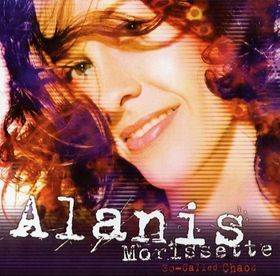
Alanis Morissette: So-Called Chaos


ALANIS MORISSETTE: SO-CALLED CHAOS (2004)

1) Eight Easy Steps; 2) Out Is Through; 3) Excuses; 4) Doth I Protest Too Much; 5) Knees Of My Bees; 6) So-Called Chaos; 7) Not All Me; 8) This Grudge; 9) Spineless; 10) Everything.

This is only slightly weaker than Under Rug Swept, running out of hooks somewhere around the middle, but, otherwise, it is exactly what we have now come to expect from the Queen of generic alt-rock: boring arrangements, honest verbosity, and non-annoyingly catchy choruses. However, before we proceed, I must, from a transparently philological point of view, object to the title of song number four.

Dear Alanis: it is very nice that you know your Shakespeare, but, for your information, 'doth I protest' is seriously ungrammatical, since 'doth' is, by all means, third person singular, never first. And if you are actually aware of that, then you are either insulting the intel­ligence of your audiences, or presuming that your basic audiences are unintelligent in the first place. In the latter case, you could have considered using your songs as «edutainment». How about singing some­thing like 'Do I protest too much? Say 'doth I' and be out of touch with classic English grammar as such!' Surely this would have been very progressive and refreshing compared with inviting your audiences to take one more traditional walk in the depths of your soul.

Now that I have gotten that off my chest, 'Doth I Protest Too Much' is a nice song (I like how she starts relying more and more on Byrdsey guitar jangle), and so are the loud rockers 'Eight Easy Steps', 'Excuses', and 'Knees Of My Bees', particularly the latter, conti­nuing to combine grunge guitars with Eastern influences, but in a more upbeat manner than previously.

Later on, the album starts sagging under the weight of unfocused ballads, and the rockers start repeating the same atmospheres and even melodies — e. g., 'Spineless' does not say anything that 'Excuses' have not already said. It is also very hard to understand why the album's worst song ('Everything') had been selected as the lead-off single. The singing is passionate, the guitars shine and glisten, the atmosphere is suitably anthemic and confessional at the same time, and, presumably, the song meant a lot to Morissette, but it has no commercial value whatsoever (and the melody is weak, so it may have little artistic value either). 'Excuses' and 'Knees Of My Bees' would have worked far more convincingly.

It does put a stop to criticisms about Alanis' «selling out» that were occasionally voiced by main­stream reviewers, just because, on the whole, So-Called Chaos is «lighter» and «livelier» and «happier» than its predecessors — at least, that is what people used to call it, seeing as how Ala­nis had finally overcome her personal problems and settled into a (relatively) quiet family life. I am not sure. I do not see how it is at all possible for Alanis to «sell out» — unless she reverts to being the Alanis of 1992 — and I did not see that much darkness on Under Rug Swept, either. Besides, what do we care whether she releases a «dark» or a «light» album? She is just not all that interesting as a person to make me involved in her yin and yang. She does write catchy melo­dies, and she seems like a nice, honest, moderately intelligent little lady. What else is in it for me? No­thing.

Thumbs up, unless you insist on analyzing her lyrics — but I have made a solemn oath not to pay attention to what exactly she is going to teach me «in eight easy steps». I do like the line 'I could be an asshole of the grandest kind', though. That's one perfect way to initiate your lead-off single.

Saturday, January 9, 2010

Alanis Morissette: Feast On Scraps


ALANIS MORISSETTE: FEAST ON SCRAPS (2002)

1) Fear Of Bliss; 2) Bent For You; 3) Sorry To Myself; 4) Sister Blister; 5) Offer; 6) Unprodigal Daughter; 7) Simple Together; 8) Purgatorying; 9) Hands Clean (acoustic).

This is a very short album-addendum; actually, a bonus EP (yes, today 40 minutes worth of music is supposed to re­pre­sent the length of an EP — so much to say, so little to learn) that accompanies Alanis' live DVD of a performance in Rotterdam from her latest tour. It may be available separa­tely, but if you are a fan, you will want the DVD anyway, and if you are not a fan, you will want to donate to the poor instead.

As the title explicitly states, these are «scraps» — outtakes — from the Under Rug Swept ses­sions, and this pretty much says it all. The songs mostly sound the same, convey the same fee­lings, press forward the same points, yet are generally worse written. Overall, a little bleaker, with a bit more emphasis on Alanis' Eastern fetish, bringing back dots of memories of Junkie, which is not always a bad thing (the tricky polyphonic arrangements on 'Purgatorying', for ins­stance, are just about the most musically complex thing you will ever encounter on an Alanis album, for instance).

But out of the eight new songs (the ninth one is an acoustic version of 'Hands Clean'), I have only latched on to 'Sister Blister', whose catchy chorus slightly transcends the clichés of alt-rock — only slightly — and 'Offer', a pretty country-pop ballad that could have been a delicate lowlight on a James Taylor album, or a smash hit on American Idol if the accompanying tits and ass were of sympathetic shape. But Alanis is no James Taylor, and as for T&A, those were out of the picture since 1992, so let dogs lie.

I have not watched the DVD myself — it must be a good treat for the fans, with a decent selec­tion of hits and rarities from the good years. Without the DVD, the «EP» on its own predictably gets a thumbs down — bear with me, fans and neighbors, no good man is entitled to deriving joy out of an album of outtakes by Alanis Morissette, and songs like 'Sorry To Myself' elevate her logorrhoea problem to brand new snow-covered heights of oxygen deprivation.

Saturday, January 2, 2010

Alanis Morissette: Under Rug Swept


ALANIS MORISSETTE: UNDER RUG SWEPT (2002)

1) 21 Things I Want In A Lover; 2) Narcissus; 3) Hands Clean; 4) Flinch; 5) So Unsexy; 6) Precious Illusions; 7) That Particular Time; 8) A Man; 9) You Owe Me Nothing In Return; 10) Surrendering; 11) Utopia.

There is A LOT of different words on this album. Each and every single song, from top to bottom, filled with endless, endless, endless verbosity, prolixity, garrulity, loquacity. And it is not over after the last sounds have died down, because there is about half a billion additional interviews, grandly flashing «Alanis Morissette Talks About Songs From Under Rug Swept!» at you.

Do not, therefore, make the big mistake of judging this album based on its lyrics, or even of dis­cussing its lyrics, no matter how this unbelievable logorrhea goads you into committing it. Con­fucius say, «Little man be guided by deep meaning in Alanis Morissette songs, big man jack off in bathroom instead». I am not saying that all the words here are necessarily awful; as a third-rate poet, Morissette is improving with each year, and by now, she can at least make sure that her words will never spoil the cumulative effect. It is just that their overall quantity and density — sometimes she almost borders on rapping, so much there is that she needs to tell you in five seconds' time — may, and will, hide the real value of the album.

This is her first record without Ballard's involvement, and, although I was not sure at first, after a few listens I am convinced that it works better. The arrangements still define «bland», but there are no conscious attempts at «toughening» the sound by overloading it with generic «alt-rock» trappings. It looks like she cares about the melodies, but does not give a damn about dressing them up, relying on any spontaneous combination of lead instruments and rhythm section that happens to materialize at any given moment. For a great artist, this would be suicide, but for an openly mediocre one, this is a very wise decision — one should never tell a mediocre artist that song so-and-so needs more cowbell. That is one sure way to spell disaster.

So the electric guitars still sound like shit, and the rhythm section still sounds like she downloa­ded most of these tracks from a South Korean musical site for $0.11 each, but the melodies — in general — are nice. '21 Things I Want In A Lover' (yes, she lists all of them) and 'You Owe Me Nothing In Return' are two of the catchiest pop-rockers she ever put up for us. 'Flinch' is her pret­tiest acoustic «ditty» so far. 'That Particular Time' is the kind of pompous, but deeply emotional ballad that Diane Warren might have written, were she a real human being instead of a devasta­ting biological weapon that somehow slipped past the Geneva convention. And her near-falsetto singing on 'Utopia' closes the record on an almost Enya-like note, awaking the romantic in those of us who are not yet completely jaded and, perhaps, not even making him regret the awakening.

Of course, the lead single from the album had to be one of its least impressive tracks — 'Hands Clean', probably because it has the highest density of words per second (but nothing like a truly catchy chorus). Maybe some of the critics were impressed, because it gave them so many points to latch on to, but the public clearly was not, and, anyway, with Under Rug Swept it became ob­vious that Alanis' days as a big pop star were clearly past her: the record made a very brief stay at No. 1, and, up to this day, has only been certified platinum once (compared to thrice for Junkie and sixteen times — sic! — for Jagged Little Pill).

I do not think, though, that the reaction came as a shock or disappointment to Alanis, and it is quite likely that the results, for her, were quite predictable. There was no huge marketing cam­paign, no conscious attempt to «rejuvenate» or «modernize» her image for the masses, not even a nationwide broadcast duet with Christina Aguilera. This is certainly mainstream, generic, and ac­cessible stuff, but it does not scream «buy me, I'm cool!» at the average market-goer, and most people probably bought it because the memories were still relatively fresh. But fade out the con­text, and you may end up like me, thinking of the album as Alanis' strongest mediocre offering to date and easily giving it a thumbs up, even despite the sadistic stream of consciousness.

Saturday, December 26, 2009

Alanis Morissette: Unplugged


ALANIS MORISSETTE: UNPLUGGED (1999)

1) You Learn; 2) Joining You; 3) No Pressure Over Cappuccino; 4) That I Would Be Good; 5) Head Over Feet; 6) Princes Familiar; 7) I Was Hoping; 8) Ironic; 9) These R The Thoughts; 10) King Of Pain; 11) You Oughta Know; 12) Uninvited.

It is theoretically likeable, this session. Alas, it does not improve much on the biggest thing it could improve upon. Considering that Morissette's full-band rock arrangements are one of the weakest spots on her studio albums, one could hope that getting rid of dreary, boring «alt-rock» guitars and dehu­manized, depressing percussion would make her material more fresh and exciting. It does not.

If anything, the only reason why Unplugged could merit consideration is Alanis' curious restraint and even a bit of «delicacy» that she gives her listeners by not overscreaming, not even on such screamfests as 'You Oughta Know'. It may not always be evident that she is an excellent singer when her bratty attitude overshadows her vocal talent, but on Unplugged, there is no bratty atti­tude whatsoever. Of course, for some fans that would only make things more boring.

To comment on the musical aspects of this session would be missing the point — Morissette's music was never about any sort of instrumental melodies in the first place, and here, her band is only to provide a properly atmospheric setting for her seriously self-sustained seance of soul sur­vival. She only serves a small helping of hits from Pill (I could easily live without 'Ironic', but three cheers for changing the vocal melody of the formerly grating chorus), goes heavier on Jun­kie material, and introduces three entirely new songs that have passed me by completely, altho­ugh 'Princes Familiar' is supposed to be a very important tune on a personal level.

It's all okay, going by gently and with relatively little pretense, but in order to really enjoy this, you have to adore Alanis Morissette as an extraordinary individual with a deeply idiosyncratic vision rather than a pop performer (for the latter purpose, studio records will suffice completely). And it is very hard for some of us to do just that — certainly not with moves so blatantly obvious as choosing, for your obligatory tribute to your influences, Sting's 'King Of Pain', and even redoing the hookline as 'I'll always be queen of pain'. She is so admirably «honest» about everything she does, I think I'm going to be sick.

First-rate singing, second-rate playing, thoughtful song selection, moderate hooks on every corner, tortured soul in abundance, all of this comes together in a depressing thumbs down that the brain had only just time enough to signal to the heart before lapsing in a coma. I envy you if you have a greater tolerance level for such sanitized atmosphere.

Saturday, December 19, 2009

Alanis Morissette: Supposed Former Infatuation Junkie


ALANIS MORISSETTE: SUPPOSED FORMER INFATUATION JUNKIE (1998)

1) Front Row; 2) Baba; 3) Thank U; 4) Are You Still Mad; 5) Sympathetic Character; 6) That I Would Be Good; 7) The Couch; 8) Can't Not; 9) UR; 10) I Was Hoping; 11) One; 12) Would Not Come; 13) Unsent; 14) So Pure; 15) Joining You; 16) Heart Of The House; 17) Your Congratulations.

So, before we proceed to discussion, here are the Google statistics as of December 12, 2009: [1] the correct way — Morissette: 1,560,000 results; [2] Morisette: 367,000; [3] Morrisette: 263,000; [4] Morrissette: 109,000; [5] Morissete: 52,000; [6] Morrisete: 29,000; [7] Morris­sete: 11,200; [8] Morisete: 19,600. (Of course, many of these are just bot copy results, but it is the relative statistics that matters, not the absolute numbers).

The conclusion is that about a third of people writing about A. M. do not even know how to spell her name properly. Of course, it is a rather hard name to spell (trickier even than Mississippi, where one just has to remember the «two of each» rule), but still, you'd expect a bit more attention paid to such a household item. Or, perhaps, it is just the name — misspelt — that is a household item, and not the music? How many people have written about A. M. without actually listening to her (as opposed to without hearing her, which is more or less impossible)?

I cannot say that Morissette's follow-up to her major commercial success is a "great" album. I cannot say that I love it, or that I will ever have a big desire to return and explore it some more. But it was Supposed Former Infatuation Junkie, not Jagged Little Pill, that finally convinced me that there is artistic merit to this girl's work. For all its flaws, Pill was not a hollow forgery — but this is best evident only after listening to the next in line. It is no coincidence that Alanis ne­ver managed to surpass the "triumph" of Pill: not only are her subsequent records sounding more and more "out of date", but they are actually sounding less and less market-oriented.

Junkie is a tremendously long, horrendously brooding, and emphatically personal record that, first and foremost, is dedicated to growing up. Once you spot the ugly horse grin on the cover, the first thought is that you will probably be subjected to even more screeching and caterwauling than last time, but the intention is rather... 'Ironic': in fact, Alanis is much more restrained and much more oriented towards a conventional understanding of 'singing' here (from time to time, with a little Indian flavor she somehow picked up over the last three years — uh, possibly as a result of her visit to India?).

More importantly, she overcomes her major weakness — inane lyrics. It is still easy to sneer at all the different, yet equally obvious ways in which she blows up her rather simple emotions; it is more difficult to admit that she has at least advanced to the stage at which she is implicit rather than explicit about it. The encription is not very difficult, but it needs to be broken; certainly a chorus like 'Thank you India, thank you terror, thank you disillusionment, thank you frailty, thank you consequence...' is more deserving of notice than 'I've got one hand in my pocket and the other one is giving a high five'. Or so it would seem.

The music is a more difficult matter. Brushing away occasionally silly critical raves ('Wow, she is writing pop songs without choruses, whoever heard of that?'), we are left with a gloomy mix of "alternative rock" with "adult contemporary", thick on atmosphere and personality, but generally thin on hooks. There are even Goth overtones on some of the numbers: Alanis is certainly intent on letting us know either that success has not gone to her head and that she has no desire to im­per­sonate a pop-rock diva, or, perhaps, more cynically, that the very success she has earned was entirely due to her neuroses, so next time around, she is happy to heap even more of those on the listener. You want trouble? You got it.

Just like before, the main problems are with the basics of the arrangements. Same boring funky beats, same lack of detail, same moribund guitar backing — a few of the riffs are good, but for the most part, they are just grumbling away in the background. Add to this the seventy-plus mi­nute length, and it becomes a real chore to sit through all of this, especially since midway through you clearly begin to understand that no, you are not getting much of anything else. For a long time, this effect prevented me from seeing 'Joining You' as the catchiest song on the album, or 'Heart Of The House' as the song with the best strings arrangement. Alas, she is still letting Glen Ballard have control of the situation, and these are the results: she has unquestionably grown up, but he has, most definitely, nowhere left to grow.

All the same, I think that 'Baba', even with all the pretentiousness and with all the grungeness, is a powerful tune; that 'That I Would Be Good' is the best Diane Warren song that Diane Warren, fortunately, never wrote (or else I would have to reluctantly pray that her approved billion years on the fry­ing pan be reduced by a few months); that the lyrical concept of 'Unsent' is pretty clever; and that I fully understand why Robert Christgau gave this record an A- as opposed to Jagged Lit­tle Pill's B+, but have no idea why he gave Aimee Mann's Lost In Space — an album that is thematically not that far removed from Junkie, but musically surpasses it in every way known to mankind — a C+.

My own verdict would be that the whole thing is monotonous but mildly intelligent; musically poor but perfectly honest; conventional but desperately trying to overcome conventionality, and for all these counterpoints, first time in this section, I would deal it out a cautious emotional-ratio­nal thumbs up. But prepare to be bored stiff.

Saturday, December 12, 2009

Alanis Morissette: Jagged Little Pill


ALANIS MORISSETTE: JAGGED LITTLE PILL (1995)

1) All I Really Want; 2) You Oughta Know; 3) Perfect; 4) Hand In My Pocket; 5) Right Through You; 6) Forgiven; 7) You Learn; 8) Head Over Feet; 9) Mary Jane; 10) Ironic; 11) Not The Doctor; 12) Wake Up.

As of 2009, thirty-three million people worldwide have purchased this album (I'm assuming, of course, that nobody bought it twice or thrice). This figure means that hype and trend alone cannot be responsible for its success; that its formula had what it takes to capture the mindset of the ave­rage music consumer in 1995 and, apparently, has not quite lost its potency even today; and that, whether we want it or not, Alanis Morissette will feature on the pages of "alternative rock" histo­ry forever, no matter how many anti-Alanis crusades we may call for.

And I, of course, am seriously tempted to join an old one or call for a new one. Jagged Little Pill is one of those records that is not awful per se — merely unremarkable — but whose thoroughly inadequate reception makes it into an awful mass conscience phenomenon. To illustrate, let me quote a user review from RateYourMusic which dubs Pill a "Great, Important, Revolutionary Al­bum": «When Alanis Morissette emerged... in 1995, the world quickly sat up and took notice. This was the pre-Lilith Fair era, when women weren't supposed to make a scene in music. And then there was Alanis — combining harmonicas, catchy melodies, and nearly screaming lyrics that we couldn't get out of our heads.»

PRE — FUCKING — LILITH FAIR ERA? I can only hope this statement is not altogether typi­cal of the thirty-three million people who bought Jagged Little Pill, but if it is and the "female musical scene" is commonly associated with Lilith Fair in the popular mind, feminism should truly pack it in, because nothing whatsoever has shifted in the dominant male perspective over the last fifty years. But forget Lilith Fair, let us ponder a more serious question: what the heck made the world "quickly sit up and take notice" of Alanis and her "near screaming lyrics" in 1995, when, for instance, just two years ago the world could have just as quickly sat up and taken notice of — to quote but one of the many possible examples — Aimee Mann's Whatever, an album that objectively rocked harder, had unquestionably better lyrics, and far more depth than all of Alanis' efforts put together?

Actually, it is not difficult to explain. When Alanis Morissette decided, after a long period of in­ternal and external struggle, to make the transition from third-rate dance-pop chick to honest sin­ger-songwriter — a decision that, by itself, can only be welcome — she did not have a clue about two things. First, although endowed by poetic aspiration, she hardly knew how to write complex, multi-layered lyrics that would be "on the level", let alone over it. Second, she may be responsi­ble for (some of) the basic melodies, but she has let her collaborator Glen Ballard come up with the arrangements, and he gives it all the most normal, predictable, unimaginative musical backing that you could expect in 1995 — yucky compressed guitar sound, danceable, mechanistic percus­sion, post-adult-contemporary keyboard sheen etc. etc.

These two flaws — corny lyrics and bland sonics — have forever banned Morissette from the predilections of sophisticated music consumers, but, of course, it is exactly these two flaws that, from the perspective of the music buyer en large, represent her greatest advantages. It does not take much effort on the part of the average Joe/Jane to get what she is singing about, and it does not take much time on his/her part to get how "modern" and "contemporary" she is, either, what with the entire production style screaming '1995!' into the ear of the time machine constructor.

And, just so that there could always be some space left to argue, every now and then the average Joe will fall upon a mystical line or two — for instance, 'I'm consumed by the chill of solitary, I'm like Estella, I like to reel it in and then spit it out' — and come running and shaking his fist at cri­tics: 'You think you're cool, man, talking all that trash about Alanis, let me tell you now, she really knows her classics, that gal, if not for her, I'd hardly ever guess what that South Park epi­sode no. 62 was all about!' Or: 'Before Alanis came along, I'd have to google for Webster each time someone said 'ironic'. Now I have finally memorized that 'ironic' is like rain on my wedding day, or a free ride when I've already paid! Sure I'm too dumb to ever have a wedding day or a free ride offered to me by anybody, but at least I know what that word means now! Stop bashing Ala­nis, go and fuckin' sell thirty million records yourself and then we'll see!'

Not to mention the harmonicas. How cool is having the album open with a folksy harmonica note — washed away in less than a second by a ge­neric power chord — harmonica battling grunge guitar — say, isn't that what true art is all about?

In short, Jagged Little Pill unsettles and depresses me, but not for the reasons that are supposed by its creators to unsettle and depress me — rather for its gruesome inadequacy and unjustified pretense. It is far removed, musically and lyrically, from Alanis' dance-pop efforts, but not far enough to lose any connections whatsoever: just like those two, it attempts to bite off much more than it can chew, and would have ended up being unintentionally funny, if only the number of copies it managed to sell didn't make it all so unintentionally sad.

But now that I got it off my chest like I am supposed to, I must approach it from a different angle and say that, taken out of its social context, Jagged Little Pill isn't all that bad. One simply has to disre­gard the trite lyrics and run-of-the-mill arrangements and concentrate on its positive sides, not the least of which is Alanis' melodic gift — yes, she does have a gift for melody, and this is one of the, if not the only one, good reason why the record shipped so many clones. The hits are catchy — 'You Oughta Know', 'Ironic', 'You Learn', etc. all have fine catchy choruses that contain some emotional essence, and although few lines can be more banal than 'You live, you learn, you love, you learn, you cry, you learn, you lose, you learn', I have not the least doubt that they are delivered with unfaked passion by someone who truly believes that she is making a big, impor­tant, personal point here. I just close my eyes and imagine she is singing in Kiswahili instead, and it brings me some odd brand of internal happiness — and it's not hard to do.

Alanis' singing is a major point of contention. Some have accused her of masking her lack of sin­ging talent or vocal power with yelling and screeching; this is pure libel — please refer to her dance-pop era to ascertain that she does have a great set of pipes and that she is well able to stay on key whenever she wants to. The style she chooses on Pill, where many of the emphatic mo­ments are, indeed, characterized by excessive paranoid whining and yelling, is intentional and works on a take-it-or-leave-it basis, the same way one gets around Kate Bush's horny kittycat in­tonati­ons on The Kick Inside. I take it, and, in fact, think of it as the record's major asset; at least this is its only working element that won't ever allow you to confuse Alanis Morissette with any­one else. If only that yelling were set to better lyrics than 'Is she perverted like me, would she go down on you in a theatre, does she speak eloquently and would she have your baby?', I'd have even fewer problems with it.

Even the music, although generally boring, is rarely disgusting. Were it oversaturated with syn­thesizers, or capitalizing on three-chord grunge riffs, like a proto-Avril Lavigne, I would have screamed bloody hell; but it is simply unremarkable rather than awful — some semi-decent riffs, lots of simple, but un-annoying folksy acoustic playing, some electric 12-string stuff, none of it has dated as badly as the synth-pop arrangements of Alanis and Now Is The Time. No revela­tions — no unexpected bathroom calls, either.

In the end, I am quite unsure about any final judgement. A thumbs down rating would mainly be me decrying the sad fate of mainstream music and expressing pity for thirty-three million people who hardly have any business taking it from me. A thumbs up rating, on the other hand, would compromise any remains of integrity I still might be preserving somewhere. I guess it is just one of those albums where any fence-straddling type of rating would never satisfy anyone.

So, instead, I will leave you baited with a little bit of funny Internet trivia I have indulged in. Appa­rently, the Great Mystery of Alanis does not even begin with her music, it begins with the way you spell her family name. Quick, close your eyes and reply: How many R's, S's, and T's are there in the name Mor(r)is(s)et(t)e?

Now open your eyes and check the statistics in the next review to find out whether you form part of the intellectual Google majority and have won your prize — a lifelong supply of jagged little pills and a used copy of Great Expectations.

Saturday, December 5, 2009

Alanis Morissette: Now Is The Time


ALANIS MORISSETTE: NOW IS THE TIME (1992)

1) (Change Is) Never A Waste Of Time; 2) An Emotion Away; 3) Big Bad Love; 4) Can't Deny; 5) Give What You Got; 6) No Apologies; 7) Rain; 8) Real World; 9) The Time Of Your Life; 10) When We Meet Again.

Essentially Alanis Vol. 2 — there does exist a school of thought (if the term "school of thought" is applicable to generic Eighties-style dance-pop in the first place) that sees a teensy-weensy bit of evolution, but I am completely blind on this occasion. Same style, same marketing trends, same level of songwriting.

In terms of individual songs, there are some really ugly low points — 'Can't Deny', for instance, is the cheapest brand of pop music imaginable; you know, the one that goes 'place one finger on the keyboard and off we go', the one I thought was invented specially for East European and Rus­sian pop consumption, but apparently Canadians enjoyed crawling under that plank, too. On the other hand, 'Real World' does have a little bite to it, and it is also the first location where you will encounter the trademark Alanis Banshee Wail, guranteed to freeze you cold (and, depending on your musical tastes, make or not make your ears fall off in the process).

Sample lyric: 'I'm having dreams in the night of you baby / And Sigmund Freud would have thought I was crazy / I wonder why you've become an obsession / All I know is that I need to have your big bad love'. Personally, I think it's great — how come the Beatles never thought of namedropping intellectual celebrities to raise the bar on their early lyrics? Just think: 'Now you're mine, and Sigmund Freud still makes me cry / And in time, Arthur Janov'll understand the reason why / If I cry, it's not because I'm sad / It's just because Carl Jung's the greatest guy I've ever read / Ask me how / I'll say Gestalt therapy is always waiting for you'. Doesn't it make you want to go out immediately and buy an extra copy of Please Please Me for each of your friends and neighbours?..

Sorry, just couldn't resist. Thumbs down.

Saturday, November 28, 2009

Alanis Morissette: Alanis


ALANIS MORISSETTE: ALANIS (1991)

1) Feel Your Love; 2) Too Hot; 3) Plastic; 4) Walk Away; 5) On My Own; 6) Superman; 7) Jealous; 8) Human Touch; 9) Oh Yeah; 10) Pretty Boy.

Oh boy. It's one of THOSE albums — ones that you'd never give one thought about if they repre­sented the artist at his/her most essential. But it so happened that Alanis Morrisette, the mainst­ream goddess of Nineties' commer-fessional singer-songwriting, started out as a Canadian wanna­be Janet Jackson, and, for the sake of formality, I have to mention her first two albums — even though many of her fans remain happily unaware of their existence.

Technically, there could be a copout here: both of these records bill her as "Alanis" (apparently, the family name was judged way too complex for the target audience, which, as allegedly pointed out by the marketing survey team, tends to have big problems with first grade spelling bees), so, from a certain point of view, we are speaking of a different artist here. It is also important to un­derstand that, having barely turned 16 (although they try to make her look 30 in the accompany­ing videos, taking all the clues from Tracy Lords, I guess), in no way was she in control of the proceedings, letting some run-of-the-mill synth-pop hacks write and arrange the music and mold her image. She is credited as co-writer on most of the tracks, to be frank, but let us not hold it against her; supposedly the hacks had a little bit of humanity left in them and decided it would be good to let her have some extra dough.

Of course, if she does assume songwriting responsibility for this tripe, that's not good. All of this is generic Eighties' dance music, with one or two corny Diane Warren-style ballads thrown in for the hankies' sake. The "hits" 'Feel Your Love' and 'Too Hot' have catchy choruses, like some of the other stuff, but in more or less the same manner that you'd expect from your aerobics workout videotape: to help you better train your butt reflexes. Vocals are decent — good dance moves and a strong throat were, after all, two sine qua non conditions that got you within the world of latex and frizzed hair at the time — but there's hardly any threat to Debbie Gibson or Paula Abdul.

I suppose a few of the tunes offer at least lyrical glimpses at the future Alanis — e. g., the "soci­al critique" of 'Human Touch' ('I'm tired of people sellin' their sex appeal', she declares, and then instantly proceeds to do just that in her videos), or the self-defense in 'On My Own'. But these aren't very convincing lyrical glimpses, and besides, they only work if one is actually a worship­per of the future Alanis. On the other hand, I can imagine where someone who hates the A. M. of Jagged Little Pill could love this album as a guilty pleasure — very, very guilty pleasure, on par with watching an old man's sex with minors. I had a bit of fun listening to it as a curious histori­cal memento, recollecting all the worst blows that the Eighties had dealt us. Then nausea started setting in, and I had no choice but to scuttle off. Thumbs down, quite predictably.