Search This Blog

Showing posts with label Amazing Blondel. Show all posts

Thursday, July 28, 2011

Amazing Blondel: A Foreign Field That Is Forever England


AMAZING BLONDEL: A FOREIGN FIELD THAT IS FOREVER ENGLAND (1972-1973/1999)

1) Introduction; 2) Seascape; 3) Dolor Dolcis; 4) Willowood; 5) Pavan; 6) Spring Air; 7) Shepherd's Song; 8) Celes­tial Light; 9) Fantasia Lindum; 10) Landscape; 11) Saxon Lady.

No missing this archive release — for anyone who is even mildly interested, that is, in learning what Amazing Blondel were really all about in their prime. Recorded on the band's 1972-73 Eu­ro­pean tour (most of the tracks seem to be from some French club gig), it's a prime slice of live Blondel at their peak — right before Gladwin's departure twisted the neck of the hen with the gol­den eggs — and it's LOADS OF FUN.

Basically, if you had any doubts about it, during the band's live shows the entire presentation was a buffonade — a bunch of jesters that never for one moment thought of their pseudo-recreation of the musical gallantry of old as any sort of «solemn» or «serious» activity. Light entertainment for the ladies and gentlemen of the audience, punctuated every now and then with bad (occasionally, good) jokes, intentionally flubbed notes, village idiot impersonations, and at least one sing-along number that's gotta rank among the goofiest audience-teasers ever put on record.

None of which belies the band's professional reputation: if anything is played «wrong» here, it is played so on purpose, and the group's collective harmonies are every bit as concentrated and con­trolled as they were in the studio. In fact, most of the songs are generally done very much by the book, and the performances themselves do not give you an Amazing Blondel that would be ama­zing in some sort of different way. The album is really treasurable for the atmosphere and the un­predictable surprises — such as singing "I'd screw you if I could" instead of "I'd woo you if I could" ('Willowood') to a stone-faced French audience, whose mastery of «Ænglisc» clearly does not extend that far.

Concerning other individual tracks... well, 'Shepherd's Song', turned into a ten-minute musical joke, may be delightful or annoying, depen­ding on your DNA structure, but is definitely unforgettable (how could one forget an aggressive­ly out-of-tune crumhorn?). 'Seascape' and 'Landscape', stripped of their orchestral arrangements, may please one more if the orchestration on England seemed too corny and overbearing (not to me, though). And 'Fantasia Lindum' is here complete in all of its 20-minute glory (one of the bits, 'Celestial Light', is even done twice).

Although I am usually wary of live albums that go over their heads in attempts to be lightweight and funny, Blondel were all right. They'd built up this weird collective personality that was, in it­self, much more English than the music they performed, and the album shows that they were fully capable of upholding it at least for the running length of one performance. Thumbs up. Not sure if Rupert Brooke would enjoy the joke at his expense, though.


Check "A Foreign Field That Is Forever England" (MP3) on Amazon

Thursday, July 21, 2011

Amazing Blondel: The Amazing Elsie Emerald


AMAZING BLONDEL: THE AMAZING ELSIE EMERALD (2010)

1) Cool Margarita; 2) Fools Gold; 3) Maybe; 4) Fools Who Try; 5) Don't Turn Your Back; 6) High Time; 7) Next Time; 8) When I Get Home Tonight; 9) Here At Last.

Betcha didn't know about this, didja? Yes, it's the new millennium alright, and Blondel are back — as simply Blondel, slyly tossing the Amazing component into the album title, because, once again, they have returned to the Dubitable Duo of Terry Wincott and Eddie Baird, bringing the circle back full time. No idea what happened to Gladwin. Maybe he went to join the House of Lords (there actually is a John Gladwin in the House of Lords, but not that one).

Last time we saw Wincott and Baird carrying on the A.B. tradition, they were busy spoiling the band's reputation in sick, perverted ways typical of the Seventies — which, supposedly, should make one highly skeptical of the results of a second reunion of such type, because turning Ama­zing Blondel into a superficially commercial proposition in the 2000s would mean taking lessons from... uh... the Backstreet Boys? Maybe Taylor Swift? Yikes.

Fortunately, no. It would take a complete set of brain drains to believe that an aging folkster duo that was never able to find steady commercial success even in its prime could raise as much as half an eyebrow in an era when musical competition is fifty times as cruel as it used to be — and, lucky for them, Baird and Wincott have aged in a graceful, not demented manner. Elsie Emerald is not a masterpiece, it is not even a very good album, but it is a bunch of songs that the old guys simply wrote and recorded because they felt like it — because, well, once a songwriter, always a songwriter, and if you do write songs, you might as well want to share them.

As expected, «Blondel» in duo format steps away from pseudo-Renaissance stuff and turns to quiet acoustic folk / soft-rock. It does not quite sound like quiet acoustic folk, because on most of the songs, they include synthesized strings arrangements, giving the whole record an odd sound — imagine a generic Seventies soft-rock LP re-recorded today in your little home studio, substi­tuting electronic instruments where possible (real drums, though). The oddest thing is, it does not sound awful! Maybe just because of the uniqueness of the approach.

Or maybe because the songs, in general, have a more tasteful atmosphere than on something like Inspiration. There are no sappy ballads; the vocals are very quiet and restrained, without ever trying to wind up to pathos or senti-falsetto (one benefit of aging — steals away your capacity for falsetto — not that it ever stopped Barry Gibb); and the duo even does its best to award each song with a modestly catchy chorus or something.

The downside is that these guys are no J. J. Cales, either, and keeping it low and hushed does not automatically make these songs into soul-delving bathyscaphes. There's no shame in singing along to pleasantly rhythmic and melodic tunes like 'Cool Margarita' and 'Fools Gold', or admi­ring the skill and professionalism with which they are still capable of weaving their harmonies together on 'Here At Last', but there is no discernible electric current flowing through this — just a case of two old guys who decided to give it one more try, for old times' sake. As in, «Can we prove that we can still make an album that does not suck Gerry Beckley's balls? Can we do any­thing to redeem the evil of Bad Dreams? Can we put up a hot young girl in a leotard on an LP sleeve and get away with it without being branded a pair of dirty old wankers?» Yeah, verily they can do all of it. Which does not, however, make The Amazing Elsie Emerald into a record that anybody, even a seasoned Amazing Blondel fan, should ever wish to own. But if you happen to run into it by accident, don't be afraid. No preliminary shots required.


Check "The Amazing Elsie Emerald" (CD) on Amazon
Check "The Amazing Elsie Emerald" (MP3) on Amazon

Thursday, July 14, 2011

Amazing Blondel: Restoration


AMAZING BLONDEL: RESTORATION (1997)

1) Benedictus Es Domine; 2) Preludium In D; 3) Highwayman; 4) Fugue; 5) Cawdor And Widdershins; 6) Aubaird; 7) Love Lies Bleeding; 8) Edagio; 9) Sir John In Love Again; 10) Interlude; 11) Road To Sedgemoor; 12) Cawdor Revisited.

Brilliant title, and an awesome idea for a photo to go along with it — the heroes of Fantasia Lin­dum twenty-five years later. With Baird, Wincott, and Gladwin suddenly and unexpectedly cros­sing their paths once more, this is indeed a «restoration» rather than a «reunion», since the resul­ting music once again carries us into the (not so distant) past in which loyalty to one's sovereign could bring on great artistic inspiration. (Alas, today we just have Ted Nugent).

As tempting as it is to state something like «Restoration takes off from where England left us in 1972», this is not quite the case. The original Blondel, at their most self-assured, tended to drown you in sights and sounds, layering on archaic instrumentation piece by piece, dub over dub, until you were almost ready to accept its authenticity just because there was so much. Restoration is a far more low-key affair than that. The album is completely dominated by classical guitar — granted, they still prefer to play it mandolin-like — very frequently in a gentle duet with some woodwinds. The other instruments (organs, harpsichords, dulcimers, etc.) are used only occasio­nally, and there is no orchestration anywhere in sight, unlike on England.

Which means that this is a very moderate restoration, of a constitutional order, if you wish, rather than an absolute one. But why should that be a problem? Certainly not in a situation when Glad­win, once again, assumes his natural role of chief songwriter; Baird is only credited for two in­strumentals (the very oddly spelled 'Aubaird' and 'Edagio') — which, frankly speaking, merely work as cute interludes — and Wincott comes up with the tragically martial 'Road To Sedgemoor' (with guest singer Joan Crowther adding atmospheric vocals).

The rest is Gladwin, and twenty years of sitting in his nowhere land have not impaired his ability to create enthralling archaicized hooks none. An atmosphere of chamber solemnity is set imme­diately with the Latin-sung hymn 'Benedictus Es Domine' — a little tongue-in-cheek, perhaps (ac­tually, hopefully a little tongue-in-cheek), but still inspiring — and then several well-written Renaissance ballads like 'Highwayman', 'Cawdor And Widdershins', and, particularly, 'Love Lies Bleeding', nothing to do with the Elton John song, just a highly stylized, manneristic, courtsy la­ment whose retro gallantry is obvious even without hearing the music: "Savour the kiss, for love lies bleeding / The horn beneath her rose pricks your pleading / The end so gently comes dis­guised in pity / That flower once warm, sublime, falls bereft in decline" — pretty impressive Sha­kespirian stylization, if you ask me. Or is that Southwellian?

Obviously, the album did not sell (in 1997, the band could appeal only to its old old fans, most of which were probably sitting on the dole and couldn't afford the record anyway; younger folk re­vival audiences preferred to go with something of a less dinosaurian nature), but I have yet to see a negative critical response — the only people who noticed Restoration were those who respec­ted the original Blondel, and if you like Fantasia Lindum at all, there is no way you won't like this experience. It didn't work out for long: the reunited band stuck around for some touring, but no further new music came out of this. Well, no wonder — restorations do not tend to last long, and, considering how much these original guys owed to the original Tudors, they could hardly hope to outlast the briefly-restored Tudors. But it was fun, and quite touching, while it lasted — hence, a loyal thumbs up from your humble servant.


Check "Restoration" (CD) on Amazon
Check "Restoration" (MP3) on Amazon

Thursday, July 7, 2011

Amazing Blondel: Bad Dreams


AMAZING BLONDEL: BAD DREAMS (1976)

1) Give Me A Chance; 2) Big Boy; 3) One Bad Dream; 4) Until I See You Again; 5) It's Got To Be A Girl; 6) I'll Go The Way I Came; 7) Wait For The Day; 8) Liberty Bell; 9) The Man That I Am; 10) Call It A Night.

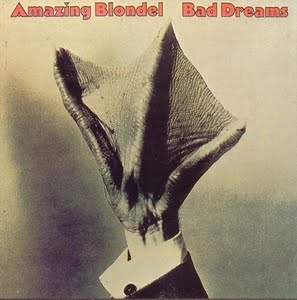
At least this time around, the title is much more appropriate (which I could not say about the front sleeve — is the webbed duck foot sticking out of the cuff link supposed to self-ironically sym­bo­lize the band's regressive evolution? Or is it merely some sort of a Burroughsian flash, conjured at the last moment to give the record a little mystique at least in terms of visual appearance?). The entire record is, indeed, a series of bad dreams — not nightmares, which could at least be memo­rable; just one icky mental turd after another.

The Big Change, this time around, is that Blondel no longer stick exclusively to soft-rock (al­though it is still their major style of expression): now they turn their attention to contemporary dance music, which, for the Europe 1976, means smooth, desensualized, cleaned up pre-disco funk grooves ('Big Boy', 'The Man That I Am') or horns-and-piano-driven uptempo pop ('Call It A Night', clearly written under the influence of one too many listens to ELO's recent hits; 'I'll Go The Way I Came'). And when they do not, it's sugar time again — more dippy ballads that do not offer anything besides dippiness ('Give Me A Chance', etc.).

Basically, with Bad Dreams the band confirmed its death sentence. By swearing allegiance to mainstream pop mechanisms and aligning themselves with the Bee Gees, the band lost its final fans from the old days — yet, naturally, was unable to procure any new ones, because who needs Eddie Baird providing the market with third-rate expendable dance grooves when you can have those right out of the hands of true giants? You really need to be a huge fan of the Seventies, and I mean huge — one who takes pleasure in amassing giant collections of all the generic crap that legions of long-haired, blue-eyed, bare-chested, sandal-wearing, coke-snorting young people put out in that decade, forever devolving the currency value of such notions as «sincerity» and «ro­mance» — like I said, a huge fan of that vast marshy territory in order to even notice Bad Dreams in that collection, let alone evaluate it on its own terms.

The best thing Blondel could do under the circumstances was retire, or, at least, retire the name; fortunately, that is exactly what they did when it turned out that Bad Dreams sold almost literally fewer copies than there are fingers on that duck foot. There are some rumors that both Wincott and Baird went on to have solo careers after that; I only know of one solo Baird album, called Hard Graft and also released in 1976, a date which does not make me overtly hopeful. As it is, at the time being Bad Dreams seemed to have closed the book on the Amazing Blondel story in tragic mode, with all the noble protagonists of the novel either metaphorically dead or figu­ra­tively pwned. But the story does not end here.


Check "Bad Dreams" (CD) on Amazon
Check "Bad Dreams" (MP3) on Amazon

Thursday, June 30, 2011

Amazing Blondel: Inspiration


AMAZING BLONDEL: INSPIRATION (1975)

1) All Time For You/Inspiration; 2) Thinking Of You; 3) You Didn't Have To Lie About It; 4) I've Got News For You; 5) The Lovers; 6) Good Time Gertie; 7) On A Night Like This; 8) Love Song; 9) Standing By My Window; 10) Be So Happy; 11) They're Born, They Grow And They Die.


There are several known usages of the word 'inspiration' as defined in Webster. One is: «the act or power of exercising an elevating or stimulating influence upon the in­tel­lect or emotions». Ano­ther is: «a supernatural influence which qualifies men to receive and communicate divine truth». Thus, all I can say is, if this album has really been created under a «supernatural influence», we're all doing good staying well grounded in the non-supernatural; and if it was recorded with the in­tention of exercising an elevating or stimulating influence upon my intellect or emotions, I can only thank God it's not 1975 all over again.

Think a sequel to Mulgrave Street, but this time, with (a) all traces of Blondel's past washed away, (b) any hopes for Blondel's new future dissipated — no wailing electric guitar solos, no catchy choruses, just a never-ending string of watery, utterly predictable mid-Seventies soft-rock à la Carpenters or, at times, even Barry Manilow. There is exactly one fully decent song on here: 'You Didn't Have To Lie About It', and even that one mostly sounds good in its context, what with its bass-heavy boppy-poppiness so reminiscent of the Beatles' style circa Sgt. Pepper (think 'Getting Better' and the like). But already the second Beatles rip — title track — commits the ut­ter sacrilege in being built around... a musical bit that is directly lifted from the instrumental sec­tion of 'Something' (!!). (Which, for a moment, brings me onto thinking that 'Something', in its way, basically invented the «deep ballad» format of the 1970s, without falling victim to it, kinda like 'Stairway To Heaven' is the Blessed Mother Power Ballad of so many rotten kids).

Everything else is, at best, forgettable, ultra-sweet acoustic pop, and, at worst, polysaccharidic balladry. Basically, the distinction is simple — as long as Baird and Wincott hunt for the Beatles, the music is tolerable ('Good Time Gertie', a 'Dear Prudence' rip-off instrumental, is another OK contribution); once they start hunting for America or James Taylor, the music is no longer music, just sap dressed up in musical clothes. To finish you off with one last staggering blow, Baird ends the album with five minutes of pure orchestral Mantovani ('They're Born...') as if Inspiration were some frickin' Hollywood epic in need of a proper exit music arrangement. Well, I exit here all right. Like I said, Mulgrave Street was at least sing-along-able, in parts; Inspiration, in comparison, is vomit-along-able, and the only reason George Harrison did not sue the bastards was that The Chiffons taught him to be a peace-abiding, court-avoiding gentleman. Thumbs down, without further debate.