Search This Blog

Showing posts with label Ayreon. Show all posts

Monday, March 11, 2019

Ayreon: Ayreon Universe

AYREON: AYREON UNIVERSE (2018)

1) Prologue; 2) Dreamtime; 3) Abbey Of Synn; 4) River Of Time; 5) The Blackboard; 6) The Theory Of Everything; 7) Merlinʼs Will; 8) Waking Dreams; 9) Dawn Of A Million Souls; 10) Valley Of The Queens; 11) Ride The Comet; 12) Star Of Sirrah; 13) Comatose; 14) Day Sixteen: Loser; 15) And The Druids Turned To Stone; 16) The Two Gates; 17) Into The Black Hole; 18) Actual Fantasy; 19) Computer Eyes; 20) Magnetism; 21) Age Of Shadows; 22) Intergalactic Space Crusaders; 23) Collision; 24) Everybody Dies; 25) The Castle Hall; 26) Amazing Flight In Space; 27) Day Eleven: Love; 28) The Eye Of Ra.

General verdict: Listening to this condensed history of Ayreon in two hoursʼ time will probably not make you a fan. Watching it with your own eyes might do the trick... but perhaps not in the way Arjen himself would want it.


As we all know, Ayreon does not perform live all too frequently... in fact, Ayreon almost never performs live, because he does not have a sufficient budget to feed all the guest singers and to replace himself with a set of live musicians and the fireworks and the dry ice and the big screen with psychedelic visuals and the buckets of chicken blood... okay, could do without the buckets of chicken blood, perhaps, but not without the big shiny robot costumes and all the Star Trek hairdressers. And yet, on the other hand, somehow we saw it coming: all that immense legacy of fantasy had to come out onstage sooner or later.

A first taste had already been presented a couple years earlier, with the audio and video release of The Theater Equation, which, as you can guess, was a theatrical staging of The Human Equation in its entirety. But surely just one measly rock opera cannot cover the breadth and scope of Ayreonʼs vision that encompasses everything that the corny sci-fi genre is capable of. And so, two years later, welcome to Ayreon Universe: a gala-level grand presentation of the entire legacy of Arjen Anthony Lucassen, recorded over two days in September 2017 with the aid of ten musicians and sixteen guest vocalists — including such luminaries as Blind Guardianʼs Hansi Kürsch, The Gatheringʼs Anneke van Giersbergen, Nightwishʼs Floor Jansen, and Katatoniaʼs Jonas Renkse. (Unfortunately, Paul McCartney of The Beatles couldnʼt make it. He was supposed to appear, but they asked him to sing ʽDay Sixteen: Loserʼ, and he took offense at this veiled hint at the artistic failure of Press To Play on the sixteenth year of his solo career).

The setlist, as you can see, tries to justify the album title as much as possible: it puts together highlights from every single Ayreon record, and not one of them seems to be preferred over the others — although, by some strange coincidence, Universal Migrator, which I usually select for my top Ayreon pick, somehow gets the short end of the stick, each of its parts being represented by only one song (and the one song from the first part is not ʽThe Shooting Company Of Captain Frans B. Cocqʼ, which is still probably my single favorite Ayreon track of all time). More than that, it seems to me that they have tried to forge an entirely new, somewhat cohesive, story out of these highlights — at least such is the implication of having a booming-voice narrator intrude from time to time and explain what might be going on. But this, of course, is of more importance to the true fans of Ayreon (all nine thousand of them that were in the audience on those nights) than to somebody like me, who is always more amused by this music than impressed by it.

Many of the songs still have to be significantly truncated — selecting two hoursʼ worth of content from Ayreonʼs 12-hour legacy is a delicate matter — but it is more interesting that at least when it comes to the early material, some of these live renditions sound much better, bypassing some of Ayreonʼs past problems with glossy and stuffy productions, featuring more intricate vocal harmonies, less cheesy synthesizer tones, and livelier drumming. This is, however, the absolute maximum of what I can say about the music — commenting on individual tracks might make it seem like I actually care, which I absolutely do not.

I did watch a couple of video previews that Arjen himself posted on YouTube, and if you are a fan, by all means get this in video rather than audio form, because this is, like, the ultimate in clichéd nerdy fantasy: waves upon waves of guys and girls in black leather and ridiculous sci-fi cosplay gear, miles and miles of long hair waving in the winds of time, and gallons upon gallons of futuristic pomp. Sure, itʼs been that way ever since the invention of progressive and power metal, but if you need an overdose rather than just a simple fix of that, Ayreon Universe is a great bet. Besides, for some reason it makes me happy that a thing like this is at all possible in the modern world — I mean, geeky nerds worldwide deserve their own brand of buffoonery, donʼt they? Truly, this is some Superbowl level shit, I could totally get into Ayreon going out there and having a blast with ʽAmazing Flight In Spaceʼ instead of Beyoncé or Katy Perry. 

Saturday, September 9, 2017

Ayreon: The Source

AYREON: THE SOURCE (2017)

CD I: Chronicle 1: The 'Frame: 1) The Day That The World Breaks Down; 2) Sea Of Machines; 3) Everybody Dies; Chronicle 2: The Aligning Of The Ten: 4) Star Of Sirrah; 5) All That Was; 6) Run! Apocalypse! Run!; 7) Condemned To Live.
CD II: Chronicle 3: The Transmigration: 1) Aquatic Race; 2) The Dream Dissolves; 3) Deathcry Of A Race; 4) Into The Ocean; Chronicle 4: The Rebirth: 5) Bay Of Dreams; 6) Planet Y Is Alive!; 7) The Source Will Flow; 8) Journey To Forever; 9) The Human Compulsion; 10) March Of The Machines.

Where do you go, exactly, after you have just dealt with The Theory Of Everything? Any other deity of rock would probably retire into singularity, the karmic cycle being completed once and for all. And yet again, Arjen «Beyond-The-Cosmic» Lucassen proves to us that his conscience penetrates far behind the limits of the unlimited — with his thoughts now bent upon the source that sets the «everything» in motion. Physicists and cosmologists all over the world, beware: you've got literally nothing on this guy, who, with just a humble budget of a few thousand dollars and a little help from his illustrious friends, is capable of penetrating the mysteries of the universe in a way that all your billion-dollar colliders and synchrotrons will never be able to replicate...

...but actually, no. Once you look into the concept, disappointment quickly sets in, because tech­nically, The Source functions as a constrained prequel to 01011001, telling the story of an early human (humanoid?) race living somewhere in the Andromeda Galaxy and eventually forced out of their homelands by machines that they created themselves — a story told so many times that I guess it must be true, be it in the distant future or in the even more distant past. So, a few of these humans escape, develop some sort of superdrug that helps them live underwater (apparently, it is the drug that is called ʽThe Sourceʼ), and eventually settle on Planet Y in the system of Sirrah, where they begin working on even more and better machines, rebooting the cycle. Frankly, I sort of expected better from the guy than this regurgitation of a motive he'd already used at least once, or maybe more than once (honestly, I do not remember).

And if his basic fantasy channels have ceased to transmit fresh ideas, then what is to be said about his musical channels? This here is yet another sprawling «soft power metal» opera, spread across four parts on two CDs and featuring a cast of 12 vocalists for 12 different roles — this time, however, somewhat less eminent than last time; I recognize Dream Theater's James LaBrie, Blind Guardian's  Hansi Kürsch, and Symphony X's Russell Allen, but most of the rest are from even lesser entities (Nightwish, Between The Buried And Me, etc.); then again, why should the biggies want to star in some wretched prequel, of all things?.. And in terms of melodies, this is precisely what you expect of Ayreon these days — nothing more, nothing less; refer to the Theory Of Everything review, whose musical summary is perfectly applicable to this album as well.

Which is not to say that it sounds bad, mind you. By this time, we all know how to treat Ayreon space operas — they are the musical equivalent of your average Hollywood sci-fi blockbuster, with the word average heavily stressed: good enough for a relaxed evening of popcorn and Coke, and maybe one extra night of Walter Mitty-style dreaming if you, like, totally let yourself go. His big advantage is diversity: the music is still well correlated with the dynamic twists of the story, so you have your metallic sections with chuggin' riffage, your lyrical sections with strings and angelic harmonies, your desperate-suicidal sections with delirious guitar solos, your pastoral sections with Tull-style flutes, and your ambient-atmospheric sections with electronic loops and heavenly synth tapestries. If not for the fact that most of the guest vocalists take the «rock opera» moniker way too seriously and end up outscreaming each other, there would be very few irrita­ting factors about The Source. But this is power metal, apparently, and so everything has to be done with power, or else the loyal fans will think they're all faking it, you know.

Was there anything special, this time, that somehow managed to seduce my attention? Over ninety minutes of music? Absolutely and totally nothing. At best, it was "this sounds totally like Eighties' metal-era Jethro Tull" (ʽDeathcry Of A Raceʼ), or "this sounds totally like the Alan Parsons Project" (ʽThe Source Will Flowʼ — needless pun on Frank Herbert here?), or "this is like a 100% Iron Maiden rip-off, man!" (ʽRun! Apocalypse! Run!ʼ, for some strange reason not featuring Bruce Dickinson, but featuring three or four guys who all want to sound like him). And no, it's not like all the music here is completely stolen — it's that the tunes to which you might really want to pay some attention are precisely the ones that sound like classic acts. The ones that just sound like Ayreon pass by without a twitch.

As for the storyline, I'd advise not to look too deeply into it. Typical lyric is: "Planet Y is alive, our race will survive! Forever we're free and forever we'll be and forever we will dream!" (For some reason, as I mentally translate this into High German and try to picture this in a Wagner libretto, it no longer sounds that bad — perhaps it is the operatic-pop singing style, after all, that completes the Heavy Blush effect). Just drift on the fringes and you'll be okay to survive the ride, with a large size bucket of heavily buttered popcorn and, preferably, the speakers blasting this shit at top volume. Also, Floor Jansen (Nightwish) as The Biologist is hot. I wish they'd give her a couple arias or something (actually, this is one more flaw: every track here is delivered by mul­tiple vocalists in short bits, never giving us the chance to establish much of a bond with any single character — certainly not something you could ever accuse Wagner of).

I don't know why I am not giving this a thumbs down. I guess there is still something vaguely amusing about all these Ayreon albums and how he not only seems to take it all quite seriously himself, but convinces all his endless guest stars to take it seriously as well. On the other hand, The Source, like everything that precedes it, completely lacks the preachy aspects of the worst prog rock — it's just a sci-fi roller coaster, with an amazing shitload of work going into it, too, so I can understand all the rave reviews from power metal and neo-prog lovers. I certainly won't be the one to stop the source from flowing, much as I'd wish that, every once in a while, it would flow through slightly less predictable ground.

Saturday, February 15, 2014

Ayreon: The Theory Of Everything

AYREON: THE THEORY OF EVERYTHING (2013)

CD I: Phase I: Singularity: 1) Prologue: The Black Board; 2) The Theory Of Everything, Part 1; 3) Patterns; 4) The Pro­di­gy's World; 5) The Teacher's Discovery; 6) Love And Envy; 7) Progressive Waves; 8) The Gift; 9) The Eleventh Dimension; 10) Inertia; 11) The Theory Of Everything; Phase II: Symmetry: 12) The Consultation; 13) Diagnosis; 14) The Argument; 15) The Rival's Dilemma; 16) Surface Tension; 17) A Reason To Live; 18) Potential; 19) Quantum Chaos; 20) Dark Medicine; 21) Alive!; 22) The Pre­dic­tion.
CD II: Phase III: Entanglement: 1) Fluctuations; 2) Transformation; 3) Collision; 4) Side Effects; 5) Frequency Mo­dulation; 6) Magnetism; 7) Quid Pro Quo; 8) String Theory; 9) Fortune?; Phase IV: Unification: 10) Mirror Of Dre­ams; 11) The Lighthouse; 12) The Argument; 13) The Parting; 14) The Visitation; 15) The Breakthrough; 16) The Note; 17) The Uncertainty Principle; 18) Dark Energy; 19) The Theory Of Everything, Part 3; 20) The Blackboard (Reprise).

Well, I guess that if it was inevitable for a concept album about «the theory of everything» to be produced in the first place, it might have also been inevitable that Arjen Lucassen would have to be the mastermind behind it. Let's face it, after all the Universal Migrators and Human Equa­tions there was simply nowhere left to run but to the very top of the tower. This is the album to end all albums, the ultimate in the ultimate, Ayreon's Lifehouse, Topographic Oceans, and Mahler's 9th all rolled in one. A single listen to all four sides in a row will give you the intellect of a Stephen Hawking, two listens will empower you to rule the world, and a final third run will, beyond all reasonable doubt, allow you to reweave the fabric of the universe at your whim. But remember — only supreme, absolute concentration will get you anywhere with this, and it takes intellectual skill, psychological training, and a really high degree of tolerance for kindergarten-le­vel sci-fi anecdotes to immerse yourself, freely and lovingly, in the world of Ayreon.

I must say, though, that I honestly admire how high the man has managed to raise the stakes. The very fact of The Theory Of Everything being yet another double-CD rock opera is not surpri­sing, but this may be the most cohesive, story-dependent, and ideologically ambitious project in Ayreon history so far, and among the usual horde of guests to help the artist bring it to fruition, there are no less than four prog veterans: Rick Wakeman plays piano throughout and has an «old school» synth solo on ʽSurface Tensionʼ, Keith Emerson has an astral Moog solo on ʽProgressive Wavesʼ, Steve Hackett adds a guitar solo on ʽThe Partingʼ, and John Wetton sings the important part of The Psychiatrist. Not to mention, of course, all the innumerable singers and players from newer, somewhat less legendary prog and metal outfits (Dream Theater, Nightwish, Lacuna Coil etc.) — ol' man Lucassen has lost none of his supernatural gravitational charisma.

The story itself needs no retelling and can be partially deduced from simply glancing at the song titles — speaking of which, the «songs» themselves are really just small individual parts of four lengthy suites («Singularity», «Symmetry», «Entanglement», «Unification»), with track separa­tion engineered the way it is usually done with classical operas in the CD age. The story seems to be drawing its inspiration as much from A Beautiful Mind as it does from Tommy, and has all the complexity, originality, and general appeal of a second-rate comic book. The lyrics are best left alone, and I mean it, really. Let me just give you a couple samples: "(Prodigy:) A grand design in all its majesty / Vibrating strings, quantum gravity / Why was I chosen? / What does it mean to me? / Tell me why!" Or this: "(Rival:) One day I'll show them / I am the genius / One day the whole world will know / One day I'll show them / Who he really is / One day they'll know". Per­sonally, I think there'd have been no harm in jettisoning a few of the guest musicians and using the money to hire a good librettist instead. But it's really all about the music, right?

Well, here comes the nasty part. The music behind all this is... sort of a very typical, very smooth, very predictable Ayreon sound. Not particularly heavy, although some tracks are well within the limits of «power metal» stylistics; highly influenced by Celtic and other folk traditions; well stocked up on electronics, since a proper, well-behaved «theory of everything» should be able to look both to the past and to the future; professionally-impeccably played and sung. But, just like on the previous Ayreon album, there are no musical ideas here that would justify the «progres­sive» tag — some of the riffs may be «new» from a purely technical point, yet the ideology be­hind them is strictly conservative. If there is any bar at all to be raised on The Theory Of Every­thing, it is only the self-satisfaction bar. It may well be so that, listening back to those tapes, Lucassen finally said to himself — «here is the album I've always aspired to make, where every­thing is in its right place and all the ingredients are mixed in just the right proportions». So now you, the listener, can simply chuck all the previous Ayreon albums out the window and satisfy yourself with this one. Heck, maybe you can chuck all your albums out the window, period — this is The Theory Of Everything, after all, isn't it?

My biggest problem is with the «rock opera» approach: all the pieces being so short, it is hard to get focused on any particular one. In the classical paradigm, even the most story-dependent, plot-driven operas usually have their individual overtures, arias, and interludes that stand out like par­ticularly bright brushstrokes on a monotonous canvas. Here, apart from one or two recurrent themes (like the Jethro Tull-style guitar/flute title theme), the trivial plot overshadows everything, and, since it is downright impossible to empathize with the grossly cartoonish «characters» that would probably be rejected even by Japan's cheesiest anime studios, the «extra-melodic» factors do not compensate for the auxiliary nature of the music. Which is a pity, because somehow I feel that at the core of this sprawl, lies a potentially decent 40-minute instrumental album, with frien­dly guest contributions from Wakeman, Emerson, and Hackett, a few memorable themes, and re­latively tasteful arrangements that combine impressive playing technique with moral restraint, not letting the whole thing run into an Yngwie Malmsteen flying circus extravaganza. But the «rock opera to end all rock operas» fetish just does not let me verify this.

It must be said, however, that finally we have a musical composition named ʽString Theoryʼ that is entirely dependent on... guess what? Yes, that's right, the entire world of science has spent half a century wondering when exactly the essence of the theory would finally be encapsulated in a ninety-second string quartet retelling. Two problems, though: (a) the track also relies on synthe­sizers, ruining the purity of the experiment; (b) where the hell is ʽSuperstring Theoryʼ, with all the guest musicians pulling out their violins and finally delivering that «lost chord» which Pete Townshend himself was unable to find?

Granted, I even feel a little sorry that such an ambitious project, upon completion, has largely remained limited to specialized audiences and publicity sources — even the All-Music Guide has failed to provide an appropriate review, and the record has mostly been picked up on by various metal-oriented magazines, which is not justified at all, since it is not at all a metal album. Then again, there is no use pretending, either, that a rock album called The Theory Of Everything can be perceived as anything other than (a) intentionally humorous or (b) unintentionally ridiculous, and since Ayreon is very rarely (a), that this here is most likely a case of solid (b). The only thing that, from my point of view, excuses Lucassen is that the man combines the qualities of a fana­tical whacko and a hard-working professional. And, from that angle, The Theory Of Everything is one of the whackiest and the most professional records he ever made. The kind of crap that you just don't come across on a daily basis — like a white rhino's, or something like that.

Check "The Theory Of Everything" (CD) on Amazon
Check "The Theory Of Everything" (MP3) on Amazon

Saturday, January 26, 2013

Ayreon: 01011001


AYREON: 01011001 (2008)

1) Age Of Shadows; 2) Comatose; 3) Liquid Eternity; 4) Connect The Dots; 5) Beneath The Waves; 6) Newborn Race; 7) Ride The Comet; 8) Web Of Lies; 9) The Fifth Extinction; 10) Waking Dreams; 11) The Truth Is In Here; 12) Unnatural Selection; 13) River Of Time; 14) E = mc2; 15) The Sixth Extinction.

I am ashamed to say that, this time around, I did not even bother looking up the basic contours of the story. It seems to be something of a cross between the, ahem, «realism» of Human Equation and the sci-fantasy of Universal Migrator, all having to do with machines overtaking man, when everybody starts thinking and acting binary (or, at best, hexadecimal), and somehow conceptually tied in to every other Ayreon album ever released — you gotta give Lucassen some credit, his megalomania never got in the way of accurately tying together all the little loose ends.

The problem is, this time around the music never really stimulated me into looking up any details. If the first half of Universal Migrator worked moderately well as a «musical picture gallery» of sorts, and Human Equation, de-padded and properly filtered, had a psycho-thriller sheen to it, then this follow-up, being every bit as large and pompous, hardly offers a single fresh idea. Se­ven­teen singers in total show up for the project — at this point, it seems that contributing to an Ayreon prog-metal-opera turns into an obligatory clause in every power / symph / doom-metal band frontperson's contract, and they are all standing in line on his front porch on a daily basis. (Gotthard, Blind Guardian, and King's X are among the more notorious acts this time). And they all blow it on this mastodont, quite mediocre even for Ayreon's usually questionable standards.

Of course, there is no questioning the technical side of it all. Every note is in place, all the acous­tic, electric, and electronic overdubs meticulously tested and adjusted to each other, each singer and singerine wined, dined, coached and poached to perfection. We could hardly expect anything less of a guy who has never sullied a single one of his fantasies with overt sloppiness. Extract it from its context, forget about every other Ayreon record ever released (better still, forget about every other record ever released, period), and 01011001 will be a monumental achievement in its own rights. As it is, it is about as exciting as the sequence of zeroes and ones that constitutes its true title (the letter ʽYʼ, short for either YAKETY-YAK or YARDBIRD YAWN, depending on your current state of mind).

In utter frustration, I cannot think of a single track here worth a specific mention. It seems as if Lucassen was so overwhelmed by the sheer number of people he got to act in his next play that he subconsciously fell back on his old musical stock, recycling all of his «meat-and-potato» ideas (folk, metal, electronic) without bothering to find any new combinations. Even the presence of one or two ʽLosersʼ or ʽShooting Companiesʼ could have already made a big difference, but no, these hundred minutes run on without a single ripple on the surface.

Obviously, this criticism makes little sense if we are simply supposed to like Ayreon as a musi­cal phenomenon. One does not criticize something like, say, Haydn's symphonies for (frequently) soun­ding indistingui­shable from one another, so why should this be different with Lucassen? Yet, first of all, it does not hurt to remember that 01011001 is Lucassen's first, and only, musical of­fering in four years (how many symphonies could Haydn have come up with in the same inte­rim?), and even a hardcore fan could be entitled to something that did not sound exactly like a rearranged/restructured medley of past successes (and failures).

And second — this is where personal taste comes in — Ayreon's music has always been cheesy, humorless, padded, bloated, and emotionally monotonous. It was only during those select, happy, cherished moments where Lucassen was able to break through these walls that I felt like there was something to gain (and there really was). «Generic» Ayreon material has no reason to exist in my world («poor man's Rush» could be a good description), and I wouldn't want to recommend it for anybody else's, either. Hence, decidedly a thumbs down here, and here's hoping that the next Ayreon release will be more creative and let us learn something that we didn't already know, and wished we never knew in the first place.

Check "01011001" (CD) on Amazon

Saturday, January 19, 2013

Ayreon: The Human Equation


AYREON: THE HUMAN EQUATION (2004)

1) Day One: Vigil; 2) Day Two: Isolation; 3) Day Three: Pain; 4) Day Four: Mystery; 5) Day Five: Voices; 6) Day Six: Childhood; 7) Day Seven: Hope; 8) Day Eight: School; 9) Day Nine: Playground; 10) Day Ten: Memories; 11) Day Eleven: Love; 12) Day Twelve: Trauma; 13) Day Thirteen: Sign; 14) Day Fourteen: Pride; 15) Day Fifteen: Be­trayal; 16) Day Sixteen: Loser; 17) Day Seventeen: Accident?; 18) Day Eighteen: Realization; 19) Day Nineteen: Dis­closure; 20) Day Twenty: Confrontation.

By now, we all should know: Arjen Lucassen is really «The Flying Dutchman», that is, he is ac­tually trying to officially enshrine himself as the Wagner of rock music: writing nothing but ope­ras, using fantastic settings to reflect universalist messages, and ensuring that only the strongest, with the biggest attention spans and the most time to burn, will survive. Unfortunately, the com­parison is hard to elaborate — unlike Wagner's librettos, Lucassen's lyrics are not only preten­tious but, for the most part, childishly crafted, and he has yet to find his own Tristan chord. The main problem of Wagner's music is, however, shared with fidelity — each of the «operas» is hor­rendously pad­ded out. Music of such ambitious stature cannot deserve being spread across less than two CDs, after all. Yeah, there used to be a time when the Beatles could sum up the state of the world within the five minutes of ʽA Day In The Lifeʼ, but they were just summarizing — Ayreon is here to present you with a detailed account balance. Or, at least, such might well be Arjen Lucassen's personal philosophy.

What is interesting about The Human Equation is that, for once, Lucassen decided to break up the series of fantasy tales in favor of something more «mature» — a bizarre Freudian opera about psychic convalescence through a twenty-day-long period of re-experiencing one's accumulated traumas in a comatose state, or something like that. In fact, this is nothing less than Ayreon's own personal version of The Wall: here, too, you will find abusive schoolteachers, carefree parents, abandoned lovers, and a climac­tic scene of «disclosure» where... anyway, I am not going to pretend that I am unwilling to spoil the plot for you, given as how I am not sure I got it all right in the first place (and I never really bothered much about the second one).

Does it help make the music any better? Absolutely not. Arjen Lucassen knows not the meaning of the word «subtlety», and has never heard the expression «less is more», or, if he has, he must have understood it the other way around — this is why no Ayreon album is ever going to threaten the shelf status of The Wall, even relative to modern kids who practice the «never trust anybody any art piece over thirty» ideology. Frankly speaking, you'd only understand the deep substantial difference between Universal Migrator and Human Equation if you started checking on them armed with a lyrics sheet — and I wouldn't advise you to do that. "It's time to leave your shel­tered cage / Face your deepest fears / The world is against you / You're fighting back the tears" is about as profound as it ever gets. Oh well, could be worse.

Lucassen did get some top-notch vocal talent for this Psychodramatic Masterpiece, though. The protagonist («Me») is voiced by Dream Theater's own James LaBrie, one of the major anta­gonists («Fear») — by Mikael Åkerfeldt of Opeth, and another one («Rage») — by Devin Townsend of Strapping Young Lad: again, not much ground for practicing «subt­lety» with these steel-throat war machines, but oh the masculinity of it all! And, matching the good old Aryan, uh, I mean, Ayreon manpower are the ladies — lead singerines from the little-known bands Elfonía (Marcela Bovio) and Mostly Autumn (Heather Findlay), the latter of which, playing «Love», can go from a Sandy Denny lament to a Kate Bush purr whenever she wants to. Nifty, if not exactly breath­taking.

But interesting musical ideas have decidedly given way to being a bit too much focused on the operatic components. Although Lucassen is no longer segregating his «progressive» and «metal» sides — meaning that there will be no fifty-minute long unbroken stretch of bland power metal — the re-blending is sorta sour, with way too many tracks simply fusing together the grumbly chugga-chugga and the strings-supplying synthesizers (see ʽSchoolʼ, for instance): so many, in fact, that the good bits have to be fished out like dumplings from a broth, over the course of re­peated listens. This means work, and who likes being driven to work by pretentious long-haired Dutch potheads? There you are.

Cutting to the chase, here are some tasters that might — or might not — convince you that The Human Equation is not utterly worthless. Actually, all of them were cleverly released as singles. ʽDay Seven: Hopeʼ, re-titled for single release as ʽCome Back To Meʼ, is a somewhat touching, well-written art-pop song, carried by a catchy organ pattern. ʽDay Eleven: Loveʼ has a somewhat annoying power metal chorus, but the main melody is a surprisingly sexy waltz (the major attrac­tion here are Heather Findlay's alluring Kate Bush-isms).

Weirdest of all is ʽDay Sixteen: Loserʼ, which might be the first track I know of to combine the sound of an Australian didgeridoo (played by Jeroen Goossens) with that of an Irish jig — and then lay some mammoth metal riffage over both. If that is not enough for you, try waiting until the end of the song for a ridiculously over-the-top death metal rap to put the cherry on top. Oh, and how could I forget the added bonus for Uriah Heep fans? Ken Hensley himself wanders into the studio to play an old-style ʽGypsyʼ-like psychic organ solo. The oddest thing of all, it seems to work — the song is so utterly baffling that, at some point, it transcends «hilarious» and starts sending out schizophrenic waves all over the room.

Other than the singles, Equation has quite a respectable finale — ʽDay Twenty: Confrontationʼ builds up genuinely spooky atmospherics with cleverly piled up loads of phased and echoey gui­tars, processed organ, and «metal slide» riffs saved for the chorus. With all the vocalists coming together and the song eventually speeding up, it does seem to be headed for some sort of Wagne­rian finale — unfortunately, the abrupt ending is sort of anti-climactic, but I guess Ayreon just had to ensure himself some continuity with the rest of his oeuvres, which explains the superfluous reference to the «Dream Sequencer».

None of this should conceal the fact that a large, large, large chunk of the material is quite non-descript (and the problem would only get worse with the next release), and can only appeal to big fans of power metal vocalization. But then, come to think of it, such is the fate of 90% of operas ever written — not only is it impossible to keep the genius afloat for two or three hours on end, but you are not even really supposed to try. What is really bothersome is that so many of the tracks stretch out past acceptable limits, and that so many of the themes are rather monotonous variations on each other — not just «boring», but «boring in the same boring way». On the other hand, this might simply be an invitation to make your own Human Equation: I'm sure that most of us could trim this down to about forty minutes of interesting and even inspiring music. Start off with the singles, then think about whether you need the rest. The singles are good.

Check "The Human Equation" (CD) on Amazon
Check "The Human Equation" (MP3) on Amazon

Saturday, January 12, 2013

Ayreon: Universal Migrator


AYREON: UNIVERSAL MIGRATOR (2000)

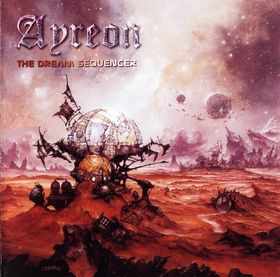
Part I – The Dream Sequencer: 1) The Dream Sequencer; 2) My House On Mars; 3) 2084; 4) One Small Step; 5) The Shooting Company Of Captain Frans B. Cocq; 6) Dragon On The Sea; 7) Temple Of The Cat; 8) Carried By The Wind; 9) And The Druids Turn To Stone; 10) The First Man On Earth; 11) The Dream Sequencer (reprise);
Part II – Flight Of The Migrator: 1) Chaos; 2) Dawn Of A Million Souls; 3) Journey On The Waves Of Time; 4) To The Quasar; 5) Into The Black Hole; 6) Through The Wormhole; 7) Out Of The White Hole; 8) To The Solar System; 9) The New Migrator.

Technically, these are two albums: breaking slightly with Ayreon's standard pattern of releasing 2-CD packages, Lucassen decided to split his «prog» and «metal» sides, releasing the first half of Universal Migrator as a special treat for the «artsy types» and the second half for the «metal­heads». Consequently, on a formal basis Part I: The Dream Sequencer and Part II: Flight Of The Migrator count as separate entries in the discographies and tend to earn separate reviews. However, I see no reason to follow this tradition, since: (a) a 2-CD deal is a 2-CD deal, and no renegading will be tolerated; (b) the concept and storyline are sort of continuous, after all; (c) al­though Arjen does formally enforce the musical boundaries, what with the first album all ruled by electronic textures and acoustic guitars, and the second completely dominated by heavy electric riffage and soloing, the «B-movie spirit» that guides the man is always the same anyway. Plus, above and beyond all that, I am not sure if I have enough impressions to carry me through two different reviews here.

Although, on second thought, I could have, because, once you get to at least partially assimilate the expected sprawl, The Universal Migrator is no less fun than Into The Electric Castle — in fact, it is more fun, because this time, the underlying story, while still a story, functions more like a flimsy framework for a set of autonomous musical landscapes. Formally, it is a sequel / prequel / interquel / whatever (with time travel in the picture, you never know) to The Final Experiment, describing the hallucinations of the last man left alive after humanity's extinction — in The Dream Sequencer, he travels through several different historical epochs, and in Flight Of The Migrator, takes stuff to a whole different level by heading straight for the Big Bang... and never coming back, so it seems, but enough of that.

For the first CD, the basic inspiration was clearly Pink Floyd — the instrumental introduction brings to mind both Wish You Were Here and The Wall at the same time, and then there is this idea of musically capturing a patch of bleak desperation and loneliness, puffed up to universalist levels... ring a bell? No, it is not expressed with comparable ferocity — maybe because there is no autobiographic value in these compositions — but there is a pretty nifty fanfare theme nestled in the depths of ʽMy House On Marsʼ (although it would probably have been more effective if played with real fanfares rather than Arjen's well-worn synthesizer equipment).

What really won me over in the course of Disc 1 was ʽThe Shooting Company Of Captain Frans B. Cocqʼ — not only is the song named for the «authentic» title of the painting we usually know as The Night Watch, but it is actually an attempt at a «musical translation» of Rembrandt's mas­terpiece, trying to recreate with electronic textures, dark guitar solos, and psychedelic, phased vocals straight out of 1967 (courtesy of Tuesday Child's Mouse) that shadowy mystique of van Rijn's trademark style. Maybe it does not succeed, or maybe it does, but the point is — the idea itself is fairly extravagant, and totally unconventional, for a guy usually perceived as a sci-fi / D&D / B-movie freak. Besides, regardless of the context, the song simply has a catchy chorus and an impressive guitar theme to it.

Dancing out from that starting point, there's more — ʽDragon On The Seaʼ, with lyrical referen­ces to the fleet of Queen Elizabeth, is an exuberant folk-prog epic, overdubbing bleeping electro­nic patterns over folksy acoustic strum and making it work; ʽTemple Of The Catʼ features a love­ly vocal part from Jacqueline Govaert and samples from a Maya festival; and ʽThe First Man On Earthʼ, with vocals from Spock's Beard's Neal Morse, is a fairly friendly and upbeat song for a subject as grim as the first appearance of Homo sapiens on the planet. Diversity is the key — as the hero moves from locus to locus, the music incorporates more and more influences; the only bad news is that the instrumentation lacks the appropriate diversity — guitars and keyboards ex­press most of the moods, where sometimes mandolins or pan pipes would be more welcome. Oh well — budget is budget.

The second part, Flight Of The Migrator, was almost universally panned by reviewers when compared to the first part, and for a good reason: the idea to filter out the metal from Dream Se­quencer and tightly pack an entire sixty-five minute disc with it really did not work. For it to work, Arjen would need to at least be a first-rate metal-riff writer — but most of the riffs hardly strike me as being original or inspiring. Where Dream Sequencer is an imaginative neo-prog record, Migrator is, overall, rather pedestrian power metal.

Lucassen's personal charm did help him to engage a whole swarm of notorious metal singers — Bruce Dickinson himself, for instance, pulls ʽInto The Black Holeʼ out of the black hole of un­memorable melodies, and then there are guys from Stratovarius, Primal Fear, Helloween, Thres­hold... pretty impressive heap, unfortunately, saddled with mediocre and monotonous material (and where the monotonousness is broken, it is broken with the same synthesizer fanfares, as in ʽDawn Of A Million Sunsʼ, of which we'd already had our full share on Sequencer).

Only once does this rather boring journey to the beginnings of the Universe break out of its set pattern: as the hero goes ʽThrough The Wormholeʼ, the tempo picks up — they aren't, after all, called «wormholes» because you're supposed to move through them like a worm — and a merry jackhammer-ish thrash-boogie rips your speakers in half, reminding of the old trickster school running from Van Halen to Extreme. Aaaaah, kick-ass! Unfortunately, it is one of the shortest tracks on the album — a measly six minutes.

Still, if you are a really big fan of power metal, I guess the guest vocalists alone, who all seem to be quite seriously into this stuff, will provide sufficient reason to own the album. And by combi­ning the two parts of Universal Migrator, I have cunningly gotten rid of the necessity to award Ayreon with another thumbs down — the first half is an unquestionable thumbs up, and the se­cond half is... well, think of it as a really large bonus for the metalheads. Oh yes, and the hero dies at the end, but his soul manages to merge with the Universal in the process, restarting the cycle of life from the beginning, so, theo­retically, you will be able to listen to this record an infi­ni­tesimal number of times — might as well try to enjoy it, for lack of a better alternative.

Saturday, January 5, 2013

Ayreon: Into The Electric Castle


AYREON: INTO THE ELECTRIC CASTLE (1998)

1) Welcome To The New Dimension; 2) Isis And Osiris; 3) Amazing Flight; 4) Time Beyond Time; 5) The Decision Tree (We're Alive); 6) Tunnel Of Light; 7) Across The Rainbow Bridge; 8) Garden Of Emotions; 9) Valley Of The Queens; 10) The Castle Hall; 11) Tower Of Hope; 12) Cosmic Fusion; 13) The Mirror Haze; 14) Evil Devolution; 15) The Two Gates; 16) Forever Of The Stars; 17) Another Time, Another Space.

Despite — or, perhaps, because of — a slight trimming that Ayreon gave his lush campy spirit on Actual Fantasy, the album did not sell at all well. Allegedly, this prompted a gamble — on his next album, Lucassen vowed, he would virtually pull all the stops, and if this did not work, he would put the Ayreon brand under glass, once and for all. Considering that this is far from the last review of Ayreon here, we have to assume that the gamble worked — I do not have the sales fi­gures on hand, but they must have at least compensated for the impressive budget spent on the album: with no less than ten guest vocalists and about as many session musicians teaming up for the project, Arjen must have pawned his entire collection of D&D editions.

Into The Electric Castle finalizes and stabilizes the Magic Ayreon Formula, which has so far remained unchanged: a double-CD, approximately two-hour-long, album in the form of a «prog rock opera», featuring multiple role-playing vocalists and a cohesive sci-fi storyline, primarily in­fluenced by trashy B-movies and pulp, but not without an occasionally surprising lyrical insight. Here, the storyline is that eight different heroes from various times and social environments have to undertake a challenging and perilous journey to... well, you can always rely on good old Wikipedia for these things; suffice it to say, there have been worse storylines, and, not being an expert on sci-fi / fantasy and not even dreaming of ever becoming one, I cannot really give a good judgement from within the con­fines of the genre. From without these confines, it is exceedingly silly, but then, what isn't?

What about the music, then? Despite the impressive diversity of approaches — as with every self-respecting neo-prog album, the influences range from classical to medieval folk to psychedelic pop to heavy metal to electronica to whatever else I've forgotten — the music does not leave a particularly lasting impression. Once you start poking around in the textures of any given track, short or long, monotonous or multi-part, none of these textures will probably impress you with original solutions, or jolt your emotions if you are already well-versed in classic prog.

On the other hand, one need not necessarily expect scattered individual wonders of intellectual creativity and emotional resonance from a two-hour prog rock opera — yes, a few of them would be nice, but the most important question is whether this mammoth is «valid» as a whole. And to this, my answer is — I'm not sure, which, in almost any prog-related situation, translates to «give it time and it will either stay the same or grow better».

Here are the benefits. Into The Electric Castle mostly manages to avoid boredom — there are no lengthy, flashy, self-indulgent jams or solos; the melodic patterns and moods alternate with each other on a regular basis; the instrumentation is diverse enough to avoid immediate pigeonholing — and certainly, so is the singing, with all the guest vocalists representing personalities widely removed from each other, so that you have «metal-opera» guy Damian Wilson contrasted with folkie lady Sharon den Adel, or with ex-Marillion frontman Fish playing a «Highlander», or with Lucassen himself impersonating a 1960s hippie (not very credible, but amusing).

Into The Electric Castle manages to avoid or minimize direct rip-offs — you can see tributes and homages pulsating all over the place, but there has really been a lot of serious hard work thrust into Lucassen's composing here. A single six- or seven-minute track will always lead you through several sections — each of which, on its own, will seem like you've already heard it somewhere else (you just can never tell where), but together they will be woven in a seamless, unforced manner. Can Sixties' psychedelic pop, Seventies' jazz-fusion and Eighties' hair-metal coinhabit the same song without mortal injury to each other? Check something like ʽGarden Of Emotionsʼ and see for yourself.

Finally, Into The Electric Castle manages to avoid ploughing the depths of bad taste — it is not exactly «tongue-in-cheek», but most of the time, it stays within a strict «B-movie» pattern, work­ing on cheap thrills without pumping out moralizing pathos. Maybe I am wrong and Lucassen is dumb enough to think that a record like that is supposed to trigger spiritual cleansing and emotio­nal catharsis, but that is not what my intuition suggests — there is no deep «philosophy» behind this music, this ain't Yes or even Rush, this stuff calls for popcorn and a large Coke, and Arjen is simply happy to deliver the goods.

For a moment out there on ʽThe Mirror Hazeʼ, I almost jumped as, at one point, the man veered straight into the main theme of Phantom Of The Opera — then quickly pulled out before it would be too late — but, in a way, this is Phantom Of The Opera: pulp entertainment where it really only matters how unexpectedly and how often the creator manipulates the fabric of events, and how professionally it is all done. In other words, there has to be a course of intrigue, and there have to be grounds for respect. 'Sall.

Into The Electric Castle satisfies on both counts. You know more or less what to expect from the man, but you never know exactly — he may drag out a sitar player to play a little raga, or get a little flower-powerish for no apparent reason, or fall upon a cool metal riff that happens to have been underused, if not exactly genius, or go for some growling vocals when the script demands it. Yes, much of the time is dedicated to playing rather tired old Celtic / Anglo-Saxon folk scales, but this is still much better than the pompous adult contemporary motives that sometimes pass for (bad) «neo-prog» — and at least we know for sure that Lucassen is generally more inspired by Led Zep III / IV than by Journey and Styx. All in all, I can't remember a damn thing about this album — other than it was goofy fun, and if one hundred minutes of a prog rock opera can be «goofy fun», it's a thumbs up for sure.

Check "Into The Electric Castle" (CD) on Amazon
Check "Into The Electric Castle" (MP3) on Amazon

Saturday, December 29, 2012

Ayreon: Actual Fantasy


AYREON: ACTUAL FANTASY (1996)

1) Actual Fantasy; 2) Abbey Of Synn; 3) The Stranger From Within; 4) Computer Eyes; 5) Beyond The Last Hori­zon; 6) Farside Of The World; 7) Back On Planet Earth; 8) Forevermore; 9) The Dawn Of Man*.

Lucassen's sophomore release is probably his least known of all, since it is highly atypical of the man's usual formula. It is not a single-concept «rock opera», but a conglomeration of separate songs, only loosely tied up with a general conceptual framework of the past, present, and future mysteries of the universe. It is much more heavily based on electronics than the rest of his albums (and a new, completely re-recorded version, called Actual Fantasy Revisited and released in 2004, continued and deepened that trend). And it only features the barest minimum of guest stars: two or three vocalists, a lonesome violin player (Floortje Schilt), a couple stray keyboardists, and Ayreon himself providing most of the instrumentation. And, in its original form, it only runs for about 55 minutes — ridiculous­ly short for a guy who would, since then, strictly follow the law: «If it ain't on 2 CDs, it ain't worth a green goblin's crap».

That said, when it comes down to the actual content, the album is no less fun than its predecessor, and in some ways is actually a huge improvement — particularly in the songwriting department. Without being constrained by the needs of operatic storytelling, Lucassen can afford to invest more effort into the search for hard-hitting, if not exactly stunning, musical themes, and present them in a less campy manner (not a «non-campy» manner, mind you, but the lyrics are generally less inane and the vocal deliveries refrain from extra pomposity).

ʽThe Stranger From Withinʼ, in particular, is a fine and dandy piece of lite prog-metal: rhythmic, catchy, with a good balance between the electronic effects and the electric and acoustic guitar soup, and gradually building up towards a surprisingly ferocious climax, where a quasi-Metallica «terror riff» pops out of the ground at 6:18 into the song and very soon blows it up from within. (For some reason, the coda was not made part of the shortened single version — that's the best part of the song, you silly Dutch minstrel!).

Length is generally a problem, of course: Arjen-Aryon presumably deems it an insult both to his un­der­standing of Art and to his slowly growing squad of fans to record anything under six mi­nutes. On the other hand, these are prog epics, and they need to take the time to slowly come to­gether out of the blue, get fleshed out, develop some dynamics... so I wouldn't really presume to use the term «padded» without reservations. It isn't always done well, but that is a different prob­lem — whether we are ready to accept the derivative nature of these works or not.

As I said, the basic themes of the songs are strong foundations, guaranteeing memorability and, perhaps, even a little bit of emotion from repeated listenings — be it the spirit-raising synth fan­fares of ʽAbbey Of Synnʼ, the robotic funk-metal riffage of ʽComputer Eyesʼ, the folk-rock cho­rus melody of ʽBeyond The Last Horizonʼ (that one brings to mind Mike Oldfield in his «pop» days), or the looped Vivaldian violin-led coda of ʽForevermoreʼ. Structurally, however, all of these bits are rather plain and straightforward — I would hardly expect anything but contempt here on the part of hardcore prog fans, and would certainly refrain from praising them as marvels of contemporary songwriting. But compared to tons of other «neo-prog» records that try to battle lack of genius with studious intelligence, Actual Fantasy is, at the very least, not as overtly bo­ring, and the hooks grow hookier with each new listen.

In the end, I give the album a thumbs up. It is honest (the «real thing» for Lucassen himself, at the very least), far from monotonous (the balance between electronics, metal, folk, classical, and psychedelia is very even, almost calculated, I'd say), and does not really contain one single mo­ment worthy of the proverbial cringe reaction (mainly because the vocalists are so wonderfully restrained most of the time, and even for pathetic climaxes, prefer the simple «folk» mode to «mock-opera»). And the arrangements are certainly far from trivial: I believe that the way in which all the electronics are integrated with live instruments commands respect, regardless of how crude one might or might not find the major musical themes. But yeah, this is still fantasy-based neo-prog, and much of it still sounds silly, so it's not as if I didn't warn you.

Check "Actual Fantasy" (CD) on Amazon

Saturday, December 22, 2012

Ayreon: The Final Experiment


AYREON: THE FINAL EXPERIMENT (1995)

1) Prologue; 2) The Awareness; 3) Eyes Of Time; 4) The Banishment; 5) Ye Courtyard Minstrel Boy; 6) Sail Away To Avalon; 7) Nature's Dance; 8) Computer-Reign (Game Over); 9) Waracle; 10) Listen To The Waves; 11) Magic Ride; 12) Merlin's Will; 13) The Charm Of The Seer; 14) Swan Song; 15) Ayreon's Fate.

Everybody get out your cheese forks, the fondue is steaming hot and waiting for you. Meet Arjen An­thony Lucassen, «Aryon» for short, a long-haired, mind-twisted Dutch guy who spent so much time reading Ursula Le Guin, playing Dungeons & Dragons, and listening to Eloy and Hawkwind that one actually wonders how in the world did he have any left to learn to play his instruments, or compose his mega-epics.

Actually, before going solo, he'd spent a whole decade playing in a metal band called Vengeance, which never managed to achieve success, but gave him time to hone his chops and understand that heaviness for heaviness' sake was simply not his thing. His thing, apparently, was to explore the corny side of progressive rock — finish the dubious task of merging symphonic rock with pocketbook fantasy, something that early Uriah Heep and early Rush were so deep into, but even­tually decided to advance to a more «serious» level. Fuck them pretentious, obscurantist creeps, Arjen Anthony Lucassen said: I am getting into this the right way, and I am never getting out of this once I'm in. Pledging complete allegiance and loyalty to wizards, unicorns, and damsels fair.

The Final Experiment, recorded in 1995 with approximately a dozen guest vocalists and a dozen session players (mostly little-known Dutch musicians), was formally credited to «Arjen Lucas­sen»: «Ayreon» was the name of the rock opera's protagonist, with whom Lucassen empathized so much he ended up borrowing his name for the rest of his life. The album was rejected by seve­ral record labels — «unicorn bands are on their way out», so they said — but Ayreon persisted in a most medieval way, eventually got what he wanted, and the world has never been the same ever since. Now let me quote:

This is the voice of Merlin. Listen well, for it concerns you. This chronicle commences in the year 2084 A.D. Mankind has virtually destroyed itself. Its survival depends on The Final Experi­ment. Scientists from the 21st century have developed a new computer program called ʽTime Te­lepathyʼ. By using this technique they have sent visions of humanity's decline back in time. These transmissions have been received by the mind of a blind minstrel who lives in 6th century Great Britain. His name is Ayreon... It shall be Ayreon's quest to sing of these visions and thus warn the world of its impending downfall in order to change its future into a long and prosperous one...

...okay, you get the drift already. Now the important thing here is neither make the mistake of trying to take it too seriously nor immediately laughing it off without giving it a decent chance. The concept itself, per se, is neither good nor bad; it is frequently dragged down by primitive ly­rics (Merlin: "Ayreon, you are an evil stranger / Ayreon, you have become a danger / Your words are all but a lie / I vow that ye shall die"), but the lyrics are entirely secondary here: Lucassen is primarily a composer. It could have helped, probably, if he'd spent some of the money wasted on guest stars to hire a proper English librettist.

The music, though, is surprisingly not bad. The emphasis is on a rich, diverse, fully fleshed-out sound — well, as fully fleshed-out as it can be when your budget is sort of stretched and you can­not allow yourself a decent orchestra. But in addition to synthesizers, where Lucassen comes ac­ross as a diligent, if not particularly gifted, disciple of Wakeman, there are acoustic and electric guitars, pianos, cellos, flutes, woodwinds — definitely a far cry from the monotonous «art metal» sound of bands like Queensryche. And, most importantly, the guy knows how to use them for proper atmospheric purposes.

All the melodies are strictly traditional. There is the expected medieval folk (ʽThe Awarenessʼ; ʽYe Courtyard Minstrel Boyʼ — sheesh!); the ʽKashmirʼ-ian mid-Eastern vibe (ʽEyes Of Timeʼ); the synthesized horn-dominated progressive anthem (ʽSail Away To Avalonʼ); the melodramatic rock opera flash with guitar pyrotechnics (ʽWaracleʼ); even a multi-part prog-rock suite going from soft acoustic to fast'n'furious rocking bits (ʽThe Banishmentʼ) — Lucassen is being quite honest with you: he is not pushing forward any boundaries or making any bold statements, just trying to put his own stamp on a whole musical direction that he clearly adores. Even the «pom­pous» message seems more like an honorary tribute to Rush than a genuine attempt on the part of «Ayreon» to warn his listeners of the impending doom.

And some of these melodies are quite good, really: at the very least, any fan of the whole «neo-prog» schtick should try this out — they are not nearly as complex as, say, anything by Ängla­gård, but they are generally catchier, and they all make sense within the story, as silly as the story might be. Nothing on an Ayreon album can be emotionally «gripping» for me (I can be moved by parts of Lord of the Rings, for sure, but it takes a certified Professor of English Language And Li­te­rature to achieve that effect; Arjen Lucassen is nowhere near as well-trained), but much can be curious and intriguing. It is all a bunch of high-quality B-level trashy fun. Some of the singers, including «Ayreon» himself, tend to oversing, but we are not dealing with twenty-four-hour-a-day operatic bombast here — the vocal parts are as diverse as the melodies.

The production is far from ideal: there is too much echo, too many electronic effects on the drums (sometimes drum machines are used altogether), and the synth-strings and synth-horns are way too strongly associated with washed-up art-rock dinosaurs so as not to sound seriously dated to­day. But there was probably no alternative to this anyway, certainly not in the mid-Nineties when «Ayreon» was still a relative nobody. Besides, not even the best studio, or the best session play­ers, or the use of the finest symphonic orchestra in the country could have removed the inevitable campy flavor. I refrain from giving the record any sort of judgement — its philosophical flaws and emotional stiffness are beyond doubt, but so is the musical boldness and professionalism that it took to put the record out. And then there is always sheer curiosity. After all, want it or not, this whole project is a weird one.

Check "The Final Experiment" (CD) on Amazon
Check "The Final Experiment" (MP3) on Amazon