Search This Blog

Showing posts with label Alice Cooper. Show all posts

Tuesday, August 14, 2018

Alice Cooper: Paranormal

ALICE COOPER: PARANORMAL (2017)

1) Paranormal; 2) Dead Flies; 3) Fireball; 4) Paranoiac Personality; 5) Fallen In Love; 6) Dynamite Road; 7) Private Public Breakdown; 8) Holy Water; 9) Rats; 10) The Sound Of A; 11*) Genuine American Girl; 12*) You And All Of Your Friends.

General verdict: Just some light-hearted fun this time around, with some old and new friends. The only thing that is truly paranormal about this record is Alice's endorsement of its production.


It is nice to know that Mr. Cooper is alive, well, and has not lost his energy, humor, and desire for further creativity at the ripe age of 69. This is probably all you need to know about Paranormal, a record that adds nothing whatsoever to our general understanding of Alice Cooper — if you are not planning to listen to it. If, however, you are enough of an Alice fan to still bother, do not make the mistake I made — even after three sub-par studio albums in a row, I still subcon­sciously keep expecting a Cooper album to bite me, if not with the bite of Killer, then at least with the bite of a Last Temptation or a Dragontown. But perhaps this is my problem and not the artist's; and if we do acknowledge the right of toothless kitsch to count as an art form alongside ironic satire, how could the artist be blamed for jumping from one to another at random?

Paranormal is a very lightweight record; so lightweight, in fact, that even Alice's voice here sounds strangely more youthful than before — when, after the long intro of the title track, he comes in with "I'm condemned to the long, endless night", I almost got the impression that he set himself the goal of emulating the average emo teenager. Later on, you do get the screechy growl and the guttural howl, but for the most part, Paranormal is all about the 69-year old Alice Cooper trying to convince you that, deep down in his heart, he is still just a nasty, reckless, and badassfully charming teenage brat from Detroit. Aiding him in this noble goal are several members of the original Alice Cooper band — all except Glen Buxton, who passed away twenty years before he could get this chance to rejuvenate himself — although they only play on a few of these tracks, with Dennis Dunaway also credited as co-writer.

This noticeably forced youthfulness is pretty much the only conceptual element about the record: otherwise, it is merely a collection of pop-rock songs about issues ranging from getting some to getting wasted to getting used to the imminent end of the world as we know it. It could, in fact, be legitimately seen as the conclusion to a sort of «Detroit trilogy» that began with The Eyes Of Alice Cooper and continued on Dirty Diamonds — with Paranormal never managing to recapture the grit and venom of the former, but arguably putting a slight improvement on the relative blandness of the latter. Music-wise, the worst thing about the album is the production: in between all the sound compression and all the unimpressive session musicians, there is not a lot of truly gritty-crunchy joy to be found in those rockers — ever so often, it sounds like you are not listening to a classic hard rocker, but rather to alt-rock in the vein of Ash. Which is not the worst thing in the world, but slickness in hard rock is generally a crime, and particularly if all your riffs and solos are essentially the result of a third or fourth cycle of recycling.

Still, I must stress that while I was very disappointed upon my first listen, by the time my ears adjusted to the slickness, Paranormal began to occasionally provide small bursts of fun. It is hard to resist the pure intelligent silliness of Cooper slipping into old school rockabilly on ʽRatsʼ (a song that, in a measly two minutes, manages to ironically lambast both politicians and their entire electorate — well, Alice never really concealed his belief that 90% of the people are idiots), or the catchy onslaught of the Dunaway-cowritten apocalyptic anthem ʽFireballʼ. On ʽFallen In Loveʼ, Alice engages Billy Gibbons of ZZ Top, producing a bona fide ZZ Top non-classic in the process. ʽDynamite Roadʼ, sounding like a brief retelling of the storyline from Tarantino's Death­proof, is campy to the extreme, but it is such a speedy, over-the-top, utterly ridiculous rock'n'roll monolog that it is hardly possible to either get bored or offended by it.

Only once, at the very end, Alice decides to go serious on our asses and offer an atmospheric, mournfully creepy ballad (ʽThe Sound Of Aʼ) — not very effective, and not just because it steals its vocal lines from Pink Floyd's ʽBrain Damageʼ, but mainly because after all the giddy, over­slicked fun of the previous songs, this last out-of-nowhere attempt to make us feel genuinely uncomfortably feels misplaced. I ended up liking the song anyway, but it is no ʽPass The Gun Aroundʼ or ʽWe're All Crazyʼ when it comes to serious-soulful moments in the Coop's life.

Perhaps all of this could be better with a different bunch of producers: Tommy Henriksen and Tommy Denander, who had already worked with Alice on the Welcome 2 My Nightmare disaster, are fairly generic dudes, mostly known for bringing «rock» elements into the sound of Kesha and Lady Gaga, and their presence on the album very much overshadows that of Bob Ezrin, also credited as co-producer, but why, I do not exactly know — apart from ʽThe Sound Of Aʼ, nothing here has the deep spookiness that used to characterize Ezrin's best work with Cooper and Pink Floyd. Even with better production, though, Paranormal would never pretend to anything higher than recycled nostalgia — but Alice Cooper is still capable of putting the fun back into recycled nostalgia, and a dude who can have this much fun at the age of 69 certainly deserves respect.

Wednesday, February 8, 2012

Alice Cooper: Welcome 2 My Nightmare


ALICE COOPER: WELCOME 2 MY NIGHTMARE (2011)

1) I Am Made Of You; 2) Caffeine; 3) The Nightmare Returns; 4) A Runaway Train; 5) Last Man On Earth; 6) The Congregation; 7) I'll Bite Your Face Off; 8) Disco Bloodbath Boogie Fever; 9) Ghouls Gone Wild; 10) Something To Remember Me By; 11) When Hell Comes Home; 12) What Baby Wants; 13) I Gotta Get Outta Here; 14) The Underture.

Sequels that try to catch up with the original thirty-five years later cannot work effectively — there must be some mathematical law out there to prove that, but I’ll take it on pure intuitive trust for the moment. Let us refresh our memories: in 1975, Alice was all but injecting one last breath into the dying lungs of «glam» rock, hybridizing it with vaudeville and Vegas, much to the dis­gust of some fans, but much to the delight of others. Under all of its glitz and camp, Welcome To My Nightmare had a purpose — it offered fresh, sizzling sensations with strategically placed drops of intelligence (so that for each ʽCold Ethylʼ and ʽBlack Widowʼ you got yourself a ʽDepart­ment Of Youthʼ or an ʽOnly Women Bleedʼ).

Compared against that landmark, the predictably, but uncomfortably titled sequel Welcome 2 My Nightmare (for one thing, you can’t even express the difference in spoken words, only graphi­cally) is an inevitable flop. It has only one advantage: SCOPE. What began as a light nostalgic collaboration between Alice and Bob Ezrin somehow managed to evolve into a sprawling, mega-ambitious project involving a whole army of people. Even if all of these songs sucked from be­ginning to end, it would still be worth at least one listen just to see all these guys assembled in one place. The three original Cooperites (Michael Bruce, Dennis Dunaway, and Neal Smith) col­laborating on three of the numbers. Steve Hunter and Dick Wagner, the Coop’s guitar god savi­ours of the late 1970s, on a couple others. Desmond Child, the malicious hero of Trash, co-wri­ting the lead-in track. Good old pal Rob Zombie adding backing vocals on another one. And that is just the beginning of the list. It must have taken lots of energy to simply get all these people to participate — let alone shuffle their contributions into some sort of coherent mix.

But is there a coherent mix? The question might be moot, since, at his most inspired, the Coop was always about eclecticism and unpredictability. The presence of a «heavy guitar rock» sound is, by and large, the only glue that holds most of this material together (and even then there are exceptions — ʽLast Man On Earthʼ is an attempt to work within the Kurt Weill / Tom Waits idi­om), but the original Alice Cooper band members certainly do not play the same way as Hunter and Wagner, let alone «modern» guitar players. From the industrial metal echoes of Brutal Pla­net to the neo-punk crunch of The Eyes Of Alice Cooper to the glam metal days of Trash to the MTV-friendly bowtie-guitars of ʽWhat Baby Wantsʼ, we have everything.

Concept? Well, was there really a concept behind the original Nightmare, other than just of­fe­ring a general framework within which the man could worship his fetishes and poke fun at so­ci­e­ty’s vices? From that point of view, the sequel works just as well. There are songs about ghouls, devil women, and disco dancing in hell, yet there are also songs about mechanical world evils, child abuse, life in the fast lane etc.: quite a workable mix if you know how to work it.

But the album still does not work as an album; it never becomes bigger than the sum of its parts, which is further exacerbated by the fact that, since there are so many different parts, quite a few of them sum together in the negative. The standard culprit, for instance, is ‘What Baby Wants’, a collaboration with a weird by-product of today’s pop culture called Ke$ha (supposedly, on the next sequel we will be seeing Justin Bieber take on the role of Steven). Some folks naturally sug­gested «big bucks» and «getting hip with the youngsters», but they are missing the point here: the former may work for Elton John and the latter for Mick Jagger, but the Coop is a seasoned joker, and bringing in the latest shit-hip-pop-sensation is this season’s idea of a joke. If only the song it­self had more to it than its insanely annoyingly catchy two-bit chorus, it might even have been a successful joke. But it doesn’t, so it wasn’t.

Other misfires include: (a) heavy use of auto-tune on ‘I Am Made Of You’, employed as a purely artistic device, of course (God save us from living to see the day when Alice starts needing auto-tune!), but still as utterly ugly as every other bit of auto-tune on the planet — and the song itself is one of Desmond Child’s least convincing contributions to Cooper’s legacy; (b) the lack of ei­ther humor or interesting musical ideas in ‘Disco Bloodbath Boogie Fever’, a song that tries to go for the same sort of vibe as the dance-oriented tracks on Goes To Hell, but add a little techno fla­vor to the soup — the effect is confusing, and the message seems misguided (a guy as smart as Alice should not, I think, try to write songs that attempt to make fun of Boney M and the modern dance scene at the same time); (c) the big obligatory ballad, ʽSomething To Remember Me Byʼ: even if it was announced as an old song, originally written by Alice and Dick Wagner in the late 1970s, it does not have the «grit» of ‘Only Women Bleed’, nor the pretty hooks of ‘I Never Cry’, nor even the simplistic sentimentality of ‘You And Me’ — and, furthermore, it is almost arranged as a power ballad; cutting down on some of that guitar pomp might help.

On the winning side, there is still ‘When Hell Comes Home’, a song that returns us to the already well-exploited topic of dysfunctional families, but with the aid of one of the meanest, darkest riffs in Cooper history; and the galloping rock’n’roll of ‘A Runaway Train’ (which is the only track here that does indeed bear a strong resemblance to the «Alice Cooper Band» era). (The third track written and recorded with the old pals is ‘I’ll Bite Your Face Off’; a far less interesting pro­po­si­tion, built on generic blues-rock chord sequences and sounding like, er, well, pretty much like The Rolling Stones on A Bigger Bang, which should be telling). ʽLast Man On Earth’ is a fairly funny Tom Waits imitation, and ‘The Congregation’ does indeed sound a little Beatlesque, as Alice himself claimed, but mostly due to his singing the melody in a Lennon-like style.

So, on the whole, there is a lot to learn about Welcome 2 My Nightmare and quite a few things to enjoy about it, but as an album it is still an embarrassment, unfortunately, making it Alice’s se­cond embarrassment in a row, and this time, I cannot even overcome myself and explicitly give it a thumbs up — creating the illusion that it, in any way, might rival Welcome 1. (And if you are not a fan of that one, don’t even fantasize about getting this one). What should have been done, under the circumstances, was to dispatch the idea of a «sequel» altogether, and simply profit from the presence of so many old-time pals by having them write better songs. Come to think of it, nei­ther Bruce, nor Dunnaway, nor even Desmond Child had anything to do with the original Night­mare — why saddle them with unnecessary responsibility for the «sequel»? (Fortunately, in the­ory only: their songs are the least 1975-ish on the album).

In other words, Alice keeps balancing on the fringes: after a decade-long genuine «comeback», he goes back to being happy about playing the fool for playing the fool’s sake, regardless of how many repulsive lapses of taste this attitude is bringing along. Too bad, because even at this well-advanced age, I believe, he still may have one or two Brutal Planets inside him, and if that is right, why waste that age with ridiculous «sequels»? Just to remind us one more time how all va­lues are relative, and how one man’s «lapse of taste» is another one’s «challenge to taste»?

PS. ʽThe Undertureʼ, masterminded by Ezrin, is a decent enough potpourri arrangement, but if its chief message is in persuading us to accept the blood brotherhood of Welcome 1 and Welcome 2, it is wasted on me at least. And I genuinely hope that «Steven» has finally made his last appea­r­ance on this record. Imagine McCartney sticking with Sergeant Pepper for the next thirty years of his career — as an evil running gag of sorts.


Check "Welcome 2 My Nightmare" (CD) on Amazon
Check "Welcome 2 My Nightmare" (MP3) on Amazon

Wednesday, May 12, 2010

Alice Cooper: The Life And Crimes Of Alice Cooper


ALICE COOPER: THE LIFE AND CRIMES OF ALICE COOPER (1999)

CD I: 1) Don't Blow Your Mind; 2) Hitch Hike; 3) Why Don't You Love Me; 4) Lay Down And Die, Goodbye; 5) Nobody Likes Me; 6) Levity Ball (studio version); 7) Reflected; 8) Mr And Misdemeanour; 9) Refrigerator Heaven; 10) Caught In A Dream (single version); 11) I'm Eighteen; 12) Is It My Body; 13) Ballad Of Dwight Fry; 14) Under My Wheels; 15) Be My Lover; 16) Desperado; 17) Dead Babies; 18) Killer; 19) Call It Evil; 20) Gutter Cat Vs. The Jets; 21) School's Out; CD II: 1) Hello Hooray; 2) Elected (single version); 3) Billion Dollar Babies; 4) No More Mr Nice Guy; 5) I Love The Dead; 6) Slick Black Limousine; 7) Respect For The Sleepers; 8) Muscle Of Love; 9) Teenage Lament '74; 10) Working Up A Sweat; 11) Man With The Golden Gun; 12) I'm Flash; 13) Space Pirates; 14) Welcome To My Nightmare (single version); 15) Only Women Bleed (single version); 16) Cold Ethyl; 17) De­par­t­ment Of Youth; 18) Escape; 19) I Never Cry; 20) Go To Hell; CD III: 1) It's Hot Tonight; 2) You And Me (single version); 3) I Miss You; 4) No More Time For Tears; 5) Because; 6) From The Inside (single version); 7) How You Gonna See Me Now; 8) Serious; 9) No Tricks; 10) Road Rats; 11) Clones (We're All); 12) Pain; 13) Who Do You Think We Are (single version); 14) Look At You Over There Ripping The Sawdust From My Teddy Bear; 15) For Britain Only; 16) I Am The Future (single version); 17) Tag, You're It; 18) Former Lee Warmer; 19) I Love America; 20) Identity Crisises; 21) See Me In The Mirror; 22) Hard Rock Summer; CD IV: 1) He's Back (demo version); 2) He's Back (The Man Behind The Mask); 3) Teenage Frankenstein; 4) Freedom; 5) Prince Of Darkness; 6) Under My Wheels; 7) I Got A Line On You; 8) Poison; 9) Trash; 10) Only My Heart Talking; 11) Hey Stoopid (single version); 12) Feed My Frankenstein; 13) Fire; 14) Lost In America; 15) It's Me; 16) Hands Of Death; 17) Is Anyone Home; 18) Stolen Prayer.

Release of monstruous, multi-CD box sets for artists whose creative careers still go on is an ethi­cally questionable business. How can you call something The Life Of... when the life in question is far from over? Since the day this boxset came into existence and up to the time when this re­view has been written, Alice has released no less than five additional studio albums, and a sixth one is reportedly in the works. So, who will really need The Life Of... ten years from now, apart from curio collectors? No doubt, it will be superseded at some point by an even fatter, an even more gruesome, and, perhaps, even more senseless collection.

So let us take this review as simply an excuse for a few scattered general and particular remarks. First, Vincent Furnier, even discounting the last decade, has indeed had a long, unpredictable, thrilling, and wobbling career. Perhaps it does take the space of four CDs to prove that, and the selections are well-planned, placing slightly more emphasis on the Alice Cooper Band period than his solo career — reasonably so — but still careful enough to track down fine selections from each and every one of his records, even the ones that were decidedly uncommercial. (I do take offense at the slighting of Special Forces, Zipper Catches Skin, and Dada, though).

Second, unlike Bob Dylan, Vincent Furnier does not have a ton of concealed goody-goodies for future generations to uncover and delight in. Rarities and previously unreleased material that are in­cluded contain a few tasty bits, but no forgotten masterpieces. I count three songs exactly — no more — that really interest me as elegant pieces of art rather than curios/novelties. The B-side 'No Tricks', from 1978, written and recorded in the confessional manner of From The Inside, ve­ry much belongs on that album, and should count as one of the four or five most intensely perso­nal songs Alice ever dared to deliver publicly.

The 1982 single 'For Britain Only' was, true to its name, only released in the UK, and is a fine sharp stab at either Britain or those who visit Britain, I have forgotten which, but I do remember it is as hilarious as everything Alice did in those weird days of New Wave. (Two other little-known tracks from that period, movie soundtrack contributions 'Identity Crisis' and 'See Me In The Mirror', are only semi-decent, but at least show that he was still writing bizarre material as late as 1984, so his conversion to hair metal in 1986 must have been quite immediate).

And the 1991 cover of Jimi Hendrix's 'Fire', while obviously inferior to the ori­ginal in terms of music (those were the hair metal years, remember?), yields a deli-salaciously sleazy vocal per­for­mance — it fits in perfectly with Alice's dirty sexual escapades like 'I'm Your Gun' or 'Snakebite', but the latter were written by corporate sleazebags, and the former by you-know-who. 'Jimi's rol­ling over', the Coop sneers during the coda, and he most certainly was, but I am pretty sure that, had the Coop included more cover versions like these instead of third-rate outside material from his delivery guys, Jimi wouldn't have minded rolling over a little bit to uphold Alice's artistic re­putation. For all of its campiness, this way of doing 'Fire' is one of the few things that can, to an extent, redeem our nostalgia for the days of The Big Frizz.

Outside that field, the goody-goodies are mostly here to remind us that, apart from the Life side of Mr. Alice, he also had his Crime side — and by that, we do not mean his anti-social stage per­sonality, but rather true crimes, subject to capital punishment, such as:

— the agreement to participate in the farce of the Sgt. Pepper movie (a memento of which is left in the form of his strange cover of 'Because');

— the silly early days when The Alice Cooper Band were supposed to be The Spiders, but in reality tried to be lame clones of the ques­tionable facets of The Rolling Stones by covering the likes of Marvin Gaye's 'Hitch Hike';

— the ir­ritable and malodorous love for B- and C-movie clichés, which led the man to contribute corny Seventies' bubblegum rock to corny soundtracks for cornier, com­ple­tely forgotten flicks like Flash Fearless Versus The Zorg Women ('Space Pira­tes' is pure delirious idiocy);

— the unforgi­vable decision to include two alternate mixes of 'He's Back (The Man Behind The Mask)' — both of which are superior to the final version, but still not enough to make it into anything non-stinky;

— the idea to transform the monster original version of 'Road Rats' from Lace And Whiskey into a whiny, wheezy, synth-heavy, smelly little gnome of a tune, donate it to a movie with Meat Loaf in the title role, and then have the nerve to include it on this boxset instead of the original.

That said, such was his life, and such were his crimes, that the two are hard to separate from each other. At the very least, here is a man that has definitely paid for his crimes many times over in his lifetime — you could say that to every person who has ever wished him to hang for un­lea­shing the likes of Constrictor on humanity, he was happy to donate a personal hanging. Or be­heading. Or zapping. In the meantime, The Life And Crimes Of Alice Cooper play out like a sensible, reasonable, properly constructed re-enactment of all these things, even though there is very little reason for anyone to waste money on this.

Wednesday, May 5, 2010

Alice Cooper: Along Came A Spider


ALICE COOPER: ALONG CAME A SPIDER (2008)

1) Prologue: I Know Where You Live; 2) Vengeance Is Mine; 3) Wake The Dead; 4) Catch Me If You Can; 5) (In Touch With) Your Feminine Side; 6) Wrapped In Silk; 7) Killed By Love; 8) I'm Hungry; 9) The One That Got Away; 10) Salvation; 11) I Am The Spider (Epilogue).

After the brief relaxation of Dirty Diamonds, Alice returns to concept mode — but I am not en­tirely sure if this particular concept is really such a great step forward for the father of shock rock. That the Coop is a huge fan of generic slasher movies, we all know very well: all through the Ei­ghties, he had constantly expressed this love with both his albums and his occasional songwriting and even acting contributions to such movies. But with The Last Temptation and whatever fol­lowed, it seemed like this preoccupation was somewhat behind him, and that he would now fore­ver be focusing his attention on worthier matters.

Apparently not. Apparently we have been wrong all these years. Along Came A Spider brings back the fetish in full force: the entire album is a mini-rock-opera about a serial killer who — ima­gine that — is busy collecting eight human legs in order to construct his personal spider, lea­ving the rest of the bodies behind wrapped in silk cocoons. His only mistake is falling in love with his last victim — justice, after all, must triumph. (He even repents in the end — a good Christian like Alice must always leave his heros at least a theoretical chance of "Salvation").

The bad news, therefore, is that the overall style of the record, out of all of Cooper's past output, is most closely reminiscent of the campiness of Constrictor. The good news is that Alice is not toying with commercialism this time around, and is neither intentionally dumbing down his ly­rics to appeal to the scum of the earth, nor calling upon the most clichéd musical arrangements in exi­stence to «fit the times». He has once again changed his working partners, to be sure, replacing long-term partner Ryan Roxie with guitarists Danny Saber and Greg Hampton, but they fit Ryan's shoes pretty well, so the transition will not be painful for anyone. And these guys help him write decent songs, too — a collective Kane Roberts they are not.

The overall sound is more or less what we would expect based on past observations: heavy and crunchy, but not industrial-brutal crunchy à la Brutal Planet — surprisingly, this may be the clo­sest Alice has ever come to capturing the classic grunge sound: metallic sound tones applied to punkish guitar riffs. He has not asked us if we really want to hear the classic grunge sound all over again, but it does agree with the concept: setting it to the old hair metal style would be just as ridi­culous as setting it to the garage riffs of The Eyes.

None of the songs will probably become classics, considering that their primary way of working is as part of the concept. Alice has not even taken them along for the supporting tour (!), with the exception of 'Vengeance Is Mine', either because, deep down inside, he had a feeling they really sucked, or because he did not think performing them individually would make much sense. (The latter consideration, mind you, never stopped him from staging the freshly released Welcome To My Nightmare in its glorious entirety back in 1975). My feelings exactly: individually, the songs are no great shakes, but together, they work. For B-movie fans, that is.

There is plenty of exciting Cooper-worthy moments, however, scattered around. The opening funk-metal riff of 'I Know Where You Live'. The hooting harmonica on 'Wake The Dead' (where Alice is joined by Ozzy on the vocals, but you wouldn't get it without the liner notes). One more outburst of believable Lennonesque sentimentality on the chorus of 'Killed By Love'. The unex­pected piano opening of 'Salvation'. These are just a few occurrences that make the record musi­cally interesting. If only they were matched by solid riffs and choruses throughout — but they are not. The riffs are «healthy» — they growl, roar, and threaten in all seriousness — but not really «solid». The emphasis is clearly on the storyline, not on the music; too bad, because some time in the past Alice made us believe that he was capable of keeping one eye on the concept and the other one always fixed on the hooks.

And, coming back to where we started, what sort of concept is this, really? Yes, I realize perfectly well that, in our modern world, one can express a far more unique and profound artistic inter­pretation of one's surroundings through a concept album about a serial killer who wraps his victims in silk webs than one about the abstract vices and shortcomings of the planet in general. But, for all of Alice Cooper's genius, he is no Umberto Eco, and Along Came A Spider is no Name Of The Rose. Heck, it is even no M or Silence Of The Lambs. It is what it is: a suitably ade­quate tribute to second-rate horror movies. Perhaps, in the long run, we should be glad that Alice got it out of his system; he must have been waiting a long, long time to do that. Now that he did do it, it is time to get back to bigger and better things. And yet — still a thumbs up, because as a soundtrack to a second-rate horror movie, it works as best as it can. Plus, even though I do not watch a lot of second-rate (or even first-rate, for that matter) horror movies, it is sort of uncool to say they stink, and frequently garners the humiliating response of «go back to your Julia Roberts, you cog», so if you wanna propagate Along Came A Spider as the greatest piece of work to grace the Noughties, I am not going to be so stupid as to argue.

Wednesday, April 28, 2010

Alice Cooper: Dirty Diamonds


ALICE COOPER: DIRTY DIAMONDS (2005)

1) Woman Of Mass Distraction; 2) You Make Me Wanna; 3) Perfect; 4) Dirty Diamonds; 5) Pretty Ballerina; 6) Sun­set Babies; 7) Zombie Dance; 8) The Saga Of Jesse Jane; 9) Six Hours; 10) Steal That Car; 11) Run Down The De­vil; 12) Your Own Worst Enemy; 13*) Stand.

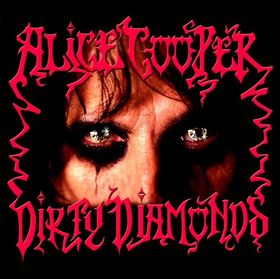
The album cover is almost the same as before — the important half of Alice's face staring at us from be­hind some ornamental camouflage — but the music is seriously different. Dirty Dia­monds is Alice's first album in God knows when that follows no specific agenda whatsoever, and deals with no particular concept other than «life as seen from the viewpoint of a cartoonish half-Satanic, half-criminal character», which is, by now, more than thirty years old. Now that all the points have been stated, all the comebacks effectuated, and all the trends perpetrated, there is lit­tle left to do other than simply write songs and record them. Or play golf. But I guess even a ma­niac golfer can go crazy from doing nothing other than play golf.

This is a good record, but it is not as focused or energetic as the four that came before it, so we can probably send the curve sloping down once again. Big bulging concepts do not work for eve­ryone, but they usually do for the Coop: his 1994-2002 «Trilogy of Hell» burned the same fuel of commitment to the idea as the rejuvenated ode to backyard brawls that was The Eyes Of... Two years later, Alice ran out of big ideas, and what we get is a rag-tag collection of small ones that frequently work, but also have the tendency to misfire from time to time.

Frankly speaking, the rock'n'roll numbers here are about as interesting as the recent attempts by the Rolling Stones — nostalgic riff-recyclers that will never appeal to the jaded fan, and, in all probability, will only make him mourn the fact that new generations of listeners, whose ability to turn the clock back usually gets lost together with their milk teeth, will take this for the real thing; but Alice Cooper may not be judged by 'Woman Of Mass Distraction' any more than the Rolling Stones' place in history can be decided based on 'Rough Justice'. It is a moderately fun song, but the chords are almost as recognizable as any standard 12-bar progression, and as for the sleaze — well, we sort of thought Alice would have outgrown that since his hair metal period; why return to it now? To appeal to the sacrilegious Eighties nostalgia guard?

The same criticism applies to 'Perfect' and maybe a couple other numbers that history, hopefully, will discard as unfortunate errors born out of boredom and temporary lack of focus. Then there are a few more similar numbers, helped out by nagging, nifty vocal hooks (the 'woo-hoo-hoo' on 'You Make Me Wanna') or by a combination of said hooks with on-the-level crunchy character asassinations ('Sunset Babies' — any song that trashes spoiled glammy trash is OK by me; where do I sign for turning the line 'Sunset babies all got rabies' into an international slogan?), but even these are sort of «melodically grim». And I do not support the idea of taking the Ramones' solo on 'Now I Wanna Sniff Some Glue' and turning it into the backbone for the title track (granted, that solo was probably a lift itself, but that is beyond the point).

So the album is probably at its best every time it steps away from the generic rock'n'roll idiom; two obvious standouts are a beautifully felt and executed cover of the Left Banke's 'Pretty Balle­rina' (the Coop continuing the honourable mission of opening up the vaults of golden oldies to new listeners — although it is a little sad that most people commenting on the album do not even seem to realize the song's origins) and 'The Saga Of Jesse Jane', a tongue-in-cheek Johnny Cash send-up about a transvestite cowboy ending up in jail for defending his rights a bit too much on the violent side (and Brokeback Mountain had not even hit movie theaters at the time). Melody-wise, the latter at least hangs on a beautiful, melancholic guitar line that I do not recall ever ha­ving heard before — and this combination of ridiculously pointless lyrics with guitar gorgeous­ness gives it a nice post-modern flavour that the rest of the album lacks.

That said, I reiterate that Dirty Diamonds only sucks when taken in context — namely, in the context of Cooper's blistering renaissance with his four previous albums, and in the context of ha­ving almost nothing to add to the history of rock'n'roll as we know it. On their own, clear and unsoiled by extra knowledge, each number kicks its own midget ass, with the exception of the silly bonus track 'Stand' recorded in tandem with the rapper Xzibit (not just because it has a rap section, which can be tolerated, but because it is one of those ugly examples of the «let me teach the younger generation the important morals of life through their own voice because they are too dumb to figure them out on their own» approach that is always pretentious and fake, and I am sur­prised how a guy like Alice with his IQ level keeps falling in that pit so often). So, from the bottom of my heart, I still give it a moderate thumbs up; yet there is every reason to be afraid that the final comeback is over, and perhaps Alice should spend more time with that golf club, after all. Or, at least, try to write a concept album about golf.

Wednesday, April 21, 2010

Alice Cooper: The Eyes Of Alice Cooper


ALICE COOPER: THE EYES OF ALICE COOPER (2003)

1) What Do You Want From Me; 2) Between High School And Old School; 3) Man Of The Year; 4) Novocaine; 5) Bye Bye Baby; 6) Be With You Awhile; 7) Detroit City; 8) Spirits Rebellious; 9) This House Is Haunted; 10) Love Should Never Feel Like This; 11) The Song That Didn't Rhyme; 12) I'm So Angry; 13) Backyard Brawl.

Jumping on bandwagons is a skill, one that few can master as smoothly as Cooper. Clearly, the decision to dive into the oilfield of heavy metal must have been influenced by the success of nu­metal bands like Korn and Limp Bizkit; but it was carried out in full accordance with the Alice spirit, which makes Brutal Planet and Dragontown perfectly enjoyable on their own.

By the early 2000s, the new trend for the «alternative mainstream» emerged as the neo-garage rock of the Strokes, the Vines, and the Hives, and, according to the strict laws of determinism, there was simply no chance that Alice could have missed the opportunity, particularly since what the Strokes and the rest were reviving was, in part, Alice's own ancient style — the proto-punk vibe of the Detroit scene. The MC5, the Stooges, and Alice Cooper of Love It To Death fame. Let's admit it: if you spot a pack of spoiled, hedonistic young whippersnappers stealing your mu­sic, it is only natural for you to get pissed off and decide to resteal it from them. Is stealing from thieves stealing at all? The Eyes Of Alice Cooper may not rise up to the level of Love It To Death — no surprise, since that would require a bottle of rejuvenation pills and a time machine — but at least it competes fairly well with the Strokes and the Vines, and it still shows who is really the boss in all of this, lack of sales notwithstanding.

There is no trying to mask the «retro» attitude on this one. The title itself, focusing us on Alice's «eyes», makes us notice that he is not wearing much makeup except for the spiderish shades around those eyes, just like he did in 1971. The back cover shows him together with his new band, first time in decades — ever since the demise of the original Alice Cooper band, no sidemen ever got the unimaginable honour of entouraging The Monster on any album sleeves. And, speaking of the band, well, the band may lack the crudeness and imagination of Alice's former pals, but they still do a mighty impressive job. Of particular notice is Ryan Roxie, arguably the only guitarist in Cooper's history to wilfully go through several distinct styles — he is just as convincing as a pun­kish rock'n'roller as he was in the guise of an industrial metallist.

Then there are the songs, on which Alice, once again, rises to the occasion. Thirteen tracks, each one pretty damn good in its own way. Monotonousness is out of the question: the rock numbers are evenly split between «poppy» and «hard», and, from time to time, interspersed with ballads (one sentimental, one comical) and even a solitary «horror» number ('This House Is Haunted', written and recorded in the «spook that kid» style, rather unusual for Alice). Melodies? You bet. Humour? Lots. If there is one thing to complain about, it is the occasional scent of excessive «overproduction»: the guitars, at times, are too noisy, perhaps the biggest difference between Eyes and the true classic Detroit sound, which, after all, was born and extinguished not only in pre-Strokes times, but even in pre-Ramones' ones.

It would be nicer, I think, if more of the songs here were along the lines of 'Detroit City', or, ra­ther, its first thirty seconds, with the cool old chugga-chugga hard rock style, after which the wall of sound still kicks in (it is, however, notable that Wayne Kramer of the MC5 fame himself adds some guest-guitar to the recording). But then, of course, the entire album would be skewed to­wards the «nostalgia» line — 'Detroit City' alone, with its 'Me and Iggy were giggin' with Ziggy and kickin' with the MC5...' has drawn its fair share of smirks.

So let us enjoy life as it is, and just give in to the hooks of the female-bashing 'What Do You Want From Me', the bourgeois-bashing 'Man Of The Year', the amour-bashing 'Love Should Never Feel Like This', and especially the self-bashing 'Between High School And Old School', which is where Alice finds himself stuck in between — a perfect projection of the «confused teen anthem» style onto the idea of «too old to rock'n'roll, too young to die». Behind the big, fat sound on all these songs we still find the same indomitable spirit, plus a catchy hook or even two per song. And, just as the genre requires, much of this is about anger, anger, anger. No wonder the last two songs are 'I'm So Angry', where he takes it out on his cheating girlfriend, and 'Backyard Brawl', where he takes it out on anyone stupid enough to get in the way. 'Backyard Brawl', in par­ticular, stomps and thrashes about with such passionate violence that, unless you have seen one of Alice's peaceful, relaxed golf videos recently, you will be fooled.

However, I have to confess that my own favourite song on the album is the most peaceful one — the sweet love ballad 'Be With You Awhile', which sounds 100% like a solo John Lennon ballad, right down to all the vocal modulations, and, (not) coincidentally, the most beautifully arranged Coo­per ballad so far — a mix of deep underwater-ish electric piano, high above-the-sky-ish Mel­lotrons, and juicy, colourfully distorted electric guitars that, unlike the rockers, arises completely out of nowhere and is thoroughly unpredictable. And, unlike Alice's former hits in the balladeer­ing genre, this one is completely untouched by the chisel of commercialism. As hard as it is, es­pecially in recent times, to combine simple, old-school sentimentality with a sugar-free, pathos-free environ­ment, 'Be With You Awhile' is a total success. (Although, of course, the anti-senti­mentalists of our modern age will hardly pay much attention to it; they will prefer to concentrate on the hilarious send-up of 'The Song That Didn't Rhyme', a cool joke tune about the worst song ever written — 'a three minute waste of your time, no redeeming value of any kind').

The Eyes Of Alice Cooper cannot be among the greatest records of Alice Cooper: any album from an old Alice Cooper that toys with the departed spirit of the young Alice Cooper is doomed to be forever sitting in the second or third row, at best. But the goal has been achieved, and the have not been disappointed; the brain marvels at the efficacy of evading all the reefs and pitfalls, and the heart rejoices at the delightful mix of the rough and tender — thumbs up from both sides.

Wednesday, April 14, 2010

Alice Cooper: Dragontown


ALICE COOPER: DRAGONTOWN (2001)

1) Triggerman; 2) Deeper; 3) Dragontown; 4) Sex Death And Money; 5) Fantasy Man; 6) Somewhere In The Jungle; 7) Disgraceland; 8) Sister Sarah; 9) Every Woman Has A Name; 10) Just Wanna Be God; 11) It's Much Too Late; 12) I Am The Sentinel.

For the direct sequel to Brutal Planet, Alice reteams with old friend Bob Ezrin; the impact is hard to measure, since, out of all his Ezrin-produced records, this one sounds the least like Ezrin. Possibly because Cooper was still in his «doom metal» phase, and the mystical Ezrin touch is not as transparent behind the dark waves of deep distorted guitars as it usually is behind the pianos, strings, special effects, and echoes.

Still, at least several songs are immediately distinguished by the new presence — such as the title track, whose Middle Eastern keyboard patterns on the verses immediately bring to mind similar arrangements on DaDa. And this ties in well with Alice's decision to vary the stylistics a bit: Dragontown is not simply one titanic metal onslaught following another, but rather a more diver­sified journey through the pleasures and horrors of our times, liable to be set to grinding gnashing me­tal just as easy as it can be set to light balladry or even rockabilly.

Strangely, the record does not start off on an epic note: 'Brutal Planet' announced its goals from the first minute, but Dragontown takes things more slowly, conducting the listener to its own brand of hell in several steps. First, there is the introduction of 'Triggerman', a fast, churning ro­cker that introduces your own personal Virgil who's going to be your guide for the rest of the al­bum: "I'm pure non-entity, don't even watch for me, I watch you when you sleep". Who is that? Subconscience? Some sort of inner voice? Nah, probably just Satan once more.

Then the real metal starts, plunged in a felt-more-than-heard swamp of Ezrin's Gothic effects — 'Deeper' is the descent: "The elevator broke, it went right through the floor...". Corny, B-movie level, but catchy and exciting as always, and, more importantly, evocative; here is a man who understands what these deep guitar tones are there for. And, finally, the gates burst open on Track Three — the magnificent 'Dragontown', unfurling slowly and almost unwillingly through a maze of swirling keyboards and basses into the gritty singalong chorus. If 'Brutal Planet' was all a big ball of disgust and hate, 'Dragontown' is more personal and frightening, as if the Coop were stret­ching out his gnarled set of claws to you right out of the speakers: "Come on, I've got something to show you — come on, you're really gonna love this!"

I have caught myself plenty of times on the realization that, at some point, despite all the obvious­ness and simplicity, the Coop's cartoonish vibe transcends these flaws, making even prepared lis­teners of the «been-there, heard-that, no surprises» caliber experience an unfaked internal shiver. Dragontown has plenty of moments like this. On the previous album, the evil of genocide was vividly described within 'Pick Up The Bones', inspired by events in Bosnia; here, the subject continues with 'Somewhere In The Jungle', reminding Western audiences of even bloodier events in Rwanda (granted, most people won't even pay attention to the lyrics, and those that will may not know what the thing is specifically about; it does not help matters much that the reference to the Serengeti is somewhat misguided — that's, uh, in Tanzania, Alice, on the other side of Lake Victoria. Might as well say the Kalahari). Nevertheless, it's quite scary as well.

On the lighter side, the humor is back, and most of the heaviest songs are imbued with sarcasm so as not to sustain the same homicidal level of depression throughout. 'Sex, Death And Money' in­troduces the deadliest, zombiest guitar tone you will ever hear on a Cooper album, but the song's message ("sex, death, and money, sonny, that is why we all are gonna fry") is delivered with iro­ny: for all of Cooper's unexpected Christian morality, he sure knows a mean way how to hand out a moral message and have a good laugh at professional moralists at the same time and not end up sounding like a cheap hypocrite.

There are also some killer send-ups on the record. 'Fantasy Man' returns us to the lambasting of the redneck stereotype: "I don't do dishes, and I'm suspicious of any grown-up man that does; I'm homophobic, don't do aerobics, just lay around and catch a buzz" — he hasn't nailed that stereo­type that well since 'I Love America' in 1983. 'Disgraceland', alternating punk-pop with rockabil­ly, is a, ahem, «tribute» to The King, whom we apparently meet doing time in Dragontown, re­plete with a not-half-bad Elvis impersonation. And the hilarious industrial rap of 'Just Wanna Be God' goes as far as to send up the principal anti-hero himself — now we know that all of man­kind's troubles are really, in fact, the sole consequence of some solitary individual's inferiority complexes: "I only wanna build my statue tall, that's all — why can't I be God? I only wanna be God!" Thanks a lot, pal.

To complete the picture, we have the obligatory woman-is-the-nigger-of-the-world sensitive bal­lad ('Every Woman Has A Name', hardly better or worse than all of Alice's similar creations, but give the guy extra points for consistency) and a lighter pop-rocker about a guy who seemingly led a righteous life but is now wondering how the hell he ended up right in it ('It's Much Too Late', which, according to rumors, is dedicated to Lennon and, indeed, sounds a bit like John, but it is a little difficult to imagine John as the protagonist of a song whose lyrics go "When I was a teen, all the sex that I missed was an abstinence blessing to me", don't you think?).

We are more or less accustomed to Cooper's albums arriving in pairs — Welcome To My Night­mare in a two-fer with Goes To Hell, Trash with Hey Stoopid, etc. — but most of these pairs had a clear superior and inferior member. With Brutal Planet and Dragontown, no such decisi­on can be taken. The former has the upper hand when it comes to pouring out bare emotion — it pummels you right across the floor; the latter, while slightly more restrained and calculated, is, on the other side, more interesting in that the sheer number of ideas is much larger. Naturally, it is as easy a thumbs up as its predecessor, continuing to build up Alice's reputation for the new millen­nium (and setting up an impressive record of two consecutively fine albums in two years for a rock icon in his fifties).

Wednesday, April 7, 2010

Alice Cooper: Brutal Planet


ALICE COOPER: BRUTAL PLANET (2000)

1) Brutal Planet; 2) Wicked Young Man; 3) Sanctuary; 4) Blow Me A Kiss; 5) Eat Some More; 6) Pick Up The Bones; 7) Pessi-Mystic; 8) Gimme; 9) It's The Little Things; 10) Take It Like A Woman; 11) Cold Machines.

For the first time since the weirdness attacks of Zipper Catches Skin and Dada, Alice puts out a decidedly non-commercial album, one that not only ignores current marketing trends, but goes as far as not yielding even a potential hit single, not to mention being released on a tiny indie label (Spitfire) with little or no marketing potential whatsoever. No one can call Brutal Planet a com­mercial flop: with its subject matters, its sound, and its intentional lack of promotion, it was never supposed to be «huge». This is hardcore Cooper for hardcore fans.

How would an artist like Alice Cooper prefer to greet the new millennium? Quite likely, by cas­ting a wicked glance at the then-and-now and, in his own individual style, telling us the obvious: want it or not, this world pretty much sucked in the past two millennia, goes on sucking today like there was no tomorrow, and is more or less doomed to go soon if things continue the way we continue doing them. Come to think of it, quite a predictable thing to be preached by an old, griz­zled, spiteful, born-again Christian. It all hangs on the manner of preaching.

Brutal Planet is Cooper's heaviest album to date, and possibly ever, and «heavy» here refers both to the music, cast in the questionable, but potentially killer genre of Industrial Metal, and the subject matter, since Alice has apparently decided to address all seven deadly sins and more. Let's see: I clearly perceive wrath ('Wicked Young Man'), greed ('Gimme'), gluttony ('Eat Some More'), uh... well, the rest does not work out so well, but at least you get the basic idea.

Mind you: this is not an intellectual celebration. The lyrics are rarely ambiguous, and the riffs are rarely complex. In a way, this is a retread even from the level of The Last Temptation. But we can buy this regardless of the fact that the number of employed chords is not overwhelming, be­cause Brutal Planet was clearly designed with this idea in mind — someone, thinks Alice, needs to brutally bash the concept of a «brutal planet» into the heads of the current generation. To hell with obscurity and complexity; let us have a simplistic metal ball before we get all blown to the same hell, and who knows, perhaps this simplicity might get at least a few of us to stop and con­sider not being blown to hell after all.

The incessantly ironish guitar tones should not really be hard to bear. Behind them lie standard Alice Cooper pop hooks, much like the ones on Trash, except they have been better fleshed out and their metal encasing is sharp, crisp, and hot, much unlike the commercial gloss of the days of yore. (There have been complaints that, in reality, Alice is simply jumping the freshest band­wagon of nu-metal, but frankly, I do not hear any Korn or Limp Bizkit in these songs, way too truly evil to be compared to these youngsters). The riffs frequently come in pairs — a low, scary one that carries the rhythm, and a higher, whiny one that highlights the pop melody, as you can immediately hear on the title track. The so­los usually come in short, garage-style outbursts: professional, but humble blasts of ass-kicking courtesy of Ryan Roxie, I believe. And the singing... well, that is one area where we should never bother; Alice Cooper is, by all means, guaranteed for life.

As simple as it all sounds, much of it is genius simplicity, plus there are unpredictable touches all the way through. The title track, on which Alice trashes humanity as a whole (admitting, however, that it is really the Biblical serpent who is behind all the shit), introduces, out of nowhere, a drea­my female chorus of rose-colored glasses-wearing angels, which is then contrasted with Cooper's devilish shouting. 'Wicked Young Man', possibly the most hateful send-up of hatred ever put on record ("I read Mein Kampf daily just to keep my hatred fed" transcends simple kitsch and dives head first into Monty Python territory, but that's cool), borrows an alert siren as its second riff. 'It's The Little Things', fastest song on here but also serving as a bit of comic relief, falls back on the legacy by namedropping some of Alice's previous hit titles, etc.

There is also the predictable, although this time decidedly non-hit, ballad ('Take It Like A Wo­man') that is essentially 'Only Women Bleed Part Two'; but it is the only time when the metallic punching fades away, only to come back once more and predict the rise of 'Cold Machines' (yes, what's up with us forgetting about that? thank you for reminding us, Alice!). As monotonous as it all feels together, each hook is different, and although the basic anger behind this is simply Anger, it is exciting to be able to feel Anger at so many different things: the original sinners, the skin­heads, the consumerists, the genocide instigators, the social-darwinists, and all those other inha­bitants of the brutal planet — and it is fairly certain that, in one song at least, you, the reader, will be able to spot yourself, because the Coop spares no one.

Lumping and leaden, impressive and memorable, funny and scary, it is an album that cemented Cooper's status as that of the old guy who made it artistically intact into the new millennium, along with just a bare handful of his colleagues from the old days such as Lou Reed or David Bowie. Heartily recommended for metal fans in general and Alice fans in particular, the heart gives it a thumbs up, and the brain is still trying to figure out how it is possible to squeeze that much sense out of a handful of primitive metal riffs.

Wednesday, March 31, 2010

Alice Cooper: A Fistful Of Alice


ALICE COOPER: A FISTFUL OF ALICE (1997)

1) School's Out; 2) Under My Wheels; 3) I'm Eighteen; 4) Desperado; 5) Lost In America; 6) Teenage Lament '74; 7) I Never Cry; 8) Poison; 9) No More Mr. Nice Guy; 10) Welcome To My Nightmare; 11) Only Women Bleed; 12) Feed My Frankenstein; 13) Elected; 14) Is Anyone Home?

The idea behind Cooper's second live album was to remedy the flaws of the first one. Since The Alice Cooper Live Show had been released in 1977 without the artist's consent and, according to his opinion, did not offer a proper audio representation of what the show was really about, it was only a matter of time before a real, officially endorsed, live album would see the lights of day — strange that it took a sobered-up, activity-bursting Cooper a whole decade to get around to it, but it is pretty fortunate that it did, because otherwise we would have ended up with a bunch of Kane Roberts machine gun solos on some of Alice's worst songs.

The irony is, of course, that A Fistful Of Alice, fine-sounding as it is, does not capture the «true» Alice Cooper show any more than the 1977 album did. Specially recorded at the Cabo Wabo club in San Lucas, Mexico, and fattened up by guest appearances from Slash, Rob Zombie, and even Sammy Hagar (fortunately, on guitar only!), it reads as a Greatest Hits Live. Only 'Desperado' had not been previously released as a single — and, vice versa, pretty much all of the hit singles Alice ever had in his career are represented, including even a livened up version of 'Teenage La­ment '74' and (only on the expanded Japanese version) 'Clones', songs that were not at all part of the regular show at the time. On the other hand, the album that he was promoting at the time — The Last Temptation — is only represented by 'Lost In America', the «hit song», ripping out any hopes of conceptuality or coherence ('Nothing's Free' and 'Cleansed By Fire' were regular parts of the setlist).

So the purpose of the album is somewhat obscure; loyal fans would likely have preferred a more authentic document, and casual fans, by 1997, would hardly be interested in anything other than regular «greatest hits» packages, not bothering to see them re-recorded in a live setting. Never­theless, on its very own, A Fistful Of Alice is still fun. What is there to dislike about the Coop's hit singles, with the possible exception of 'Poison'? Nothing. The man is in top vocal form, the backing band is in good taste (Fistful marks the first appearance of soon-to-be Alice's regular sidekick Ryan Roxie on guitar), the sound quality is crisp, the volume levels awesome.

Here is just a bunch of off-the-cuff remarks on minor special details that may or may not entice you into hearing this: (a) 'Teenage Lament '74', losing Lisa Minelli, gets a crunchy power-pop coating that almost wipes out its vaudeville spirit; (b) 'Welcome To My Nightmare' has a brief 'Steven' introduction, and keyboard player Paul Taylor manages to simulate the powerful brass section so that the results are almost credible; (c) Rob Zombie's growling on 'Feed My Franken­stein' adds nothing to the song, but Slash definitely spices up the sound on 'Lost In America'; (d) 'Elected' serves as a pretty good Grand Finale to the whole show.

As a tempting bonus, the fans get one new studio track, the acoustic-and-slide-led pop rocker 'Is Anyone Home', similar in tone and message to 'Wind-Up Toy', nowhere near as desperate, but much more instantly likeable in terms of arrangement, because the guitars follow the sonic pat­terns of The Last Temptation rather than Hey Stoopid. Should it be tempting enough to make A Fistful Of Alice into an obligatory part of the fan's collection, or will the album forever remain in the status of an obsolete curio? Depends on how much you are into black leather. But thumbs up regardless of the answer.