Search This Blog

Showing posts with label Brainiac. Show all posts

Thursday, April 30, 2015

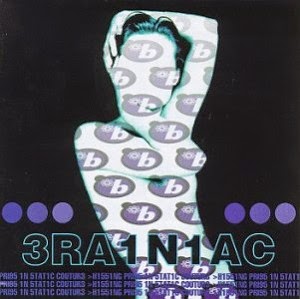
Brainiac: Hissing Prigs In Static Couture

BRAINIAC: HISSING PRIGS IN STATIC COUTURE (1996)

1) Indian Poker (part 3); 2) Pussyfootin'; 3) Vincent Come On Down; 4) This Little Piggy; 5) Strung; 6) Hot Seat Can't Sit Down; 7) The Vulgar Trade; 8) Beekeepers Maxim; 9) Kiss Me, U Jacked Up Jerk; 10) 70 Kg Man; 11) Indian Poker (part 2); 12) Nothing Ever Changes; 13) I Am A Cracked Machine.

I seriously dislike the title of this album — sounds like four unrelated words joined together through random selection. If anything, it should have been named after one of its tracks — ʽHot Seat Can't Sit Downʼ is a near-perfect description for its overall sound. Which has not changed all that much since Bonsai Superstar — but now it is even wilder, faster, uglier, and crazier, so if you liked Superstar for all these reasons, you are almost legally bound to develop an even higher appreciation for Hissing Prigs.

Unless you already are an experienced consumer of various sorts of noise, some of the small arch-experimental links may be hard to fathom — if the industrially distorted «pan-fried» electric guitar duo on ʽIndian Poker (part 3)ʼ does not kill you on the spot, just wait until you get to the high-pitched electronic sirens on ʽIndian Poker (part 2)ʼ (boy, am I glad they declined to end the album with ʽIndian Poker (part 1)ʼ — that would probably have been the sonic torture to out­shame all other sorts of sonic torture). Even before that, the already major crazy ʽ70 Kg Manʼ, running along at top speed to the sound of fizzed-out punk guitars and dissonant overdubbed vocal harmonies of the chorus, is interrupted midway through by a «bridge» of electronically treated barking hounds — let me tell you, there's absolutely no fun in hearing this at top volume in headphones, and oh, my name is Peter Townshend, by the way.

But do not make the mistake that it's all about ugliness, either. Brainiac's chief influences are still the same — main cues taken from the Pixies and, through them, from the Ramones and other punkers who value fun, catchiness, and entertainment at least as much as they value rebellious­ness, schizophrenia, and social message. Once the initiation of ʽIndian Pokerʼ has diligently driven out all the «wusses» and «pussies», ʽPussyfootinʼ really turns out to be quite a conserva­tive rock track, oddly adorned only with Tim Taylor's inimitably screechy vocal style and a series of slightly deranged babbling interludes. And no amount of hysterical electronic effects can dis­guise the fact that ʽVincent Come On Downʼ is essentially just a solid slice of classic punk-rock, with nothing particularly «avantgarde» about its basic chord structure.

But do not make the mistake that it's really all so simplistic. The above-mentioned ʽHot Seatʼ, for instance, starts off with quite a tricky guitar riff and an even trickier time signature, well worthy of King Crimson — matters get simplified once Tim starts to sing, but the song switches gears several times and is, on the whole, far more complex than anything ever produced by, say, Nir­vana (not that it automatically makes it better — I am merely making a case here for Brainiac as a «musician's band» rather than a «general public band»). And the guitar melodies on ʽThis Little Piggyʼ, despite the relative simplicity of each, remain ever so slightly, but steadily and intentio­nally out of sync with each other, which means they are taking their clues from the avantgarde artists, after all. There's nothing like mapping craziness through intelligence.

But do not make the mistake that it's really all so esoteric. Once most of this stuff has properly sunken in, the professional headbanger will headbang to it all the way through to ʽNothing Ever Changesʼ, whose combination of galloping rock rhythm with catchy electronic pulse could make it into a ʽRock Lobsterʼ for the 1990s, and the closing ʽI Am A Cracked Machineʼ, which is also a damn good title — the whole song, heck, the whole album, dammit, this whole band has made a career out of portraying the daily routine events in the life of a «cracked machine», one that might be expected to churn out «normal» electronic music, but, due to its being cracked, turns out every­thing but normal — and loves every moment of it.

Even if your mind will not get attached to specific songs, it would be hard not to get involved in Brainiac's rusty robotic carnival as a whole. I hold no illusions for Brainiac's future — there is no guarantee that, had Tim Taylor not perished in an unfortunate auto accident a year later, they would have retained their edginess and freshness. The several songs they still had time to record and put out as an EP (Electro-Shock For President) show that the plan for the next stage was to relinquish guitars altogether and go completely electronic for a while — not the best idea, per­haps, because the songs became completely depersonalized and were unable to capitalize on Tim's eccentric individuality. Still, that's hardly a polite pretext to say that nobody will miss Tim Taylor — over those brief, but eventful several years, he did help out to make the decade a little more colorful and crazy, and Hissing Prigs is arguably the highest point of that color-add-on, so it gets yet another thumbs up from me, and with that, the story of Brainiac is over.

Thursday, April 23, 2015

Brainiac: Bonsai Superstar

BRAINIAC: BONSAI SUPERSTAR (1994)

1) Hot Metal Dobermans; 2) Hands Of The Genius; 3) Fucking With The Altimiter; 4) Radio Apeshot; 5) Trans­missions After Zero; 6) Juicy (On A Cadillac); 7) Flypaper; 8) Sexual Frustration; 9) To The Baby-Counter; 10) You Wrecked My Hair; 11) Meathook Manicure; 12) Status: Choke; 13) Collide.

With the arrival of guitarist John Schmersal in the place of Michelle Bodine, the classic Brainiac lineup falls into place... wait, no, actually, I am not sure I would have noticed the replacement without additional info. Sure there are no female vocals now, and sure no two musicians play their instrument in the exact same way, but on the whole, this is still Tim Taylor running the whole show and others are playing what they are being told, or at least the way they are being told to play. The main difference is not in the change of style, but rather in its tightening up, so much so that guitars and electronics fuse even more seamlessly, and it gets harder and harder to simply view Brainiac as a «guitar rock band with Moogs».

For one thing, they get more heavily involved with sampling, and pretty creatively: ʽFucking With The Altimeterʼ builds a rhythmic pattern out of spooky whispered vocals, and in several other places they play around with radio static, using it as a greasy paste from which one can mold just about anything, given patience and time. For another thing, guitars and keyboards now often either play the same melody or play small, splintered melodic bits that are tightly inter­woven around each other. Throw in Taylor's now-permanent operation in the mode of «total mu­sical madness», and here's a sound that's pretty damn hard to confuse with anything.

The bad news is that, the more they solidify around this thing they do best, the more one-dimen­sional they become. Although some of these songs are fast and some are slow, some are punkier and some are bluesier, some are lighter and some are heavier, the basic message of each tune is more or less the same — «the modern world and modern technology has made us nutty as hell, and we love love love it!». This is, indeed, like one particular angle borrowed from the Pixies and magnified to the proportions of a grand hall, but this is also why Brainiac could never hope to achieve the kind of recognition and popularity that the Pixies have: too focused on one single theme, too radical in their exploration of it. I really like the record, yet I cannot even write a pro­per review, because the songs leave few possibilities for individual analysis.

I will simply state, then, that Bonsai Superstar is one of the most credible «mad albums» of the post-punk epoch that would not be done from a sociopathic standpoint, but rather from a «harm­less» angle. One big mistake that so many «mad» artists make is that, for some rea­son, they usually think that «madness» always has to be aggressive — which it does not. Here, even when Taylor drives himself up the wall and the guitars and keyboards begin locking into a paranoid, dissonant howling (ʽYou Wrecked My Hairʼ), the feeling is that the anger is mostly internalised, that the singer is trying to knock out his demons without expectorating them. More often, though, he is simply just being playful — like on the hilarious ʽJuicy (On A Cadillac)ʼ, a basic rock'n'roll number offset by hiccupy «rubbed-glass» noises that might equally well be synthesizer tones or treated samplings of scratched records, but, regardless of this, add a touch of «dynamic idiocy» to whatever is going on. Or he is being explicitly androgynous, as on ʽFlypaperʼ, where his near-fal­setto vocals are driven so high up in the mix, it's as if he were making a pass at you or something. Okay, that might be dangerous... but nah, not really.

One thing to add is that, from a technical angle, I think that lovers of guitar experimentation will find plenty of interesting stuff going on here — Schmersal's passages often presage «math-rock» as we know it in the 21st century, though, of course, they are nowhere near as technically accom­plished as the average «math-rock» product these days. But they do not need to be, since the melody, as such, is always subdued here to atmosphere and energy, by definition. Had they had a Robert Fripp in the band, he would surely have introduced a tighter level of «discipline»; but then, I suppose that any band that would have Robert Fripp and Tim Taylor in it at the same time would have decayed faster than a mendelevium isotope. So let us be content with what we have here, a maniacal celebration of electronic insanity without any harmful repercussions for progres­sive humanity. In other words, a thumbs up.

Thursday, April 16, 2015

Brainiac: Smack Bunny Baby

BRAINIAC: SMACK BUNNY BABY (1993)

1) I, Fuzzbot; 2) Ride; 3) Smack Bunny Baby; 4) Martian Dance Invasion; 5) Cultural Zero; 6) Brat Girl; 7) Hurting Me; 8) I Could Own You; 9) Anesthesize; 10) Draag; 11) Get Away.

All right, so despite their name, Brainiac weren't exactly the most original band to come out of the whole underground-indie-alternative bouillon of the early 1990s. There may be a good reason, or even more than one, why their three albums have been relegated to the «connaisseur» shelf, pardon my French again, and why the memory of Sonic Youth, Pixies, Nirvana, and Radiohead will linger long after the last real brainiac has emptied his recycle bin containing Smack Bunny Baby, Bonsai Superstar, and Hissing Prigs In Static Couture. After all, not everybody can be so lucky — wherever that bus is going, the number of seats is always limited.

But none of that prevents me from actually liking these guys: I think their records are fun, and their creative angle is actually quite unique, even if it does not make a lot of sense. Basically, they were surrealistically aggressive punkers with an electronic coating — but a retro electronic coating at that, with the band's leader Tim Taylor playing a Moog as his instrument of choice. Now, quickly, off the top of your head, how many punk bands with Moog synths can you name? (I mean, other than Emerson, Lake & Palmer, of course?) Not too many — even though, come to think of it, the Moog can be as in-yer-face punk as any stringed electric instrument.

So, as the album kicks out the door, for the first twenty-five seconds you feel like you're listening to a Pixies clone — a little introductory noise and a droney guitar riff played at full throttle. But as the vocals make their appearance, they are accompanied with a series of fussy electronic noises that sound as if they've been taken from some arcade experience — hilariously deconstructing any «authentic» anger and aggression that may have been placed in the song. ʽI, Fuzzbotʼ could have worked even without these quasi-Pacman bleeps and bloops, but its frantic "GET OUT OF MY MIND!" chorus just sounds way too much like Black Francis for the band to escape being branded as copycats. Add some of these ridiculous electronics, though, and you get something seriously different — and bizarrely intriguing.

Most of the songs here work at the intersection of energetic and inspired, but utterly unoriginal alt-rock guitar riffage; Tim Taylor's vocal hooks in the choruses, which can be catchy, but do not differ that much from any other repetitive, screamy choruses in punk history; and the use of elec­tronics, formally «superfluous», never truly essential to the songs' basic structures, but always serving as their main identificator — after a brief period of initiation, you will never mistake a Brainiac song for anything else, because the bleeping, howling, wheezing, wailing Moogs give them away at a moment's notice.

Lyrically, Brainiac are also not too different from the usual punk/alt-rock territories — their songs are mostly about pain, confusion, insanity, lack/loss of self-identity, most of the topics revolving somewhere in between the dangerous anguish of Kurt Cobain and the surrealist para­noia of Black Francis. But since the tempos are consistently fast, the guitars are consistently loud, and the vocals consistently rise to a scream, you probably won't be able to make out most of the lyrics anyway, and why should you? This band is all about finding out how cool a punk-rock guitar can sound in a formerly alien context — sort of a «Mini-Sonatas for Pissed-Off Electric Guitar and Moog Synth» experiment, and quite a successful one, in my opinion, even if most of the songs seem so similar, if you discount occasional individualistic vocal gimmicks (like the creative use of the "nah-nah nah nah-nah-nah" teaser in ʽCultural Zeroʼ or the horrorific voice-and-synth sonic meld in ʽDraagʼ which gives me awful visions of a person mutating into a syn­thesizer — quite a productive idea for a musical video, I'd say).

Other than Tim Taylor, the band does not have any creative quasi-geniuses at this point, but guitarist Michelle Bodine ain't half-bad (since Taylor is also credited for guitar playing, I have no idea how many of the riffs are actually played by her, but she must have been the primary guitar player during the band's live shows anyway) and she has a strong Riot Grrrl-type voice as well — too bad they only let her sing lead on one track (the aptly titled ʽMartian Dance Invasionʼ, since nobody would be surprised if the Martians chose Brainiac as their favorite dance music). On the whole, definitely not bad for a first try for someone hailing from Dayton, Ohio — they may not be bursting with creativity, but their one fresh idea works well enough for 36 minutes (and do thank God that they respect the punk aesthetics enough not to let it run for 70, despite living in an age when the new CD format was poisoning everybody's brains). Thumbs up for sure.