Search This Blog

Showing posts with label Budgie. Show all posts

Friday, March 4, 2016

Budgie: The BBC Recordings

BUDGIE: THE BBC RECORDINGS (1972-1982; 2006)

CD I: 1) Rape Of The Locks; 2) Rocking Man; 3) Young Is A World; 4) Hot As A Docker's Armpit; 5) Breaking All The House Rules; 6) Crime Against The World; 7) Napoleon Bona-Part 1 & 2; 8) Forearm Smash; 9) Panzer Divi­sion Destroyed; 10) Wild Fire; 11) Breadfan [lost edit].
CD II: 1) Sky High Percentage; 2) In The Grip Of A Tyrefitter's Hand; 3) I Turned To Stone; 4) Superstar; 5) She Used Me Up; 6) Forearm Smash; 7) Crime Against The World; 8) I Turned To Stone; 9) Truth Drug; 10) Superstar; 11) She Used Me Up; 12) Panzer Division Destroyed.

Okay, here is another one worth a quick mention. Again collected from radio transmissions, but this time spread out over a much larger period and concentrating way too heavy on the John Thomas stage of the band, including not one, but two mini-shows (or excerpts from shows) at the Reading Festival, in 1980 and 1982 respectively, which explains why some of those less-than-stellar songs are captured here in two versions.

Of course, fans might be interested in the John Thomas version of the band performing ʻBread­fanʼ — just to see if he can nail that fabulous riff, and you know what? He comes somewhat close, but he can't, which is probably why they cut down the number of bars repeating it, and did not include the number in the original transmission either (it is qualified as a «lost edit» here, with a lopped off intro and probably a lopped off outro as well, since it concludes with a lengthy show-off guitar solo without returning to the opening theme). Just a somewhat telling bit of difference between the old and the new guitarist — or, rather, between classic Seventies and early Eighties styles of metal playing.

On the other hand, the disc is historically treasurable for containing some of the earliest live Budgie recordings caught on tape — four tracks from a 1972 show at the Paris Theatre in London, with Bourge setting the world on fire with his soloing on ʻYoung Is A Worldʼ and ʻHot As A Dockers Armpitʼ, the band still riding that old Sabbath vibe for all it's worth. The two tracks from 1976 are not nearly as stellar — ʻSky High Percentageʼ is a throwaway from one of their weakest albums, and the classic riff of ʻTyrefitter's Handʼ sounds so much shriller and sharper in the stu­dio that they might as well have left it out of the setlist for good.

And the new stuff? Well, one thing's good: the decision not to include (or perform) any of the awful songs from Deliver Us From Evil, except for one (ʻTruth Drugʼ, which was originally not transmitted, but the Devil made them excavate it anyway). I certainly do not mind them doing their AC/DC-type schtick like ʻForearm Smashʼ and ʻSuperstarʼ, except that AC/DC have ways to make their stuff even more exciting live than it is in the studio and these guys are too laid back to do it. The audiences love it, though — from both festivals, you have your fans going wild and screaming their heads off for "Budgie! Budgie! Budgie!" (One question, though: why didn't you buy the records, if you loved the band so much?).

In any case, this collection still does not properly satisfy the demand for a Budgie live album, and makes one wonder how the hell is it at all possible that not one single complete recording of a classic era Budgie live show has survived in acceptable quality to complete and dignify this series of semi-satisfying archive releases. Was the band too hard up back in those days, or were they just too lazy to set up a bunch of recording equipment, letting the BBC do it all for them? (Note that there is at least one officially released live album from the reunion era — 2002's Life In San Antonio, but the setlist there is way too unappealing, with way too many songs from the expen­dable 1980-82 era, for me to bother).

Friday, February 26, 2016

Budgie: Radio Sessions 1974 & 1978

BUDGIE: RADIO SESSIONS 1974 & 1978 (2005)

CD I: 1) Breadfan; 2) You Are The Biggest Thing Since Powdered Milk; 3) Hammer And Tongs; 4) Zoom Club; 5) Parents; 6) Rocking Man.
CD II: 1) Melt The Ice Away; 2) In The Grip Of A Tyrefitters Hand; 3) Smile Boy Smile; 4) In For The Kill / You Are The Biggest Thing Since Powdered Milk; 5) Love For You And Me; 6) Parents; 7) Who Do You Want For Your Love; 8) Don't Dilute The Water.

Budgie proudly subscribe to the rule that says the less important a certain band is, the more archive releases it has to put up on the market (because ten cheaply assembled albums will even­tually sell more than two, even if the total number of copies will still be hardly enough to cover your cigarette expenses). There's quite a few packages of outtakes, rarities, and live performances out there for the hardcore devoted fan — we are only going to focus on a couple, and rather brief­ly at that, because...

...well, see, one of the reasons why Budgie never put out a live album in the Seventies (just like Black Sabbath) is that they were never a particularly outstanding live band, and this double live CD is a very representative example. We have two shows here, one recorded relatively early in the band's career (London, 1974) and one from the Impeckable era (Los Angeles, 1978) — different drummers, but Bourge is the guitarist on both shows, so you could theoretically hope for the best. Unfortunately, even if you disregard the questionable sound quality of the 1974 show (the 1978 one is much better), it is not easy to recommend them as useful additions to the studio versions, let alone suitable replacements.

Technically, the band sounds good, although Shelley occasionally finds it hard to sing and play bass at the same time (ironically, he has his worst flubs on ʻBreadfanʼ, where you'd rather expect Bourge to slip every once in a while on the speedy riff). But the songs are performed very close to the studio originals and inevitably pale whenever Tony finds it impossible to reproduce all the original overdubs (he does try to insert a few screeching gulls on the early version of ʻParentsʼ, with questionable effects, but he hardly even tries any more on the later version). There is no extra improvisation whatsoever, with the exception of an obligatory-unnecessary drum solo in the middle of ʻRocking Manʼ; and the songs are not taken to a new level of wild wild metal energy because... because, I guess, Budgie are not really wild wild metal people.

Basically, the guys were hard working pros with a knack for a certain humbleness (and maybe so much for the better, because Burke Shelley as a Robert Plant-style swaggering frontman would only embarrass people) — perfect for the studio, not so interesting for the stage. Add to this the occasional problem with the setlist (ʻHammer And Tongsʼ does not cease to be a lame ʻDazed And Confusedʼ rip-off just because it is rolled out on the arena), the occasional problem with the sound, and most likely you will not be returning to these recordings fairly soon. Which should not prevent you from having at least one good listen, though. But Live In Japan or Live After Death this ain't, not by a mile.

Friday, February 19, 2016

Budgie: You're All Living In Cuckooland

BUDGIE: YOU'RE ALL LIVING IN CUCKOOLAND (2006)

1) Justice; 2) Dead Men Don't Talk; 3) We're All Living In Cuckooland; 4) Falling; 5) Love Is Enough; 6) Tell Me Tell Me; 7) (Don't Want To) Find That Girl; 8) Captain; 9) I Don't Want To Throw You; 10) I'm Compressing The Comb On A Cockerel's Head.

Anyone up for a new Budgie album in the 21st century? I originally had sort of assumed that after the release of Deliver Us From Evil, Shelley just retired the band's name and went on to have a solo career or something — apparently, though, «Budgie» as a touring band functioned all the way into 1988, and even after the last gigs Shelley never did much of anything except for a few collaborations on side projects. But supposedly, boredom got the better of him after a while, and there you have it — a brand new Budgie album in 2006, replete with a typically Budgie title and a typically Budgie album cover.

The music, unfortunately, is not at all typical Budgie. The original post-1974 drummer Steve Williams returns as a loyal servant, but the guitar player is brand new: a guy called Simon Lees, who was actually born one year before the release of Budgie's first album, and began his guitar training at the height of the hair metal era, and it still shows, no matter how much he is trying to hide it. In any case, the guitar sound on this album is largely bad — overcompressed, genetically modified, synthetically treated, and way too much influenced by nu-metal — and the aesthetics of the album is way too heavily rooted in the Twisted Sister / Poison camp, which is all the more surprising considering that Budgie did not even have the proper time to live into the hair metal age. It's as if at least half of these songs were really written circa 1984-85 (and why not?), then given the «modern» production treatment.

The record is not without a certain bizarre charm: Shelley and Lees use the pop metal idiom without subscribing to the pop metal lifestyle — this is not a collection of "let's party" anthems, cock rockers, and power ballads; the approach has elements of unpredictability, surrealism, and Budgie's obfuscated social criticism. But what of it all if the riffs are no good? To be sure, songs like ʻJusticeʼ and ʻDead Men Don't Talkʼ are full of metal riffage, but this is just metal riffage like tons of other metal riffage — no revelatory note combinations, no juicy tones, no personality whatsoever. In addition, Shelley has to really strain his aging voice to outshout the plastic electric noise, and he was never a screamer and still isn't.

Ultimately, the only songs on the record that have a bit of emotional resonance are the quiet ones. The title track is a decent ballad, leaning towards toothless adult contemporary, but with some pretty harmonies in the chorus — pretty enough to make me believe that, perhaps, we are all living in cuckooland indeed, or else why would we have to bother with this record in the first place? ʻCaptainʼ is a bit of acoustic folk that would be 100% filler on a classic Budgie album, but here becomes a highlight just because it is one of the few not-overproduced, not-overscreamed tracks. Is this praise? Doesn't sound much like praise to me.

Strangest of the lot is ʻI'm Compressing The Comb On A Cockerel's Headʼ, a track that sports a trademark Budgie title but sounds like a cross between Devo and Limp Bizkit, spludging along to a martial-industrial-metal rhythm and a particularly ugly vocal melody, as if Shelley tried to imitate the death metal growl to the best of his abilities. Adding insult to injury, almost the entire second half of the lengthy track is given over to a «phone-dialing» synth solo (or is that a synth guitar solo?) the likes of which went out of style at the end of the New Wave era, I think. Again, there's a certain bizarre attraction stemming from the stupidity of it all, but should we give the songs a thumbs up just because they're so ridiculous?

The real bad news is that the record will most likely confuse and baffle veteran Breadfans who'd like to be in for the kill, without attracting any new fans because that task is impossible unless Shelley somehow gets some of his Metallica admirers to guest star on the record. Ultimately, the best thing about this unfortunate «reunion» attempt remains the album cover — yes, the lanky bassist still retains some style, but the substance, alas, is still long gone and can never be re­covered again. Thumbs down.

Friday, February 12, 2016

Budgie: Deliver Us From Evil

BUDGIE: DELIVER US FROM EVIL (1982)

1) Bored With Russia; 2) Don't Cry; 3) Truth Drug; 4) Young Girl; 5) Flowers In The Attic; 6) N.O.R.A.D.; 7) Give Me The Truth; 8) Alison; 9) Finger On The Button; 10) Hold On To Love.

The less said about the last Thomas-era Budgie album, the better. I wish things could be ex­plained as easily as «they hired themselves a keyboard player, and it totally ruined them», but even without Duncan Mackay's keyboards (which are not the worst sort of keyboards played on a metal album, no) these songs seem absolutely pitiful in the era of classic Judas Priest and Iron Maiden, not to mention absolutely unworthy of Budgie's own legacy.

At least Power Supply had those jagged Priest-like riffs, and Nightflight tried a bit of a pop-metal approach that was essentially listenable — here, the band goes for «power», with lots of power chords, gang choruses, brawny-hero screaming, and stadium appeal. Bad move for every­body involved: Shelley is about as natural in this "scream for me Long Beach!" role as Woody Allen, and the guitarist's modest, but non-zero talents are more or less wasted on this collection of completely interchangeable power-fests.

The influence of the pop style of Nightflight is still evident — most of the choruses aim for catchiness, though usually of the super-stupid kind (ʻHold On To Loveʼ is a particularly annoying example, with an anthemic refrain that probably took five seconds to write and whose simplicity is not redeemed by its stupidity, because when you deliver simple-and-stupid with such grand pathos and no signs of irony, how can you truly convince the demanding fan of how important it is to "hold on to, hold on to love, everyone hold on to love?").

Respecting the spirit of the times, they do a political song that wishes to offend politics but ends up offending countries (ʻBored With Russiaʼ is really one of the most misguided titles in the his­tory of Cold War-related pop songs) — fortunately, the song is so bland that it should have been called ʻBored With Budgieʼ instead, with a chorus that is more adult contemporary than solid hard rock or metal. They also do a ballad on which the synthesized strings drown out the vocals and the vocal melody seems to be written only up to a certain point, after which the singer just takes the sentimentality wherever it takes him (ʻAlisonʼ). And they do an «epic» number (ʻFlowers In The Atticʼ) about abandoned children or something like that with a power ballad chorus and not a shred of personality.

Overall, this was a clear sign that the band had better vaporize before it put out something even more embarrassing (and this was only 1982, the decade still being so young), so upon getting the predictable thumbs down from just about everybody, Budgie were no more.

Friday, February 5, 2016

Budgie: Nightflight

BUDGIE: NIGHTFLIGHT (1981)

1) I Turned To Stone; 2) Keeping A Rendezvous; 3) Reapers Of The Glory; 4) She Used Me Up; 5) Don't Lay Down And Die; 6) Apparatus; 7) Superstar; 8) Change Your Ways; 9) Untitled Lullaby.

I cannot really make up my mind whether I should feel more empathy towards Power Supply-era Budgie or Nightflight-era Budgie. What's the difference, you might ask? Well, there is some — basically, their second album with Thomas is a step back from the «hardcore» new-wave-metal­lism of the 1980 offering, as they try to sweeten and mollify Power Supply's dry brutality with some poppy and even «retro-progressive» (is that even a word?) elements. Probably, this means that Nightflight will have a little more appeal for fans of classic Budgie — yet on the other hand, it is also clear that the classic days will never come back, and it does not make a whole lot of sense trying to force them back.

I am talking about ʻI Turned To Stoneʼ, of course, the six-minute «folk-metal» anthem that opens the record on a very different note from ʻForearm Smashʼ. We get those melancholic minor chord acoustic melodies, powerful build-ups and slide-downs, and the metal-soulfulness which these guys could master well earlier on (ʻParentsʼ, etc.). Ultimately, however, the guitar tones are too much «early hair metal», the main riff of the chorus sounds like «under-chugged» Sabbath-lite, and although John Thomas unleashes some nice furious soloing in the sped-up gallop coda, it is hardly enough to redeem the song on the whole. Nice try, though.

Curiously, the tone of the record gets much lighter after that, and some of the tunes could, in fact, qualify as «lightly metallized» power-pop — ʻKeeping A Rendezvousʼ, ʻShe Used Me Upʼ, ʻChange Your Waysʼ are toe-tappy sing-along pop-rockers with a fairly light mood. However, they wobble on the edge of MOR blandness, and sometimes go right over that edge: ʻApparatusʼ is a faceless power ballad that could be Foreigner, Foghat, Styx, or whatever you wanted it to be in the late Seventies.

Arguably the most memorable — in a rather stupid way — tune here is ʻSuperstarʼ, a song that must have very clearly been influenced by AC/DC's ʻGirl's Got Rhythmʼ, which would have been perfectly fine if Shelley were able to demonstrate a better sense of humor; instead, for some rea­son, he intends to transform this funny, harmless little pop chugger into a serious social statement on superstar hypocrisy, for which he has neither the charisma nor the power of conviction. The variation on the ʻGirl's Got Rhythmʼ riff is a nifty one, though, I'll admit that much.

Overall, I guess it's just different from Power Supply — not for better or worse. At this time, «better» and «worse» aren't even valid options for Budgie: Shelley seems lost in space, unable to bring back the aesthetics of old and not quite getting the new realities, either. Not that this was a good time for power trios: heavy metal was all about creative guitar duos, of the Judas Priest type or the Iron Maiden type, or, if you only had one guitarist, you had to make sure it was a Van Halen type. John Thomas is a nice guy, but he doesn't experiment much, and he hasn't quite got the flashy technique of even one of the Iron Maiden guitarists, not to mention a Van Halen. So they try to get by, and I've heard much worse albums than this, but I do not think there'll come a time in anybody's life when ʻI Turned To Stoneʼ is exactly the kind of soul-crushing epic one is in dire need of at any particular moment. Unless you're so much a child of the Eighties that your ears only perk up at the sound of those thick, overproduced heavy guitar tones.

Friday, January 29, 2016

Budgie: Power Supply

BUDGIE: POWER SUPPLY (1980)

1) Forearm Smash; 2) Hellbender; 3) Heavy Revolution; 4) Gunslinger; 5) Power Supply; 6) Secrets In My Head; 7) Time To Remember; 8) Crime Against The World.

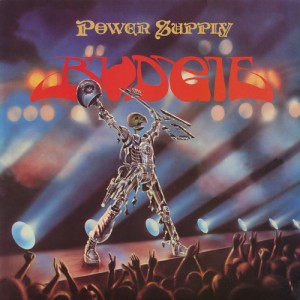
I used to be excessively harsh on this album, and, in truth, it is hard not to be harsh on an album that sounds like an unimaginative cross between Judas Priest and AC/DC. But then it might also be a little silly to accuse Budgie jumping on the early Eighties metal bandwagon, if only because Budgie had always been professional wagon-jumpers, ever since ʽGutsʼ so openly nicked off the Sabbath sound ten years before. So how could we call it a crime when, upon Bourge's departure from the band, Shelley instigated a transition into more «modern» territory?

If there's a problem here, it is with Shelley's personality. One thing that early Eighties metal de­manded was brutal, sweaty, swaggering frontmen that could match the sweat, brutality, and swag­ger of that new guitar sound — and Burke Shelley, with his lean lanky nerdy figure, whiny vocals, and encumbering bass, could hardly qualify. His voice is high-pitched enough, for sure, and he can raise it to a proper scream when necessary (see the chorus to ʽHeavy Revolutionʼ), but it has none of the steel overtones of a Brian Johnson or a Bruce Dickinson, and that scream can never turn to roar; just not the same level of aggression, sorry. Just like it's hard to imagine Geddy Lee doing a credible cover of ʽHell's Bellsʼ, or something like that.

New guitarist John Thomas is quite competent, though, I'll give them that. He can come up with riffs that are almost as good as K. K. Downing's, and he can play insane-delirious solos just like Angus Young — both these skills are immediately evident on the opening number, ʽForearm Smashʼ, where in the mid-section they nearly pull off a ʽWhole Lotta Rosieʼ. ʽHellbenderʼ and ʽHeavy Revolutionʼ are also not half-bad, riff-wise, with all those nasty tones and clever use of stock metal licks. Nothing too special, but the instrumental sections of these songs are seriously enjoyable — provided you like the not-too-experimental, ass-kick-oriented style of early Eighties metal in general, I don't see how it is possible not to toe-tap or play at least a little air guitar to these songs. They're fun.

If you try to subject them to a little closer analysis... well, don't. You might stumble upon the lyrics to ʽHeavy Revolutionʼ, which seem to be a sincere appraisal of the arena-rock image: "Our heads jumping up and down / Heavy rock bands are back in town", without a single noticeable shred of irony — quite embarrassing to see them associated with Mr. Shelley and his nerdy looks (it's a good thing that no video footage of the band from that era has been preserved). Essentially, all of Budgie's «cleverness», including those nutty song titles which used to relate them to Blue Öyster Cult, seems to have evaporated, replaced with far more explicit and provocative imagery. Not that Budgie lyrics have ever mattered much — and the words do go well with the music, they just don't go all too well with the singer.

There's exactly one power ballad in the mix (ʽTime To Rememberʼ), mediocre, but not awful (depending on whether you think the echo on Shelley's vocals — "time... time... time... to remember" — is an impressive or a stupid idea). There's exactly one song with an acoustic intro­duction (ʽGunslingerʼ) that dutifully segues into an epic rock guitar battle of life against death. There's exactly one slow rocker (ʽCrime Against The Worldʼ) that concludes the album on an almost relaxed note compared to most everything else. And most everything else taps their not-so-large «power supply» to the max. So at least they're going for it hardcore-style — no «sissy keyboards», not too much overblown sentimentality. Certainly could be worse, had they hired a less competent guitarist. But do remember that this is «Budgie 2.0», a completely different thing from what it used to be, and even if you loved Impeckable, you have to have yourself a ʽHeavy Revolutionʼ to love Power Supply.

Friday, January 22, 2016

Budgie: Impeckable

BUDGIE: IMPECKABLE (1978)

1) Melt The Ice Away; 2) Love For You And Me; 3) All At Sea; 4) Dish It Up; 5) Pyramids; 6) Smile Boy Smile; 7) I'm A Faker Too; 8) Don't Go Away; 9) Don't Dilute The Water.

A brief, if somewhat half-assed, return to hard rock quality here. Perhaps they realized that Brit­tania took things a little too far and placed them in danger of completely losing whatever little bits of identity they had. In any case, Impeckable rocks with more energy and has somewhat better riffs — but that's about it, then: not a single song has the stunning power of a ʽBreadfanʼ or the viciousness of ʽIn For The Killʼ. Which is too bad, because some stunning power and vicious­ness would have fit in very well with the look on the face of that black cat on the cover. Wait a minute, though... the cat is aiming for the budgie, right? So what is this, a hint at the dark hand of fate poised to tear the band in two?

As in some other cases as well, the best songs here are probably the first and last tracks. First one comes on as a strong imperative (ʽMelt The Ice Awayʼ), boogies like crazy, and builds a nice descending ladder in the chorus, while Bourge tries on Angus Young's speed-choked soloing style for a change. Last one is a prohibitive (ʽDon't Dilute The Waterʼ) has some well constructed sectional transitions and arguably the best riff on the album (there are several, actually, but you'll know the one when you hear it), providing us with at least one «snappy» moment (meaning that you'll actually be feeling the guitar attacking you, lashing out at your heels, rather than just doing its independent shtick somewhere out there in the atmosphere).

In between... well, some of the songs are really strange, like ʽLove For You And Meʼ, where the verse sounds like a preview of late period AC/DC (slow lumpy leaden riffage) and the chorus bor­rows its formulaic soulfulness from Foreigner; or like ʽDish It Upʼ, where they once again make the mistake of descending into funky territory. But the power ballad ʽAll At Seaʼ is surpri­singly not bad, with tasteful, lovely, melancholic harmonies in the chorus; and the return to acous­tic guitars and falsetto harmonies on ʽDon't Go Awayʼ seems to me to be more successful than ʽRiding My Nightmareʼ from their best album.

Still, it is clear that re-embracing the past is no longer an option for these guys: something went wrong, and now it is as hard for Bourge to stay sharp and inspired as it was for his senior pal Iommi that very same year (Sabbath's Never Say Die alos showed a sharp drop in quality — was it really the wind of change, or, more accurately, the New Wave of change that kicked the ground from under all these old heavy rockers' feet around 1978?). Even the best songs meander, and it never feels as if the players believe in themselves and their mission. At least Tony certainly did not: right after the album was released (and flopped), he quit the band for good.

Essentially, Impeckable was released at a turning point for the heavy metal scene — the old school ideas were running out of steam, and the New Wave hadn't quite kicked in yet, let alone the speed and thrash idioms. On the other hand, since the «refreshed» Budgie of the 1980's never truly managed to make a respectable transition to the new values, a half-hearted, meandering, transitional record like this is still preferable to whatever happened when Mr. Shelley switched his role model from Black Sabbath to Judas Priest. Seen from that angle, ʽDon't Dilute The Waterʼ is at least a fitting swan song for the classic era of this band.

Friday, January 15, 2016

Budgie: If I Were Brittania I'd Waive The Rules

BUDGIE: IF I WERE BRITTANIA I'D WAIVE THE RULES (1976)

1) Anne Neggen; 2) If I Were Brittania I'd Waive The Rules; 3) You're Opening Doors; 4) Quacktor And Bureau­crats; 5) Sky High Percentage; 6) Heaven Knows Our Name; 7) Black Velvet Stallion.

Budgie's first serious misstep on the road to oblivion — and what makes matters sadder is rea­lizing that this was not even an intentional commercial sellout, but rather a confused, uncertain attempt to branch out and experiment without any clear understanding of where they were going and why they were going there. Alas, some people are born to make their mark in many places, but some should rather stick to set formulae. Imagine AC/DC trying to play James Brown-style funk or Canterbury-style progressive rock — this is not exactly what happened to Budgie on this album, but it comes close.

The title track here, for instance, is a real mess. Opening up with a decent enough metal riff, it quickly dispenses with it in favor of a light, wimpy funk groove alternating with boring folkish arpeggios, then eventually slips into disco territory, with Shelley in full-fledged Studio 54 mode and Bourge previewing the Nile Rodgers style; all that's missing is some of those disco strings to complete the picture. Not that there's anything wrong by default with Budgie playing disco, but this particular section seems to exist only for the sake of contrast with the opening heavy metal bits — and it's a rather meaningless contrast, frankly. All the song does is waste a potentially good pun on a stupid musical synthesis where the individual parts exist only for the sake of a col­lective effect, and the collective effect is best described as "what the..."?

Worse, they are beginning to lose it even when staying in more familiar territory. ʽAnne Neggenʼ, opening the album, is an honest rocker, but they probably had so much fun shaping a monde­green from the refrain ("and again, and again, and again...") that they not only forgot to throw in a good riff, but did not even bother to bring the track up to their esteemed standards of heaviness — Bourge plays almost the entire song as quietly and cautiously as if he were afraid to wake up the neighbours. In the past, all of their albums started out with impressive heavy openers (ʽGutsʼ, ʽBreadfanʼ, ʽIn For The Killʼ, etc.) that immediately set a sympathetic tone for the entire album; ʽAnne Neggenʼ immediately sets the wrong tone, as if we are being introduced to a forced change of musical diet for health reasons.

As we go further and further, corrections to these mistakes are not being made. The ballad ʽYou're Opening Doorsʼ sounds like another preview — to bad Foreigner. ʽQuacktor And Bureau­cratsʼ at least starts out with a thick, distorted tone for the rhythm guitar, but hopes for something crunchy and snappy are quickly dissipated as the song proves to be a fairly (sub-)stan­dard baroom rocker with totally predictable chords and no musical development whatsoever. ʽSky High Percentageʼ is a generally okay, but unmemorable piece of boogie, and the second ballad just completely passes me by.

In the end, there is exactly one song worth salvaging off the album: ʽBlack Velvet Stallionʼ some­how succeeds as an epic piece despite the melody hanging upon a four note syncopated bass/rhythm guitar riff throughout, the kind of phrase that tends generally to be used for tran­sitions from one section of the song to another. However, Shelley manages to inject a good dose of the old «Budgie sorrow», and Bourge finally gets a chance to unleash some inventive soloing, going from minimalist, almost ambient mode into a series of scorching bluesy licks and then building up to an awesomely climactic coda. What exactly prevented them from featuring the same level of intensity on all those other songs, I have no idea.

Usually, when trying to explain such failures, people pronounce the word «drugs» (which is a great universal key to everything — as we know, both the greatest music ever and the shittiest music ever always owe their success/failure to drugs), but I don't even know if drugs were invol­ved in the first place. More likely, they just said to themselves at one point, "Hey! We're doing great, but it's all because we have awesome riffs and guitar solos. Why don't we show them how great we can do if we toss away the awesome riffs and guitar solos? If we were Brittania, we'd waive the rules, you know!" I almost hate to be giving this a thumbs down, because deep down inside, I respect failed experiments, but these failed experiments aren't even particularly fun to listen to for the sake of understanding where and how they failed. And one good song out of seven, coming on as a comforting bonus for your patience, does not count for much.

Friday, January 8, 2016

Budgie: Bandolier

BUDGIE: BANDOLIER (1975)

1) Breaking All The House Rules; 2) Slipaway; 3) Who Do You Want For Your Love; 4) I Can't See My Feelings; 5) I Ain't No Mountain; 6) Napoleon Bona-Part, pts. 1 & 2.

Arguably the last album of Budgie's «classic» period, Bandolier is also fairly short — just six compositions, with the long ones being fairly repetitive at that. Nevertheless, it is hard to guess that they were running out of steam, because on the whole, the results are quite satisfactory. The music is a little less heavy than last time (nothing even remotely approaching the evil bass blasts of ʽIn For The Killʼ), but still heavy enough and riff-a-licious enough to keep the entertainment value high while they're poking around basic boogie, funky R&B, and faintly proggy flourishes. Oh, and they have yet another drummer here, Steve Williams, although I honestly can't tell where he is to be found on the album sleeve — those parrakeet heads are quite confusing.

Anyway, the spot to aim for here is the epic ʽNapoleon Bona-Partʼ. The first part is a rather in­conspicuous, melancholic acoustic/slide ballad, but the second is a vicious galloping monster with a chuggin' riff that is half-thrash and half Morricone, heroic vocals and solos, and a brace-yourself race to the end; the bit where Tony enters with yet another high-pitched, banshee-wailing counter-riff at around 5:20 is, in fact, my single favorite sonic moment in the entire Budgie cata­log — the perfect answer to that eternally nagging question, «how to double the excitement when it's already there?» With a little nudge to the imagination department, you could also think of that second part as a musical representation of a Napoleon cavalry assault — crushing everything in its path as presumed, but then suddenly disappearing into thin air. Kind of agrees with the Napoleo­nic fantasies of the protagonist, too — and, come to think of it, they were almost ready for their own Waterloo just as well, if you pardon the triteness of this remark.

Next to ʽNapoleonʼ, the opening long number is a bit more primitive and lightweight, but I still respect it how the band is able to take one of the world's most obvious five-note sequence and pro­mote it like The Riff To End All Riffs, returning to it over and over and over until it suddenly begins to produce a mantra-like effort, especially at the end, where there's, like, no escaping it — the band should have stopped long ago, but it just keeps returning and returning, like a homeless dog that can endear itself to you by stubbornly sticking around, until it feels like family despite your strongest psychological resistance. Maybe this is what they really mean by ʽBreaking All The House Rulesʼ, although, actually, the song is about a family man succumbing to some fleshy temptation. Can you imagine a nerdy, freaky fellow like Burke Shelley succumbing to temptation? On the other hand, it doesn't seem like he is the one taking the initiative here.

The rest of the album is spottier: ʽWho Do You Want For Your Loveʼ starts out on the wrong note, either as an unfunny parody on or an unsuccessful imitation of a sentimental funk ballad, then picks up a more proper groove, but still refuses to match the awesomeness of ʽZoom Clubʼ; the ballad ʽSlipawayʼ has some pretty solos, but little else; ʽI Can't See My Feelingsʼ, later co­vered by Iron Maiden, relies too much on borrowed chords (from ʽSunshine Of Your Loveʼ, ʽFoxy Ladyʼ, and a couple Sabbath songs) to provide much of a memorable melody; and what the hell made them go out and cover Andy Fairweather-Low? ʽI Ain't No Mountainʼ sounds like a really, really stupid hillbilly joke, a barroom rocker without any redeeming humor to it. Would the next step be Gary Glitter? This just isn't like Budgie at all.

Still, that one kind of embarrassing song aside, the rest of the album ranges from awesome (the bookmarking tunes) to passable (everything else), and to me, that is enough for a modest thumbs up rating, particularly since after 1975, such ratings would be harder and harder to come by. You can already see the beginning of the demise — the fate of this band was always directly depen­dent on the strength of Tony's riffs, and with the musicians moving into other, less riff-dependent directions, they would inevitably lose out. But Bandolier still features barely enough of the clas­sic, vintage Budgie style to make the jump. As to whatever follows — buyer beware!

Friday, January 1, 2016

Budgie: In For The Kill

BUDGIE: IN FOR THE KILL (1974)

1) In For The Kill; 2) Crash Course In Brain Surgery; 3) Wondering What Everyone Knows; 4) Zoom Club; 5) Hammer And Tongs; 6) Running From My Soul; 7) Living On Your Own.

Despite some minor inconveniences, such as the departure of drummer Ray Philips (replaced by Pete Boot), at least the first side of Budgie's entry for 1974 is as strong as anything they ever did; maybe even stronger than anything they ever did, if you consequently test all four links in this chain. The title track borrows its introduction from Jeff Beck's cover of ʽI Ain't Superstitiousʼ, but then quickly segues into an original monster riff, one of Budgie's heaviest ever — think Sabbath's ʽChildren Of The Graveʼ with the accents reversed, so you get a lumbering Godzilla instead of a charging T. Rex. There's not much more to the song than the riff and how well it agrees with the chorus tagline ("...the meaning of life is I'm in for the kill"): the bridge section devolves into run-of-the-mill blues-rock, and they couldn't think of a good coda, so they just fade it out after a while. But that riff, woohoo boy, I could listen to it for the entire six minutes. Such a deep, crisp, re­freshing guitar tone to go along with it. Snappy!

The two short songs that ensue, likewise, represent one of Budgie's best rockers and one of their best ballads. ʽCrash Course Surgeryʼ, later covered by Metallica along with ʽBreadfanʼ, is actual­ly remixed from a much earlier version, originally released in 1971 as a single (so it features Ray Philips on drums). If anything, it is this band's answer to ʽParanoidʼ — the same type of short, concise, anguished heavy rocker with a nagging, repetitive riff racing along the short track with grim determination — and although the level of intensity is not nearly as high (mainly because this riff is not tying our attention to a single note), it is still an excellent specimen of the «crash course» approach to heavy metal. And then, finally, with ʽWondering What Everyone Knowsʼ, Budgie emerge with an excellent acoustic ballad — going for a depressed-melancholic rather than sweet-romantic attitude, which suits Shelley's vocals much better. The lyrics are too obscure to allow for a straightforward interpretation (lost love? dearly departed? cold turkey? whatever), but this only works to the song's advantage as it conveys an atmosphere of general confusion.

Finally, there's ʽZoom Clubʼ, a lengthy epic with funky and progressive overtones, possibly in­spired by some of Zeppelin's work on Houses Of The Holy, but also, in a way, presaging much of Zep's subsequent work on Physical Graffiti (Bourge's guitar work on the song's first two mi­nutes should remind you of the likes of ʽCustard Pieʼ, ʽTrampled Underfootʼ, etc.). Shelley cooks up a vocally challenging chorus (the resolution on the "..move on, music man!" bit of the chorus is quite unusual and unexpected), and Bourge throws in a long instrumental passage, alternating funky riffage with bluesy solos in a way that should have definitely earned some respect from Jimmy Page: the song is totally on the level, and at nearly ten minute length, it does not feel parti­cularly overlong due to the never-slackening intensity of the groove.

Unfortunately, they do seem to run out of great ideas on the second side, with three more songs that never stick around for too long. ʽHammer And Tongsʼ is slow, lumpy blues-rock that is so utterly derivative of ʽDazed And Confusedʼ that it isn't even funny. ʽRunning From My Soulʼ is a piece of generic boogie blues, which is not what this is band is really about. And ʽLiving On Your Ownʼ is another epic piece, but this time devoid of memorable riffs — then, for some rea­son, it transitions into an uncredited cover of ʽBeck's Boleroʼ (Jeff could have very easily sued the band, except that the instrumental's authorship has always been problematic — there's a still un­resolved dispute between Beck and Page over the priorities), before returning to the original un­focused melody. Not particularly bad, just lacking in inspiration.

Nevertheless, the first side alone is worth stating that Budgie had entered the mid-Seventies with enough dignity, and were going to survive at least into the late Seventies era; the album clearly deserves its thumbs up, at least as a 20-minute long near-perfect EP with 20 more minutes of take-it-or-leave-it bonus tracks. And, might I add, that's a pretty mean-lookin' budgie out there on the album sleeve. Shouldn't they have renamed themselves "Killer Eagle", given the chance? I mean, just think about how the name "Budgie" must have negatively influenced their sales among the hard rock crowds...

Sunday, December 27, 2015

Budgie: Never Turn Your Back On A Friend

BUDGIE: NEVER TURN YOUR BACK ON A FRIEND (1973)

1) Breadfan; 2) Baby Please Don't Go; 3) You Know I'll Always Love You; 4) You Are The Biggest Thing Since Powdered Milk; 5) In The Grip Of A Tyrefitter's Hand; 6) Riding My Nightmare; 7) Parents.

Smart move — replacing Rodger Bain with Roger Dean. After all, when it comes to production Budgie could very well be their own producers, but when it comes to painting your album sleeve, none of the band's members could draw worth a damn, so why not hire the hippest of the hip? The style is immediately recognizable; the only question is, will that style be superimposed on music that will be closer in sound to Yes — or to Uriah Heep?

The answer is neither. The album cover may be colorful and enigmatic (what the hell is that guy doing with that mutant eagle?), but Budgie stubbornly remain a heavy rock band above every­thing else — only one track on here displays extra «progressive» ambitions, and, to be honest, they are not even the kind of ambition that Black Sabbath displayed that very year, when they got Rick Wakeman to play for them a bit. To compensate for this, though, they tighten up their for­mula to the max: there is really no other Budgie album where they would kick ass on such a consistent, inventive, and, might I add, intelligent basis. (Yes, kicking ass can actually require inventive­ness and intelligence).

Of course, I suppose that the true reason why this record is usually brought up as Budgie's finest hour is ʽBreadfanʼ — not only would that be the only Budgie song to be revived and popularized in the future (by Metallica), but it is clearly also the Budgie song, period; the one that, in Mick Jagger's own words, "makes a dead man come". Bourge's opening riff is so good that the band repeats it over and over for almost a minute before Shelley starts singing — a classic combination of speed, precision, and fury that predicts the stylistics of thrash metal a good decade before thrash metal. There's other goodies scattered around, too — like the hilarious (anti-capitalist?) lyrics with nursery rhyme elements, or the slightly creepy dark-folk acoustic bridge; but essen­tially it's all about the riff, and if you think the song is too abusive and repetitive, well, it's meant to be that way. It must actually be quite a chore, I suppose, to be able to play that tricky riff so many times in a row so quickly without making any mistakes — of course, with the advent of Slayer and Megadeth this all became standard practice, but I honestly don't know a single other track from 1973 that would have a riff like ʽBreadfanʼ's.

Still, the album is much more than just ʽBreadfanʼ. Their cover of ʽBaby Please Don't Goʼ, which they borrowed from Them (and the Amboy Dukes) rather than Muddy Waters (and which would later be re-borrowed by AC/DC), has the crunchiest rhythm sound of all these covers and an ex­cellent slide guitar solo that puts Ted Nugent to shame (and I am quite a fan of Ted Nugent's guitar playing) — AC/DC would have more fun with the track, but this one's my bet if you want a stone cold dead face to go along with it. ʽYou Are The Biggest Thing Since Powdered Milkʼ could certainly live a healthier life without the silly «phased» drum solo that eats up almost two minutes, but other than that, it is still a major riff-fest, even if it is arguably the most Sabbath-de­rived tune here (particularly when the second, boogie-oriented, part comes along).

On Side B, you have the magnificent ʽIn The Grip Of A Tyrefitter's Handʼ, where Tony has a brilliant idea — chop the minimalistic four-chord riff in two parts and place both of them in dif­ferent channels, so you get the effect of two guitars chatting with each other in point / counter­point mode; beyond that, the instrumental breaks totally dispense with solos in favor of an extra bunch of riffs, including an oddly tuned «pseudo-Eastern» one. And then there is ʽParentsʼ, a 10-minute epic about the perils and insecurity that await you upon graduating from Dad's and Mom's care — not a particularly innovative or insightful topic, but somehow they manage to get the tragic vibe just right. I still don't know why they thought it useful to mimic a seagull squad on top of these solos, but apparently «seagulls shrieking» = «thunderstorm coming», and that's, like, a metaphor for the perils of grown life once you're ripped out of your safety net. Anyway, it's a major improvement on ʽYoung Is A Worldʼ and arguably Budgie's best attempt at a sentimental, heart-on-sleeve, and simultaneously heavy/thunderous epic.

In the end, my only gripe with the album are the acoustic links — ʽYou Know I'll Always Love Youʼ and ʽRiding My Nightmareʼ definitely overdo the soft-and-tender thing, and Shelley's fal­setto actually grates on my nerves far worse than his normal «bleating» on the harder tracks: there is something very unnatural about his trying to pass for Art Garfunkel. Fortunately, that's just two short tracks that can be skipped if you find this style an irritant, too.

No unreasonable expectations, please — ʽBreadfanʼ may indeed contribute their most significant contribution to the world of heavy music, but other than that, Never Turn Your Back On A Friend is just a solid piece of work in an already well-functioning and properly explored area. But it is a solid piece of work: I mean, if a band can be complex-and-catchy (ʽBreadfanʼ) and simplistic-and-catchy (ʽIn The Grip...ʼ) on the same album, it's gotta count for something. Deri­vative or not, Tony had the golden touch at the time, and even made a few tentative moves to wiggle himself out from under the other Tony's shadow (even ʽIn The Grip...ʼ sounds like nothing Sabbath ever did up to that point, let alone ʽBreadfanʼ). Clearly a thumbs up here — this record is a must-hear for any hard rock fan, even those who have a natural aversion towards Roger Dean covers, because you can sometimes find a Jon Anderson hiding underneath.

Sunday, December 20, 2015

Budgie: Squawk

BUDGIE: SQUAWK (1972)

1) Whiskey River; 2) Rockin' Man; 3) Rolling Home Again; 4) Make Me Happy; 5) Hot As A Docker's Armpit; 6) Drugstore Woman; 7) Bottled; 8) Young Is A World; 9) Stranded.

This was originally my introduction to the Budgie sound, and so I am somewhat partial to their second album, even though, when you put it in the proper context, it loses to the self-titled debut in terms of freshness and to their third album in terms of polish and ambition. Still, it seems clear enough that Squawk is not just a mechanical retread of Budgie: in the year 1972, broade­ning of the horizons was still considered more noble than locking oneself into a tight, never-changing formula, and next to Budgie, Squawk has a bit more of everything — more acoustic numbers, a stronger folk and even Delta blues influence, and a small, but solemn progressive streak that suggests Moody Blues and King Crimson as humble, but insistent competitors to Black Sabbath as the band's primary musical mentor.

Two tracks in particular stand out, each one illustrating a different facet of the band. On the in-yer-face blood-and-guts hard rock front, the neorealistically titled ʽHot As A Docker's Armpitʼ is an early classic, with a super-catchy pop-metal riff whose notes are precisely echoed by Shelley's vocals (even if it requires introducing a rather silly stutter) and a speedy mid-section with one of Bourge's speediest solos ever played (possibly influenced by ʽChild In Timeʼ), while the final section, with its bolero structure, plays out like a Jeff Beck tribute. Derivative as heck, yes, but its swagger cannot be beat — and while it is possible to be distracted or irritated by Shelley's «goat» vocals, I think they work very well in the context of this ironic, irreverent music that never asks you to take itself too seriously. There's some sort of early proto-hipster snootiness about all this that could be despised in a different context, but comes across as delightfully hilarious when you remember all the «serious» hard rock bands playing around in 1972 — yes, even Deep Purple.

The second track is ʽYoung Is A Worldʼ, showcasing Budgie's romantic / sentimental / artsy-folksy side — their initiation, in fact, into this tricky world, and a fairly successful one. The acoustic introduction, the Mellotron touch, Shelley's oddly seductive declarations of "I can be big" and "I can be small", Bourge's massive infusions of thick riffs and droning solos that come and go while the main romantic theme keeps returning — all of this is not exactly King Crimson quality, but a reasonable facsimile; at the very least, this helps them break out of Sabbath's sha­dow, since Sabbath themselves would not begin their own «artsy» phase until a year later. Even outside of any context, though, ʽYoung Is A Worldʼ is just a nicely pulled off epic track, and Shelley in particular plays the part of a naïve wild child very convincingly — he should have actually sung more often in this high-and-deep register.

The rest of the material, though not as immediately hooky or epic, is still quite consistent. ʽWhis­key Riverʼ cleverly introduces a funky vibe into an otherwise generic blues-rocker (Ray Phillips' drumming is particularly recommendable here); ʽStrandedʼ begins like it wants to rip off Jimi's ʽIf 6 Was 9ʼ, but then moves into Zeppelin territory instead and becomes their answer to ʽWhole Lotta Loveʼ; ʽBottledʼ is a short and cool slide guitar instrumental (hence the title); and on ʽRol­ling Home Againʼ, Budgie become the Monkees and play a friendly little country-pop ditty, which sounds totally out of outer space in this context, but feels like a very welcome companion. I am definitely not a fan of such relatively by-the-book blues-rockers as ʽRockin' Manʼ and ʽDrugstore Womanʼ (the titles kind of speak for themselves), but I don't have anything against them, either — there's enough sectional changes and plenty of energy to keep them afloat without raising too much interest.

Nevertheless, I do have to admit that if Squawk happened to be the last record by this band, any memory of it would have washed out fairly quickly. Its thumbs up are perfectly well guaranteed, but it is not here, no, that Budgie would briefly turn into an unstoppable monster on the brink of dominating the hard rockin' scene. To do that, they'd need to tighten and sharpen their act some more — and one element of that was shedding their Sabbath skin completely, by getting rid of Rodger Bain in the producer's chair.

Sunday, December 13, 2015

Budgie: Budgie

BUDGIE: BUDGIE (1971)

1) Guts; 2) Everything In My Heart; 3) The Author; 4) Nude Disintegrating Parachutist Woman; 5) Rape Of The Locks; 6) All Night Patrol; 7) You And I; 8) Homicidal Suicidal.

Apparently, the distance between Birmingham, England, and Cardiff, Wales is smaller than 120 miles — no wonder, then, that the stylistic difference between early Budgie and early Black Sab­bath is so tiny, your first and fully legitimate reaction should be: «Rip-off! Inferior rip-off!» Of course, this is actually better explainable by the fact that all these early albums shared the same producer, Rodger Bain; having just completed work on Sabbath's Master Of Reality, he clearly had little strength or desire left to search for a different sound when faced with the task of producing ano­ther hard rock-oriented bass/drums/guitar combo.

Indeed, when that low, rumbling, carnivorous seven-note riff of ʽGutsʼ breaks through the audio channels, then gets augmented by the rhythm section several bars later, then finally gets comple­ted with another, more high-pitched but even more mean and hungry second guitar overdub, dif­ferentiating this sound from classic Sabbath is downright impossible without prior knowledge. This is, in fact, precisely the same type of sonic buildup that Bain had just engineered on ʽSweet Leafʼ and a few other Sabbath songs. And since that sound was clearly in high demand at the time, we can hardly blame the band for embracing it. The question is: does it hold up? After all these years, is there a safe place for Budgie on your shelf next to Paranoid?

My own answer would be a definitive yes, because behind all the superficial similarities, Budgie are actually quite a different band from the Sabs. Although not exactly a «thinking man's heavy metal group», their heaviness was not so much due to their fascination with B-movies and the occult, but was rather inherited from the psychedelic excesses of Vanilla Fudge and Blue Cheer, to which they added a tongue-in-cheek attitude and a sense of irony that presaged and predicted Blue Öyster Cult. Oh, and let us not forget the thin, nerdy, bespectacled countenance of bass player and helium-voiced lead singer Burke Shelley — the earliest prototype for Mr. Geddy Lee, with whose four-letter band these guys also share occasional similarities (particularly if you think of Rush's first couple of albums, before they went all-out Ayn-randian on us).

None of that would matter, though — we could just keep treating these guys as second-rate imi­tators or pale predecessors of their betters — if their songs weren't so well-written. The key to enjoying Budgie is the same as the key to enjoying the Sabs: if the riffs are good, the songs are swell, but if the riffs are boring, the songs are shite. And in Tony Bourge, the band had the great luck to own a riffmeister who, while not quite on the same level with the other Tony (Iommi), still had a God-given knack for simple, meaningful, powerful note sequences delivered in delici­ously fuzzy «earthquake tones». Like the one in ʽGutsʼ, yes — a giant mutant mole burrowing through your back yard regardless of any obstacles. Just run for your lives.

Like Sabbath, Budgie prefer drawn-out, multi-part compositions, where slow parts alternate with bits of boogie (and, for what it's worth, they're actually better at boogieing than their occultist Birmingham brethren); in between we may find a few short acoustic «links», but they are really not necessary here — minute-long snippets of Burke Shelley romancing the band's potential girl fans before turning his full attention to the band's potential boy fans: "yes, you are everything in my heart", even repeated four times, is not nearly as convincing as the protagonist's psychosleazy visions of a ʽNude Disintegrating Parachutist Womanʼ, descending upon him on the clouds of yet another classic early stoner rock riff. That song, by the way, with its nearly nine-minute running length, is the clear central point of the album, and a fabulous ride it is — first in its hazy slow part, then in the lengthy speedy boogie escapade, probably influenced by the Amboy Dukes' ʽBaby Please Don't Goʼ (which they would later cover directly) and Deep Purple's ʽWring That Neckʼ in equal degree. Bourge gets a good solo on that part, but really Budgie sound their best when the guitar and the bass player are galloping along in complete unison — for one thing, Budgie could be really incredibly tight, far tighter than the Iommi/Butler/Ward combo ever got to be.

My only gripe is that at this early point, the Budgie formula is not quite ripe yet; they'd polish it to near-perfection on the next two albums, but here, they are sometimes too obsessed with the ly­rical message over the musical substance (ʽRape Of The Locksʼ, a stereotypical rant in defense of long hair as part of one's ego — heavy on accusations, low on A-level riffs), and have not yet learned to seamlessly integrate soft acoustic and heavy electric parts (ʽThe Authorʼ seems like a mere warm-up to similar numbers on Squawk). But in the face of classics like ʽGutsʼ, ʽParachu­tist Womanʼ, and ʽHomicidal Suicidalʼ, this is but a minor gripe.

Derivative as hell, Budgie is still instantly likeable — which is far more than I could say about similar «derivative» albums by modern day acts like Black Mountain, to whom you still have to warm up for quite some time. Just goes to show that you can't kill the vibe — back in 1971, there was this special something in the air that allowed you to put out a really solid album in somebody else's style (styles), even if you had no truly groundbreaking ideas of your own. Well, other than naming your grizzly Welsh band after a pet parakeet, of course. That alone could be worth a thumbs up, but fortunately, there's also a bunch of kick-ass songs here as a bonus.