Search This Blog

Saturday, January 12, 2013

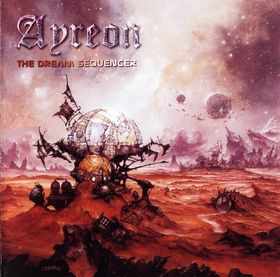
Ayreon: Universal Migrator


AYREON: UNIVERSAL MIGRATOR (2000)

Part I – The Dream Sequencer: 1) The Dream Sequencer; 2) My House On Mars; 3) 2084; 4) One Small Step; 5) The Shooting Company Of Captain Frans B. Cocq; 6) Dragon On The Sea; 7) Temple Of The Cat; 8) Carried By The Wind; 9) And The Druids Turn To Stone; 10) The First Man On Earth; 11) The Dream Sequencer (reprise);
Part II – Flight Of The Migrator: 1) Chaos; 2) Dawn Of A Million Souls; 3) Journey On The Waves Of Time; 4) To The Quasar; 5) Into The Black Hole; 6) Through The Wormhole; 7) Out Of The White Hole; 8) To The Solar System; 9) The New Migrator.

Technically, these are two albums: breaking slightly with Ayreon's standard pattern of releasing 2-CD packages, Lucassen decided to split his «prog» and «metal» sides, releasing the first half of Universal Migrator as a special treat for the «artsy types» and the second half for the «metal­heads». Consequently, on a formal basis Part I: The Dream Sequencer and Part II: Flight Of The Migrator count as separate entries in the discographies and tend to earn separate reviews. However, I see no reason to follow this tradition, since: (a) a 2-CD deal is a 2-CD deal, and no renegading will be tolerated; (b) the concept and storyline are sort of continuous, after all; (c) al­though Arjen does formally enforce the musical boundaries, what with the first album all ruled by electronic textures and acoustic guitars, and the second completely dominated by heavy electric riffage and soloing, the «B-movie spirit» that guides the man is always the same anyway. Plus, above and beyond all that, I am not sure if I have enough impressions to carry me through two different reviews here.

Although, on second thought, I could have, because, once you get to at least partially assimilate the expected sprawl, The Universal Migrator is no less fun than Into The Electric Castle — in fact, it is more fun, because this time, the underlying story, while still a story, functions more like a flimsy framework for a set of autonomous musical landscapes. Formally, it is a sequel / prequel / interquel / whatever (with time travel in the picture, you never know) to The Final Experiment, describing the hallucinations of the last man left alive after humanity's extinction — in The Dream Sequencer, he travels through several different historical epochs, and in Flight Of The Migrator, takes stuff to a whole different level by heading straight for the Big Bang... and never coming back, so it seems, but enough of that.

For the first CD, the basic inspiration was clearly Pink Floyd — the instrumental introduction brings to mind both Wish You Were Here and The Wall at the same time, and then there is this idea of musically capturing a patch of bleak desperation and loneliness, puffed up to universalist levels... ring a bell? No, it is not expressed with comparable ferocity — maybe because there is no autobiographic value in these compositions — but there is a pretty nifty fanfare theme nestled in the depths of ʽMy House On Marsʼ (although it would probably have been more effective if played with real fanfares rather than Arjen's well-worn synthesizer equipment).

What really won me over in the course of Disc 1 was ʽThe Shooting Company Of Captain Frans B. Cocqʼ — not only is the song named for the «authentic» title of the painting we usually know as The Night Watch, but it is actually an attempt at a «musical translation» of Rembrandt's mas­terpiece, trying to recreate with electronic textures, dark guitar solos, and psychedelic, phased vocals straight out of 1967 (courtesy of Tuesday Child's Mouse) that shadowy mystique of van Rijn's trademark style. Maybe it does not succeed, or maybe it does, but the point is — the idea itself is fairly extravagant, and totally unconventional, for a guy usually perceived as a sci-fi / D&D / B-movie freak. Besides, regardless of the context, the song simply has a catchy chorus and an impressive guitar theme to it.

Dancing out from that starting point, there's more — ʽDragon On The Seaʼ, with lyrical referen­ces to the fleet of Queen Elizabeth, is an exuberant folk-prog epic, overdubbing bleeping electro­nic patterns over folksy acoustic strum and making it work; ʽTemple Of The Catʼ features a love­ly vocal part from Jacqueline Govaert and samples from a Maya festival; and ʽThe First Man On Earthʼ, with vocals from Spock's Beard's Neal Morse, is a fairly friendly and upbeat song for a subject as grim as the first appearance of Homo sapiens on the planet. Diversity is the key — as the hero moves from locus to locus, the music incorporates more and more influences; the only bad news is that the instrumentation lacks the appropriate diversity — guitars and keyboards ex­press most of the moods, where sometimes mandolins or pan pipes would be more welcome. Oh well — budget is budget.

The second part, Flight Of The Migrator, was almost universally panned by reviewers when compared to the first part, and for a good reason: the idea to filter out the metal from Dream Se­quencer and tightly pack an entire sixty-five minute disc with it really did not work. For it to work, Arjen would need to at least be a first-rate metal-riff writer — but most of the riffs hardly strike me as being original or inspiring. Where Dream Sequencer is an imaginative neo-prog record, Migrator is, overall, rather pedestrian power metal.

Lucassen's personal charm did help him to engage a whole swarm of notorious metal singers — Bruce Dickinson himself, for instance, pulls ʽInto The Black Holeʼ out of the black hole of un­memorable melodies, and then there are guys from Stratovarius, Primal Fear, Helloween, Thres­hold... pretty impressive heap, unfortunately, saddled with mediocre and monotonous material (and where the monotonousness is broken, it is broken with the same synthesizer fanfares, as in ʽDawn Of A Million Sunsʼ, of which we'd already had our full share on Sequencer).

Only once does this rather boring journey to the beginnings of the Universe break out of its set pattern: as the hero goes ʽThrough The Wormholeʼ, the tempo picks up — they aren't, after all, called «wormholes» because you're supposed to move through them like a worm — and a merry jackhammer-ish thrash-boogie rips your speakers in half, reminding of the old trickster school running from Van Halen to Extreme. Aaaaah, kick-ass! Unfortunately, it is one of the shortest tracks on the album — a measly six minutes.

Still, if you are a really big fan of power metal, I guess the guest vocalists alone, who all seem to be quite seriously into this stuff, will provide sufficient reason to own the album. And by combi­ning the two parts of Universal Migrator, I have cunningly gotten rid of the necessity to award Ayreon with another thumbs down — the first half is an unquestionable thumbs up, and the se­cond half is... well, think of it as a really large bonus for the metalheads. Oh yes, and the hero dies at the end, but his soul manages to merge with the Universal in the process, restarting the cycle of life from the beginning, so, theo­retically, you will be able to listen to this record an infi­ni­tesimal number of times — might as well try to enjoy it, for lack of a better alternative.

Friday, January 11, 2013

Bad Religion: 30 Years Live


BAD RELIGION: 30 YEARS LIVE (2010)

1) Fuck Armageddon, This Is Hell; 2) Dearly Beloved; 3) Suffer; 4) Man With A Mission; 5) New Dark Ages; 6) Germs Of Perfection; 7) Marked; 8) A Walk; 9) Flat Earth Society; 10) Resist Stance; 11) American Jesus; 12) Social Suicide; 13) Atheist Peace; 14) Tomorrow; 15) Won't Somebody; 16) Los Angeles Is Burning; 17) We're Only Gonna Die.

I suppose that every band that has managed to last for 30 years — yes, even Chicago! — is en­titled to a live album commemorating such a jubilee, particularly if it is offered as a free down­load, so that nobody has any official reason to complain: if you don't want it, pretend it never existed, and don't worry about your refunds. And besides — honestly, not every rock'n'roll band will last 30 years without losing a single vibration of their original sound. Of course, sticking to hardcore regulations helps a lot: unlike, say, The Rolling Stones, you have to keep yourself in super-tight shape at all times to match the format. No matter how many chords are involved — throw yourself off the rhythm once or twice and you're dead. From that point of view, 30 years on, Bad Religion are, indeed, very much alive.

Most sources state that the 30-year jubilee tour went a notch higher in pomposity than usual: every night, the band would play exactly 30 songs, which extended the preferable length of the show to about twice as long as required by everybody's understanding of the norms of hardcore. (For some reason, they only played about 20 dates, though, which drags down the symbolic value of the tour). Furthermore, no single setlist repeated itself more than once, assuring us all that Bad Religion are capable of such endearing silliness as memorizing their entire catalog (not that it should require a particularly large stock of memory cells, but Graffin does have to remember all the words, not to mention spitting 'em out at rapid-fire rates — that university degree has got to count for something, after all).

Disappointingly, the resulting album only has 17 songs, clocking in at a measly 41 minutes — a strange decision, since a 70-minute download with thirty songs in 2010 would hardly result in overclocking anybody's bandwidth. The «defective» setlist consequently overlooks several key albums — nothing from No Control or The New America, for instance — and is heavily biased towards the «new shit», with around three songs each for the new albums and even a preview of a couple numbers from the upcoming Dissent Of Man. Obviously, this is supposed to mean that even thirty years into their career, Bad Religion are still as relevant for the world as they used to be — and even though we might be sick to death of them already, we still have to admit that, in a way, this is absolutely true.

Rating this album feels useless: the performances are predictably top-notch and just as predic­tably predictable, with both sides canceling out each other's excitement and boredom. The setlist does tilt somewhat into the «non-hit» direction: many of the oldies and most of the «newies» are either second-row singles or non-singles, so you get a chance to refresh stuff like ʽMarkedʼ or ʽTomorrowʼ in your memories. And, conspicuously, the album both opens and closes with a num­ber from How Could Hell Be Any Worse?, implying that, perhaps, after all, the band does acknowledge that it already had said it all on their first LP — and that everything that followed was just for the pinheads who didn't get it straight the first time. Other than that, there is really nothing else to prompt any serious mental activity on the part of the reviewer.
 

Thursday, January 10, 2013

Banco Del Mutuo Soccorso: Io Sono Nato Libero


BANCO DEL MUTUO SOCCORSO: IO SONO NATO LIBERO (1973)

1) Canto Nomade Per Un Prigioniero Politico; 2) Non Mi Rompete; 3) La Città Sottile; 4) Dopo... Niente E Più Lo Stesso; 5) Traccia II.

This record is less known than Darwin! — for a technical reason, I believe, since «second-row» progressive rock (or any rock, for that matter) bands tend to be illustrated in textbooks by just one album, and Darwin! is an obvious choice due to its thematic cohesion. «Italian prog-rockers break through with an album centered on evolution», etc. This follow-up, in comparison, tends to be overlooked: it is not as thematically coherent, has fewer songs, and a long Italian title that, even if it is really hardly in any need of translation, is still a long Italian title.

However, it is every bit as good as Darwin!, and, perhaps, in some ways even better. It does suf­fer from the usual standard issue: ʽNon Mi Rompeteʼ is yet another in the ongoing series of Banco's ro­mantic Mediterranean ballads that will either make you swoon — or cringe, depending on your genetic constitution and social upbringing. Personally, I would gladly do with just the lovely folk patterns from Marcello Todaro's guitar, watching them gradually turn psychedelic through added phasing effect and form the backdrop for Vittorio's «whistle-synth» solo. Alas, I also have to live with DiGiacomo's «proverbially beautiful» singing — but if you are a fan of that style, it is probably done perfectly.

But other than the ballad (which would, of course, go on to become a crowd favorite), the album is dang near impeccable. ʽCanto Nomadeʼ (ʽA Nomad Chant For A Political Prisonerʼ) follows up on the album title — a 15-minute suite devoted to issues of personal and political freedom that mixes classic symph-prog, folk motives, noise, jazz-fusion improvisation, and a weird tribalistic percussion-dominated section without any seeming effort, as if to prove us the point about being born free. The individual themes are not exceedingly striking on their own, but, as in all of Ban­co's best works, they have this seductive lightness and fluency to them — the track hops along butterflyishly, from flower to flower, right down to the finale, where, fed up with nectar, it finally makes the landing with a swift and satisfied bombastic thud.

Side B is dominated by two shorter epics: ʽLa Città Sottileʼ is a dark mid-tempo piano-based epic, and ʽDopo... Niente E Più Lo Stessoʼ, opening with the album's catchiest theme — a strange «pas­toralesque jig» that almost sounds childish in comparison to everything else — soon turns out to be the album's resident rock piece, with heavy electric riffs, aggressive drum patterns, and a steady build-up to a state of barely-controlled instrumental chaos... before switching back to the little-boys-and-girls whistling dance once again at the very last moment.

Does it all «make sense»? Not in any objective manner — more than anything else, Io Sono Nato Libero simply seems carried away by its flow: other than the carefully pre-composed ʽNon Mi Rompeteʼ (and the brief final crescendo theme of ʽTraccia IIʼ, ending the album with an appropri­ate slice of stately majesty), the boys are working according to the «try anything» principle, as long as the «any­thing» in question does not carry them too far away from the shores of melody, harmony, and purity (such things as «feedback» or «atonality» do not seem to be favored in Ban­co's lexicon). But that is one hell of an exciting flow anyway — as usual, not bent on lengthy «noodles-style» soloing, but on carrying on a lively dialog between various instruments, one that never sticks too long around a single topic. Hence, it never becomes boring, and hence, there is always a good pretext to return to the album again. Thumbs up.

Check "Io Sono Nato Libero" (CD) on Amazon

Wednesday, January 9, 2013

The Band: Jubilation


THE BAND: JUBILATION (1998)

1) Book Faded Brown; 2) Don't Wait; 3) Last Train To Memphis; 4) High Cotton; 5) Kentucky Downpour; 6) Bound By Love; 7) White Cadillac (Ode To Ronnie Hawkins); 8) If I Should Fail; 9) Spirit Of The Dance; 10) You See Me; 11) French Girls.

Of the three «sorta-reunion» albums released by «The Band», it is usually only Jericho that gets a decent rap — having expressed the obligatory respect towards the legendary minstrels of Ame­ricana who are back «at it» again, the critics and the public quickly went on to forget about their presence, and the pig with the evil grin on his face was no big help either. Most critical sources either ignore these records, or give all of them a more or less equally condescending pat on the back. And it's not as if there weren't a good reason behind such behavior.

That said, I find myself just a wee bit more partial towards Jubilation, the last record in this relatively ill-fated trilogy. Perhaps it is a silly feeling, motivated by some trifle. For instance, the fact that they swing back to tolerable album sleeves now — instead of the ridiculously clothed Sus domesticus, we get a half-kiddie, half-Indian-style drawing (by «famed Illinois folk artist George Colin», according to Net sources). Or the fact that it is so relatively short — good old normalized roots-rock is best taken in small dosages, after all, certainly not exceeding the classic fourty(-five) minute LP boundaries.

Or maybe just the fact that it is the last one: a year and a half later, Danko would pass away from drug-related heart failure, finally leaving Helm and Hudson in no position to go on driving Old Dixie down. Of course, there was no predicting this in mid-1998, while the album was being re­corded, but there is no denying, either, that age and health problems were quickly catching up, and (gruesome but true) it was basically a question of who would go first — both Rick and Levon sound completely wrecked on most of the tracks. Although Rick lost in the competition by more than a decade (mainly because of far heavier substance abuse throughout his life), the outcome is certainly not clear if you just listen to the songs.

All the more ironic is the album title: Jubilation consistently sounds like a fatalistic dirge rather than a celebration of anything in particular or in general. The title comes from a line in ʽSpirit Of The Danceʼ, which, technically, is indeed a New Orleanian, Allen Toussaint-ish dance number, heavy on brass fanfare and twisted syncopated rhythms. But its minor-key mood, dark basslines, and plaintive lead vocals do not even begin to approach an atmosphere of rejoicing — either it is a complete failure to reach the achieved goal, or that goal was never set in the first place, and the whole "dance, dance 'til the break of day, dance all our cares away" routine was firmly tongue-in-cheek from the very start. Honestly, no self-respecting Creole would probably want this played at his wedding or birthday. Maybe for the funeral?..

Another omen is that Jubilation was recorded at Levon's home studio in Woodstock — thus com­pleting the circle begun in 1967, when The Band was officially christened as an independent artistic unit by Godfather Bob. No idea whether shades and echoes of Music From Big Pink were ringing in the original members' ears when they were recording these songs, but the fact does remain that Jubilation has a strong «weepy» aura around it, starting from the very first song — Paul Jost's ʽBook Faded Brownʼ, either a religious anthem tailor-made for the local Amish po­pulation or just a «nostalcholic» look back at all the good times that the singers had before fate drafted them into the Confederate Army.

The song is generically composed, but tastefully arranged and mildly touching — and so is pretty much everything else on Jubilation, which tends to avoid experiments, production excesses, and any attempts at sounding like «rock'n'roll» (with one tolerable exception — ʽWhite Cadillacʼ, suppo­sedly a tribute to the old boss Ronnie Hawkins, who, contrary to rumors and impressions, was not dead at all, but actually outlived them all; beginning quite deceptively, with an old rockabilly in­tro that you can hear on the Burnette brothers' ʽTrain Kept A-Rollin'ʼ, it goes on to become a mild country-rock boogie where the piano and accordeon «rock» harder than the guitars). Quite a few of the numbers are now credited to The Band itself, and although that does not improve the gene­ral level of songwriting, at least it makes Jubilation into a more «authentic» proposition than its predecessors, to some degree.

Curiously, the album is very light on whatsoever kind of electronics: for the most part, Hudson sticks to regular old pianos and, predominantly, the accordeon, which is also responsible for gi­ving Jubilation much more of an «old-timey» feeling. All of Garth's «modernistic» passions are in­tentionally saved for the last track: ʽFrench Girlsʼ is a two-minute-long instrumental synth-based coda (still with the inclusion of saxes and accordeons, nevertheless) that, in keeping with the over­all somber mood of the album, would rather seem to be dedicated to the likes of Saint Jeanne than to the Folies Bergère, if you get my drift.

Perhaps if the players were in better shape, or spent more time coordinating their act, or had a slightly better and less «subconscious» understanding of why they were there in the first place, Jubilation might have even been comparable in status to one of the classic Band's «minor» albums, like Cahoots or something (ʽSpirit Of The Danceʼ does, after all, seem to have been written «in memory» of ʽLife Is A Carnivalʼ). As it is, Jubilation is limp, formulaic, and not at all memorable — but it still sounds decent while it's on: professionalism and good taste are, after all, the only proper guides through the local reefs and shallows when all else is gone.

Most importantly, it all sounds natural — it is all exactly the way these guys were in 1998: old, sad, nostalgizing, well aware of their imminent mortality, and maybe just driven by a subcon­scious desire to leave just one more tiny particle of themselves behind while they still have time and just enough strength to do it. That seems to be the main vibe permeating most of these songs, and that vibe suffices for a thumbs up — and, more importantly, for an acknowledgement: Jubi­lation can be accepted as a minor «post-scriptum» to the history of The Band, where I would have a real hard time convincing myself that Jericho and particularly High On The Hog could be incorporated in the same history.

Check "Jubilation" (CD) on Amazon
Check "Jubilation" (MP3) on Amazon

Tuesday, January 8, 2013

Billy Preston: Live European Tour


BILLY PRESTON: LIVE EUROPEAN TOUR (1974)

1) Day Tripper; 2) The Bus; 3) Let It Be; 4) Will It Go Round In Circles; 5) Let's Go Get Stoned; 6) Space Race; 7) Amazing Grace; 8) That's The Way God Planned It; 9) Outa Space; 10*) Day Tripper; 11*) The Bus; 12*) Let It Be; 13*) Let's Go Get Stoned; 14*) Billy's Bag; 15*) Will It Go Round In Circles; 16*) Outa Space; 17*) Higher; 18*) Get Back.

Maybe this is it. Yep, if you are wholeheartedly determined to own a Billy Preston album because he has such a cute gap in his front teeth — but are stubbornly determined to own only one Billy Preston album because he only got one gap in his teeth, or for any other such reason — this live performance from the time when the man was at the peak of his powers (no matter how high one believes that peak to have been) might be a better choice than even the best studio records.

These recordings were made on the brief European tour where Billy supported the Rolling Stones — the same tour that did not yield the official release of the famous Brussels Affair show, but did yield a live album for Billy, and we do have the Stones to thank for that. First, because it is a real mean feat to be the opening act for the Stones, particularly around 1973: with all the people gathered to see a real hot rock'n'roll show, you have no choice but to work double hard on the atmosphere — leave behind most of the sentimentality and concentrate on the fire.

Second, because I have always felt that what was missing the most on Billy's albums was the pre­sence of a reliable guitar sidekick — somebody who could, on a steady basis, provide much-nee­ded sparring partnership, push the guy towards reaching new extremes, crunch-ify the procee­dings and add diversity. Somebody like Clapton, whose presence on the original ʽThat's The Way God Planned Itʼ made it so unforgettable.

Well — turns out that for most of the duration of Billy's set, none other than Mick Taylor himself, warming up for the main gig, would come out and play along. It goes without saying that, consequently, the album is an absolute must-have for all those who hold a special place in their hearts for Mick's guitar tones and fluent bluesy phrasing. In fact, one could argue that it is on Billy's songs where Taylor really gets to play his heart out: with the Stones, the guy was «con­trac­tually» held back both in the studio and (to a lesser extent) on the stage, but with Billy, there was no such obliga­tion — so that every time Mick launches into a solo on here, all the attention is immediately diverted to his playing... and Billy is such a nice guy that he doesn't mind too much: in fact, he does not fail to remember to thank «his friend Mick Taylor» at the end of the show.

The latest CD edition of the experience actually contains two versions of the album: one from the US and one from the UK market, which differ quite significantly — about half of the tracks ac­tually represent alternate versions, plus the UK album has ʽBilly's Bagʼ and ʽGet Backʼ on it, whereas the US ver­sion replaces them with a closer-to-home instrumental take on ʽAmazing Graceʼ. So, despite all the similarities, there is really very little duplication going on here, and we should be quite happy with eighty minutes of live Billy/Mick material instead of fourty.

Billy winds himself up fairly quickly — after a brief two-minute warm-up with ʽDay Tripperʼ (yes, the Beatles crop up quite often on this record, but, given the particularities of Billy's biogra­phy, we could not expect otherwise), we get a ten-minute monster jam based around ʽThe Busʼ, which is as blisteringly raw and kick-ass as the album gets in general. With Preston hopping around from organ to Moog and back again, and Taylor having the permission to throw his hard blues chops in the spotlight anytime he feels like it, the ten minutes pass by in a flash — and at the jam's peak, with the two players «weaving» their lead lines around each other, they easily build up as much rock'n'roll excitement as the Stones themselves.

In a few tiny areas, the energy level might seem to sag a little — for instance, Billy's «comical» impersona­tion of Ray Charles on ʽLet's Go Get Stonedʼ is rather misguided, and ʽAmazing Graceʼ does not truly find its voice until Taylor joins in at the end — but for most of the time, the heat is totally on: if ʽThe Busʼ were to still leave any doubts, the monster run through ʽOuta Spaceʼ will dissipate the last of them. The final part of that jam features a particularly tense duel between Billy, getting a vile, poisonous tone out of the Moog, and Taylor, spurred on to new heights of slide-playing power (UK version only — the keyboard mix on the US version is not good enough, although Taylor's kick-ass licks are just as good).

Overall, this is an essential listen for all those who tend to think of Preston as somewhat of a lite-entertainment «sissy», all gospel anthems and sentimental ballads and fluffy pop songs about no­thing from nothing (speaking of fluffy pop songs, even ʽWill It Go Round In Circlesʼ sounds tough and threatening in this here context). Were it so, the Stones would hardly have entertained the idea to pick on him as a support act (not to mention playing keyboards on their own part of the set) — and while, on his own, he would probably never be in a position to steal the show, the subtle alliance with Mick Taylor almost threatens to do just that. At the very least, I'd bet there was never any clamoring of «we want the Stones!» during Billy's star time. Thumbs up.

Check "Live European Tour" (CD) on Amazon

Monday, January 7, 2013

Bo Diddley: The London Bo Diddley Sessions


BO DIDDLEY: THE LONDON BO DIDDLEY SESSIONS (1973)

1) Don't Want No Lyin' Woman; 2) Bo Diddley; 3) Going Down; 4) Make A Hit Record; 5) Bo-Jam; 6) Husband-In-Law; 7) Do The Robot; 8) Sneakers On A Rooster; 9) Get Out Of My Life.

And the story goes on: no sooner does Bo find himself a comfortable, modern-sounding, tradi­tion-respecting groove to slip in, than his record label, anxious to make just a few cents more on the name, steers him into a «fashionable» direction. This time, «fashion» involves teeming up with a bunch of British blues-rock players, following in the sagging footsteps of Howlin' Wolf (who had the misfortune to actually make his record a stable seller, ensuring trouble for all of his colleagues), Muddy Waters, Chuck Berry, and (from a different label) B. B. King. The logic re­mains the same — with UK blues-rockers conquering the original turf of old Chicago bluesmen, both critically and commercially, old Chicago bluesmen are now in need of the big names in the business to sell their records. And, of course, the big names in the business could get all snub-nosed and haughty — but why should they? These are their idols, after all, and no Eric Clapton or Rory Gallagher could ever get arrogant enough to claim that they have already advanced to the point where no B. B. King or Muddy could catch up with them. Be it the truth or not.

Problem is, once they finally decided to repeat the trick with Bo Diddley, all the good guys had already been taken, or, perhaps, had decided that they'd already paid their dues in full. In fact, it turns out that much, if not most, of the recordings here were really made in Chicago, and only a few of the songs really stem from London studios — just enough to barely justify the name of the album. Most of the players are little-known American session men; the only UK credit that I feebly recognize is guitar player Ray Fenwick, famous for the immortal nugget ʽCrawdaddy Si­moneʼ recorded during his brief stay with the Syndicats, but it is not clear which of the tracks feature his playing, and, in any case, there is nothing here that would even remotely approach the primordial wildness of ʽCrawdaddy Simoneʼ.

Basically, this is just another set of rather restrained, unexceptional blues-rock and funk-rock, no­where near the level of excitement and unpredictability of either Black Gladiator or Where It All Began. To see that point, try playing ʽBad Tripʼ and ʽDo The Robotʼ back-to-back: the for­mer is an evil monster of acid funk, the latter — merely a professional workout, with plenty of people in the studio but not a single one daring to take any chances: six minutes go by in vain expectation that something will finally break out of this, but what exactly can break out when everybody just keeps politely saying «after you, Mr. Second Guitarist!» or «no, no, Mr. Organist, I insist!...» or «don't mind me, ladies and gentlemen of the rhythm section, I'm just sitting in the corner here, adding some high-pitched funky salt licks to this nice soup you got cooking».

Many of the songs are spoiled off the bat with a «de-luxe» big brass section — such as the boo­gie-blues of ʽDon't Want No Lyin' Womanʼ, where the only thing of note is Connie Redmond's powerhouse vocalizing; Bo, on the other hand, cannot truly break through the wall of guitars, or­gans, and brass that not only cancel out each other's effectiveness, but also cancel out the validity of the leading artist. The same disappointment concerns some of the funkier numbers as well, e.g. ʽHusband-In-Lawʼ and ʽGoing Downʼ.

Overall, like most of the London Sessions series, the chemistry here is quite weak, and the re­cord very rarely rises above «listenable». The re-recording of ʽBo Diddleyʼ with new lyrics is smooth and mildly catchy (mainly due to the amusing invention of the "oooooh... ouch!" harmo­ny trick); ʽMake A Hit Recordʼ, with Bo trying out the «stuttering» technique of delivery, is fun­ny for the first minute (and utterly annoying for the remaining four); and only the album closer ʽGet Out Of My Lifeʼ is in any way reminiscent of the scary bite of Bo at his funky best — all of a sud­den, it's like both the rhythm and lead guitars have received clearance for extra aggression, and, for all of our patience, we are rewarded with ass-kicking crunch. Maybe it was an outtake from the previous year — I have no idea, but I wouldn't be surprised.

By that time, however, The London Sessions have already lost whatever credibility the title could offer — the album as a whole can only serve as further evidence of the ineptness of the old labels to take the fates of their old artists into their own hands. Hence, worth a listen or two, but nothing helps to rescue The London Sessions from the good old thumbs down, unless you just love the «old school» so much that you have no desire to distinguish between the exceptional and the run-of-the-mill sorts of material.

Check "The London Bo Diddley Sessions" (CD) on Amazon
Check "The London Bo Diddley Sessions" (MP3) on Amazon

Sunday, January 6, 2013

Britney Spears: Oops!... I Did It Again


BRITNEY SPEARS: OOPS! ...I DID IT AGAIN (2000)

1) Oops! ... I Did It Again; 2) Stronger; 3) Don't Go Knockin' On My Door; 4) (I Can't Get No) Satisfaction; 5) Don't Let Me Be The Last To Know; 6) What U See (Is What U Get); 7) Lucky; 8) One Kiss From You; 9) Where Are You Now; 10) Can't Make You Love Me; 11) When Your Eyes Say It; 12) Girl In The Mirror; 13) Dear Diary.

Contrary to rumors, Britney's sophomore release is not a carbon copy of ...Baby One More Time — it is more like a slightly genetically modified clone. After all, "hit me baby one more time", unless viewed as a submissive / masochistic statement in the light of violent polysemy of the verb ʽto hitʼ, is a fairly cuddly hook next to "I'm not that innocent" — the coming-down line that really constitutes the true hook of ʽOops!... I Did It Againʼ (along with the moans and groans that hint at an already better understanding of one's bodily powers and wishes than the "oh baby baby" trick on ʽOne More Timeʼ).

Then again, Britney did turn 18 during the recording sessions for the album, which explains a few things. In general, the record is still quite strictly targeted at bubblegum teen-pop audiences: rose-colored ballads, Disneyworld-ish dance numbers, and pseudo-schoolgirl-scribbled lyrics form the bulk of it — but already the industry is trying to sex the girl up, starting from the album cover (bellybutton on the loose, and that strange wallpaper bears a suspicious resemblance to a bee­hive... beehive, get it?) and ending with the more-than-obvious choice of «obligatory classic rock cover» — no less than ʽSatisfactionʼ itself. (Or perhaps that was the condition under which Jann Wenner would allow Britney to appear on the cover of his respectable magazine).

Funny thing is, ʽSatisfactionʼ in Britney's hands actually sounds interesting, if not exactly good, for the first fourty seconds — the acoustic intro, where the chorus is re-imagined as a teen girl's complaint at not being able to satisfy her... oh never mind. Then, as the plastic soul rhythms come in and the song becomes a cruddily programmed anthem to «finding your own self», we quickly plunge into the depths of the ridiculous, such as hearing the line "I've got my own identity!" from Ms. Spears (because she doesn't care much for tight skirts, apparently).

Just as before, Britney's worst enemy here is not even the song material, but the production — we are supposed to be taking this in as «live» music, with acoustic guitars, (occasionally) real drums, and played rather than programmed keyboards manning the melodies. But most of the melodies are trivial slow or mid-tempo grooves that require real hot playing to be effective, whereas here there is absolutely no player involvement anywhere in sight — just a bunch of probably well-paid professionals wasting their lives on fluff and letting us all know that they know it, too.

In another age, in another world, a song like ʽLuckyʼ, contributed by the ever-present Max Mar­tin, could be a source of inspiration — written with a clear nod to classic Motown conventions, so much that, with a little imaginative effort, you could envisage it done by a Mary Wells or a Diana Ross... okay, at the very least — by an ABBA or someone like that. But the drums are crappy, the synthesizers' only point is to provide tonal accompaniment, the lyrics are trite even for the pop level of a 1962 (although, granted, probably just right for the level of the average 12-year girl), and the hook-forging process involves making one out of "she cry-cry-cries in her lonely heart" which might be embarrassing to sing along to even for certain 12-year olds.

Other than the «retro-potential» of ʽLuckyʼ and those amusing forty seconds of the intro to ʽSatis­factionʼ, there is nothing of interest on the album whatsoever — ʽOops!...ʼ is a stylistic clone of ʽOne More Timeʼ, but without the cool piano notes it is even less redeemable; and its companion piece, ʽStrongerʼ, makes the best of Britney's vocal abilities (her lower notes always sound more authentic and realistic than her higher ones), but completely misses its point — there is nothing about her performance that truly suggests getting "stronger than yesterday, now it's nothing but my way" (if one of your idols is Janet Jackson, this does not automatically mean that Max Martin can make you into a Janet Jackson with one wave of his songwriter's pen).

Worse, towards the end of the album they really blow it with a set of never-ending adult contem­porary and / or power ballads, including a donation from devil lady Diane Warren and a song called ʽDear Diaryʼ, co-credited to Britney herself — and it shows, it shows! not even a federal grant-supported sociological survey into the blogging activities of middle school teenage girls could have yielded such an authentic reconstruction on behalf of a middle-aged professional song­writer. I wonder if Steve Tyler would still insist that pink is his favorite color, having heard this particular song?

So, overall, even though the choice is altogether pathetic, this is probably the worst album in Britney's entire career — generic mainstream bubblegum pop from the late 1990s is bad enough as it is, but recycled generic mainstream bubblegum pop brings «regurgitated spam» to mind, or maybe even more horrendous things than that. Cute bellybutton, of course, but we'd already seen it in her videos anyway.

Saturday, January 5, 2013

Ayreon: Into The Electric Castle


AYREON: INTO THE ELECTRIC CASTLE (1998)

1) Welcome To The New Dimension; 2) Isis And Osiris; 3) Amazing Flight; 4) Time Beyond Time; 5) The Decision Tree (We're Alive); 6) Tunnel Of Light; 7) Across The Rainbow Bridge; 8) Garden Of Emotions; 9) Valley Of The Queens; 10) The Castle Hall; 11) Tower Of Hope; 12) Cosmic Fusion; 13) The Mirror Haze; 14) Evil Devolution; 15) The Two Gates; 16) Forever Of The Stars; 17) Another Time, Another Space.

Despite — or, perhaps, because of — a slight trimming that Ayreon gave his lush campy spirit on Actual Fantasy, the album did not sell at all well. Allegedly, this prompted a gamble — on his next album, Lucassen vowed, he would virtually pull all the stops, and if this did not work, he would put the Ayreon brand under glass, once and for all. Considering that this is far from the last review of Ayreon here, we have to assume that the gamble worked — I do not have the sales fi­gures on hand, but they must have at least compensated for the impressive budget spent on the album: with no less than ten guest vocalists and about as many session musicians teaming up for the project, Arjen must have pawned his entire collection of D&D editions.

Into The Electric Castle finalizes and stabilizes the Magic Ayreon Formula, which has so far remained unchanged: a double-CD, approximately two-hour-long, album in the form of a «prog rock opera», featuring multiple role-playing vocalists and a cohesive sci-fi storyline, primarily in­fluenced by trashy B-movies and pulp, but not without an occasionally surprising lyrical insight. Here, the storyline is that eight different heroes from various times and social environments have to undertake a challenging and perilous journey to... well, you can always rely on good old Wikipedia for these things; suffice it to say, there have been worse storylines, and, not being an expert on sci-fi / fantasy and not even dreaming of ever becoming one, I cannot really give a good judgement from within the con­fines of the genre. From without these confines, it is exceedingly silly, but then, what isn't?

What about the music, then? Despite the impressive diversity of approaches — as with every self-respecting neo-prog album, the influences range from classical to medieval folk to psychedelic pop to heavy metal to electronica to whatever else I've forgotten — the music does not leave a particularly lasting impression. Once you start poking around in the textures of any given track, short or long, monotonous or multi-part, none of these textures will probably impress you with original solutions, or jolt your emotions if you are already well-versed in classic prog.

On the other hand, one need not necessarily expect scattered individual wonders of intellectual creativity and emotional resonance from a two-hour prog rock opera — yes, a few of them would be nice, but the most important question is whether this mammoth is «valid» as a whole. And to this, my answer is — I'm not sure, which, in almost any prog-related situation, translates to «give it time and it will either stay the same or grow better».

Here are the benefits. Into The Electric Castle mostly manages to avoid boredom — there are no lengthy, flashy, self-indulgent jams or solos; the melodic patterns and moods alternate with each other on a regular basis; the instrumentation is diverse enough to avoid immediate pigeonholing — and certainly, so is the singing, with all the guest vocalists representing personalities widely removed from each other, so that you have «metal-opera» guy Damian Wilson contrasted with folkie lady Sharon den Adel, or with ex-Marillion frontman Fish playing a «Highlander», or with Lucassen himself impersonating a 1960s hippie (not very credible, but amusing).

Into The Electric Castle manages to avoid or minimize direct rip-offs — you can see tributes and homages pulsating all over the place, but there has really been a lot of serious hard work thrust into Lucassen's composing here. A single six- or seven-minute track will always lead you through several sections — each of which, on its own, will seem like you've already heard it somewhere else (you just can never tell where), but together they will be woven in a seamless, unforced manner. Can Sixties' psychedelic pop, Seventies' jazz-fusion and Eighties' hair-metal coinhabit the same song without mortal injury to each other? Check something like ʽGarden Of Emotionsʼ and see for yourself.

Finally, Into The Electric Castle manages to avoid ploughing the depths of bad taste — it is not exactly «tongue-in-cheek», but most of the time, it stays within a strict «B-movie» pattern, work­ing on cheap thrills without pumping out moralizing pathos. Maybe I am wrong and Lucassen is dumb enough to think that a record like that is supposed to trigger spiritual cleansing and emotio­nal catharsis, but that is not what my intuition suggests — there is no deep «philosophy» behind this music, this ain't Yes or even Rush, this stuff calls for popcorn and a large Coke, and Arjen is simply happy to deliver the goods.

For a moment out there on ʽThe Mirror Hazeʼ, I almost jumped as, at one point, the man veered straight into the main theme of Phantom Of The Opera — then quickly pulled out before it would be too late — but, in a way, this is Phantom Of The Opera: pulp entertainment where it really only matters how unexpectedly and how often the creator manipulates the fabric of events, and how professionally it is all done. In other words, there has to be a course of intrigue, and there have to be grounds for respect. 'Sall.

Into The Electric Castle satisfies on both counts. You know more or less what to expect from the man, but you never know exactly — he may drag out a sitar player to play a little raga, or get a little flower-powerish for no apparent reason, or fall upon a cool metal riff that happens to have been underused, if not exactly genius, or go for some growling vocals when the script demands it. Yes, much of the time is dedicated to playing rather tired old Celtic / Anglo-Saxon folk scales, but this is still much better than the pompous adult contemporary motives that sometimes pass for (bad) «neo-prog» — and at least we know for sure that Lucassen is generally more inspired by Led Zep III / IV than by Journey and Styx. All in all, I can't remember a damn thing about this album — other than it was goofy fun, and if one hundred minutes of a prog rock opera can be «goofy fun», it's a thumbs up for sure.

Check "Into The Electric Castle" (CD) on Amazon
Check "Into The Electric Castle" (MP3) on Amazon

Friday, January 4, 2013

Bad Religion: New Maps Of Hell


BAD RELIGION: NEW MAPS OF HELL (2007)

1) 52 Seconds; 2) Heroes & Martyrs; 3) Germs Of Perfection; 4) New Dark Ages; 5) Requiem For Dissent; 6) Before You Die; 7) Honest Goodbye; 8) Dearly Beloved; 9) Grains Of Wrath; 10) Murder; 11) Scrutiny; 12) Prodigal Son; 13) The Grand Delusion; 14) Lost Pilgrim; 15) Submission Complete; 16) Fields Of Mars.

Nothing I can say, write, or even think of will seem fresh, relevant, or startling when it comes to New Maps Of Hell, Bad Religion's 14th studio album that could just as well be 5th, 12th, 16th, or 667th. By now, it is clear that there are only two types of Bad Religion albums: those that are fast, aggressive, and kick-ass, and those that are slower, feebler, and duller. With Gurewitz still in the band, and Hetson and Baker still sticking to second and third guitar respectively, and — most importantly — the George W. Bush administration still in power, you may make a safe bet that this album will rather fall in the first than the second category. And that's about all that may mat­ter to anyone who ever cared about Bad Religion.

Well, on second thought, let us be fair: Gurewitz and Graffin are still trying to come up with new chord sequences and new patterns of guitar interplay. As simple as the basic formula is, any mu­sicologist will tell you that its raw potential is not that limited — particularly when you have three guitars at your disposal and a permission to work poppy vocal hooks into your choruses. ʽHeroes & Martyrsʼ may be undistinguishable from ʽGerms Of Perfectionʼ upon first listen, going for the same mood at the same speed with the same guitar tones, but the main riffs are different — first one a little more syncopated and metallic, second one a little more «folk-punkish» (first one credited to Gurewitz, second to Graffin: feel the difference?).

And goddamnit, but they do sound great on ʽNew Dark Agesʼ — an even better anthem than ʽThe Empire Strikes Firstʼ, especially for those ready to believe that the «new dark ages» are indeed upon us (living in Putin's Russia helps plenty, but is hardly an obligatory condition). The scrat­chy choo-choo train riffage, the well-crafted vocal buildup to the chorus, the desperate release of "these are the new dark ages and the world may end tonight" — all that's lacking is one of these bursting-with-madness Mötörhead-ish guitar solos.

What this means is, if there is at least one great track on a Bad Religion album that one feels pressed to mention, this is already a positive sign — there actually may be others. You just have to grope around a bit; I do not have much time for that, so I can only say that ʽFields Of Marsʼ has a brief piano intro (which then returns for an interlude), and that ʽProdigal Sonʼ features a blunt lyrical reference to Fogerty's ʽFortunate Sonʼ (just for the sake of being able to sing "I ain't no prodigal son" instead of "fortunate son" — intertextuality ahoy!).

In the end, we will just let it be with another thumbs up — maybe the songs, overall, are a trifle less inventive than the ones on Empire, but the motivation, the fire, and the hooks are all there, even if albums like these are like a wave of reviewer's nightmares.
 
Check "New Maps Of Hell" (CD) on Amazon
Check "New Maps Of Hell" (MP3) on Amazon

Thursday, January 3, 2013

Banco Del Mutuo Soccorso: Darwin!


BANCO DEL MUTUO SOCCORSO: DARWIN! (1972)

1) L'Evoluzione; 2) La Conquista Della Posizione Eretta; 3) Danza Dei Grandi Rettili; 4) Cento Mani E Cento Occhi; 5) 750,000 Anni Fa... L'Amore?; 6) Miserere Alla Storia; 7) Ed Ora Io Demando Tempo Al Tempo... .

Although the theory of evolution has always constituted a rich source of material for pop art, I am not quite sure if I actually know of any other concept album that would be entirely based around this subject. Of course, lots of artists, starting with The Hollies and ending with Viper, have had LPs out called Evolution, but they weren't really about evolution — they just used a cool word with a progressive ring to it. Hence, Banco can be commended not only for a formally pioneering artistic effort, but also for choosing a reality-based theme as a foundation for their concept, in an era when progressive artists generally preferred constructing fantasy worlds of their own. (Of course, for some people, even today, the story of evolution is little more than a fantasy world in itself — one terrific comment on Darwin! at RateYourMusic reads: «as much as I can't stand the Charles Darwin's theory of evolution and atheism, I'm glad it's in Italian! Because I don't under­stand a lot of it! GREAT MUSIC TOO!» — but that point of view is beyond our current scope).

I know relatively little about old Charles' musical preferences, but it is usually claimed that he had a taste for Chopin and piano-based music in general, so he might have been pleased to learn how deeply this Italian piano-based prog band was inspired by his findings. And much of this al­bum, indeed, consists of fabulously composed, arranged, and performed music. It is not my favo­rite Banco album — I would say that the basic musical themes on Io Sono Nato Libero are bet­ter fleshed out and even less conventional — but there is a good reason why it remains a critical fa­vo­rite and, essentially, serves as the band's calling card for all newcomers, and that reason has nothing to do with atheism or scientism. (Well, maybe it does... a little... but actually, that's a dif­ferent reason altogether).

Here, the band consciously purges out the last remainders of the «boogie» approach (such as were still evi­dent on ʽR.I.P.ʼ), and goes for an organic synthesis of pop, psychedelia, jazz, and Italian «lite clas­sical» — the latter with much more emphasis on the piano than on the vocals, and this means relying a little less on DiGiacomo's vocal trills. Direct influences of musica leggera are limited to the melodramatic ballad ʽ750,000 Anni Fa... L'Amoreʼ, DiGiacomo's chief moment of dubious glory on the record — he ends up sounding exactly like Demis Roussos in spots, which means that this is, at best, an acquired taste. In the «lush Mediterranean ballad» category, it may objectively rank quite high, but I would prefer just to hear the piano.

However, most of the rest of the album avoids excessively romantic pitfalls, which is only natural considering the decidedly non-romantic subject of natural selection that lies at the core of the al­bum's concept. ʽL'Evoluzioneʼ is a grand 14-minute panorama, the chief musical inspiration for which must have been ELP's ʽTarkusʼ, as it fluctuates between classically and «jazzily»-arranged parts, going from stately-majestic to jerky-paranoid and back. But these guys are no power trio, and their big advantage is not the tightness of their collective sound, but rather the textural diver­sity they bring in — pianos and organs are always the mainstays for the show, yet every now and then they drag out guest stars: Moog synths, chimes, clarinets, psychedelic guitars with flashing colors... creativity on the rampage, and, of course, one should expect no less from an anthem to the leading force in the establishment of organic diversity on Earth, right?

Actually, discussions of individual songs would only make sense here in the context of a long and detailed study — almost every track, no matter how short or long, consists of several sections, some of which duplicate each other mood-wise, and it makes much better sense to simply take it all in, like an extended ʽTarkusʼ or a compacted Thick As A Brick, especially since few of the themes are strikingly individualistically memorable on their own. Well, there is this dangerous-sounding synthesizer motif in ʽLa Conquista Della Posizione Erectaʼ... and this melancholic mu­sic-hall-derived piano melody in ʽDanza Dei Grandi Rettiliʼ... and this moody clarinet dirge in ʽMiserere Alla Storiaʼ... but they still tend to blend in unless you are paying lots of attention.

The important thing is that, like most of the really great complex prog albums of the early 1970s, this is not something that demands to be memorized upon first listen — upon first listen, we are simply supposed to admire the freedom, the genre mergers, the sincerity of intentions, and the playing dexterity (for that matter, some of the piano parts here could rank quite high on the Cho­pin / Liszt fan list). Then, eventually, the melodies will start sinking in, and who knows, in just a little while you might find yourself dancing along to ʽThe Dance Of The Great Reptilesʼ, even if it is really about as danceable as the average Thelonious Monk number.

Perhaps Darwin! is not really quite up to the task of providing an adequate musical soundtrack to the bearded one's scientific vision — perhaps Wagner or Mahler would be more suitable primary influences here than the comparatively «wimpy» romantic players of the first half of the XIXth century. In fact, without the album and song titles, or ready access to the album's lyrics with a bit of knowledge of Italian, no one will probably want to associate the shifting moods, styles, and to­nalities of the record with billions of years of mutation and selection. But, as you can see, if Dar­win's theory helps inspire this kind of genre-smelting progressive rock, it can't be all wrong even from a creationist's point of view. Thumbs up — for the influence of the erect position on classic Italian progressive rock, and for the best impersonation of the gene flow process ever attempted on a classically tuned piano.

Check "Darwin!" (CD) on Amazon

Wednesday, January 2, 2013

The Band: High On The Hog


THE BAND: HIGH ON THE HOG (1996)

1) Stand Up; 2) Back To Memphis; 3) Where I Should Always Be; 4) Free Your Mind; 5) Forever Young; 6) The High Price Of Love; 7) Crazy Mama; 8) I Must Love You Too Much; 9) She Knows; 10) Ramble Jungle; 11) Young Blood*; 12*) Chain Gang.

Rule # 1: you do not call your album High On The Hog and place an ugly swine on the cover if you care at all for your reputation. Above everything else, High On The Hog used to be the name of a commercially successful Black Oak Arkansas album, which swept up the charts with the aid of the hit single ʽJim Dandyʼ, a novelty tune that sounded cute, charming, and kick-ass when done by LaVern Baker ages ago, but dumb and tasteless when reworked by crude Southern rock­ers in the 1970s. Now these here guys in The Band must have had a complete memory reboot to forget about it — or else, they consciously went for the same title. Needless to say, that is not a good sign. Neither is the nasty grin on the piggy's face.

No composing activity from the original members is registered here whatsoever: «The Band» is co-credited on ʽThe High Price Of Loveʼ, which is really another Jules Shear song, and Helm and Hudson take partial credit for ʽRamble Jungleʼ, which is not really a song at all, but rather a triba­listic jam beaten out by several very tired old men. Additionally, Helm's lead vocals sound awful on most of these songs — perhaps not much worse than on Jericho, but somehow the trans­for­ma­tion of his deep-set, snappy laryngeal bark to an annoying high-pitched whine is far more notable here, further depriving The Band of energy. And there are no signs of Hudson making any efforts to return from his position of bit player to a more advanced role in the group.

Consequently, this is yet another decrepit show: snail-paced, melodically trivial roots-rock with generic arrangements — and are we really going to emphasize real drums, modest use of elec­tro­nics, and carefully rehearsed ʽLife Is A Carnivalʼ-style brass parts as «charm-workers»? As in, «yeah all right, but this could have been so much worse»... well, no, it probably could not, beca­use to some extent, The Band are under a strict obligation to respect the trademark, and it is hard to imagine, for instance, Garth Hudson head-diving into «adult contemporary». In other words, as inoffensive background music, High On The Hog is still effective.

But the bad news is, they are not even pretending to try. ʽStand Upʼ, with the already mentioned brass arrangements and a stinging clavinet line straight outta ʽUp On Cripple Creekʼ, seems to be the only song at all that took a little bit of pre-writing and rehearsing; everything else could easily have been slap-dashed out in the studio with a total of thirty minutes allocated to each song. Chief culprits are a cover of J. J. Cale's ʽCrazy Mamaʼ, done in improvised 12-bar blues mode, and a long-winded, never-ending re-recording of Bob's ʽForever Youngʼ (a song that was already ori­gi­nally re­corded by Dylan with The Band in 1974) — supposedly dedicated to the passing of Jerry Garcia in this particular case, but the years have worn away the touching effect, and now it is just another ʽForever Youngʼ, and who needs it?

Bob actually contributes another song here, the only fast rocker on the entire album — ʽI Must Love You Too Muchʼ; it functions as a much-needed change of pace, but the guitars are dull pub-rock, and the noisy keyboard and whatever-else background makes it sound overproduced and fussy at that. Still, it is kinda fun, and definitely livelier than the stiff slow-tempo country-blues of about half of the other numbers.

Towards the end, they plunge into older outtakes — another post-mortem souvenir from Manuel (no less than a live recording of a Bread ballad, aaaahh!), and the above-mentioned ʽRamble Jungleʼ, where the players are led by blues pioneer Champion Jack Dupree in a session that has little other than historical interest. Again, «listenable» (only because Manuel is such a good sin­ger, even when he is totally soaked, and because we are all supposed to love all the old blues guys, no matter what) is the most polite definition that can be hung on these tunes.

To add insult to injury, British and Japanese first pressings of the album used to replace ʽRamble Jungleʼ with a cover of ʽYoung Bloodʼ — with most of the world unaware that the track was originally recorded for a tribute album to the recently deceased Doc Pomus. On that tribute album, it certainly belongs; on a new Band original, it only brings to mind the principle of «If you have no idea what to do, do another ʽYoung Bloodʼ», first implemented by Bad Company in 1976 (because, frankly speaking, The Coasters went as far with that novelty number as it was possible to go already in 1957), and serves as a total downer of a «grand finale».

Overall, of the three post-Robbie albums, High On The Hog is easily the worst — containing even less involving song material and even more boring arrangements than Jericho, dragging on for far longer than the ensuing Jubilation, and — last, but maybe not least — featuring arguably the single worst album cover in Band history. Thumbs down guaranteed a-plenty here.

Check "High On The Hog" (CD) on Amazon
Check "High On The Hog" (MP3) on Amazon

Tuesday, January 1, 2013

Billy Preston: Everybody Likes Some Kind Of Music


BILLY PRESTON: EVERYBODY LIKES SOME KIND OF MUSIC (1973)

1) Everybody Likes Some Kind Of Music; 2) You Are So Unique; 3) How Long Has The Train Been Gone; 4) My Soul Is A Witness; 5) Sunday Morning; 6) You've Got Me For Company; 7) Listen To The Wind; 8) Everybody Likes Some Kind Of Music (reprise); 9) Space Race; 10) Do You Love Me; 11) I'm So Tired; 12) It's Alright Ma, I'm Only Bleeding; 13) Minuet For Me.

Billy Preston unofficially recommends: if you do not know how to write a good song, write a good concept, and you will have yourself a perfect excuse for each individual instance, because didn't your mother ever explain to you that the sum is always greater than the parts?

And the concept is good out here, because it is quite simple, unambiguous, and universally rele­vant. "Everybody likes some kind of music" is, after all, a nearly-true statement (especially if we include Justin Bieber and Taylor Swift into the «some kind of music» category), and every near­ly-true statement like that can easily do with a concept album built around it. In this particular case, Billy exerts himself in producing a set of songs — all but one written or co-written by him­self in person — that represent, one way or another, all the musical genres he had come in touch with over the previous two decades. Not all genres as such — you won't see any Indian ragas or heavy metal on here — but as much as one Billy Preston can handle in half an hour.

The challenge, as such, would be interesting in the hands of any professional artist — even if the ambitions are not supported by actual genius, the diversity of approaches, from the very outset, will stimulate curiosity. Technically, the idea is carried out well: there is never any feeling here that Billy is doing «something he shouldn't ought to», not even when he is pulling a Chopin on ʽMinuet For Meʼ, daring to close the record with a little traditionalist classical composition. But in substantial terms, of course, all of these songs are rather weak on their own.

Besides the «bold» advance into classical territory, tackled genres include: (a) light lounge jazz (ʽHow Long Has The Train Been Goneʼ, perhaps with a slight subtle reference to Duke Ellington); (b) gospel — Billy's mother milk (the fast-paced ʽMy Soul Is A Witnessʼ); (c) country-western — the somewhat deceptive ʽSunday Morningʼ, which starts out totally in ʽOb-La-Di Ob-La-Daʼ mode, but then quickly moves from ska to banjo-adorned cowboy territory; (d) lush pop balladry (ʽYou've Got Me For Companyʼ — as if we didn't realize that already); (e) gritty electronic funk — ʽSpace Raceʼ, a direct, but not as particularly interesting, sequel to ʽOuta Spaceʼ; (f) blues-de-luxe — ʽDo You Love Meʼ, which would eventually serve as the lazy basis for The Rolling Stones' ʽMelodyʼ on Black And Blue; (g) Bob Dylan — with an ominously orchestrated and slightly funkified take on ʽIt's Alright Maʼ which is... alright, I guess.

With the addition of a few «regular» R&B pieces like ʽListen To The Windʼ, this does broaden Billy's usual scope a lot — he'd never ventured into pure jazz or country territory before, let alone classical — and, combined with his ever-present charisma, makes for a fun listen. That said, what the album lacks in the process is one or two standout tracks: all of these exercises are predictably formulaic and, for the most part, exploit progressions that are so standard and so over-abused that it makes no sense whatsoever to discuss the numbers on their own.

As an experiment, the album «makes the grade», but is quite forgettable once the grade has been made — proving, unfortuna­tely, that not only is Billy Preston no John Lennon/Paul McCartney combined, but he ain't even no Todd Rundgren (much as I consider Todd Rundgren seriously overrated by the hipster crowd as an exemplary pop master). That said, Everybody Likes Some Kind Of Music got as much soul as any given Billy Preston album, and if you are not into Billy Preston for the soul, I have no idea what else is there that you might be into Billy Preston for. Oh, and the overall production and playing are at the usual high / tasteful level for the early 1970s, but if we are talking 1973, that is to be expected, on the whole.

Check "Everybody Likes Some Kind Of Music" (CD) on Amazon