Search This Blog

Sunday, September 12, 2010

Arcade Fire: The Suburbs


ARCADE FIRE: THE SUBURBS (2010)

1) The Suburbs; 2) Ready To Start; 3) Modern Man; 4) Rococo; 5) Empty Room; 6) City With No Children; 7) Half Light I; 8) Half Light II; 9) Suburban War; 10) Month Of May; 11) Wasted Hours; 12) Deep Blue; 13) We Used To Wait; 14) Sprawl (Flatland); 15) Sprawl II (Mountains Beyond Mountains); 16) The Suburbs (continued).

Arcade Fire's third album seems to have confused the world even more than Neon Bible. Too many people probably expected them to learn their lesson, rebound from the alleged «sophomore slump», and deli­ver another fine barrel of catharsis. Now The Suburbs could be called many things, good or bad, but one thing it does not do is overwhelm emotionally — at least, not imme­diately. And with the stakes raised so high, what is there to do? Most of the «official» reviews have been positive, because no self-respecting critic likes to come across as a dumbass, writing about the same band as saviours of the world one day and as pathetic losers the next. Many, if not most, of the unofficial ones have been honestly hateful.

Perhaps the saddest thing about The Suburbs is this: Arcade Fire's third record leaves little, if any doubt, as to the fact that this band will never ever top Funeral as its finest hour, and, on an even sadder scale, confirms my deep-running suspicion that no band or artist of today has it in them to lay more than one definitive masterpiece — with everything else essentially being «just for the fans». The Suburbs is not a bad album by any means, nor does it show any significant de­terioration of the band's enthusiasm, but neither is there any discernible progress. Mostly they are running on the spot, and it does not help matters much that they do this over a running length of sixteen tracks and sixty three minutes, either.

Let us begin with the fact that this is a record about... the suburbs. Not exactly the least untapped subject in the world of American art. Not exactly the least untapped subject in the world of Ar­cade Fire, either: suburbs and neighbourhoods belong together, don't they? It is not bad that they decided to move away from the globalistic-apocalyptic ambitions of Neon Bible; it is not too go­od, though, that they decided to retread back to the trodden paths of Funeral in order to stretch wide and dig deep that which has already been stretched and dug quite sufficiently.

Of course, this particular weakness is easy to override. Want it or not, lyrics and concepts in rock albums generally exist so as to facilitate the job of the critic, who is supposed to entertain his rea­ders with pseudo-philological and mock-philosophical babble rather than dry descriptions of sca­les, modulations, and tonalities. Burn the CD booklet, unlearn the English language and forget the Latin alphabet, and you will never ever know that Butler and Chassagne's songs are somehow supposed to deal with memories of their suburban lives and reflections on how different those lives are from those of suburban kids today. I have not been able to perform any of these three tasks, yet even so I fail to see a deep connection between the words and the music. I am certainly no expert on the suburbs of Texas, but my intuition quite suggestively tells me that The Suburbs is as much a proper reflection of that life as a hip-hop musical would be reflective of the life and times of Leonardo da Vinci.

So let 'em. It may be about the suburbs, or it may be about twelfth century alchemists, or about the secret lives of black beetles — my focus is on the music rather than on homebrewn philoso­phy. And the music, unfortunately, prolongs and, sometimes, even exacerbates the problems al­ready evident on Neon Bible.

First, there is the issue of monotonousness: this whole friggin' thing sounds mostly the same. Not only that, it makes little use of the band members' individual talents. I had to doublecheck, for instance, whether Sarah Neufeld is still an official member: her violin, so essential to the sound of Funeral, is pretty much drowned out for good on most of the songs. Guitars have been compres­sed and reduced to one- or two-note drones, or, at best, echoey substitutes for white noise in the background. And even so, with individualities spliced together in one monolith, the album still does not have even one truly collective, boundary-shattering anthem à la 'Wake Up'. At times, it all feels like a huge army of clones, blindly following general Butler's directions.

Second, I join the angry chorus of those who insist that the whole thing is just way too drawn out. All of us will have our own choices of which songs are winners and losers, but most of us will probably agree that at least four or five tracks should have been left on the cutting floor (for the record, my immediate choices for the shitter are 'City With No Children', 'Suburban War', 'Was­ted Hours' — indeed! — and maybe one or two other tracks from the way too saggy middle). God had his reasons, you see, for deeming fourty — fourty-five minutes as the ideal running length of an album, and if Arcade Fire are God's chosen ones indeed, what's up with forgetting His cove­nant? Who are they aiming at — Michael Jackson?

If there is one thing that still saves The Suburbs and still shows that Funeral was not an acciden­tal fluke, it is that Arcade Fire still understand the devastating power of the simple vocal and instrumental hook. About half of these songs, when all the nasty words have been spoken, are still great pop music, and they are still capable of reminding us how so much can be done with so little — and then, how it takes so much to make you believe in the power of so little. For instance, the title track, opening the album — first time around — with no build-up at all, but launching direct­ly into battle, would have never worked without its trivial honky tonk piano riff, but it also takes all the Cure/U2-precision-level arrangements of keyboards, strings, and haunting vocals in the background to make that honky tonk piano riff work.

The arrangements may be devoid of individuality, but on the best songs their components are still perfectly integrated together; the simple vocal hooks of 'Ready To Start' and 'We Used To Wait' would probably have never worked without all the electronic and analog backing. (On the other hand, 'Empty Room', with Chassagne's vocals brought closer to the forefront, seems to work bet­ter live than in its overproduced studio arrangement). And it still puzzles me why the final grand scale number, 'Sprawl II (Mountains Beyond Mountains)', works as well as it does, despite being all rooted in a simplistic, repetitive synth-pop riff that could have come off some Kylie Minogue album, for all I know; most likely, due to Regine's ongoing charm — she still sings the same way as usual, as if she'd just learned the basic technique the previous evening, always on the verge of breaking down but always careful enough not to take that treacherous last step.

If there is one totally unusual song on the album, it must be 'Rococo', eerie and creepy in its total absurdism: to mix together mantra-style chanting of the word 'rococo' (yeah, I like the way it sounds, too) with music that has nothing to do with rococo and lyrics that have even less to do with it is something somebody must have dreamt in a nightmare, and that's the exact feeling I get. It may warm my heart to hear the lyrics mercilessly lambasting the kids of today ("they seem wild but they are so tame, they're moving towards you with their colors all the same" — that's right, have at 'em, Will!), but, again, the music itself is much weirder than that, a slow whirlwind of strings, keyboards, and howls the exact likes of which I never heard before, as if the Cure, Coc­teau Twins, and Radiohead all joined forces on that one.

One thing is for sure: The Suburbs, like all other Arcade Fire albums, not only stands up to, but definitely requires repeated listens. Do not try it out if you are one of the few unlucky souls that remained untouched by the gruff majesty of Funeral; do not expect to be upgraded to Level 3 with a solid bonus if your soul has been lucky, either; try not to think of it in terms of «how seri­ously they carry on with their world-saving mission» — and your reward will arrive soon enough. Even though I do realize that for many people this reward will be nothing compared with the bit­ter disillusionment: what do you know, Arcade Fire are actually human beings, not infallible dei­ties descended into human forms in our desperate hour of need. Still, painful as it may be, thumbs up, gentlemen — there's something to be said for imperfection. At least they've dropped most of the Springsteenisms of the last album.


Check "The Suburbs" (CD) on Amazon
Check "The Suburbs" (MP3) on Amazon

Saturday, September 11, 2010

Änglagård: Hubris


ANGLAGARD: HYBRIS (1992)

1) Jordrök; 2) Vandringar I Vilsenhet; 3) Ifrån Klarhet Til Klarhet; 4) Kung Bore; 5*) Gånglåt Från Knapptible.

Progressive rock. Wise men say that the thing died sometime around 1976 or 1977; that the thing was no real good even while being at the peak of its reputation; and that the thing enjoyed some sort of semi-intelligent rebirth, its arrogant ambitions tempered by humility and common sense, with the arrival of bands like Radiohead. All the same, a stark collection of unabashed veterans will be ever so ready to insist that prog never died, but continued to develop steadily from the late Seventies up to the present time — simply going underground, out of the reach of both popular taste and critical anger.

Technically, they are correct. Bands like Gentle Giant, Yes, and King Crimson either petered out like the first, joined the oldies circuit like the second, or adapted to newer times like the third. Then there was the «neo-prog» thing of the 1980s, with bands like Marillion trying to put a more modern sheen on old values, attracting some old guard prog fans and repulsing others. But then there were also people who, quite honestly, did not understand what the hell was so wrong with the classic prog sound in the first place. So the critics trampled upon Tales From Topographic Oceans — big deal. If there is at least a couple dozen thousand fans all over the world who like it, where the heck is the sequel? What's keeping 'em up?

Then the Eighties began to dissipate, with frizzed coiffures and synth guitars and electronic drums out­wearing their novelty-based attractiveness, and some began to realize that — you know what? — music in the 1970s might have actually been a whole lot better than ninety percent of the radio crap from the big hair decade. And, for all we know, it might not have been a total mat­ter of sheer coincidence that Änglagård, a bunch of young, aspiring Swedish musicians, released their debut LP, honoring the legacy of 1970's prog masters, not long after Nirvana released Ne­ver­mind, symbolizing, likewise, a conscious retread to older musical values.

In stark contrast with the likes of Marillion and IQ, Änglagård play «retro-prog», not «neo-prog». Having listened to Hybris from first to last second, it is, of course, possible to suspect that the LP was not recorded in 1976, but hardly possible to understand when it was recorded as such. Listen to small chunks one at a time, though, and, unless you are a historical expert on the giants of prog, you will think that you are hearing obscure outtakes from Genesis, Jethro Tull, and Caravan re­cords. Not only do these Swedes trustily re-enact ye olde melodic structures, they also brush the dust off ye olde guitar pedals, Moogs and Mellotrons, boosting the local pawn shop business and bringing to orgasm all the old fogeys who'd renounced all hope of ever getting it up again at least ten years prior to the fact.

The LP consists of four (five, counting the bonus track on the CD re-issue) eight-to-twelve minute multi-part suites, mostly instrumental (they do sing, but none of the band members were vocally endowed, so, wisely, they keep it to a mini­mum) and generally not too heavy on hooks, as would befit a proper progressive composition. The mo­od, overall, is the same: mysterious, medievalistic, dark, and foreboding — think of Genesis' 'Supper's Ready' as the chief inspiration (but withhold all of Peter Gabriel's flowerish tomfoolery; these guys do not really believe that humor belongs in music, not in their music, anyway). The idea is to cram in as many different instruments and melodies as a ten-minute length will allow; all of the players are professionals (a point that must be particularly stressed in the light of the players' young age; Mattias Olsson, the percussionist, was 17 at the time!), but none are solo vir­tuosos, and they far prefer the art of smooth collective playing to individual showmanship.

What this kind of music clearly offers over uninspired third- and fourth-degree prog exercises à la Kansas is a complete lack of cheap pathos; the sonic landscapes that these guys create are all out there for you, the listener, to accommodate to your own dreams and values, not for some pre­tentious idiot singer to tell you that his music must make you sympathize with the plight of the Indians or ponder upon the vanity of your existence. (It does not hurt, either, that the few lyrics there are are all in Swedish — might have been even better if they were in Kobaian or Klingon).

What this kind of music does not offer is a real valid point, other than «we love, love, love what these awesome British guys were doing twenty years ago, and we wanna be just like them». Quite a few people whose opinions on this album you can check out on the Web state that Änglagård have their own, unique take on prog, being more than the sum of their influences — no one I ever saw being able to explain or even hint what that take is. Of course, they think of their own melo­dies (at least, I think they try to; noticing and putting down mutual rip-offs between prog bands is a special art that should be taught in post-graduate studies), and they combine their influences in complex ways, so that a suite might begin like King Crimson, go on like Gentle Giant, and end up like Tull; but surely true «individuality» must mean more than that.

Obviously, Hybris is a must-listen for any self-respecting fan of the classic progressive style, if only because (a) all such fans are always clamoring for more and (b) it is at least interesting and instructive to see how such an honest and, essentially, working replica could have been made in 1992. For those who are quite happy with their Foxtrot and Red, though, Hybris will probably not be necessary. As a serious, loving tribute to them good old days, though, it is an experiment that works 100%, and for that, deserves a thumbs up; I, for one, enjoyed it all the way through. But now that it's over, I want my MTV, uh, I mean, my Tarkus.

Friday, September 10, 2010

The Art Of Noise: Who's Afraid Of The Art Of Noise?


ART OF NOISE: WHO'S AFRAID OF THE ART OF NOISE? (1984)

1) A Time For Fear (Who's Afraid); 2) Beat Box (Diversion One); 3) Snapshot; 4) Close (To The Edit); 5) Who's Afraid (Of The Art Of Noise); 6) Moments In Love; 7) Momento; 8) How To Kill / Realization.

Today, sampling is so much part of the everyday culture — regardless of whether one loves the art for its unlimited capabilities or hates it for demeaning the whole idea of music — that albums like Who's Afraid Of The Art Of Noise are often thought of as possessing nothing but historical value. Critics with the ability to look back over their shoulder still rate it highly, but popular opi­nion no longer holds the hooliganry of Trevor Horn, Anne Dudley, and Paul Morley in any kind of high esteem. For better or for worse?

Obviously, this album — preceded by an EP called Into Battle With The Art Of Noise which I am not discussing separately (both of its major tracks are reproduced here) — is as much the ine­vitable offspring of the Fairlight CMI sampler as it is a creation of artistically minded humans. And, obviously, samplers have gotten much more clever since then, and humans have learned to use them in more sophisticated ways. But there is always something to be said for the joy of ini­tial discovery; and whenever I listen to Who's Afraid, I share this giggly feeling, that of a mis­chi­e­vous little kid given full reins on some exciting naughty project — in dire contrast with lots and lots of complex electronic stuff from the last two decades, whose biggest fault is taking itself way too seriously. This bunch of noise is light and exuberant, in comparison.

Ironically, it is the most «serious» track that has managed to retain the most appeal; 'Moments In Love', whose sexy sensual synthesized sighs still impress impressionable lovers around the world. It may be aiming a bit too squarely at the «gorgeous» target — becoming a variety of penthouse muzak for post-graduate romantics — but it is still heads and tails above most competition in the genre, and it also helps to have the full ten-minute version that leads you into several different, unexpected directions along the way.

But the true soul of Who's Afraid lies in those tracks that take the art of hooliganish collating to the limits: 'Beat Box', 'A Time For Fear', and, of course, the famous single 'Close (To The Ed­it)' with its infamous video of a dressed up mini-Madonna-girl smashing up musical instruments. Even after all these years, the use of a car's startup noises as the backbone for a rhythm track still excites, as well as the understanding that, no matter how many times you listen to the composi­tion, you can still never remember well what comes next — a synth horn blast? a funky bass riff? a shout of 'hey'? a bird chirping? a tra-la-la? a bunch of angelic backing vocals? and what the heck is it all supposed to mean?

Nothing, of course. Read all you want about it, but it is perfectly obvious that there was no con­cept, no ideology, no understanding. Just a bunch of people excited with new technologies and instruments and doing weird stuff with not the vaguest idea of where it will lead them. It is a good thing that all of them were accomplished musicians with a good ear for melody and a good foot for rhythm, because in less experienced hands such an approach would never have paid off. As it is, Who's Afraid is clearly dated, but I do not see how anybody who admits the values of sampling and electronica in the first place could pronounce that with shades of gray in his voice rather than yellow, orange, and red. It is not the actual sounds of the album — admittedly, coming across as cheaper and flatter than whatever can be produced today — that constitute its value, nor is it the alleged facelessness of the album (at that time, the band stood opposed to most compe­ti­ti­on in remaining as anonymous as possible). Instead, it's just the spirit: light, playful, humo­rous, and not giving the slightest damn about what the hell is going on. Except that the stakes are high, and that the question of "Can I say something? Can I-Can I say something?", endlessly looped on one of the tracks, would be a far more telling choice for the album title than the provoking ques­tion they put on the sleeve instead. Why else would they want to sample the Who's 'Baba O'Rei­lly', of all choices, if not to underscore that, whatever they are fiddling with here, they intend it to come across as an anthemic experience for the new generation?

As surprising as it may be, I think Who's Afraid is a record more for the heart than for the brain. All these collages and samples are pretty naïve indeed for today's standards, and they probably weren't all that complicated in 1984, either, not with the new sampler hanging around. But the fun part of it all, that's what's priceless. Like the end of the title track, with that echoey laugh and the girl going "Boom! Boom!" like she were just fooling around in a cave, enjoying life's options instantaneously as they come along, no second thoughts about it. That's so goddamn sym­bolic of it all. Kids at play, with creativity on the rampage. Thumbs up.

Thursday, September 9, 2010

Alan Parsons Project: I Robot


I ROBOT (1977)

1) I Robot; 2) I Wouldn't Want To Be Like You; 3) Some Other Time; 4) Breakdown; 5) Don't Let It Show; 6) The Voice; 7) Nucleus; 8) Day After Day; 9) Total Eclipse; 10) Genesis Ch. 1 v. 32.

If asked, «Who would be the perfect artist to transfer the ideas and the general feel of Asimov's work(s) onto a musical setting?», the average knowledgeable person would probably name Kraft­werk, or, perhaps, somebody within their innumerable legions of electronic followers. And that would be wrong — because Kraftwerk would try to approach the goal exclusively from the ro­bot's point of view, whereas Asimov's concern has always been that of depicting the man — ma­chine interaction rather than the machine itself.

Which means that, in 1977, no one could have done it better than The Alan Parsons Project, a musical team assembled specifically for the purpose of gluing together traditional values of melo­dy and harmony with the world of technical progress and automatic programming. You may like I Robot or hate it, but what it sets out to achieve, achieve it does. Not to mention that it is also the most technically complex and unpredictable record in the band's catalog, which, per se, could be an asset only for major prog-rock fans — and major prog-rock fans generally tend to avoid Parsons for all of the man's immaculately calculated commercialism. (They do fail to remember that if commercial success were Parsons' prime interest, he could have turned his band into Styx or Journey with one wave of his hand; he never did).

More than a third of the record is completely instrumental, with tracks ranging from purely am­bient-atmospheric ('Nucleus' — solemnly happy electronic waves of sound to illustrate physical processes; 'Total Eclipse' — a spooky marriage of Gregorian chant with synthesizer science) to re­petitive, but memorable melodic drones (the title track, unexpectedly white-funky; 'Genesis 1:32', announcing the next unwritten episode in the history of Creation but not sounding too hap­py about it — well, the Alan Parsons Project is very rarely happy about things). In terms of con­ceptuality and complexity, the instrumentals are really the meat of the LP as such, and they are so well done that any talk of progressive rock being deader than a doornail by 1977 must be put to rest on this sort of evidence alone. This stuff sounds good, and it sold, too.

But sell it did, most likely, on the strength of its vocalized poppier-oriented content. Two of the singles were ballads: 'Day After Day', sung by Jack Harris, is gallantly Floydian in tone and me­lody, yet never once injected with Waters' misanthropic venom, and 'Don't Let It Show', sung by Dave Townsend, is a sappy soft-rock tear-jerker whose artificial tenderness will undoubtedly lead many to accuse the song of criminal activities against good taste. I would probably hate it per se, were I to hear it on some classic rock radio station, but it feels nice and cozy in the overall con­text of the LP, where the listener can make sure that, in fact, this kind of sound is an exception for this album rather than its norm.

Third single was 'I Wouldn't Want To Be Like You', whose single-power is derived from its be­ing so attractively rhythmic; with the rhythm section locked in a shy funk groove and the guitar player taking a lesson in chicken-scratching, you could stick it in the midst of your local disco­theque selections and no one would have noticed. Funk rears its head on 'Breakdown', too, graced with the instantly recognizable vocals of Hollies' frontman Allan Clarke, and even more so on 'The Voice' (Steve Harley of Cockney Rebel fame at the wheel), with a wah-wah solo, no less.

In fact, the only vocal number which does not reflect a 180-degree turn from the style of Tales is 'Some Other Time': stately, mid-tempo, solemn brass, choral vocals, cold lonesome feeling, the works. Everything else is subtly targeted at modernistic audiences. But the charm of I Robot is that the first impression is still that of an intelligent, complex, well-crafted album dedicated to a serious topic; it is not until later that you start to notice how busy Parsons and Woolfson actually are concocting the balance between paying tribute to Asimov's vision (or, more precisely, their vision of Asimov's vision) and making a record fit for the public taste of 1977.

In the end, not all that much is left of Asimov's vision. The instrumental numbers are ambiguous, and the lyrics, which are generally described by reviewers as being «about robots», are in fact somewhat obscure, not to mention clichéd. But there is a huge emotional palette here, all the same — anger, fear, sadness, tenderness — making I Robot stand on its perfect own as, perhaps, the richest musical experience to be gained from the Project; and, disregarding most of the critical scorn that used to go hand in hand with each of Parsons' new ventures, one should not really be ashamed of issuing a thumbs up to this album at least, fantastically solidly constructed from the brainwise point of view and harboring plenty of delight for the senses as well.

Wednesday, September 8, 2010

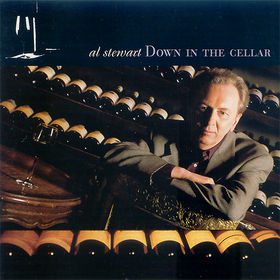
Al Stewart: Down In The Cellar


AL STEWART: DOWN IN THE CELLAR (2000)

1) Waiting For Margaux; 2) Tasting History; 3) Down In The Cellars; 4) Turning It Into Water; 5) Soho; 6) The Night That The Band Got The Wine; 7) Millie Brown; 8) Stained Moon; 9) Franklin's Table; 10) House Of Clocks; 11) Sergio; 12) Toutes Les Etoiles; 13) The Shiraz Shuffle.

It is hard to imagine anybody other than al Stewart, in the whole wide world, recording an entire album of songs about wine — and, more or less, getting away with it. That Al is a seasoned con­naisseur, is no sin of his. That he is capable of writing a nice, friendly tune about taking a sip, there is hardly any doubt. But surely a whole concept album drawing on his love for wine would be overkill? Boring at best, kitschy novelty at worst?

Well... it is not the best Al Stewart album ever, that one is for sure. Some songs work well and some not quite so. He did overestimate the power of inspiration evaporating from that cellar; and, what's worse, there is a quaint, uncomfortable aroma of snobbery. There is no reason to doubt the man's noble and innocent intentions (heck, he just loves all sorts of wine, what's wrong with that? Not everyone is supposed to inherit the tastes of John Lee Hooker) — but somehow I, for one, feel it easier to fall under Al's enchantment when he is reminding me of Josephine Baker and Charles Lindbergh rather than extolling the virtues of Margaux and Shiraz.

So, as a sprawling, many-faced ode to wine, Down In The Cellar is ambiguous, not only because a rock LP praising wine is suspicious per se, but also because the songs themselves are not all that reminiscent of alcohol-related environment, if you know what I mean. A note from a listener I once fell upon read something like, "I hate wine, but I liked this record" — meaning that Al es­sen­tially failed in his task. If this were a good record about wine, it would have been hated by all strong wine-haters — or it would have converted the weak ones. Instead, this is just a good record. Forget about the wine.

Since there are no production excesses (everything is kept in strict accordance with Al's no-extra-ornaments folk-rock formula: acoustic essence, minimalistic rhythm section, occasional electric guitar, occasional pianos, occasional chamber strings arrangement), and since there are no excu­ses for genre-hopping and experimentation such as provided by the topical matters of Between The Wars, the melodies do not require description; as usual, they are, uh, melodic — simple, mo­ving, and memorable. Humble, too: only 'The Night That The Band Got The Wine', with its lengthy epic title, six-minute running length, and increased levels of loudness, pretends to epic status, but is actually underpinned by its pretense; I'd rather look for the meaning of life in the rococo strings of 'Franklin's Table' (apparently, Ben was a big fan of the spirits, too), the dense medieval drone of 'Soho', and the echo-laden lonesome howling-wolf electric solos of 'Stained Moon'. Beautiful tunes, these.

Unfortunately, Down In The Cellar suffered doubly because of lack of promotion (the Miramar label that was supposed to take care of the album in the States went bankrupt before it managed to release it), and because of being tagged as some sort of «special interest» item. Not to worry: it is a perfectly normal, regular Al Stewart album reflecting his normal, regular skills at writing, singing, and playing. And who really gives a damn about the wine? Thumbs up.

Tuesday, September 7, 2010

Aretha Franklin: La Diva


ARETHA FRANKLIN: LA DIVA (1979)

1) Ladies Only; 2) It's Gonna Get A Bit Better Now; 3) What If I Should Ever Need You; 4) Honey I Need Your Love; 5) I Was Made For You; 6) Only Star; 7) Reasons Why; 8) You Brought Me Back To Life; 9) Half A Love; 10) The Feeling.

Totally worthless crap — one of those few fortunate spots where critical sense, bad taste instincts, and public opinion all come together in a rare moment of unity. The sleeve photo was probably suf­ficient in itself to repulse most of the old fans and bore stiff all the potential new ones: the Lady reclining on a red sofa in a Donna Summeresque position, sexy slit dress, cowboy boots, cheesy coiffure, and album title spelled out in bright shiny stars all present. A closer look at the Lady's face, how­ever, reveals that the Lady has absolutely no idea what exactly she is doing on that sofa; the idea of marketing Aretha Franklin off as a sexy disco chick is comparable in its idiocy to a heavy metal image for Pat Boone.

To be perfectly fair, again, there is not all that much disco stuff on the album, but what there is is truly disgusting, including arguably the worst song ever recorded by the Queen, 'Only Star', which truly has to be heard to be disbelieved — or, better, to remind ourselves why disco (a genre that has, since its downfall, been partially rehabilitated because its few successes have lingered in memory where its many gross-out horrors have faded away) truly deserved all the public hate; with atrocious, bimbo-style delivered, lines like "I'm gonna be the only star tonight at the disco", Ms. Franklin has introduced her own small contribution to the shift in standards, and thank her very much for that. The one thing I totally cannot understand is that 'Only Star' is credited, of all people, to Are­tha Franklin: she wrote this garbage herself? Why?..

The lead single, 'Ladies Only', was also self-penned — and almost as awful. It thinks it's clever — it's a trick song, see: one minute it's a slow-moving syrupy ballad, then whoosh, off go the veils, and there goes the brandest new disco tune from that piece of real hot stuff, the sexy Aretha «Burst-Yer-Pants» Franklin. It might have been funny, had it not all been so sad.

La Diva was produced by somewhat legendary hitmaster Van McCoy, who died of a heart attack a few months before the album was even released (that should probably give you an extra hint on the quality); out of all the disco songs on it, his 'The Feeling' is probably the best one (some cool Saturday Night Feveresque orchestration, at least), which is not saying much. The best song ov­erall is probably Lalome Washburn's 'It's Gonna Get A Bit Better', whose muscular funky arran­gement kicks tons of shit from all the inane disco on here, not to mention Aretha being overall far better used to this style — any normal record executive, upon listening even once to the final product, would have immediately thrown out half and make the lady record more songs like this Washburn number, but hey, we all knew that disco would last forever back then, didn't we?

Thumbs down without question, and chalk that album up as one of the top 10 reasons why disco had to die — it all but destroyed Franklin's artistic reputation without even compensating her on the material level (La Diva was one of the poorest selling albums in her career), and finally seve­red her ties with the Atlantic motherlode as well. Not that anybody really cared by then: Atlantic's golden days were over, and, with R'n'B standards moving steadily into the «faceless automaton» department, with hits that might as well be performed by machines rather than people, there was hardly any chance that the label would strike that gold one more time.

Monday, September 6, 2010

B. B. King: To Know You Is To Love You


B. B. KING: TO KNOW YOU IS TO LOVE YOU (1973)

1) I Like To Live The Love; 2) Respect Yourself; 3) Who Are You; 4) Love; 5) I Can't Leave; 6) To Know You Is To Love You; 7) Oh To Me; 8) Thank You For Loving The Blues.

Little known, little appreciated, To Know You is still B. B. King's juiciest attempt at an almost proper R'n'B album, with an absolute minimum of 12-bar and lots of rhythm. Recorded with the Memphis horns and the Philly rhythm section, this was done at the exactly right time, with B. B.'s competitor Albert King riding a similar brand of sound with albums like I'll Play The Blues For You and I Wanna Get Funky. Well, B. B. ended up wanting to get funky, too.

For the first time in a long, long while, if not ever, even those tracks on which King plays very little, if any, guitar, are perfectly enjoyable — just for the simple joy of listening to all these mu­sicians gelling so perfectly, the bass, drums, rhythm guitars, keyboards, and horns whirling like freshly-oiled cogs in one of the world's smoothest-running musical machines. And when the big man starts to play, Lucille's sound is giving a smoother, slicker coating than usual, which is per­fectly all right with this kind of ambience (although it would probably not work at all on some­thing like Completely Well).

The obvious hit, highlight, and constant presence in the Church of the Latter Day Compilations, is the title track, written for King by Stevie Wonder himself (and, once you know that, you will realize that B. B.'s singing, too, is tentatively following Stevie's usual vocal modulations — per­haps it would have worked even better as a duet between the two). It is soulful, passionate, reli­gious, and quite long, allowing it to work both as a moving love song and as a hot, pristine jam instead of failing at both; every single player shines like the sun.

It may be impossible to outdo the Staple Singers at their cut-out job, but the King still does his best at bringing a comparable amount of sincerity and conviction into his singing, and carves out a suitable weeping set of riffs for Lucille. 'I Like To Live The Love', the record's other hit, has no lead guitar at all and is happy enough to function within the generic dance-pop formula of the first half of the decade — could, perhaps, benefit from an Al Green at the helm rather than the relatively rugged delivery of old man B. B., but it is still a charming song, and not entirely grit­less, either, if only for the iron groove that has it locked in its grip from first to last second.

'I Can't Leave' is the only song that reverts us fully to the standard 12-bar blues-de-luxe formula, but in the overall context it blends in well (what other B. B. King album could be said to contain one generic blues song for the sake of diversity?), and then there is also a traditional spoken blues piece at the end that thanks us for loving the blues and slowly melts away in a hushed, minimalis­tic jam with some of the most subtle passages in B. B.'s career.

It all works, and once again goes to show just how greatly a super-professional R'n'B band and a brilliant blues guitarist can complement each other. Now if only somebody had, at least once, thought to finish off the picture by bringing in a genius songwriter and a mindblowing singer... but, possibly, so many cooks would have killed off the broth. Let us be happy with what we have and hope that the album, only recently restored in print, will eventually solidify in its classic sta­tus. Thumbs up and a must-have for any fan of Seventies' R&B (not so sure about hardcore blues lovers, though — but let us not forget that B. B. King as such is hardly music for blues purists).

Sunday, September 5, 2010

Arcade Fire: Arcade Fire


ARCADE FIRE (2003)

1) Old Flame; 2) I'm Sleeping In A Submarine; 3) No Cars Go; 4) The Woodland National Anthem; 5) My Heart Is An Apple; 6) Headlights Look Like Diamonds; 7) Vampire / Forest Fire.

There is very little on Arcade Fire's humbly self-titled EP debut from 2003 to suggest that, in less than a year from then, they would start topping critical lists and being regarded as the saviours of their generation. And yet, at the same time, there already is everything: Win Butler's paranoid, bullied-boy-takes-last-stand-in-the-corner vocals and Regine Chassagne's naughty-excited-girl-de­fying-prescriptions «singing»; multi-layered arrangements where each instrument plays some­thing tremendously simple, but like its player's life depended on it; and, of course, the overall starry-eyed idealism within which it is considered sacrilegious to borrow from one's ancestors in a post-modernistic manner (although it is permitted to maintain one's sense of humor).

The difference is that these seven tracks are very clearly tentative; the best way to ascertain this is to compare the original version of 'No Cars Go' — easily the most memorable track — with its masterful reworking on Neon Bible, where it is nevertheless only one of several highlights. The lo-fi production (everything was recorded in some cheap barn somewhere in Maine) is violently at odds with the band's ambitions, and does not allow the senses to be properly overwhelmed. God only knows how many of the other tracks could benefit this much from being re-recorded a few years later; my serious bet is on 'Headlights Look Like Diamonds', Chassagne's tour-de-force whose head-spinning harmony line deserves a whole lot more vibrations out of one's speakers.

On the other hand, several of the songs, sounding like un-fleshed and, possibly, un-fleshable de­mos, would hardly convince the hardened skeptic about the capacities of indie rock in any setting: 'The Woodland National Anthem' is more like 'The Ragged March Cat Anthem' with the approp­riate musical accompaniment from a band of drunken hobos, and the closing seven-minute num­ber works out the style, but not the essence of true anthems-to-come like 'Power Out' and 'Rebel­lion'. This is probably because most of the songs do not bother to find the proper underpinning musical hook, or do not take enough care with the musical buildup, or just do not hold that rhythm nearly as steadily as they would soon be able to.

In short, Arcade Fire is not so much a proper debut as a bit of a training camp, and, in retrospect, should not be anybody's first point of acquaintance with the band; once Butler and his friends get in the history books and stay there, everyone who cares about past sounds will want to visit this departure locus (it is still, after all, a matter of spending thirty minutes in a moderately pleasing way), yet it is not deserving of much on its own, even if 'Headlights Look Like Diamonds' threa­tens to become an unjustly overlooked power pop gem, and 'My Heart Is An Apple', perhaps, an equally unjustly forgotten intimate tearjerker.

Saturday, September 4, 2010

Ani DiFranco: Red Letter Year


ANI DIFRANCO: RED LETTER YEAR (2008)

1) Red Letter Year; 2) Alla This; 3) Present/Infant; 4) Smiling Underneath; 5) Way Tight; 6) Emancipated Minor; 7) Good Luck; 8) The Atom; 9) Round A Pole; 10) Landing Gear; 11) Star Matter; 12) Red Letter Year Reprise.

2008 may have been a red letter year for Ani's country, which is what the album title is «subtly» trying to tell us, but for Ani herself that year was 2007, when she had her first baby. With less free time on her hands than usual, yet still not willing to forsake the one-album-per-year routine (God knows what this world will come to if it forgets about her existence for three hundred and sixty five days), she released her first official retrospective package, titled Canon and picturing a cannon (puns! puns! puns!). Despite some predictably lame selections mixed in with the classics, on the general art plane it must have been a good move — not only did the world get to re­mem­ber what Ms. DiFranco used to be in the good old days, when she would still stoop to using the guitar as an ins­trument rather than a sonic prop, but it also gave her some breathing space to put a little more work than usual in the next record.

Meaning that Red Letter Year, although not quite reaching up to the pleasantly-mediocre level of Knuckle Down, is at least less generally irritating than Reprieve. With mother cares at hand, she does not have that good an opportunity to focus on her political anger; and with a full band in the studio once again, chances are that not every song is centered around an uninspired, meaning­less pummelling of her acoustic six-string. This is not to say that I honestly liked any of the songs. But at least I was honestly indifferent to them rather than honestly desiring to shove them down the songwriter's throat.

The most prominent political curses come at the beginning, but the predictable anti-Bush jabs and troop condolences lose much of their potential obnoxiousness by hiding behind dense arrange­ments: reverb, echo, chimes, and New Age effects on the title track, U2-ish rebounding guitars on 'Alla This'. After that, the band sincerely tries to introduce teensy bits of diversity on each new track; they never succeed properly, but they do take away Ani's ability to torture the listener. The best song is probably 'The Atom', if you listen to it long enough to appreciate the professionalism of the build-up from minimalistic acoustic mantra to psychedelic freakout — somebody must have been a good fan of Wilco's Yankee Hotel Foxtrot.

For me, the best thing about it all is 'Red Letter Year Reprise', which is not so much a reprise as a friendly, loose jazz jam between all concerned. In general, it's just six minutes of poorly coordi­nated free-form horn noise, but it contains a paradox — it just feels so much more liberating in es­sence than any single word-containing song on this album, recorded by an artist that is suppo­sed to be the biggest liberator of them all. For this nice, unexpected touch Red Letter Year de­ser­ves a hateless thumbs down rather than a hateful one. Also, amazingly, the entire year of 2009 went on by without a new DiFranco album, suggesting that perhaps her newly-found family life is steering her into the right direction, after all.

Friday, September 3, 2010

Angry Samoans: The 90's Suck And So Do You


ANGRY SAMOANS: THE 90'S SUCK AND SO DO YOU (1998)

1) I'd Rather Do The Dog; 2) Letter From Uncle Sam; 3) Suzy's A Loser; 4) In And Out Of Luv; 5) Mister M. D.; 6) My Baby's Gone Gone Gone; 7) Beat Your Heart Out; 8) Don't Change My Head.

By the mid-Nineties, little was left of the Angry Samoans but Metal Mike who, for some reason, was still in love with the name, mildly justifying it, perhaps, by the continuing presence of ori­ginal drum­mer Bill Vockeroth. The only studio memento of that incarnation was this predictably laconic, unpredictably boring eight-song disc, the best thing about which might have been its title — ringing truer than any given piece of its content, even though one can just as easily replace «The 90's» with any other decade.

The album is, overall, heavier than STP, but even less deserving of getting aligned with the rest of the Samoans' legacy. Basically, it's just minimalistic, heavily distorted power pop, reading like a sincere, but uninspired tribute to the Ramones — which means that we would all be much better off simply listening to the Ramones instead, since even their worst, most heavily derivative al­bums contain more excitement than this leaden platter.

There is absolutely no «band presence» here; the credits do list two extra bass players and one ad­ditional guitarist (Alison Victor), but ninety percent of the mix are occupied by Saunders' fuzzy, always same-sounding riffs and blubbery nasal vocals. This is bad: punky-pop needs band pre­sence to convince and satisfy. The riffs are technically well played, but most have been regurgi­tated so many times already over the past twenty years that they can only generate emotion in a newborn baby. The vocals totally suck — Saunders sings everything in a daze, as if they'd thrust that microphone under his nose just as he was slipping out of some narcosis. Maybe that was his idea of imitating the rough tenderness of Joey Ramone's love ballads, but it's a total failure: Joey could generate innocent sentimentalism in a jiffy, whereas when Metal Mike sings that "all the girls are after me", the effect is not even funny, it's that of a big question mark.

The bottomline is that it is really unnecessary to pursue the band's career after Back From Sa­moa; in fact, it would make much better sense to pretend that the band never really existed after 1982, an assumption that would make them the perfect hardcore band — one that said everything it had to say in the appropriate 20 minutes it took to say it, and then was no more, which might be an even greater artistic achievement. The idea that even now, in the XXIst century, there is still a band called the Angry Samoans, playing assorted West Coast pubs to whatever unlucky souls they might find there, is, in fact, so absurdly preposterous, that I simply refuse to believe it. As for the album, I'd theoretically like to give it a thumbs down, but the right side of my mind tells me that it is just a phantom — like the Amityville Horror or something, so why bother?

Thursday, September 2, 2010

Alan Parsons Project: Tales Of Mystery And Imagination


ALAN PARSONS PROJECT: TALES OF MYSTERY AND IMAGINATION (1976)

1) A Dream Within A Dream; 2) The Raven; 3) The Tell-Tale Heart; 4) The Cask Of Amontillado; 5) Doctor Tarr And Professor Feather; 6) The Fall Of The House Usher: Prelude; 7) Arrival; 8) Intermezzo; 9) Pavane; 10) Fall; 11) To One In Paradise.

There is one solid objective reason for why Tales Of Mystery And Imagination, a concept al­bum based on a bunch of stories by Edgar Allan Poe, should have been the best album by the Alan Parsons Project — namely, because the Alan Parsons Project, to a large part, was launched out of a desire to record a concept album based on a bunch of stories by Edgar Allan Poe.

Alan Parsons and Eric Woolfson met in 1974. The former wanted to become something more than «the guy who engineered Dark Side Of The Moon», and the latter loved Poe. The union was blessed, and the outcome was a record the likes of which did not really exist prior to 1976; at the very least, to the best of my memory, no rock album presented as a soundtrack to literary glo­ries had ever captured the public eye so much before that time. Commercially, it was hardly huge, but it established the Project as a serious attraction, and has ever since remained as the corner­stone of their legacy — even many of the active Parsons haters confess to falling under its charm from time to time.

There is some strange magic at work here indeed. On one hand, Tales is a huge venture. It covers the matters of three Poe stories and one Poe poem on the first side, then invests everything into the lengthy multi-part 'Fall Of The House Of Usher' suite on the second. It downplays Parsons' manipulations with electronic keyboards in favour of a whole ton of guest musicians and an entire orchestra. It features a different guest vocalist on each song, including moderately big names like Arthur Brown, John Miles, and Terry Sylvester. And yet, on the other hand, apart from a few iso­lated moments, it feels wrong to describe it as «bombastic». It has an odd claustrophobic aura around it, as if one were locked in an ice palace, staring out the frozen windows at distorted sha­des of reality and not knowing how real they really were. It may be off-putting, and it may not be exactly suitable for Poe-related purposes, but somehow, it works.

Indeed, some original reviews complained that the album had missed its mark — that, regardless of how good the music was on its own, it did not convey the proper associations, that the tense sensations of fear, thrill, death, and gloom were nowhere to be found. They were right, but, after all, The Alan Parsons Project formed as a progressive rock outfit, not as a brand of shock-rock à la Alice Cooper. The songs should be thought of as inspired by Poe rather than reflecting Poe, at which point they really come to life as original creations.

The first side is the diverse one. 'The Raven' is taken at an almost martial pace, emphasizing the inescapability of the bird's message right from the first bass note that drips on your ears in comp­lete loneliness for a few seconds. 'The Tell-Tale Heart' is molded as a rocking chunk of Arthur Brown madness — probably the closest they ever get to pinning down one of Poe's heroes (one might think that the fast blues-rock tempo may not be the most suitable choice for picturing a cra­zy protagonist going nuts over the heart of a murdered man pursuing him from beyond the floor­boards — but then it's also a pretty good approximation of a crazy-beatin' human heart). 'The Cask Of Amontillado' ascends from a lovely ballad (think one half Paul McCartney, one half Peter Gabriel) to epic horn-held heights of mu­sical vendetta. And 'Doctor Tarr And Professor Fe­ther' is just a good pop-rocker with a memorable riff — an amusing trifle in Poe's career, a fun, but not breathtaking entry in Parsons' catalog.

The second side, almost entirely dedicated to the 'Usher' suite, is an acquired taste like most prog rock suites at the time — a piece to be tolerated in some spots and admired in others. Taking a few cues from Debussy's unfinished opera of the same name, it moves through different sections that are not as much creepy as «archaic»: the 'Pavane' section lives and breathes the souls of past generations, but never once does it suggest death and retribution, which is why the minute-long 'Fall' itself is sort of flat and anti-climactic. Fortunately, the album prefers to end with 'To One In Paradise', another ballad worthy of a distinguished disciple of both the Beatles and Pink Floyd.

On the whole, one shouldn't be too harsh on Tales. It is intelligent, tasteful, and melodic, and if it does not exactly reach cathartic effects (although the ominous climactic bits on 'Amontillado' come close), it is only because it does not aspire to them, not because it fails at them. It also has the dubious honor of being one of the coldest, iciest prog-rock albums ever released, just by the very fact of its existence, not because Parsons and Woolfson derive some sort of sadistic satisfac­tion by sucking the warmth out of your bodies as you listen to this. It's just a particular type of musical animal. Rare at its peak, completely extinct today. Thumbs up.

Wednesday, September 1, 2010

Al Stewart: Seemed Like A Good Idea At The Time


AL STEWART: SEEMED LIKE A GOOD IDEA AT THE TIME (1996)

1) Where Are They Now; 2) Fields Of France; 3) Soho (Needless To Say); 4) In Red Square; 5) A Sense Of Déjà Vu; 6) How Does It Happen; 7) Coolest Winter In Memory; 8) Candy Came Back; 9) Jackdaw; 10) The Bear Farmers Of Birnam; 11) In The Dark; 12) Blow Your Mansion Down; 13) Willie The King; 14) Merry Monks; 15) Ghostly Horses Of The Plain; 16) Mixed Blessing.

This collection of outtakes and rarities was only available for a limited period through a fan club distribution in the mid-1990s, and, for the most part, has been made obsolete since then by the re­cent CD re-releases of Al's catalog, through dismemberment and dispersal of most tracks as bo­nuses for the corresponding chronological periods.

Nevertheless, it still exists — in the form of a used item on Ebay, a low-quality download on the local torrent site, or a discography memento graced with a slightly corny photo. And it has its use as a one-time sixty-minute listen, too, being fully on the level. Not every artist can boast an out­take collection that is almost as entertaining as an original, semi-coherent LP; Al, in terms of qua­lity if not recognition, joins the league of Dylan and Nick Drake.

The time period covered spans pretty much all of Stewart's pre-1996 career, the earliest track be­ing 'Jackdaw' from the late Sixties, the latest — several tracks from the Between The Wars ses­sions; and most are just as melodic and moving as the typically best stuff from the guy, someti­mes even more. 'Jackdaw' gives us the early innocent Stewart with pastoral flutes and starry eyes, spoiled somewhat by cooky backing vocals; but already the tracks dating back to the Parsons ye­ars are magnificently serious folk-rock, particularly 'A Sense Of Déjà Vu', worthy of the stateli­ness of a George Harrison classic, and 'Willie The King', a bleak, depressing cross between a bar­room blues and a prog-rock epic.

Later numbers are a 'Mixed Blessing' indeed — some, like this particular song, are hopelessly overwhelmed by crap-Eighties production, but generally they match the standards of the corres­ponding LPs: 'In Red Square', for instance, would have made a decent addition to Russians & Ame­ricans, but was, perhaps, excised for way too many references to Russian history targeted at audiences who might not have too pleasant a time refreshing their memories on Khrushchev. The New Wave trimmings of 'Candy Came Back' will please fans of 24 Carrots; the synth-pop lea­nings of 'How Does It Happen' will probably please no one, though — lines like "An original thought can be such a rush, why do they feed you on a diet of man-made mush?" do not sound all that convincing when they are set to man-made mush. Then the mood will be set right with the light humor of 'The Bear Farmers Of Birnam' ("...oftentimes the girls reject you — a bear won't treat you so; you're satisfied to know, when he chews you up, he still respects you"), the cheery medievalism of 'Merry Monks', and what may be the grandest and gorgeous-est entry of 'em all, 'In The Dark', from not-exactly-sure-when with a beautiful piano melody played by not-exactly-sure-whom.

All in all, a great collection — thumbs up, and way too bad if some of the best tracks happen to get lost in the process of dismemberment — but the tormenting question is: who the hell thought it was a good idea to start things off with two tracks from Last Days Of The Century? Fanclub releases seem to have their own unexplicated bits of weirdness.