Search This Blog

Showing posts with label Billy Bragg. Show all posts

Thursday, October 8, 2015

Billy Bragg: Tooth & Nail

BILLY BRAGG: TOOTH & NAIL (2013)

1) January Song; 2) No One Knows Nothing Anymore; 3) Handyman Blues; 4) I Ain't Got No Home; 5) Swallow My Pride; 6) Do Unto Others; 7) Over You; 8) Goodbye, Goodbye; 9) There Will Be A Reckoning; 10) Chasing Rainbows; 11) Your Name On My Tongue; 12) Tomorrow's Going To Be A Better Day.

Billy's latest release so far has been, if possible, even more humble and low-key than Mr. Love & Justice. This time, he is largely acoustic, with a minimal backing band, and all the songs are shushy — quiet, reserved, introspective, even introvert. Yet it all sounds so completely natural that you almost begin to wonder if this is not the real Billy Bragg, and all these years of electrobusking and political activism were merely an attempt to cure himself of a natural shyness; and now it's all coming back to him.

Or maybe it is simply that Woody Guthrie experience — you begin as an idealistic activist, but eventually you just get tired, say «fuck it», and become a whisperer rather than a shouter. Not that Tooth & Nail is, by any means, a cynical or a mean record: Billy is still willing to spread the good vibe, not the bitter vibe, as the song titles clearly show (ʽDo Unto Othersʼ, ʽTomorrow's Going To Be A Better Dayʼ). It is just... quiet. No grand rallying statements, just good old timey music from the living room, where you use the medium for a quickie cheer-up. Or cheer-down, because the songs here aren't exactly «cheerful». But they're not all that sad, either.

It is all about the vibe, and the vibe is very cool. Billy's voice has finally matured to the point of providing us with a real personality — this homey, cozy Brit guy who's worried about all the problems in the world, yet is really just a quiet family man in the depths of his heart. A song like ʽHandyman Bluesʼ, where he admits that "the screwdriver business just gets me confused / It takes me half an hour to change a fuse / I'm not your handyman!", goes all the way straight to my own heart, and so do most of the others as well. The melodies are nothing to remember — your regular old folk and country chord changes, with simple, tasteful, unadorned acoustic guitars, pedal steel, and piano to carry them out — but when taken together with the personality, they become charming and endearing.

Sometimes he seems to be pushing it: ʽGoodbye, Goodbyeʼ could easily be taken for a song of resignation, of closing the door on his rowdy past — which is probably not quite what is meant, seeing as how Billy did not exactly become a recluse in 2013 or anything. On the other hand, ʽTomorrow's Going To Be A Better Dayʼ concludes the album with a generally optimistic state­ment, telling you not to "become demoralized by this chorus of complaint" — even if the song it­self is so quiet and shaky that it seems as if the man himself were having trouble believing in his own words. Oh well, I guess that if a musically generic, but atmospherically charismatic record presents itself as a bundle of contradictions, it's all for the better.

The album's «biggest» song is arguably ʽNo One Knows Anything Anymoreʼ, played out a bit louder than everything else (at least, the drums are loud enough) and laying out Billy's general perception of things: "No one knows anything anymore / Nobody really knows the score / Since nobody knows anything / Let's break it down and start again", he suggests to a leisurely tempo and lazy country-rock backing. If this is a denial of progress, you know, he just might have some­thing there — at least, this is consistent with the album's general message: stop the crazy rush, relax, take the time to take it slow and easy (and who knows, maybe you'll also kill a little less people that way). I'm all for progress, but I'm also partial to this vibe, and so, even if the songs here are musically generic, I'm giving the record a thumbs up for all it's worth.

Thursday, October 1, 2015

Billy Bragg: Mr. Love & Justice

BILLY BRAGG: MR. LOVE & JUSTICE (2008)

1) I Keep Faith; 2) I Almost Killed You; 3) M For Me; 4) The Beach Is Free; 5) Sing Their Souls Back Home; 6) You Make Me Brave; 7) Something Happened; 8) Mr. Love & Justice; 9) If You Ever Leave; 10) O Freedom; 11) The Johnny Carcinogenic Show; 12) Farm Boy.

Six years between albums is a long time even for the 21st century — you'd think that, perhaps, the artist has completely run out of new things to say (which, of course, has never prevented bad or desperate artists from putting out new music anyway, so it's actually more of a compliment than a critique in this case). And when, eventually, new things had accumulated to a proper de­gree, what we saw was an almost strangely humble and low-key Billy Bragg, almost as if he'd seen his turning fifty as a sign from God to quiet down and start acting his age. No loudness, no tension, no screaming, no anger — a wisened-up elder statesman.

The music is still nice, though. Sentimental, touching, with a pinch of catchiness and the usual intelligent Billy Bragg charisma, even if it is occasionally wasted on very local pieces of pro­gressive propaganda (yes, ʽThe Johnny Carcinogenic Showʼ is a rant against the advertising of tobacco companies on TV, which is a noble cause in general but makes for poor art in particular). But these pieces are not frequent — somehow, peace, love, and tranquility seem to be the album's main topics, since even the anti-Iraq war tune (ʽSing Their Souls Back Homeʼ) is more of a sin­cere prayer for the soldiers' safe return than a passionate rant against the crooked politicians who sent them there in the first place.

And that's all right, as it seems that Billy does honorably perform the artist's main duty — follow the tugs of the heart, wherever it happens to find itself at the moment. The tone of the record is immediately set by its opening and arguably best number, ʽI Keep Faithʼ: true to the title, the song has subtle gospel overtones (mainly reflected in the use of organ and vocal harmonies), but it is anything but traditionally religious — the artist keeps faith in humanity rather than God, and proves it with a low-key anthem where, perhaps, the greatest asset is the tone that he has chosen for his voice: cracked, worn, and weary, yet deliberately friendly, optimistic, and supportive. Nice chorus resolution, too, and a good mix of pianos, jangly guitars, and strings.

Everything that follows is plain, simple, unadorned, and direct, yet with enough stylistic and in­strumental diversity to be very easily sat through without getting bored. Sometimes it's just a bit of a carefree pop-rock romp at the happiness of having something that still conforms to the man's socialist ideas (ʽThe Beach Is Freeʼ, with a slightly «de-syncopated» Bo Diddley rhythm expres­sing the happiness); sometimes it's a dark folk dance acknowledging the sadness of the ultimate crash of these ideas (ʽO Freedomʼ, featuring the most paranoid, Richie Havens-worthy, acoustic backing track and the mantra "o freedom, what liberties are taken in thy name!" for the chorus); but most often, it's just a quiet love song — not a breakup song, not a bad bitch song, but an "if you ever leave me, my dear, there's nothing for me here" type of song.

And at the end of it all, Billy offers us a confession — as it turns out, he is "just a farm boy" and he is "just dreaming of the time when I can go home". Formally, it's just another anti-war song, but it can also be interpreted as a sort of "I'm tired" statement in general, tired especially from being pushed around by idiotic and/or oppressive decisions of, you know, the System, without really being able to do anything about it. There is no exaggerated desperation or frustration, it's all more of an "I'm old and tired, I'd just like to settle down and love my wife, but they still keep pestering me with all that shit" vibe that most of us are likely to empathize with more and more as we reach mid- and then old age. It's a reasonable vibe indeed, and it's propped up by a set of okay songs that suit it well — not too striking, but not completely unoriginal, either. And maybe it's just me, but it seems as if Billy's abilities as a singer are only improving as time goes by (and his drawn-out Cockney accent, funny enough, is also much less prominent). No great shakes, but enough love, justice, and honest songwriting on the record to guarantee a modest thumbs up.

Thursday, September 24, 2015

Billy Bragg: England, Half-English

BILLY BRAGG: ENGLAND, HALF-ENGLISH (2002)

1) St. Monday; 2) Jane Allen; 3) Distant Shore; 4) England, Half English; 5) NPWA; 6) Some Days I See The Point; 7) Baby Faroukh; 8) Take Down The Union Jack; 9) Another Kind Of Judy; 10) He'll Go Down; 11) Dreadbelly; 12) Tears Of My Tracks.

Curiously, it took Billy almost twenty years to do this, together with the experience of working with Wilco and then with his own specially assembled band, The Blokes — but England, Half-English finally does the trick: here be a pretty decent «political pop» record, where the majority of songs is given over to liberal-political manifestos, and yet does not suck from a detachedly musical standpoint. Yes, that's a very rare thing in general, and almost like a first for Billy, whose best musical numbers up to now were usually of a lyrical nature.

This may be, of course, due to active collaboration with The Blokes, who, for this album, also included Ian McLagan of the Faces on keyboards, and Lu Edmonds of The Damned and PiL on guitar — and about half of the songs here credit them both or at least one of them as co-writers. More than that, ʽSt. Mondayʼ, the spritely record opener, is credited to Billy solo, but the cheery piano rolls that open and then dominate the tune are prime McLagan — nothing like a true vete­ran of Brit-pop-rock lending his spirit and good will to make a tune so optimistically infectious, especially for all those who, like Billy, hate working on Mondays.

But who did what and why is all just speculation; the pure fact is that I really like the record and think that it hits home more often than it does not. Even the title track, which, as you have pro­bably already guessed, lashes out at anti-immigrant sentiments by accentuating the perpetually mixed nature of English culture ("St. George was born in Lebanon / How he got here I don't know / And those three lions on his shirt / They never sprung from England's dirt") and could have allowed itself doing and being nothing else whatsoever (Important Social Statement being enough for liberal musical critics), is a fairly odd musical concoction that deliberately tries mixing together elements of Latin and African rhythms, with a little bit of vaudeville in between. It's danceable, it's catchy, it's got a rippin' percussion track, and it makes some good culturo­logical points — what's not to like? Unless you're a member of the Enoch Powell fan club or something. (Like Eric Clapton.) (Who would now deny it.) (But truth will out!)

Stuff like ʽNPWAʼ (ʽNo Power Without Accountabilityʼ) is more trivial musically — just a straightahead mid-tempo blues rocker — but it still sounds okay, as emphasis is made on the sternness, harshness of the arrangement, with all the musicians (particularly the drummer and the organ player) getting into the same accusatory spirit as Billy and hammering out these largely familiar chords with meaningful determination. And while most people will only comment on ʽBaby Faroukhʼ from an "Oh look, here's a happy song about a pretty baby written from a pro-immigration perspective!" (you never can really tell, though — it could be about Freddie Mercury, for all we know), the song actually has a fun guitar melody and a classy instrumental break, equal­ly divided between pretty acoustic and electric slide guitar licks. (The vocal harmonies are a little hicky, though — a somewhat clichéd representation of the «Oriental ladies chanting a new­born baby's praises» idea).

There's a couple really good songs here, too, where «good» means «deep-cutting» rather than just «satisfactory». ʽHe'll Go Downʼ, for instance, is a subtle, haunting ballad where Billy becomes Tom Petty when singing the chorus, but usually tries to be Leonard Cohen, and the organ and the guitars play little contemplative melodies off each other in spooky-midnight mode. And ʽAnother Kind Of Judyʼ, following an almost Madchester-style rhythm, might be the best fully arranged properly Eighties-style pop song Billy ever put on record — a decade too late, perhaps, but then nothing is really too late in the 21st century, where you can be anybody from Socrates to Kurt Cobain and still feel at home with at least one target audience group.

Anyway, by the time he gets around to the smarty-pants ʽTears Of My Tracksʼ — reverting a Smokey Robinson title to sing a lament for his freshly sold vinyl collection — the record has fulfilled its proper function and proven that yes, sincere and straightforward liberal propaganda need not be defiantly anti-musical, no matter how many hardcore artists try to convince you other­wise. A masterpiece for the ages this might not be, but it gets its thumbs up anyway. Now it's up to you, Ted Nugent, to take up the challenge! 

Thursday, September 17, 2015

Billy Bragg & Wilco: Mermaid Avenue Vol. II

BILLY BRAGG: MERMAID AVENUE VOL. II (w. Wilco) (2000)

1) Airline To Heaven; 2) My Flying Saucer; 3) Feed Of Man; 4) Hot Rod Hotel; 5) I Was Born; 6) Secrets Of The Sea; 7) Stetson Kennedy; 8) Remember The Mountain Bed; 9) Blood Of The Lamb; 10) Against The Law; 11) All You Fascists; 12) Joe DiMaggio Done It Again; 13) Meanest Man; 14) Black Wind Blowing; 15) Someday Some Morning Sometime.

Okay, almost everyone says this one's not so good, and how could it be? Maybe the impressive success of the first volume was not enough to make them go back into the studio and record some more — but it was enough to make them release most of the stuff that did not make it onto Vol. I, and if these are outtakes, well, there must have been reasons for their being outtakes from the very beginning, right? Scraps are scraps, even if you're a giant of popular music.

Honestly, though, I do not share this popular opinion about the sequel being so seriously inferior. Maybe it is because I do not view the original Mermaid Avenue as a masterpiece — merely as a very pleasant, very insightful, very tasteful synthetic exercise — and without elevated expecta­tions for the sequel, the sequel just comes across as yet another such exercise. In fact, one reason why these songs were discarded originally may have been not the lack of quality, but their being generally much more distant from the standards of «folk rock» than the songs on the first album: here, Billy and Jeff really go a long way, adapting Woody's words to so many different musical styles that poor Woody must have rolled over in his grave much more than once. They may have ditched some of this first time around just so as not to have Norah scratch her head and wonder whether the decision to entrust this stuff to a couple of modernist clowns was such a good idea in the first place. But second time around... there's just no stopping them.

See for yourself. ʽMy Flying Saucerʼ is a folk-pop song all right... in Buddy Holly, not Woody Guthrie style (starts out ʽPeggy Sueʼ style). ʽFeed Of Manʼ is a slide guitar-heavy swamp rocker that sounds like Rory Gallagher with Brian Jones on second guitar. ʽSecrets Of The Seaʼ is an in­die pop song that is 100% Summerteeth-era Wilco. ʽAll You Fascistsʼ is speedy blues-rock with crazy guitar and harmonica romps that may have been inspired by Five Live Yardbirds. And weirdest of all is ʽMeanest Manʼ, a song with such strange lyrics that the only thing Bragg could do about it was turn it into a wannabe Tom Waits number... and sing it like Tom Waits, too. (Why didn't they try to get the real Tom Waits, I wonder? They got Natalie Merchant and Corey Harris as guest stars — Tom Waits would kick their limp folksy asses).

Most of the other songs, too, sound very much «appropriated» by either Tweedy or Bragg, to the extent that the album closer, ʽSomeday Some Morning Sometimeʼ, a gentle ballad with kaleido­scopic electronic overdubs, would seem like a natural predecessor to the futuristic «folktronic» soundscapes of Yankee Hotel Foxtrot. Most importantly, they use Woody's lyrics to create moods that go way beyond Woody's lyrics — yes, it is true that these lyrics show us a much more profound and diverse Guthrie than the Dust Bowl Poet stereotype, but these guys go further than that: ʽBlood Of The Lambʼ, for instance, is cast as a bitter, sarcastic cabaret vaudeville, where Tweedy's vocals take on an almost mocking air as he sings that "I've learnt to love my peoples / Of all colors, creeds and kinds / I'm all washed in the blood of that lamb". Was it supposed to be ironic? Maybe it was. Who the heck knows?

Or ʽMeanest Manʼ — okay, so Woody writes about all those evil things that he could have been, but he isn't because of the kindness of the people around him; is it right, then, to have the song delivered pirate-style, as if the protagonist were the meanest man? Or maybe he really is? Maybe this is just a tiny hint at the creepy dark side of the man?.. Oh God, perhaps Norah should have reconsidered, after all. Then again, if the original intent was to create a multi-dimensional portrait of a man equally beset by angels and demons on all sides, then this is exactly what Billy and Jeff are doing for us here. They may have largely invented this portrait, filling in all the blank spaces with bits of their own personalities (Billy the streetwise jester and Jeff the idealistic dreamer), but there probably was a little bit of each in the old Woody anyway, so no prob.

In any case, as far as the songwriting and the arrangements are concerned, half of these tunes are bona fide Billy Bragg tunes, the other half is first-to-second-rate Wilco, a must have for all fans of the classic Wilco sound, and as a special bonus you get another brief acoustic ditty tenderly sung by Natalie Merchant's faience shepherdess — shake it, but don't break it; it's a good thing, after all, that nobody tried to make a 10,000 Maniacs album out of this set of lyrics, «This Guitar Kills Politically Incorrect Male Chauvinists»-style. This one gets another safe, friendly thumbs up. And please note that, as of 2012, both are also available together as Mermaid Avenue: The Complete Sessions, a sprawling boxset that adds yet a third bonus CD of even more stuff, which I have not heard so far, but I'm pretty sure that three's good company, and judging by Amazon prices, it's also quite a good bargain compared to buying all the stuff separately.

Thursday, September 10, 2015

Billy Bragg & Wilco: Mermaid Avenue

BILLY BRAGG: MERMAID AVENUE (w. Wilco) (1998)

1) Walt Whitman's Niece; 2) California Stars; 3) Way Over Yonder In The Minor Key; 4) Birds And Ships; 5) Hoo­doo Voodoo; 6) She Came Along To Me; 7) At My Window Sad And Lonely; 8) Ingrid Bergman; 9) Christ For Pre­sident; 10) I Guess I Planted; 11) One By One; 12) Eisler On The Go; 13) Hesitating Beauty; 14) Another Man's Done Gone; 15) The Unwelcome Guest.

It is, perhaps, ironic that when Nora Guthrie was deciding on the artist to whom she could en­trust her father's trove of unused lyrics, she ended up with an Englishman. Was there really nobody in the United States in the mid-Nineties who could be considered the current reincarnation of Woody Guthrie? Come on now! Not anyone? Not even Eddie Vedder?..

Even Billy himself was a bit scared of the honor, and agreed to set Guthrie's lyrics to music only in collaboration with somebody more authentic. Eventually, his eye fell on Wilco, and since Jeff Tweedy was born in Illinois, which is at least somewhat closer to Woody's Oklahoma than Billy's East London could ever hope to be, and also because the Uncle Tupelo/early Wilco lineage was the closest to a raggedy, authentic, but still modern-sounding rootsy sound that you could get at the moment, a musical friendship was struck — and the result was Mermaid Avenue, an album of 15 modern roots-rock tunes set to hitherto unknown lyrics by Woody Guthrie.

First things first — these hitherto unknown lyrics, practically all of them, have such a contempo­rary feel and are so remote from Woody Guthrie, «the Dust Bowl hero», that I would not be at all surprised to learn that the whole thing was a big scam, or that at least the lyrics were seriously doctored by Bragg and Tweedy before reaching our ears. If it is not a scam, though — and who of us would want to seriously accuse the daughter of mystifications in the name of the father? — then the «non-public» Guthrie was simply a very different figure from the «public» Guthrie: far more intimate, romantic, and complicated than his officially released man-of-the-people stuff would suggest him to be. Pending proper linguistic expertise, let us assume that this is the case (in fact, I am only writing about this concern due to surprise that nobody anywhere has expressed the smallest shadow of doubt), and anyway, it does not matter that much because we are mostly concerned with Billy Bragg here, Wilco coming second and the Guthries only third.

Whatever be, it's a fun, engaging, and catchy record that utilizes Billy's and Jeff's talents to the fullest — the capacity for introspection, the sense of humor, the versatility in arranging and diver­sifying the material, it's all there. The music is roughly divided in half between Bragg and Wilco (represented by either Tweedy alone or the Tweedy/Bennett duo), and, as you could expect, the Bragg half is usually more sparse and closer to the classic folk idiom, whereas the Wilco songs often sound like outtakes from Being There, and this is good, since the shuffling principle allows to keep the proceedings diverse and mildly surprising until the end.

Accordingly, Bragg usually chooses the more repetitive, singalong tunes to set to music — such as the opening comical piece ʽWalt Whitman's Nieceʼ, imagined by him as a rowdy chunk of pub rock with the lads presenting an anti-thesis to each line ("last night or the night before that — I won't say which night", etc., and was that in the original lyrics, too, I wonder?), or the sorrowful acoustic ballad ʽEisler On The Goʼ — a counting-rhyme song about communist leader Gerhart Eisler's tribulations in a post-WWII Western world (I reckon) that was probably not intended by the original writer to sound so mournful, but then Eisler probably wasn't dead when Woody wrote it, and now he's been dead for 30 years; sufficient cause for sorrow.

On two songs, Billy invites old friend Natalie Merchant: she backs him up on the playful (if still a bit sad) ʽWay Over Yonder In The Minor Keyʼ and takes over lead vocals on ʽBirds And Shipsʼ, which is probably the worst decision on the record — unlike Bragg and Tweedy, Merchant is not endowed with a sense of humor (or, if she is, she puts it under lock and key when starting off for the recording studio), and her predictably broken-hearted delivery, perfect for the expectoration of 10,000 Maniacs-style liberal guilt, feels seriously out of place on this record. Still, a friend is a friend, I guess, and she did choose a song for which those plaintive intonations would seem natu­ral outside of the general context of Mermaid Avenue.

Not to slight Billy, though, Wilco in general and Tweedy in particular steal the spotlight more often, starting with the very first number — ʽCalifornia Starsʼ is made into an immediate Wilco classic, what with that tricky way that Tweedy places the repetitive song title «outside» the main melody, creating the impression of one-breath continuity for his intellectual romanticism. ʽHoo­doo Voodooʼ is transformed into a ʽSubterranean Homesick Bluesʼ-type rap number (the lyrics, coming in punctuated bursts of half-folk, half-proto-beatnik imagery, do suggest that kind of treatment); ʽAt My Window Sad And Lonelyʼ is made into an epic ballad that stops just short of becoming a «power» ballad by disallowing the presence of electric guitars; and ʽChrist For Pre­sidentʼ is a delightful country stomp that Jeff delivers in an intentionally cracked, hoarse voice, but the real hero there is Jay Bennett, laying on layers of pianos and banjos, each of which sounds drunker than the other. Verily and truly, could a sober man ask for ʽChrist For Presidentʼ?

Mermaid Avenue is not a «great» record. Both for Bragg and for Wilco, this was a side project, and regardless of whether all the lyrics here are authentic original Guthrie or if some of them were edited, there is too little of the real Woody here to make the music (rather than the texts) of any importance to the Guthrie legacy. But it is at least as good as, say, a Traveling Wilburys re­cord — pleasant, intelligent rootsy entertainment that strikes an impressive balance between tra­dition and modernism, and throws in the intriguing novel aspect of bringing together a British electro-busker, an American revolutionizer of the folk-rock idiom, and the Dust Bowl musical pioneer who, if this is to be believed, was secretly in love with Ingrid Bergman even after she dumped her husband for Roberto Rossellini. Then again, what sort of respect for the solemnity of family values do you expect from someone who had eight kids from three wives? Thumbs up for this shameless violation of the rules of decency.

Thursday, September 3, 2015

Billy Bragg: William Bloke

BILLY BRAGG: WILLIAM BLOKE (1996)

1) From Red To Blue; 2) Upfield; 3) Everybody Loves You Babe; 4) Sugardaddy; 5) A Pict Song; 6) Brickbat; 7) The Space Race Is Over; 8) Northern Industrial Town; 9) The Fourteenth Of February; 10) King James Version; 11) Goalhanger.

After the relatively colossal (in comparison to everything that preceded it) Don't Try This At Home, Billy's late-coming follow-up at first feels underwhelming. Five years in the planning and making, delayed by personal life events such as the birth of his son, it is a very low-key effort, featuring none of the major guest stars from 1991 and feeling far more intimate, insecure, vulne­rable, and confused. Some reviewers took that for a bad sign, and stated that Bragg's muse must have abandoned him, at least temporarily. I don't think so, though.

See, this here William Bloke (a rough downgrade on William Blake) is not a return to the young and innocent days of electro-busking. Even if the arrangements are stripped, they are varied: Billy makes as much use of the acoustic guitar and piano here as he makes of the old electric, and the songs do not feel underworked and so much in desperate need of a rhythm section as they did on his first records. This is just a regular singer-songwriter album, produced in the intimate-confes­sional singer-songwriter paradigm, but with a sufficient amount of pop hooks to keep things from becoming too boring. It is true that the songs are not quite as well written and produced, but this is somehow to be expected — any record that puts the emphasis on «deeply personal» usually suffers in the hook department, since the artist tends to invest more in lyrics and vocal expression than he does in captivating chord changes.

The good news is that, to an extent, the investment pays off: some of the songs here, while not at all melodically great, show a level of rough sentimentality that was not yet achieved before. Per­haps it is his family life experience or something, but a song like ʽFrom Red To Blueʼ, where the protagonist is forced to either accept his partner's compromises for the Establishment or split ("should I vote red for my class or green for our children?") really does give us a confused, dis­appointed, deeply puzzled individual, who is capable of expressing all that mixed ball of emo­tions in three minutes' time, helped out by a little electric guitar and a little electric organ. If you scrutinize the lyrics too hard, you'll find the man to be judgmental ("the ideals you've opted out of, I still hold them to be true / I guess they weren't so firmly held by you"), but not nearly enough to become repelling — just scratching his head in bewilderment.

Elsewhere, the vaudevillian romantic-melancholic piano ballad ʽEverybody Loves You Babeʼ sounds exactly like Randy Newman (save the accent) and would probably have been much lauded had it been written by the latter. ʽSugardaddyʼ, an indictment of spoiled parents, uses melodic vocal harmonies for the chorus (even some sha-la-la's!) and sounds like a cross between 1970s McCartney and Ray Davies — which, for Billy, is at least an unpredictable novelty, and actually I think it works well. And then there's ʽBrickbatʼ, probably the most personal tune on the album, whose mournful string accompaniment reflects the song's confused introspection: "I used to want to plant bombs at the last night of the proms / But now you'll find me with the baby in the bath­room", Billy either complains of his weakness or acknowledges his maturation.

Anyway, it is easy to see why the critics, expecting yet another powerful anti-Establishment blast from the man, were miffled — but Billy Bragg is not crazy, he's normal, and every normal person sooner or later has to acknowledge that routine and mundane affairs are as much a part of one's life as rallies, protests, and revolutions. Besides, routine and mundane affairs as presented here are merely a natural continuation of the man's romantic side that was there all the way from the start; and it's not as if he's completely settled down, either — ʽNorthern Industrial Townʼ is a half-ironic, half-compassionate look at life you-know-where, and ʽA Pict Songʼ takes an obscure poem by Rudyard Kipling (Billy Bragg covering imperialist scum? No way!) and turns it into the album's only electro-busking anthem, with a thick distorted guitar tone and an anthemic refrain with which Billy does his best to give it a revolutionary stance.

Throw in a couple merry numbers like the brass-led upbeat pop tune ʽUpfieldʼ and the album clo­ser ʽGoalhangerʼ, a cleverly worded exercise in character assassination ("he hangs around like a fart in a Russian space station" is particularly expressive) set to a toe-tappy ska beat — and you get yourself a fairly assured thumbs up type album. Yes, it has to sink in a little bit after the major shakedown of Don't Try This At Home, and there are a few other ballads here that do very little for me, so we're not talking perfection or anything, but the album as a whole makes a sensible, sincere, and heartfelt soft counterpoint to its throbbing predecessor, and besides, every social activist-musician needs to sing about babies in bathrooms every once in a while — it's not as if he were shitting out little red flags every time he goes to that bathroom, anyway.

Thursday, August 27, 2015

Billy Bragg: Don't Try This At Home

BILLY BRAGG: DON'T TRY THIS AT HOME (1991)

1) Accident Waiting To Happen; 2) Moving The Goalposts; 3) Everywhere; 4) Cindy Of A Thousand Lives; 5) You Woke Up My Neighbourhood; 6) Trust; 7) God's Footballer; 8) The Few; 9) Sexuality; 10) Mother Of The Bride; 11) Tank Park Salute; 12) Dolphins; 13) North Sea Bubble; 14) Rumours Of War; 15) Wish You Were Her; 16) Body Of Water.

How nice and thoughtful of the man it is — to follow up his almost inarguably worst album with what should almost inarguably be deemed his finest hour. Yes, literally so, since Don't Try This At Home, unlike Billy's earlier albums, stretches across almost sixty minutes, and contains the finest bunch of songs he had written, arranged, and performed up to that moment. Ironically, this is his most «mainstream» and accessible record up to date — nary a sign of electro-busking any­where, and the list of guest players here (which includes Michael Stipe and Peter Buck of R.E.M., Johnny Marr, Mary Ramsey of John & Mary and later 10,000 Merchants, and Kirsty MacColl) reads like a solid pledge of allegiance to the folk-rock community, all union dues paid strictly on time. But the songs, man! The songs are good.

Maybe the full band arrangements have reduced the individuality quotient: with his fairly regular Cockney voice, Billy was never able to score too many points for uniqueness of timbre or phra­sing, and the novelty factor of «the man and his amplification» partially compensated for that. But on the other hand, as I already said, this left most of the songs in a sort of unfulfilled state, so that you found yourself looking at sketches and desperately wishing for complete paintings. And eventually, yes, that talent which was kept strictly in check for so long — well, it is really hard, I think, to listen to this record and not recognize the talent. Whatever this album may lack in dis­tinct personality, it makes up for in terms of hooks, diversity, humor, lyrical acuteness, and, last but not least, an overall sense of taste (which was so sharply lacking on Internationale).

It will take one or two listens to the opening track, ʽAccident Waiting To Happenʼ, to understand whether the entire record will appeal to you — this is smart, unassuming, boyishly energetic, well-played pop-rock that remains completely grounded all the time: no attempts to plunge to the mystical depths of your subconscious à la Stipe, no romantic mannerisms à la Morrissey, and no attempts to make you feel co-guilty for all the miseries of the world à la Natalie Merchant (who is, by the way, also here somewhere in the background ­— on the new CD re-release, she sings lead vocals on one of the bonus tracks). Fun lyrics about breaking up with a girl who is "a dedi­cated swallower of fascism" (a cheeky phonosemantic variation on the Ray Davies quote), nice unspectacular vocal melody leading to a climactic catchy chorus, inspiring echoey guitar jangle for a solo — perfect recipe for healthy goodness, if not greatness.

The only surprise that follows is the completely unexpected level of diversity, as Billy (with a little help from his high profile friends) extends into various pop subgenres, including influences from the «dreamy» side of the business (ʽCindy Of A Thousand Livesʼ, dedicated to photogra­pher Cindy Sherman and sounding very much like a gentlemanly psychedelic nugget from mid-1960s England), baroque (ʽRumours Of Warʼ), Sade-style light jazz-pop (ʽWish You Were Herʼ), and epic balladry — arguably the most unpredictable inclusion is a cover of Fred Neil's ʽDol­phinsʼ; on its own, it pales when compared to interpretations by people like Tim Buckley (whose vocal wizardry Bragg could never hope to reproduce or surpass), but in the general context of the album, it serves as a welcome drop of romantic grandioseness (but not like Morrissey, no!) in the middle of the record's overall humble inclinations.

Like I said, the hooks are not great, but they're good, and when they come packaged together with  intelligent lyrics and good humor, how could we complain? ʽNorth Sea Bubbleʼ is the catchiest and merriest tune about the complexity of the revolutionary process ever recorded — essentially, a «folk-twist» ditty with a beautifully spinning guitar line and somewhat sarcastic comments on both the people in Leningrad and the man's "American friends" who "don't know what to do / But they'll wait a long time for a Beverley Hills coup". That's political, but it isn't that much in your face, and emotionally, it is not too different from the fast country-pop of ʽYou Woke Up My Neighbourhoodʼ, to which Michael Stipe adds his background vocals and Mary Ramsey her danceable, but sentimental fiddle part — both songs just make you want to dance, and you can throw in your reactions to the lyrics at any later date.

The main single culled from the proceedings was ʽSexualityʼ, which actually managed to reach a respectable position on the UK charts and should probably be included in liberal textbooks for lines like "just because you're gay I won't turn you away" and especially singalong chorus lines like "sexuality, your laws do not apply to me... sexuality, we can be what we want to be", but musically, it is hardly a standout here — in fact, its somewhat ridiculously repetitive and badly harmonized chorus reminds me of the commercial formula behind Eighties' synth-pop. Clearly, Billy wanted some kind of easily memorable, nursery-rhyme level LGBT anthem here, and he got one, but I prefer to hunt for subtler, more insightful things, which this record actually has in spades: ʽSexualityʼ is simply the most blatant number on here.

Integration of the personal and the political feels fairly smooth here, because sometimes they are directly related (ʽAccident Waiting To Happenʼ is a prime example), and at other times, well, if your English skills are below par you won't even be able to tell the difference — ʽMother Of The Brideʼ, another fast catchy country-pop ditty about an unhappy separation in love, rolls along like a potential song of social protest, whereas the bitter piano-and-strings ballad ʽEverywhereʼ, about the post-Pearl Harbor mistreatment of American Japanese, could equally well be a Romeo-and-Juliet type of song. And it all ends in just a little bit of symbolic mysticism, as the closing ʽBody Of Waterʼ waves us goodbye on a speedy, determined, hard-rocking note, with Philip Wigg con­tributing an ecstatic guitar-hero solo (but it fades out rather quickly, because God forbid a genu­ine rock'n'roll solo would be given full freedom on a record like this). "I will cross this body of water / If you promise you won't try this at home", Billy tells us, implying, perhaps, that years of electro-busking can seriously boost your Jesus potential, but years of listening to electro-busking do jack shit in that department.

Ultimately, this is an assured thumbs up, all the more assured, that is, given how easily a record like this could slip into all sorts of ideological and bad-musical extremes and how it absolutely does not. For a folk-pop album, this stuff actually rocks harder than most R.E.M., and yet mana­ges to come across as moderately intelligent. Maybe it could benefit from at least one utter genius song (something like Billy's equivalent of ʽLosing My Religionʼ), but then again, maybe it's bet­ter this way: 16 «good» tunes in a row, with not a single one that did not at least try to be catchy, or a little different, or a bit smart — next to even one masterpiece, they'd all look dusky. And the title is actually misleading: this is the kind of style that aspiring songwriters and musicians should be trying at home, all the time. You know — simple, derivative, but tasteful music that means something. If you ain't Brian Wilson, you could very well try to be Billy Bragg.

Thursday, August 20, 2015

Billy Bragg: The Internationale

BILLY BRAGG: THE INTERNATIONALE (1990)

1) The Internationale; 2) I Dreamed I Saw Phil Ochs Last Night; 3) The Marching Song Of The Covert Battalions; 4) Blake's Jerusalem; 5) Nicaragua Nicaraguita; 6) The Red Flag; 7) My Youngest Son Came Home Today.

I am afraid there is very little to be said about this album, and what little there is to be said is nearly all bad. Perhaps the best thing is Billy's new lyrics to ʽThe Internationaleʼ, which deem­pha­size the violence of the original and focus on "being inspired by like and love". Not that this really matters any more — who has really given a damn about the anthem ever since the Soviet Union abandoned it in favor of something even more pompous and imperialistic? — but sort of a nice idea, all the same. Couldn't say the same for Billy's vocal delivery or for the mariachi-style arrangement, though: looks like he's still buskin' out there, despite the increased number of play­ers, and if I happened to pass by, I doubt I would have spared a penny. Might even have to go and report them — not for communist propaganda, but just for offending good taste.

I guess somebody must have told Billy one day, «you know, for a guy who's supposed to use music for political purposes, you sure have a lot of songs about chicks on each of your albums», so Billy eventually decided to show his true colors and record at least a small album (an EP, in fact) that would be nothing but political: anthems and workers-rights-ballads all the way, with traditional melodies, but largely new lyrics to, like, bring them more up to date in a world still largely ruled by Thatchers and Reagan-Bushes — whether you're a fan of these rulers (not highly likely if you're an avid rock music listener) or whether you hate them as much as Billy does, it is sort of a logical fact that the most blatant way to stand out against them is sing a Marxist anthem, even if you're no Marxist yourself.

You do not have to do much, really, except just take a glance at the titles — I mean, ʽI Dreamed I Saw Phil Ochs Last Nightʼ, indeed? Sung accappella? At least when Joan Baez did this at Wood­stock with the original, this could make sense to fans of Joan Baez' voice, period. Are there any fans of Billy Bragg's voice out there? (As in — real fans, people who think of him as a unique, outstanding singer, that is, not just people who have no problems with his voice, like myself). If not, well, okay, this is a tolerable, but derivative memento to Phil Ochs. "And did those feet in ancient time"... — in between Greg Lake and Eric Idle, my pop-style associations of ʽJerusalemʼ find themselves exhausted already. ʽNicaragua Nicaraguitaʼ? I sympathize with the people of Nicaragua, but not necessarily with the Sandinistas, and even then, I'm sure they can get along well enough without Billy's support. ʽThe Red Flagʼ? Oh no...

Had this album remained as just an EP, it would have quickly been forgotten in LP-centric disco­graphies, and we would all have been better off. Unfortunately, it was re-released in 2006 as part of a 2-CD edition that also contained the 1988 EP Live & Dubious — a mix of live performances from Berlin and somewhere in the Soviet Union (Lithuania, I believe), where he must have been invited as a Representative of the People, although some of his comments must have rubbed off unpleasantly on the shoulders of Party officials (for instance, having explained why the song is called "Help Save The Youth Of America", he then states that the song might just as well have been called "Help Save The Youth Of The Soviet Union").

So now this thing is very much a regular part of his musical career, and it is probably the weakest link in that career — think John Lennon's Sometime In New York City, but even that album was a groundbreaking, earth-shattering masterpiece in comparison, since Lennon at least composed his own political songs, and came up with all sorts of ideas about how to maximize their effect with various instrumentation and production tricks. The Internationale is as barebones as it gets, and for all of Billy's undisputed sincerity and enthusiasm, he should have probably just released the title track as a collaboration with Pet Shop Boys — I can easily imagine a synth-pop version and a revolutionary (in both senses of the word) video, bringing the man all the way up to the top of the charts and effectively ending Conservative rule for eternity. As it is, the album just gets a thumbs down — I don't even see it having a rallying effect, much less any musical value.

Thursday, August 13, 2015

Billy Bragg: Workers Playtime

BILLY BRAGG: WORKERS PLAYTIME (1988)

1) She's Got A New Spell; 2) Must I Paint You A Picture?; 3) Tender Comrade; 4) The Price I Pay; 5) Little Time Bomb; 6) Rotting On Remand; 7) Valentine Day's Over; 8) Life With The Lions; 9) The Only One; 10) The Short Answer; 11) Waiting For The Great Leap Forward.

If you were a mathematical model, you'd be alarmed by now — we go from just one Billy Bragg on Life's A Riot to three additional musicians on Brewing Up to a whoppin' eleven backup sin­gers and musicians on Talking With The Taxman to, finally, an amazing nineteen people offer­ing their support (and Party mandates) to somebody who, deep in his heart, still remains the same old scruffy electro-busker and does not really need anybody in particular; yet wouldn't it be strange for a union-loving leftist to just keep on doing it all alone? I mean, what sort of example would he set for society? Solitary singer-songwriters, after all, are more like Ayn Rand fodder, when you come to think about it. If you're asking for proletarians all over the world to unite, well, at least get yourself a fuckin' rhythm section to deliver the message.

Then again, despite the album title and the general artistic reputation, one need not forget that only three out of eleven songs here are political — the other eight, predictably, are about how hard it is, in a million different hard ways, to forge out comfortable relations between a male and a female spirit. Ironically, the political songs are the weakest of the lot: ʽTender Comradeʼ is an accappella piece where Billy has to struggle so hard to keep in tune, he does not have much strength left to worry about emotional resonance (and the anti-war lyrics aren't that great, either), and ʽRotting On Remandʼ is just a generic prison ballad where even the lyrics do not advance that much in comparison to your average Woody Guthrie.

There are, however, quite a few songwriting mini-gems in the love story department, where we should probably single out ʽThe Price I Payʼ, built on a lovely piano swirl with a tinge of sweet sorrow and a catchy, if a little too repetitive, vocal hook; the uptempo ʽLife With The Lionsʼ, saved from its underdone-country fate with a playful, inspired, poppy piano part from new band member Cara Tivey (she gives the whole thing a bit of a New Orleans vibe, which is always cool to have); and, uh, I guess ʽMust I Paint You A Pictureʼ, opening with a guitar line that seems like somebody'd spent way too much time listening to Hendrix's ʽLittle Wingʼ, also has a certain subtle charm nested somewhere in between guitar, piano, and vocals, though I am still in the pro­cess of trying to come up with an adequate description for it (the charm, that is).

The big problem is that, as a love poet, Billy still has a huge problem coming up with his own unique perspective on things — other than the occasional melodic invention and the occasional astute or cool-sounding lyrical twist such as "between Marx and marzipan in the dictionary there was Mary", he still does not do anything here that hadn't already been done by Elvis Costello, that is, the «intellectual-psycholo­gical love ballad with poppy overtones, non-professionally sung with some half-charming, half-irritating British accent». And therefore, each time he writes (or, rather, «under-writes») a song whose hookpower is anything less than obvious, it is instantaneously for­gettable — no free, freshly painted memory cells to accommodate these unremarkable new lod­gers. Sometimes they get a very nice, very tasteful chamber-pop sound going on (ʽThe Only Oneʼ, with a lonely viola dueting with the acoustic guitar), but nothing in the song rises above mildly pleasant — the pain is only hinted at, never properly conveyed by the instrumentation.

In the end, love and politics come together once again, and at least do a good double job of pro­viding a satisfactory final note with the tragicomic ʽWaiting For The Great Leap Forwardʼ, the closest thing this record has to an anthem, but an ironic one: "Join the struggle while you may / The revolution is just a T-shirt away", Billy says, either urging you to dive inside a Che Guevara tricotage shell, or making fun of you for doing so — you go ahead and try to determine his level of intellectual penetration yourself. The song is bouncy, catchy, has a group chorus romp sort of thing to it, enough to forgive the album for its frequent moments of boredom and ultimately may­be even try and issue it a faint thumbs up, just because, you know, it is at least Billy's first tho­rough attempt at an actual pop-rock album, and it deserves some way of recognition.

Thursday, August 6, 2015

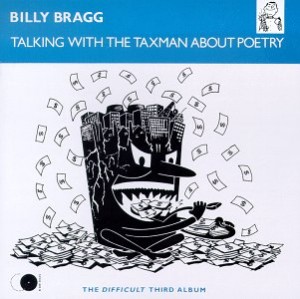
Billy Bragg: Talking With The Taxman About Poetry

BILLY BRAGG: TALKING WITH THE TAXMAN ABOUT POETRY (1986)

1) Greetings To The New Brunette; 2) Train Train; 3) The Marriage; 4) Ideology; 5) Levi Stubbs' Tears; 6) Honey, I'm A Big Boy Now; 7) There Is Power In A Union; 8) Help Save The Youth Of America; 9) Wishing The Days Away; 10) The Passion; 11) The Warmest Room; 12) The Home Front.

Finally, after years of hardcore studio busking, Billy Bragg relents upon us — if only a little bit. There is still a lot of minimalistic electro-busking here, but on many of the tunes, Billy agrees to use additional musicians, sometimes even including a rhythm session, with John Porter playing bass and several different percussionists, one of which happened to be Kenney Jones himself (ex-Small Faces and ex-Who), who also took upon himself the production duties. Ken Craddock on organ, Dave Woodhead on trumpet, and even Johnny Marr on guitar also make appearances, continuing their relations with Billy from where they left off on the previous album.

Concerning the album title, I was all set to make some clumsy joke around it when I fortunately discovered that it was actually the translation of the title of a Russian poem by Vladimir Maya­kovsky (something I would never have guessed on my own because the Russian original has the convoluted financial inspector rather than taxman — the poem was published in 1926, when the USSR had no «taxmen» to speak of) — the main idea of the poem being «defense of poet's ho­nor», stating that the profession of a poet is a legitimate occupation even in the new world, ruled with the iron fist of the proletariat dictature. Honestly, I am not quite sure how that point is to be applied to this Billy record — other than implying that he is somehow justifying himself for not working in the coal mines, back to back with The People, but rather sitting his ass off in a warm recording studio, because, well, if The People want their champion, they have no choice but to let him sit his ass off in Livingston Studios, London. I mean, he probably could take his guitar and his tape recorder and record these songs right in the coal mine, but then they'd sound... dusty. No chance of getting any hit singles that way.

In any case, the album seems better constructed than Brewing Up: lyrically and musically, there are more nuances here, and the record does not immediately come off as this unnatural, clumsily constructed «now I'm singing about people's rights» — «and now I'm singing about bitches» — «and now I'm singing about people's rights again» — «and now I'm singing about bitches again» monstrosity. Mind you, he is still mostly singing about people's rights and bitches, but the song titles, the melodies, the lyrical imagery become more diversified, and in fact, you know what? in the very first song, he actually combines the two aspects: "Shirley, your sexual politics left me all in a muddle / Shirley, we are joined in the ideological cuddle... Politics and pregnancy / Are de­bated as we empty our glasses...".

Unfortunately, even though there are more pianos, trumpets, and bass guitars on the album as be­fore, I also have to state that this comes at the expense of interesting melodies. The most obvious case is ʽIdeologiesʼ — which is simply a cover of Dylan's ʽChimes Of Freedomʼ with new, «up­dated» lyrics by Billy, and even if he is not stealing it, but honestly indicating Dylan as a co-au­thor in the credits, this is somewhat symbolic: lyrics and pure passion have completely overridden his pop writer instincts. This is not a crime — in fact, it may be a deliberate and rational decision, because the man would hate to be labeled as a «pop artist» anyway — but it still makes me sad. Intelligent political statements set to pop hooks give you so much more than just intelligent poli­tical statements (even if intelligent political statements by pop artists are by themselves much preferable to any political statements by politicians).

The most musically interesting songs here are the subtlest and most psychological ones: ʽThe Marriageʼ, a seemingly weak protest against the ties of society ("marriage is when we admit our parents were right", the chorus goes), is set to an interesting mish-mash of choppy jazz chords, blues lines, and flamboyant trumpets that has no direct analogy in the past — and ʽThe Passionʼ, symmetrically disposed on the second side of the album, also has a wonderful gliding waltz melody, not as original, but with a very deep and tender-sounding weave of two guitars sliding in and out of each other, as if symbolizing the now agreeing, now discordant relations between kids and parents that forms one of the lyrical topics of the song. There's also ʽLevi Stubbs' Tearsʼ, a mildly haunting portrait of an outcast whose only source of permanent comfort are The Four Tops (and suchlike) — a good example of the man's busking technique where he alternates between throttling/choking his guitar and letting it wail free: again, not particularly original, but very well suited for the character he is singing about.

Political stuff like ʽPower In The Unionʼ and ʽHelp Save The Youth Of Americaʼ (I do hope there was some sort of a plan to spread the song in the States — I mean, who really needed it in the UK?) is of passable interest because of the lyrics and little else. The Randy Newman-esque ʽHoney, I'm A Big Boy Nowʼ, with its shambly tack piano and nonchalant country attitude, also shows that this kind of music should better be left to musicians across the other side of the ocean; and ditto for ʽWishing The Days Awayʼ, which may be a parody on the Nashville style for all I know, but it hardly works even as a parody — more like a pack of people that decided, for no reason at all, to record a country song despite having had no experience whatsoever. Or maybe they're intentionally «deconstructing» it, I don't think it works anyway. On the other hand, ʽThe Warmest Roomʼ is an almost accomplished pop song — all it needs is a nice, memorable lead line, and this would be as close as the album comes to a potential hit (not that there was ever any thought about releasing it as a single: that honor fell to the somber ʽLevi Stubbs' Tearsʼ).

It would be almost impossible to say that the focal point of the albums are not its lyrics — for Billy, the meaning of what is sung is clearly more important than the manner in which it is sung (which is why serious comparisons with Dylan would be out of question), and it is good to know that, once again, his idea of «championing the people» is not so much to throw shit at The System as it is to try and pull the people themselves out of their somnambulant state, which is why we have all these character portraits of disenchanted lovers, disillusioned housewives, Mother and Father and Grandma, presented with just as much psychologism (sometimes more — after all, we're standing on the shoulders of giants and all that) as in any poem by Ray Davies or (early) Tom Waits. Still, now that the original novel shock at the sight of «electro-busking» has passed, Taxman comes across as a somewhat hesitant, and not very interesting transitional record: even all these extra musicians still do not feel like they have been properly integrated with Bragg's original solitary vision. A few nice songs, but nothing spectacular. 

Thursday, July 30, 2015

Billy Bragg: Brewing Up With Billy Bragg

BILLY BRAGG: BREWING UP WITH BILLY BRAGG (1984)

1) It Says Here; 2) Love Gets Dangerous; 3) The Myth Of Trust; 4) From A Vauxhall Velox; 5) The Saturday Boy; 6) Island Of No Return; 7) St. Swithin's Day; 8) Like Soldiers Do; 9) This Guitar Says Sorry; 10) Strange Things Hap­pen; 11) A Lover Sings; 12*) Between The Wars; 13*) The World Turned Upside Down; 14*) Which Side Are You On.

Compared with Life's A Riot, Billy's first full-length LP seems almost orchestrated — not only are there a few extra players spicing up the songs every now and then (Dave Woodhead on trum­pet, or Van Morrison's keyboard player Kenny Craddock on organ), but Billy's own guitar parts seem fuller, more fleshed out, more in line with the traditional understanding of what a «punk / garage rock song» should sound like. Still, I have to confess that, as much as his lonesome busker approach might have seemed revolutionary at the time, it is very hard for me to overcome the «rockist» attitude and appreciate these songs — be they well written or not — on the same emo­tional level as if they were full band productions.

Let's just face it, something like the bravado guitar intro to ʽFrom A Vauxhall Veloxʼ, for ins­tance, just begs for rhythm section support — it's one thing just doing this on a street corner or in your living room, but in the studio... well, on a purely intellectual-symbolic level, it's all under­standable, but on the level of pure instinct, it's all about «oh shit, too bad the guy was on such a tight budget, couldn't even afford himself a bass player». It just can't be helped, that's all, no mat­ter how much intoxicating London charisma he is sweating out while the tapes are running.

But yes, there are some dang good songs here — not John Lennon level, I guess, but definitely at least Elvis Costello level. Thematically, Billy goes on to develop his two major concerns: (a) fuck the system that is ruining our lives and (b) fuck the bitch that is ruining my life — and the two are so tightly intertwined that I can't help thinking, is it the system that is supposed to be responsible for the breakdown of human relationships, or is it the breakdown of human relationships that is responsible for the collapse of the system? One thing's for sure: Billy allocates the exact same amount of passion for both themes, which is ultimately good, I guess, because a two-track mind in art is always preferable to a one-track one.

And here comes another confession: at this point, I actually prefer Billy's love (or «anti-love») songs to his political statements. The reason might be very simple: they work better as stripped-down ballads, whereas the political songs are the ones that suffer the most from lack of additional musicians. (Although even there, once Billy starts to croon he begins to sound like Morrissey's ragged twin, and the songs start looking like early demos for Smiths ballads. But this problem is notably easier to overcome). ʽThe Myth Of Trustʼ, for instance, is not only lyrically smart (offer­ing its own interpretation of the allegory of Adam and Eve with the serpent left completely out of the picture), but also has a creepy «dark folk» twist to it — later on, Adam and Eve make a much happier comeback in the organ-backed ʽA Lover Singsʼ serenade, but they have to pass through some highly uncomfortable moments before they find out all about love.

Of course, though, the album will still be generally remembered not through its ruminations on the nature of sexual attraction, but through its political statements — the anti-Thatcherite ʽIt Says Hereʼ and the anti-war anthems ʽLike Soldiers Doʼ and ʽIsland Of No Returnʼ. Of these three, ʽIslandʼ packs the biggest punch and is probably the single most underworked song here: the arrogant lyrics, the furiously strummed power chords (with some funky syncopation thrown in for good measure), the way he massacres his not-too-inherently-strong voice on the line "...in his hand was a weapon that was made in Bir-ming-haaaaam!..." — these are all hallmarks of a good song... but yes, it could have been better.

Still, all in all there is definitely some progress. Billy's lyrics are thought-provoking both on the love front and on the social struggle front; his guitar playing skills, if anything, are demonstrated here even better; and the occasional guest instruments are selected with loving care (did I yet get a chance to mention the cute ʽPenny Laneʼ-like trumpet solos on ʽSaturday Boyʼ, placed there and nowhere else because this is, like, the tenderest song on the album?). For all these reasons, the thumbs up rating should never be placed under doubt — even if the final brew, alas, is just not strong enough for my tastes, and I cannot picture myself voluntarily returning to this record whenever I want to hear a love serenade (if we're talking about the same time period, I'll still predictably pick The Smiths) or a fuck-the-establishment state­ment (if we're talking about the same time period, I'll still predictably pick The Clash). Then again, who knows? Maybe in a few years' time rhythm sessions will become so passé, your spirit will realign to electric guitar bus­king without you knowing it, and then...

...anyway, on a technical note, these days this album also comes in a 2-CD edition with plenty of bonus tracks (including some Smiths and Stones covers with Johnny Marr himself guest-starring on second guitar), but I have only heard it as part of 1987's Back To Basics compilation, so my bonus tracks are three more songs from the 1985 EP Between The Wars — one of them an old cover of a pro-union song, and another one (ʽWorld Turned Upside Downʼ) is a Leon Rosselson song about the Diggers' Commune of 1649. Well... the EP was just too short a format to make space for any more love serenades, I guess.

Thursday, July 23, 2015

Billy Bragg: Life's A Riot With Spy Vs. Spy

BILLY BRAGG: LIFE'S A RIOT WITH SPY VS. SPY (1983)

1) The Milkman Of Human Kindness; 2) To Have And To Have Not; 3) Richard; 4) A New England; 5) The Man In The Iron Mask; 6) The Busy Girl Buys Beauty; 7) Lovers Town Revisited.

This might be the single most influential (or, at least, most revered) LP in the history of pop music (or, at least, UK pop music) that takes no more than sixteen minutes in total to tell you everything it needs to tell you. A much later CD edition has expanded it to more than twice its length with the addition of demos and rarities, but even then it was divided into two discs and the first one contained nothing but the original album — so you don't ever forget the importance of brevity in this line of artistic business. (I only have the record as part of the 1987 compilation Back To Basics, so I have not yet heard the additional tracks on the expanded release).

Now even though for Billy Bragg social activism and politics have always been every bit as im­portant as his music, Life's A Riot already clearly shows that he is a «singer-songwriter doing politics», not a «social activist pretending to be a musician in his spare time». The thing that he does here was something largely unheard of in 1983: «folk-punk» in the most literal sense of the word, where the artist is a one-man band, playing energetic, uptempo tunes on an electric guitar, but using it in the manner of a folk troubadour. Give the man a complete rhythm section to go along, and you will have something in between The Clash and Elvis Costello; as it is, what you have is a modern day Woody Guthrie, updated to reflect contemporary realities and certain ad­vances in playing, writing, and verbalizing that took place since the 1940s.

The way to enjoy and understand Billy Bragg is through his «persona» rather than any specific musical gift. As you see them here, these songs are neither particularly well written nor amazing­ly well performed: sure Billy can write, play, and sing, but there is nothing about these chord changes, guitar tones, or vocal inflections that has not been done better by more artists than you will have the chance to listen to in your sweet short life. However, once you put it all together — his choppy garage-rock guitar chords, his rough, earnest, Strummer-influenced voice, his deep-reaching lyrics (way above whatever you'd expect from the average leftist stereotype), and that stripped-down attitude, as if he were just recreating his usual busking on the streets of London in the studio — the whole is far more impressive than the parts.

Besides, at this point it is not even completely clear if social messages are more important for Billy than pure expression of emotion: after all, the album opens with ʽThe Milkman Of Human Kindnessʼ (already an awesome song title, isn't it?), which is basically just a romantic love song (unless, of course, you want to interpret the line "I will leave an extra pint" as indication that the protagonist is simply willing to make love to as many women as there are milk bottles, and that the current addressee is just one of the many. Ah well, still a romantic love song, just with an ad­ditional Don Giovanni twist then). As the song opens with loudly blasting, ass-kicking folk-rock guitar chords, you most naturally expect the opening to be followed with the band kicking in — bass, drums, second guitar, maybe Al Kooper on the organ or something — but it never does, and I still wonder just how much better the song could have worked on its own, if given a full arran­ge­ment. Not much better, perhaps, because the chorus has no well-placed hook (that "I will leave an extra pint" is merely memorable because it is a fun line delivered accappella for the whole world to hear and memorize) — but no harm in wondering.

Social conscience begins to kick in with the second track: ʽTo Have And To Have Notʼ is basi­cally the Clash's ʽJulie's In The Drug Squadʼ (or some other Clash song, no matter) with new ly­rics ("just because you're better than me doesn't mean I'm lazy"), but since it's more derivative, it's also catchier, and Billy's enthusiasm may even be more infectious than Strummer's, precisely because of the stripped-down arrangement. ʽA New Englandʼ makes a subtler point: "I don't want to change the world / I'm not looking for a new England / I'm just looking for another girl" could be superficially understood as reluctance to introduce changes, but in fact, it is quite clear that getting another girl is a difficult task in old England, so... anyway, the chorus here is probably the most charismatic spot on the entire record, combining a bit of melancholy, a bit of puzzled con­fusion, and a bit of optimism in the face of depressing odds. Additionally, it's a good example of Billy's way of genre-welding: "I was 21 years when I wrote this song, I'm 22 now but I won't be for long" is written and sung as if it were an old talkin' blues (close your eyes and hear Woody, or Dylan, sing this), but the accompanying guitar is doing it surf/rockabilly-style. Kinda cool.

The odd man out on this short record is ʽThe Man In The Iron Maskʼ, which totally eliminates all the garage/punk stylizations, slows down, and turns to dark European folk for inspiration — again, singing about torturous unrequited (or betrayed) love rather than social problems, and sin­ging surprisingly well: given Billy's well-defined, in-yer-face cockney accent all over the place, his take on the «quasi-medieval balladry» genre works out all right, as he never falters on the prolonged notes and switches from higher to lower registers to good effect. Maybe this is not exactly a Lou Reed or a Peter Hammill level of deep-reaching psychologism, but for just a guy with just a guitar, this is exceptionally well crafted stuff.

Nevertheless, like I said, Life's A Riot earns its thumbs up «on the whole», as a successful first-time stylistic experiment of merging the «wisdom» of old folk with the «brute force» of new punk, rather than through individual tracks — and yes, to do that, sixteen minutes are just enough (already the last two ultra-short songs bordered on «slightly tedious»). Being the people's cham­pion and all, though, Billy even made sure that you do not get overcharged: "Pay no more than £2.99 for this 7 track album", the front cover says in ineffaceable type (which still seems a bit high — that's something like £9.50 in today's prices, which is the price of a solid CD, but then again, it looks like three pounds was a fair price for a 12" release back then). Ironically, the 2-disc edition as sold on Amazon in the UK goes for £7.89 today — and the cunning bastards have erased the original small type, replacing it with the boring (but serving its purpose) tag of «30th Anniversary Edition». Apparently, there's just no getting away from capitalist swine games even for a true people's champion. Tough world.