Search This Blog

Monday, August 12, 2013

Brenda Lee: Brenda Lee

BRENDA LEE: BRENDA LEE (1960)

1) Dynamite; 2) Weep No More My Baby; 3) Jambalaya (On The Bayou); 4) (If I'm Dreaming) Just Let Me Dream; 5) Be My Love Again; 6) My Baby Likes Western Guys; 7) Sweet Nothin's; 8) I'm Sorry; 9) That's All You Gotta Do; 10) Heading Home; 11) Wee Wee Willies; 12) Let's Jump The Broomstick.

Unlike later albums, this self-titled release was actually recorded over several different sessions that took place between 1958 and 1960 — which is a good thing, since rock'n'roll was still a hot thing on the charts and in people's minds when the sessions began, and, consequently, Brenda Lee is the rockiest, liveliest set of songs in the lady's career. Hard as it is to believe for those who have some idea of a faint outline of Brenda's career, only one of these twelve songs is a sentimen­tal ballad — and it happens to be her signature tune at that. The rest is either rockabilly or dance-oriented country-western, with a little bit of twisting and New Orleans for extra diversity.

Several of the tracks had been earlier released as singles, and are presented here in remade ver­sions: ʽJambalayaʼ, for instance, which was Brenda's first nationwide success at the age of 11, is slightly sped up and nourished with some King Curtis-style sax, while ʽDynamiteʼ, the single that got her the famous nickname, is embellished with extra strings and backing vocals. Needless to say, the originals are a bit rougher and tougher, but these versions are still quite wholesome, and hold up well on their own: Brenda's pirate snarl on the "jambalaya, crawfish pie and filet gumbo" line used to literally send shivers down my spine, and still does — it probably does take a 13-year old to produce that kind of effect.

But it is really ʽDynamiteʼ that exemplifies early Brenda Lee — way down in history, way before there ever was a ʽBaby Hit Me One More Timeʼ, there was this little girl, much younger than Britney, who bellowed "If I might do all the things / I'd love to do tonight / Then I would love you dear / With all my might... I just explode like dynamite!" and you were almost ready to com­mit a capital crime by actually believing what she sang. Of course, the arrangement is very inno­cent, done in gentle Nashville style, and the kid-rock melody is vaudeville-turned-rockabilly, but the song is still a significant milestone — no other white girl, not even Wanda Jackson, who was Brenda's chief (and only?) competitor at the time, could afford to let herself that loose back in the late Fifties. And there is nothing in the song that would diminish its freshness and excitement today — this is not simply some sort of «American Idol» thing, it is a daring, bravura per­for­mance that could not have been the result of merely memorizing a set formula.

Unfortunately, ʽDynamiteʼ did not do as well on the charts as ʽI'm Sorryʼ, which first gained po­pularity as a B-side, then rose to #1 as an A-side, and eventually became the song to be forever associated with Brenda. It is a decent ballad that she honestly pushes towards greatness — where her earliest songs, for understandable reasons of age, valued adrenaline over depth and subtlety, this lost love confession prompted her to add dynamics and flexibility, and I guess it does mark the transition from child phenomenon to mature artist. But the fact that ʽI'm Sorryʼ became the first song to make her a household name also resulted in the inevitable — a tendency to drift far­ther and farther into syrupy ballad territory, and away from the rockabilly turf that gave her birth and nurtured her to this maturity.

But we are running ahead here, because, like I said, most of Brenda Lee is still deep in kick-ass territory, or, adjusting to the circumstances, in «pat-ass» territory. Most of the songs are contribu­ted by outside songwriters and are derivative to the core, but that does not matter as long as the source inspiration was fun in the first place, and it was: ʽLet's Jump The Broomstickʼ clearly owes a lot to Little Richard's ʽSlippin' And Slidin'ʼ, and it is nice to hear Brenda pay this kind of tribute, even if the cumulative effect is (predictably) a little less overwhelming. (The song was covered a decade later by Sandy Denny, who managed to make it bluesy and ominous instead of whirlygig-funny — a curious feat).

Other highlights include ʽMy Baby Likes Western Guysʼ, where the protagonist complains about her lover's Western TV show obsession impeding the lovemaking process (it is a funny song, be­lieve me, though not quite on the Coasters level); ʽSweet Nothin'sʼ, credited to Ronnie Self, the author of ʽI'm Sorryʼ, and giving Brenda the opportunity to sound a little foxy; and ʽThat's All You Gotta Doʼ, the former A-side of ʽI'm Sorryʼ, which is just a sweet fast pop-rocker — sort of Motown-lite that the early Beatles would have loved. As for lowlights... well, some of the tunes are less memorable than others — that is to be expected — but there is hardly a single song on here that wouldn't be fun at all, or would have Ms. Lee try and perform something way beyond her reach or understanding.

I would go as far as suggest that, for 1960, Brenda Lee constitutes an essential listen. Even if we want to believe that the teen phenomenon was completely «manufactured», there is nothing on the record itself to suggest that. The music is nowhere near groundbreaking, but it is consistently fun, and to have an underage female rocker shake your world in an age when most of the male «veteran» rockers were giving up their positions must have been awesome: yes, the arrangements are wimpy, but they are not completely smooth and sterile — and that voice is anything but wimpy. Thumbs up without further questions: for those who prefer to deal in original LPs rather than compilations, Brenda Lee is the real deal about this girl.

Check "Brenda Lee" (CD) on Amazon
Check "Brenda Lee" (MP3) on Amazon

Sunday, August 11, 2013

Architecture In Helsinki: Fingers Crossed

ARCHITECTURE IN HELSINKI: FINGERS CROSSED (2003)

1) One Heavy February; 2) Souvenirs; 3) Imaginary Ordinary; 4) Scissor Paper Rock; 5) To And Fro; 6) Spring 2008; 7) The Owls Go; 8) Fumble; 9) Kindling; 10) It's Almost A Trap; 11) Like A Call; 12) Where You've Been Hiding; 13) City Calm Down; 14) Vanishing.

Can an Australian band that calls itself «Architecture In Helsinki» be any good? It probably can, but it better be real good, then, since it takes an awful lot of goodness to redeem the original sin of calling oneself «Architecture In Helsinki» when not only do you not live in Helsinki, but you live so far away from Helsinki, you might as well call yourself «Architecture In Eldorado» and get away with it on a much firmer basis. In other words, these guys are so ferociously «indie-indie» even before you hear them play a single note, they have to work double hard to earn our pardon, and triple hard to earn our admiration.

The good news is that they try, and the bad news is that they do not try hard enough — in fact, their major purpose seems, above all, to demonstrate their sworn allegiance to generic indie aes­thetics. There are five primary and three secondary members in the band, playing everything from guitars to electronics to woodwinds and brass to melodica to xylophone — and, of course, there is not a single professional, let alone virtuoso, musician anywhere in sight. Vocals are democrati­cally divided between boys and girls — and, of course, there is not a single unique vocal tone or style anywhere in sight, although everything sounds pleasant. The songs are short (we don't want to seem too pretentious), the lyrics are psychedelically introspective (we do want to seem magical and mysterious), and the arrangements are multi-layered (the more instruments we play at the same time, the less people will notice that we cannot play any of them).

Did this sound like I just described Arcade Fire? Well, not quite — Arcade Fire are not afraid of letting their songs run for more than three minutes, they do have relatively unique and easily re­cognizable vocal styles, and their lyrics actually make sense and show plenty of aching relevance. Most importantly, Arcade Fire are quite heavily grounded in reality, and these guys are twee-ori­ented, riding on rose-colored clouds until the pants are soaking wet. (To make matters worse, none of this cloud-riding has anything to do with architecture in Helsinki — much of which is conceptually following Saint-Petersburg, and could, with some reservations, be called «light», but not light enough to associate itself with this kind of music).

Nevertheless, Fingers Crossed does manage to give us an interesting, not entirely predictable kind of sound. The overall vibe is that of «little-angelish» innocence, due to all the xylophones, glockenspiels, high-pitched electronics, quasi-surf guitars, and pseudo-pre-pubescent vocals. This is not news in itself, but it is made into news by an unusually equal-rights approach to all the separate elements of the band's sound: retro-pop guitar, futuristic electronics, marching band brass combos, street-player style wind-up instruments, and folk-pop singing. With this particular brand of synthesis, Architecture In Helsinki have no problem carving themselves out their own identity — even if nobody needs it, you can't at least deny it's there somewhere.

Alas, in the end it all fails for one simple — and way too common — reason: not a single member of the eight-piece band happens to be an accomplished, or even simply talented songwriter. This is not avantagarde music: they do know how to put together strings of notes so that they end up with traditional rhythmics, harmony and melody. Throw in the rose-cloudy style of arrangement, and it's all nice and pretty and you sort of begin to feel bad about criticizing this kind of music — as if you were taking candy from a baby or something. But really and honestly, there is hardly a single song on here that has anything memorable about it. It's all atmosphere, from top to bottom, and on a record that presumably consists of two-and-a-half-minute long pop songs, «pure atmos­phere» is like a humiliating rape of your expectations.

The only time where the band did strike a sensitive nerve was on ʽThe Owls Goʼ, whose repeti­tive, childish chorus, sung in feather-light mode by Kellie Sutherland (the band's resident clarinet and God-knows-what-else player), accidentally embottles an ounce of genuine protective tender­ness (it also constitutes a terrific case of misheard lyrics for me — until I looked it up, the line "finding a replacement with a heart sedated" kept coming across as "finding a replacement for the House of David", which, I guarantee it, would give the whole song an entirely different, and far more profound, meaning). In contrast, the verses, sung by one of the band's lead vocalists (pro­bably Cameron Bird, the guitar player), are completely blank and colorless.

Every now and then, something will faintly register on the radar, like a much weaker, fluffier va­riant of Broadcast (ʽScissor Paper Rockʼ, where it is clearly seen how Sutherland can come across as a shallower copy of Trish Keenan), or a watered-down imitation, perhaps a subconscious one, of the kaleidoscopic electronics of Animal Collective (ʽImaginary Ordinaryʼ), or a Beirut-like use of the brass section to generate a meekly East European flair (ʽTo And Froʼ). Nothing in these attempts is offensive or even «pathetic», because it is all so innocent and generally unpretentious: when, at the very beginning of the album, the chorus asks us, "Have we missed an opportunity?" (ʽSouvenirsʼ), you probably wouldn't even want to upset the kids with a straightforwardly nega­tive answer. But — shh, don't tell anybody in the band, but this is exactly what it is about: a missed opportunity.

I know how it could have all worked: had the band refrained from trying to write original songs and, instead, devoted itself to covering superior material, recasting it in this pretty, cloud-a-licious, modestly innovative mold, Fingers Crossed might have passed for a charming and maybe even thought-stimulating curio. As it is, the album earned mixed reviews from the very beginning, and although the band did manage to achieve minor cult status among certain circles of twee-pop lovers, it seems quite just that they never made it to the big leagues.

Check "Fingers Crossed" (CD) on Amazon

Saturday, August 10, 2013

Barenaked Ladies: Snacktime!

BARENAKED LADIES: SNACKTIME! (2008)

1) 7 8 9; 2) The Ninjas; 3) Pollywog In A Bog; 4) Raisins; 5) Eraser; 6) I Can Sing; 7) Louis Loon; 8) Food Party; 9) The Canadian Snacktime Trilogy: 1. Snacktime; 10) The Canadian Snacktime Trilogy: 2. Popcorn; 11) The Canadian Snacktime Trilogy: 3. Vegetable Town; 12) Drawing; 13) Humungous Tree; 14) My Big Sister; 15) Allergies; 16) I Don't Like; 17) What A Wild Tune; 18) Bad Day; 19) Things; 20) Curious; 21) A Word For That; 22) Wishing; 23) Crazy ABC's; 24) Here Come The Geese.

«Children's albums» recorded by adult artists more often than not turn out to be fakes — a good excuse for the artist to engage in fluffy silliness while at the same time churning out a product that most children would be, well, too child-like to properly understand and enjoy. In this respect, the Barenaked Ladies are no exception: while I do know personally a small handful of children that would probably enjoy Snacktime! and maybe even get addicted to it, most would probably find half of the record too boring, and the other half too befuddling (not to mention that there are a bit too many references to the Ladies' own childhood — I mean, Grease 2? Come on!). Adult fans of the Ladies, on the other hand, may react to the record just the way a Beatles fan reacts to ʽAll Together Nowʼ, ʽHer Majestyʼ, and ʽWild Honey Pieʼ — with a mix of mild external condescension and subtle internal amusement / excitement.

The idea of making a record specially for the children came from Kevin Hearn, who is respon­sible not only for an unusually huge percentage of the songs, but also for the artwork in the com­panion book. Robertson was in on the idea, but Page was not — he is credited for only five out of twenty-four numbers, and has since admitted that he was simply «along for the ride»; supposedly, his alienation from the affair was one of the factors that influenced his subsequent departure. It is interesting that one of the most «serious» numbers on the record — ʽBad Dayʼ, an introspective acoustic ballad that would have easily fit on any of their «adult» albums — is credited exclusive­ly to Page. Apparently, that was his little act of sabotage for the concept.

That said, as an adult who can still channel certain childhood memories and feelings, I find my­self along for the ride, too. The quirky, goofy side of the Ladies is not just activated with this pro­ject — it is put in overdrive, almost as if everything that they were holding back ever since it was decided that they should be «serious artists», not a comic act, suddenly broke through the wall and exploded it, as in the finale of a Roger Waters show. The twenty-four tracks in question run slightly less than an hour, with ideas bounced off each other in momentary splashes, and almost everything works — hilarious lyrics, replete with puns, sarcastic jabs at popular culture, and oc­casional edutainment value, set to simple, but catchy kiddie pop melodies.

The base reference point here is «wordplay» — already the opening number, ʽ7 8 9ʼ, illustrates that well enough ("why seven ate nine, nobody knows"), but the peak is reached on one of the last numbers: ʽCrazy ABC'sʼ pokes Bernard Shaw-esque fun at the peculiarities of English spelling and, along the way, introduces the listener, young and old, to words like ʽbdelliumʼ, ʽfohnʼ, and ʽqatʼ, knowledge of which is essential for survival in the Barenaked Ladies' world. (ʽZʼ is, of course, for ʽZed Zed Topʼ, whose music is also briefly referenced in the tune).

Other topics involve ninjas ("they speak Japanese, they do whatever they please and sometimes they vacation in Ireland"), raisins ("raisins come from grapes, I come from apes" — nice subtle anti-creationism indoctrination for the kiddies out there), food (ʽThe Canadian Snacktime Tri­logyʼ has a host of musicians, including Geddy Lee and Gordon Lightfoot, and their children lis­ting their favorite snacks), pencils, allergies, curiosities, wishes, in short, pretty much every single topic that an adult would like his kid to be interested in when his kid is only interested in smart­phones and video games — predictably enough, these are the exact subjects that never crop up in Snacktime!, being way too vulgar to fit in the perspective of Hearn's and Robertson's creative fantasy, stuck somewhere midway in between Lewis Carroll and Alan Milne.

Musically, Snacktime! mostly sounds like a typical pop-oriented Ladies album — lively acoustic strum (ʽNinjasʼ), thick power-pop riffs (ʽWishingʼ), with occasional smidgeons of synth-pop (ʽDrawingʼ), music hall (ʽPollywog In A Bogʼ), and country-western (ʽI Can Singʼ): again, this diversity is more likely to appeal to grown-ups than kids, accustomed to the monotonousness of teen-pop, but then again, we're hardly talking here about competing with the likes of the Mouse­keteers — most likely, the only toddlers to be exposed to Snacktime! must have been the little child­ren of old-time Barenaked Ladies fans.

In any case, goofy and silly as these songs are, they are not altogether insightless, and definitely not uninventive: whatever be, I'd rather listen to this stuff, where Robertson and Hearn are com­pletely in their element, than to Barenaked Ladies Are Me, for instance. With so many ideas to test and produce, not everything here works (I am particularly disappointed by the sentimentally anthemic album closer: ʽHere Come The Geeseʼ is too plain and repetitive to qualify for a true «grand finale», as it was probably thought of), but if everything here worked, the album would have been a downright masterpiece. As it is, it is just a very friendly thumbs up type of album.

Check "Snacktime!" (CD) on Amazon
Check "Snacktime!" (MP3) on Amazon

Friday, August 9, 2013

Bathory: Requiem

BATHORY: REQUIEM (1994)

1) Requiem; 2) Crosstitution; 3) Necroticus; 4) War Machine; 5) Blood And Soil; 6) Pax Vobiscum; 7) Suffocate; 8) Distinguish To Kill; 9) Apocalypse.

This has got to be one of the most bizarre twists not just in Bathory history, but in the entire his­tory of heavy metal. Nobody could have expected that — all of a sudden, after one suitably tran­sitional, one fully established, and one somewhat stagnant, but still understandable stylistic fol­low-up, Quorthon completely jettisons the whole «Viking metal» angle, and puts out a bona fide thrash metal album, conforming to all the laws of the genre. Insane tempos, jackhammer riffs, growling vocals, complete disregard for variety, and a running length of 33 minutes.

Now, considering that this was Quorthon, after all, the guy that moved from speedy black-metal satanism to the sacred hammer of Thor in less than half a decade, something radical could have been predicted, but hardly this, an album that shows no traces whatsoever of anything that made Hammerheart so unique. And the really bad news is that there is nothing whatsoever that would make Requiem comparably unique. It has been reported that Quorthon's goal here was simply to pay a brief tribute to some of his early metal influences — to take a break from rolling the epic stone and do something just for the momentary fun of it. Perhaps so, but this neither explains why the trend continued on his next albums, nor makes the whole experience gain in intelligence.

Two things somewhat redeem this strange decision. One, the production continues to be miles ahead of Bathory's early stuff, and Quorthon's guitars produce meticulously differentiated strings of metallic notes rather than the thick black goo of the first three albums. Second, strange as it is, many of the thrash riffs that he knocks together for these songs are fun — slow them down a bit, paint them less black, and you can get a pretty memorable hard rock album. With everything ta­ken at the same tempo (except for the mood-setting intros, which tend to be slow and sludgy), the riffs are very similar in structure and mood, but each single song does have its own riff, with slight variations, and after a couple listens you might even start appreciating the melodic com­ponent — at any rate, these songs are not ultra-quick knock-offs, because you would have to be a musical genius to knock 'em off in a couple of minutes, and Quorthon is hardly a musical genius, but he sure was a hard worker.

So it is not the riffs (which are quite fine for a generic thrash record), nor the solos (which, I do be­lieve, show further improvement in Quorthon's technique) that irritate. Irritating factors involve (a) the drumming: «Vvornth» was fine and dandy working with the slow epic stuff, but with the fast stuff, most of the time he is just too busy trying to stay on time so as to try something intere­s­ting — a regular bane with both thrash and hardcore, making the drumming patterns sound moro­nic instead of properly aggressive; (b) the singing: gone altogether are Quorthon's clean vocals, replaced by sore-throat growling that is not even banshee-style evil like on the early records, just sounds like a freshly excavated zombie from a zombie-trash style movie.

Lyrics-wise, Quorthon moves back to images of gore, violence, and Satanism, occasionally going to such extremes that, once the lyrics sheet is finally pulled out and examined, the parodic status of the album may no longer be doubted — I mean, "the altar covered in lifegiving cum / the smell of forever running wet cunts"? that's not even close to the style of the first three albums, more like Cannibal Corpse or something. But I seriously doubt that somebody will ever want to look at those lyrics with a magnifying glass — in general, my only wish is for this album to have been presented as completely instrumental, in which case we could simply take all these riffs home and stay safe, sound, and undamaged by the expelled shards of Quorthon's Miraculously Self-Regene­rating Larynx.

Thumbs up for the brave decision for a radical change — already the second one in Bathory's his­tory, propelling Quorthon's team to further levels of uniqueness — but much as I like some of these riffs, the experience as a whole is so ridiculous that the same gesture can hardly be applied to the music. Still, nowhere near as bad, mind you, as some of Bathory's disappointed fans, year­ning for another meeting with the Scandinavian pantheon, would have you believe.


Check "Requiem" (CD) on Amazon

Thursday, August 8, 2013

Barclay James Harvest: A Concert For The People (Berlin)

BARCLAY JAMES HARVEST: A CONCERT FOR THE PEOPLE (BERLIN) (1982)

1) Berlin; 2) Loving Is Easy; 3) Mockingbird; 4) Sip Of Wine; 5) Nova Lepidoptera; 6) In Memory Of The Martyrs; 7) Life Is For Living; 8) Child Of The Universe; 9) Hymn.

We all saw it coming. I'm guessing they just ran out of space on the front sleeve, preventing the album from flashing its true full name: A Concert For The People (Who Continue To Buy Our Records Because We Wrote A Very Sappy Song About Their Hometown And They Fell For It, Well What Do You Expect Of Them Dumb Krauts Anyway). In grateful and sincere recog­nition of that fact, Barclay James Harvest did indeed play a live show on the steps of the Reich­stag, no less, on August 30, 1980 — and recorded this historical event (why historical? no idea) on audio and video for as much posterity as will be ready to stand the band.

Consequently, the biggest problem with this third BJH live album in less than ten years must have been the setlist. It is not very likely that they only played the nine songs on the album (al­though these are also the same nine songs that are available on the official video): most likely, they just selected the stuff that was not yet written in the age of Live and Live Tapes. So the set­list, or at least this particular section of it, mostly focuses on their recent period — the majority of the songs stemming from either XII or the yet-to-be-released Turn Of The Tide (oddly enough, Eyes Of The Universe is completely snubbed — too bad, the 175,000 Berliners assembled for the show might have enjoyed some disco dancing). ʽMockingbirdʼ is also included since, well, it is BJH's equivalent of ʽSatisfactionʼ; and ʽChild Of The Universeʼ and ʽHymnʼ make a re­ap­pe­ar­an­ce because a live album just ain't a live album without its fair share of singalong anthems, and XII was rather lean on singalong anthems.

The album is reported to have been seriously doctored, since there were multiple problems with the recording equipment (the spirit of the Reichstag does not take lightly to overseas intruders, so it seems), and some of the guitar parts had to be recut, which is why the final version came out so relatively late. This explains why Lees' guitar solos sound so much cleaner and sharper than they did on the earlier live releases — and, as usual, plunges us into the philosophical discussion on pre-calculated quality vs. flawed spontaneity. But at least they did go to the trouble of re-recor­ding rather than, say, using the solos from the original studio mix.

Still, it is hard to think of any reasons that would make Berlin an essential listen. There are a few rearrangements — ʽLoving Is Easyʼ, for instance, is sped up (which does not make the opening bassline any less ʽPsycho Killerʼ-ish) and recast in a rockier mode; whereas ʽChild Of The Uni­verseʼ, on the contrary, seems a bit softer and slippier than the original, with more emphasis on the keyboards and less heaviness in the guitar department. But it's almost impossible to under­stand what makes this seven-minute version of ʽIn Memory Of The Martyrsʼ preferable over or in addition to the studio version — naturally, this song, written in homage of the unlucky Berlin Wall crossers, had to be played there, but it would probably make more sense to try and get ins­pired by watching the faces of the people listening to it than by the audio track of the actual per­formance. Same goes for ʽHymnʼ, of course, except that ʽHymnʼ, unlike ʽMartyrsʼ and ʽBerlinʼ itself, is not specifically targeted at German audiences.

At least, with the possible exception of ʽLife Is For Livingʼ, they don't play any of their bad material — and the concert catches them in that short-lived upwards spiral of the post-Woolly era, so it represents another bookmark in the Amazing Technicolor Story of Barclay James Harvest that most people couldn't care less about. Oh, and do buy the DVD rather than the CD if you are really desperate — Lees cuts quite a melodramatic figure, jumping around in his matching red pants and jacket, and, with his beard shaved off, he sort of looks a bit like Roy Orbison now.


Check "A Concert For The People" (CD) on Amazon

Wednesday, August 7, 2013

Blodwyn Pig: Lies

BLODWYN PIG: LIES (1993)

1) Lies; 2) The Night Is Gone; 3) Deep Down Recession Blues; 4) Latin Girl; 5) Gnatz; 6) Funny Money; 7) Witness To A Crime Of Love; 8) Aby's Lean; 9) The Victim; 10) Love Won't Let You Down; 11) Dead Man's Hill; 12) Maggie Rose; 13) I Wonder Who; 14) All Said And Done.

I have no idea why this album was credited to «Blodwyn Pig» in the first place. Once the original Blodwyn Pig split up because of creative differences between Abrahams and Lancaster (actually, the band went on for a short while without its founding father, with ex-Yes guitarist Peter Banks replacing Abrahams, but did not even manage another LP), Mick went on with a solo career, putting out a few records either as a part of the «Mick Abrahams Band» or completely by himself (allegedly, the uniquely educational record Learning The Guitar With Mick Abrahams, re­leased in 1975, even managed to find some moderate popularity).

Then, after a long break during which Mick tried out several alternate professions, he reunited with Andy Pyle, added a couple new players, and went on to play some gigs as Blodwyn Pig once again. Then he became so fond of the old name again that he retained it for his next LP — even though, as far as I can tell, by that time Andy Pyle already went his own way, and the primary credits go to Graham Walker on drums, Dave Lennox on keyboards, Mike Summerland on bass, and Nick Payne on saxophone. None of these guys ever had anything to do with the original Pig, but it is possible that Mick was simply on a linguistic nostalgia roll.

Another possibility, of course, is that Mick thought the new album was so damn good that it de­served the Pig stamp on it. And you know what — if that were the case, he wouldn't be too far off, because Lies is indeed a damn good record. It does not sound at all like the «classic» Pig. There is no guitar / sax or guitar / flute dialog whatsoever — in fact, the second most notable instrument after Mick's guitar are Lennox's keyboards, and this is not very promising, since the tones are too smooth and synthetic. There is also little, if any, will to experiment and innovate; but, since we already know that the classic Pig never succeeded in wooing audiences with their innovation, this might actually be an advantage. In fact, it is.

Essentially, Lies is just a simple blues-rock album, masterminded by a veteran and pursuing no other purpose than relieving the veteran's hands from the recording itch, accumulated therein for the previous decade. From this angle, it reminds me of the Allman Brothers' early 1990s come­back with Seven Turns — especially since I would judge it almost as respectable a comeback as the Allmans' was, adjusting for the initial disparity, of course.

There are some healthy, strong songs here, such as the title track (an old-school funk-pop num­ber with catchy interaction between main and backing vocals in the chorus); ʽDead Man's Hillʼ (fun­ny fast boogie with a sly, enticing slide riff for the main hook); ʽDeep Down Recession Bluesʼ (a true slide guitar lover's paradise here on this laid back pub rocker); and ʽLatin Girlʼ, a celebratory «roots-pop» number with a suitably Santana-esque solo, and a fine alternative to populating the record with unsavory ballads.

Corny trappings of mainstream rock still have to be suffered on occasion — usually on those songs that rely too heavily on keyboards (ʽFunny Moneyʼ would stand a better chance if its main riff were not played on the synthesizer; ʽThe Night Is Goneʼ is too overtly glossy, although key­boards are not the song's only flaw). Also, the inclusion of several «generic» covers may irritate those who still look for a little melodic originality — although Mick's choices are curiously un­predictable, including Dr. John (ʽVictimʼ) and the long-forgotten Alexis Korner (ʽI Wonder Whyʼ) — a weird salute from one obscure British bluesman to another. But they are well performed and do not take up too much space: ʽI Wonder Whyʼ does go on for nearly seven minutes, but come on, the guy should be allowed to have at least one lengthy guitar workout per record, and this one shows that his sheer technical skills have only increased ever since he taught those vinyl-loving kids how to play guitar back in 1975.

Throw in a couple of pleasant instrumentals (the multi-tracked acoustic ʽGnatzʼ is nifty, and ʽAby's Leanʼ is a bit of fast-going, feel-good country-western), and Lies is a definite keeper — much better, at least, than whatever could be expected from a guy who never managed to find a proper face for himself in rock's golden era, and, now that rock is past its golden era, has sudden­ly turned that flaw into an advantage. Lies does not set out to prove, confirm, or discover, it just wants to have fun with you, and in that, it is successful — thumbs up.

The bad news is that, ap­parently, Mick had one more original «Blodwyn Pig» album after that, called Pig In The Middle and released in 1996, but it seems to be super-rare: I have not been able to locate it, and have no idea if it matched the quality of its predecessor. Even if it does, not hearing either of these albums is not a crime, but, considering how stiff and boring most of the post-early 1970s blues-rock records usually turn out to be, there would be no crime in building up some curiosity about it, either.


Tuesday, August 6, 2013

Bob Dylan: Bob Dylan

BOB DYLAN: BOB DYLAN (1962)

1) You're No Good; 2) Talkin' New York; 3) In My Time Of Dyin'; 4) Man Of Constant Sorrow; 5) Fixin' To Die; 6) Pretty Peggy-O; 7) Highway 51; 8) Gospel Plow; 9) Baby, Let Me Follow You Down; 10) House Of The Risin' Sun; 11) Freight Train Blues; 12) Song To Woody; 13) See That My Grave Is Kept Clean.

There was never, ever a time, really, when Bob Dylan would be a «folk singer». Folk music has always provided him with base fuel, for sure, but such is Bob Dylan that one cannot even be one hundred percent certain that he likes what usually passes for folk music, much less «admires» or «respects» it. The Freewheelin', his first complete album of (formally) original compositions, had very quickly eclipsed his self-titled debut — but in a way, that debut is not any less original than Freewheelin', and remains an essential listen for even the casual listener.

For the most part, «folk music» around Greenwich Village in the early 1960s had a reverential nature. Rural tradition had to be respected, cherished, almost «sanctified» for its depth and purity, as opposed to commercial music. Robert Allen Zimmerman, a quiet, but troubled, and also slight­ly mischievous, Jewish kid from Hibbing, Minnesota, would have none of that. By the time he was spotted and signed to Columbia Records by John Hammond — the same John Hammond that, almost thirty years earlier, «made» Billie Holiday — Bob was already a pretty nifty guitar picker and harp blower, but his technical singing abilities left a lot to be desired. The answer? Quit singing? Nope — redefine singing.

Bob's guitar, harmonica, and vocals do immediately form a holy, interdependent trio, but it is naturally the voice that takes the gold. From a «natural» point of view, it is utterly unlistenable, except for when the singer is in «talking blues» mode, where it is just a blurry murmur, consci­ous­ly or subconsciously devoid of any particular shade of color; whenever the artist actually shifts his natural pitch, the results — by the standards of 1962 — are aurally hideous. And as if simply showing his style wasn't enough, Bob blows the top off the cauldron on ʽFreight Train Bluesʼ, where the vowel in the word "blues", prolonged for a staggering thirteen seconds, produ­ces an effect not unlike the «nails-on-chalkboard» or «fork-on-plate» variety.

If they pressed him into a corner and demanded nothing but the truth, Bob could probably say something about the «far-from-perfect» singing abilities and styles of many of his blues and folk predecessors, both black and white, and how it actually makes things more realistic and closer to the listener and such. But that would not be the entire story. Take a listen to Jesse Fuller's original recording of ʽYou're No Goodʼ, the song that Bob chose for his opening number — old man Ful­ler's set of pipes is nowhere near «angelic», but it does not go against the grain: in his hands, the song is just a gruff traditional folk-dance number. With Dylan, the guitar melody is insanely sped up and «fussified», the vocals are filtered through a nasal twang effect, the pitch sometimes rises to absurdly high levels that he cannot properly hold, and the «gulping» trick that he occasionally plays out certainly does not make him sound like a regular guy — more like someone suffering from a light case of cerebral palsy.

In all actuality, this is not just «folk»: this is some sort of early form of «folk-punk», and from that point of view, Bob Dylan is the natural predecessor (and potential inspiration) to such early and little-known «odd-folk» bands like The Holy Modal Rounders or The Fugs, who would, I think, be quite likely to rate Bob's then-inauspicious debut over the glorious Freewheelin'. The fact that such an album, not only thoroughly uncommercial in general but also extremely radical for the tastes of Bob's folk audience, could get an official release by a major record label in 1962 is nothing short of miraculous, and has everything to do with John Hammond's status and influ­ence — there is little doubt that Bob would have made it anyway, but who knows when, how, and what would the actual revenue have been...

So, anyway, what you get with Bob's exuberant, hyper-energetic renditions of traditional funereal standards like ʽIn My Time Of Dyin'ʼ and ʽFixin' To Dieʼ is neither reverential carbon copies (or would that be «cardboard copies»?) of exhortations done by scary bluesmen, nor reverential scho­larly interpretations, smoothly and politely dressed up for mid-level intellectual consumption. What you get is uniquely «uglified» interpretations of all that material, perhaps repelling at first, but then subtly drawing you in through all the sheer ugliness — think Elephant Man, if you wish, and the analogy is even stronger when you realize that behind this ugliness, as is the case with Elephant Man, there is sensitivity and intellect (if not necessarily kindness — Bob Dylan has been ascribed quite a few virtues over the years, but «kindness» and «niceness» were rarely spot­ted on the list).

The fact that almost the entire album is devoted to covers is, in a way, inevitable. Dylan himself acknowledged that he was «hesitant» to show all of himself from the get-go (even though he had already accumulated quite a backlog of original compositions by 1962) — and besides, all of these «original» compositions, in one way or other, were still derivative of earlier folk and blues songs, so it is instructive to look at those roots in an explicit fashion. Bob's mix of tragedy and comedy is astute — with the ratio of songs about death and suffering vs. songs about fornicating and playing the fool approximately equalling 3:1, Bob Dylan ends up grim, but humorous, per­fectly matching Bob's facial expression on the front cover: simultaneously a little sad and a little smiling, looking at us with... with... actually, I have no idea what the hell that guy is thinking when he is looking at us that way. At 21 years, he was already inscrutable.

Two of the covers should be of specific note. ʽBaby Let Me Follow You Downʼ, played in an arrangement «borrowed» from fellow folkster Eric von Schmidt ("I met him in the green pastures of... Harvard University!" Dylan jokes in the intro, poking even more fun at folkie clichés), is so simple, straightforward, and almost stupidly catchy that Bob would later, every once in while, re­vive it for his electric show. It also provided The Animals with their debut single (retitled ʽBaby Let Me Take You Homeʼ). The other one is Bob's take on ʽHouse Of The Rising Sunʼ, which he boldly sings without changing the "many a poor girl" to "many a poor boy" — something that The Animals actually did, completely turning around the song's message: their version ends up abstract and symbolic, Bob's is quite concise and literal, but the fact that this is Bob singing, and not, say, Joan Baez, adds a familiar pinch of Bob-irony. (It was claimed by Eric Burdon that the band never heard Dylan's version before recording theirs, which is strange, since it is a bit too much of a coincidence that the Animals recorded a whole two songs in 1964, both of which were included on the earlier Bob Dylan: methinks somebody's withholding the whole truth here).

As for the originals, there are only two, both of them important ones: ʽTalkin' New Yorkʼ is a fic­tionalized, humorized tale of Bob's first acquaintance with NYC, so it both introduces the artist as the artist and initiates Bob's lengthy string of «talking blues» numbers that would provide comic relief throughout his early acoustic period. ("Man there said, come back some other day, you sound like a hillbilly, we want folk singers here" — if that's autobiographical, no wonder Bob has been taking his revenge out on folk singers ever since). And ʽSong To Woodyʼ, which borrows the melody from one of Guthrie's own songs, gives the impression of being this album's one small drop of sincerity, as Bob both acknowledges his debt to the great folkster and states that he is not going to go the same route: "The very last thing that I'd want to do / Is to say I'd been hittin' some hard travelin' too". I'm not sure how many people back then scrutinized those particular lyrics, but those that did could have predicted that this guy was certainly not going to go the Dave van Ronk / Eric von Schmidt route.

Keeping all that in mind, Bob Dylan is not just a skippable foreword. On the contrary, it is es­sen­tial listening for anybody with even a passing interest in the man, although, true enough, more from an informational point of view: all of these performances are innovative, curious, and thought-provoking, but they will probably not provide you with any important epiphanies or any­thing like that. Still, Bob's career in the 1960s is one of the most important plays in XXth century theater, and when you go watch an important play, you don't want to miss the setup, don't you? You certainly don't. Hence, thumbs up all the way.


Check "Bob Dylan" (CD) on Amazon
Check "Bob Dylan" (MP3) on Amazon

Monday, August 5, 2013

Brenda Lee: Grandma, What Great Songs You Sang!

BRENDA LEE: GRANDMA WHAT GREAT SONGS YOU SANG! (1959)

1) Some Of These Days; 2) Pennies From Heaven; 3) Baby Face; 4) A Good Man Is Hard To Find; 5) Just Because; 6) Toot Toot Tootsie Goodbye; 7) Ballin' The Jack; 8) Rock-A-Bye Your Baby With A Dixie Melody; 9) Pretty Baby; 10) Side By Side; 11) Back In Your Own Back Yard; 12) St. Louis Blues.

When Brenda Lee set out to record her first LP in early 1959, she had already been a big star for three years, ever since stunning the nation with her red-hot ʽJambalayaʼ back in 1956 at the tender age of 11 (of course, Decca Records couldn't resist the temptation to label her as «Little Brenda Lee (9 Years Old)» — the old adagio of «where there's publicity, there's cheating» strikes again). More than that, she was already known as «Little Miss Dynamite», having recorded her deadliest rock'n'roll explosion in 1957 — and thus, choosing a selection of pre-war (pre-Depression, in fact, which is accurately reflected in the album title) ditties for her first LP must have been somewhat anti-climactic for the fans.

Of course, by 1959 the initial wave of rock'n'roll enthusiasm was already breaking, with well-combed «teen idols» gradually replacing the rebels for a while, and it may have been judged a prudent career move for the girl to switch from the «aggressiveness» of ʽDynamiteʼ and ʽRockin' Around The Christmas Treeʼ to something more tame and traditional. Ironically — perhaps by some sort of subconscious inertia — it is Grandma... that turned out to be one of the rockiest and brawniest albums in Brenda's huge catalog.

Recorded in two sessions at a Nashville studio, the album has no «ballads» as such — it is com­prised of old popular dance, vaudeville, and white blues songs, not surprisingly, some of which had previously already entered the rock'n'roll repertoire (for instance, Little Richard did ʽBaby Faceʼ, and Elvis, of course, covered ʽJust Becauseʼ, with both of Brenda's interpretations rather doing homage to their versions than the originals). The arrangements, despite a plethora of studio musicians, are generally sparse and homely, with at least as much emphasis on rockabilly guitar as there is on brass — and then, of course, there are the vocals.

There is not much subtlety, thoughtfulness, depth, or flexibility in these vocals — and neither could one rigorously demand all of that from a 14-year old who had the nerve to take on Sophie Tucker and Bessie Smith at the same time (kicking off the album with the former and closing with the latter). But there is power, intensity, and plenty of swagger — rustic, unrefined swagger of the rock'n'roll era, that is, not the subtle emancipated swagger of the days of old. Other than one (not particularly tragic) misstep — she does a rather wooden take on ʽPennies From Heavenʼ, especially compared with the Billie Holiday version — it all works.

Brenda's trademark «roar» that she already flashed with gusto on her earliest records is only briefly heard here on ʽJust Becauseʼ (which might, vocally, be even more impressive than the Elvis version) — but even without roaring, she is pretty good at overpowering the listener on all those songs where the listener (a hopeless male) has to be overpowered (by a strong female). It does help to remember that the girl was 14: for a fully grown-up performer, these takes on the «classics» can seem a little strained, or a little shaky, or, on the contrary, a little over-the-top, as if the performer really felt herself in need of «proving» something — which she, of course, was, as would be every 14-year old taking on the burden of recording ʽSt. Louis Bluesʼ for commercial release.

Me certainly not being a big fan of the pre-war popular song, I do recognize that it is not the sheetnotes that matter in most such cases — it is the attitude; and there is a tiny bit of punkish arrogance in the attitude that Brenda adopts for these performances, meaning that, crazy as it might seem to some, I'd rather listen to this than to, say, Bing Crosby singing the same songs. Yet even Bing Crosby fans will probably find the album to their liking. Also, just for the record, early guitar hero Hank Garland (whom most people will probably recognize from Presley's ʽLittle Sisterʼ) is responsible for most of the lead playing on the album — one more reason for a merry little thumbs up.


Sunday, August 4, 2013

Alcest: Les Voyages De L'Ame

ALCEST: LES VOYAGES DE L'AME (2012)

1) Autre Temps; 2) Là Ou Naissent Les Couleurs Nouvelles; 3) Les Voyages De L'Ame; 4) Nous Sommes L'Eme­raude; 5) Beings Of Light; 6) Faiseurs De Mondes; 7) Havens; 8) Summer's Glory.

If we (or, at least, those of us who know either French or Google Translate) concentrate on the album and song titles long enough, the first and, for now, only three records of Alcest may seem like a trilogy: Fairy Tale, Space Journey, and now, with Les Voyages De L'Ame (Soul Journeys) comes Transcendental / Religious Experience. Naturally, this is but a subjective interpretation, but it helps — when it comes to tracing the subtle differences that justify Neige's productivity.

In a way, the third album takes a step back: compared with its immediate predecessor, it is notice­ably less «metal» in nature, with growling vocals making only a brief appearance in ʽFaiseurs Des Mondesʼ and heavy guitar tones used sparingly and almost always as a backdrop for light-ringing melodic passages. On the other hand, far more attention is paid to vocal arrangements — ʽBeings Of Lightʼ is almost completely wordless, and the focus is on New Age-style angelic choral harmonies; other songs generally tend to veer closer to the French pop-inspired melodicity of Souvenirs D'Un Autre Monde. In other words, Neige has mellowed out once more, and the territory through which the composer's (or the listener's?) soul is supposed to journey seems pretty safe for it — light, bliss, beauty, the works.

At this point, one thing I'd like to specifically praise about the album is the drum work by the mys­terious «Winterhalter» (going by the real name of Jean Deflandre). Take my advice — if you happen to listen to this stuff and get bored after a while because of all the shoegazing repetition, switch your attention to the drummer guy for a bit, since he is really doing an amazing job out there: nothing particularly complex, but he goes way beyond simply keeping the beat, as you'd expect from an «ambient»-oriented record. There are all sorts of rolls, flips, tricky syncopes, build-ups and releases that do not really corrupt or sway the planned atmosphere, but make the whole experience more fun — the guy just happens to be one of those swell drummers, like Blon­die's Clem Burke, who refuses to conform to limitations of the formula and keeps inventing new and new figures out of his head. It is double fun on those rare occasions when Neige agrees to speed up the tempo, at least a little bit, like on the final section of ʽLà Ou Naissent Les Couleursʼ.

As for the melodies themselves, they present no surprises: once again, the craft is not so much in the base melodic figures (most of which show elegant geometric precision, but do not seem to carry a lot of emotional load) as in Neige's trademark crescendos, and he has not mastered any new tricks in that department — even the guitar tones mostly remain the same. ʽBeings Of Lightʼ is arguably the most atypical of these compositions, and even that one perfectly fits inside the for­mula. ʽSummer's Gloryʼ, respecting the title, is made to look like an unusually uplifting anthem, and its vocals owe the most to the old school French «mood song».

But albums like these are usually remembered by their longest tracks, and the longest track here, ʽLà Ou Naissent Les Couleurs Nouvellesʼ, consisting of a slower and faster part linked through some psychedelic jangle, is not particularly impressive, other than Winterhalter's terrific drum contributions, even if the fast section is, indeed, the closest that Alcest has ever approached to «rocking» (not that «rocking» was ever on the project's pre-planned agenda). This and similar tracks only further confirm that the Alcest formula cannot be improved upon, at least not by Neige himself. The guy is an admirable master of form, but unless he begins coming up with truly stunning musical phrases or steps away from the self-imposed «drone and repetition only» constraint, his fanbase is not likely to expand.


Check "Les Voyages De L'Ame" (CD) on Amazon
Check "Les Voyages De L'Ame" (MP3) on Amazon

Saturday, August 3, 2013

Barenaked Ladies: Barenaked Ladies Are Men

BARENAKED LADIES: BARENAKED LADIES ARE MEN (2007)

1) Serendipity; 2) Something You'll Never Find; 3) One And Only; 4) Angry People; 5) Down To Earth; 6) Beauti­ful; 7) Running Out Of Ink; 8) Half A Heart; 9) Maybe Not; 10) I Can, I Will, I Do; 11) Fun & Games; 12) The New Sad; 13) Quality; 14) Another Spin; 15) What A Letdown.

The Ladies gave the green light to the release of the rest of the songs they had recor­ded during the 2005-2006 sessions so quickly that it was quite clear — the two records do not relate to each other in a «main product / outtakes & leftovers» kind of way, but are actually two equal-rights parts of one whole. Which is, really, the only way to explain that Are Men is a significant im­provement over Are Me, much to the consolation of those (like me) who were expecting to hear something even more dreadfully dull and languid than the first part.

The general difference is that Are Me focuses on the slower, «rootsier», more intimate / senti­mental part of The Ladies' joint personality, whereas Are Men concentrates on the quirkier, more upbeat power-pop part. This is not an unbreakable law — there are exceptions to the rule on both sides — but hardly a coincidence, either: faced with the perspective of sorting their large pile into two smaller piles, Page and Robertson must have settled on a «thematic» approach. Which, upon first sight, means that Are Men has a priori better chances to succeed, given that the Ladies have always tended to thrive in power-pop, not roots-rock environments.

And it does, but not quite — some of these songs do actually manage to reach the heights of Stunt / Maroon-era material, yet on the whole the album still carries the stamp of the «quantity over quality» department. For instance, sentimental acoustic soft-rock like ʽBeautifulʼ and ʽHalf A Heartʼ is the kind of generic indie material you so often hear in pretending-to-be-cool family entertainment movies that wish to ask serious questions and then answer them with cheap soapy melodrama — uninteresting melodies spiced up with «authentic» arrangements and «intelligent» vocals. Again, the vocals are the weakest parts: sentimental music cannot be effective without actual sentiments, something that neither Page nor Robertson can properly provide — you'd at least need a Paul McCartney to make this stuff work.

The upbeat material is altogether on another plane. Sometimes it almost feels as if they try too hard: ʽAngry Peopleʼ, with its falsetto woo-hoos, martial beats, and happy harp à la Stevie Won­der, strictly follows an old patented recipe for pop catchiness — but it is, after all, a song about correcting angry people by surrounding them with happy ones, so the form suits the message to a tee, and it would be silly to get irritated instead of just getting into the fun groove. As Robertson sings in ʽDown To Earthʼ (another one of those quirky Apples In Stereo-style pop-rockers that thrives on combining guitars with sci-fi synths), "some people are just all show / well, I don't mind that if the show's worth watching" — well, the Ladies themselves operate better when they are mostly show, or, at least, when their sincere attitude is covered with plenty of makeup.

For some strange reason, Are Men yielded no singles, even though at least a good third of these songs would be top-notch single material for the band. Page's ʽRunning Out Of Inkʼ would be a prime candidate, in particular — it's fast, quirky, catchy, funny, and structurally diverse, as Page goes from a comically paranoid delivery into a comically operatic mid-section and back again. ʽQualityʼ would inevitably be a hit with college audiences, as it combines the steady romantic pulse of ʽEvery Breath You Takeʼ with lyrics that subtly send up the know-it-all attitude ("my quality, biology enhanced with high technology"): the Ladies have always tended to strictly ob­serve the balance between the college punk and the college nerd, and they do have that talent for coming across as seriously educated guys without any particular showing off.

Yet another time, two of the best songs are contributed by Kevin Hearn: ʽSerendipityʼ has serious woo-potential in its echoey riff and, especially, clever vocal modulation — since he possesses the softest and sweetest voice in the entire band, Hearn is able to work some subtle magic with it that neither Page nor Robertson can conjure, and it is almost as if they recognize and respect that, by letting ʽSerendipityʼ open the album. Good move, or «Hearn the softie» could have been lost in the 16-song ocean: it certainly takes extra time and effort to uncover the similar charms of ʽAno­ther Spinʼ, where he keeps looking for his girl in different places (including Afghanistan, if only because it dissonantly rhymes with the song title) without any hope to find the right one, but in a state of complete vocal and instrumental serenity nevertheless.

I will not attempt individual descriptions / comments on all the songs — there is nothing truly ori­ginal or vehemently thought-provoking about most of them — but on the whole, this is a good listen, and although I have encountered opinions that value the first record over the second, I really have no interest in mulling and sussing and mulling and sussing over the Ladies' intro­spective side until it finally «gets to me». They have good, natural pop instincts, and they are well demonstrated — again — on Barenaked Ladies Are Men, and that is why it deserves a thumbs up, albeit a slightly less excited one than in the case of Stunt / Maroon. If anything, splitting their personalities in two just ended up as a transparent demonstration — which of the persona­lities it would be more fun to hang out with, and which one would do better if it never showed its nose out of the dormitory, not ever again.


Check "Barenaked Ladies Are Men" (CD) on Amazon
Check "Barenaked Ladies Are Men" (MP3) on Amazon
Friday, August 2, 2013

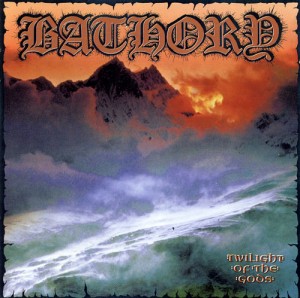
Bathory: Twilight Of The Gods

BATHORY: TWILIGHT OF THE GODS (1991)

1) Twilight Of The Gods; 2) Through Blood By Thunder; 3) Blood And Iron; 4) Under The Runes; 5) To Enter Your Mountain; 6) Bond Of Blood; 7) Hammerheart.

This thematic follow-up to Hammerheart is even more epic and ambitious in nature than its pre­decessor — starting out with the mere fact that it runs close to an hour, something that was utterly unthinkable in Bathory's early speed metal days, and even Hammerheart itself stated its point in about forty minutes. The subject matter stays the same (the album title could not be more trans­parent), but the balloon has been inflated to the limit. Lengthier, moodier intros; darker, ever more shadowy backing vocals; singalong anthemic choruses; and, most importantly — this is probably the farthest that Quorthon ever ventured away from stereotypical metal aesthetics. For­mally, this is still heavy metal («power metal», «Viking metal», whatever), but it does not feel much like heavy metal — more like a heavy rock opera with a dark folk basis.

There is nothing wrong in this per se, of course, but one big reason why Hammerheart worked so well were its undoubtedly metallic, undoubtedly killer riffs — outbalancing and justifying the relatively shallow pathos. It may or may not have given us a distinct musical vision of pre-Chris­tian Scandinavia, but at least it was a true blood-boiler. Twilight Of The Gods, in comparison, places far more faith in atmospherics — slow, leaden, repetitive, epic monsters, progressing in a regime stuck between stoner rock and snail rock. There is some sense of impending doom, yes, but it tends to quickly dissipate in the head once the tunes are over — which, it seems to me, is a sign of somewhat inefficient musicality.

The title track picks up right from where we were previously left with ʽOne Rode To Asa Bayʼ: twelve minutes of bitter ranting against the perils of monotheism (Quorthon even lashes out at «TV preachers» and such, implying that the «loss of innocence» described in Hammerheart is anything but simply ancient history, still influencing our lives on an everyday basis — and who could actually argue?), with a deeply repetitive structure, but ultimately feeling like the «smoul­de­ring ashes» sequel to the raging fire of ʽAsa Bayʼ. It is moody, and its simplistic dirge-like melody is convincing, but still overlong, not to mention the rather excessive acoustic intro and outro (with Quorthon's lack of overpowering playing technique or unpredictable inventiveness, it does not seem right for him to allocate so much space to pedestrian acoustic plucking).

Everything else follows the same formula: slow tempos, monotonous rhythms, stern Gregorian back vocals, and Quorthon himself epically wailing about what the loss of Thor's hammer and other such gadgets cost humanity in the race for survival. The best riff is probably saved for ʽBlood And Ironʼ — that particular chord sequence seems alive with the spirit of classic Black Sabbath and conveys the necessary atmosphere of sheer ravaging brutality: ʽTo Enter Your Mountainʼ, very similar in tone and structure, is already a little less efficient, and so on.

An attempt to come up with something completely different is saved for last: ʽHammerheartʼ (another of those strange cases where the would-be title track for an LP is suddenly carried over to the next LP) is nothing less than a rearrangement of Holst's Jupiter with an extra vocal part writ­ten by Quorthon and delivered in his best imitation of a «folk-operatic» voice (surprisingly tolerable for a guy who was previously known mostly for spasmodic guttural shrieking). Not par­ticularly awful for a solemn, stand-up-and-join-together coda hymn, but naturally amateurish: King Crimson might have the guts to tackle Holst, or, at least, some well-oiled, well-experienced symph metal machine like Opeth — Quorthon alone isn't quite fit to handle the weight.

Still, while it is almost inevitable that Twilight Of The Gods largely sinks under the heaviness of its titanic ambitions, the final result could have been much worse. The difference is that it is quite clear that this whole stuff really means a lot to Quorthon — the album's lack of gloss, the ela­bo­rate (if not particularly original) lyrics, the snap and snarl in Quorthon's intonations, the relentless energy expended for the repetitive punching out of the simple riffs, it all has a positive effect. It's just that you either give your listeners a heavy metal album — and in that case, Twilight Of The Gods suffers from a lack of classy riffs — or a «heavy-art» album, in which case, it suffers from extreme monotonousness and straightforwardness of approach.

For all the bravery and an overall lack of embarrassing moments (even ʽHammerheartʼ, amateu­rish as it is, does not qualify as «offensive» in my book), Twilight Of The Gods deserves a thumbs up alright. But in retrospect, it seems like a wrong move, a case of overstepping into alien territory, and, although few people can be said to have been well acquainted with the odd workings of Quorthon's mind, it may well be that the man was disappointed with the final product himself — sufficiently disappointed to plunge head first, as a misguided counteract, into the corniest phase of his lonesome career.


Check "Twilight Of The Gods" (CD) on Amazon
Check "Twilight Of The Gods" (MP3) on Amazon

Thursday, August 1, 2013

Barclay James Harvest: Turn Of The Tide

BARCLAY JAMES HARVEST: TURN OF THE TIDE (1981)

1) Waiting On The Borderline; 2) How Do You Feel Now?; 3) Back To The Wall; 4) Highway For Fools; 5) Echoes And Shadows; 6) Death Of A City; 7) I'm Like A Train; 8) Doctor Doctor; 9) Life Is For Living; 10) In Memory Of The Martyrs.

This time, the album title is anything but random: this is arguably the most optimistic-sounding record put out by BJH since God knows when, if not ever. Perhaps it had just sunk in how much happier they were without Woolly and his Mahlerisms (not likely), or maybe, like the song ʽHow Do You Feel Now?ʼ, it reflects John's uplifted mood upon the birth of his daughter (a little more likely), or it could be a consequence of the band's surprisingly high commercial success in Europe — in many a well-known case, all it takes is to start making a little money on artistic depression to make artistic depression go away. But this is all guesswork, and the plain fact is that most of these songs (with the deceptive exception of the opening lost-love-style number) stick together as a consciously designed, and sincere-sounding, ode-to-joy.

More importantly for long-time followers, Turn Of The Tide is also the first BJH album to be almost completely keyboard-dominated: in addition to Kevin McAlea, new guest member Colin Browne also adds his support on numerous instruments, including synthesizers — and guitars are all but relegated to either, sometimes, providing a wimpy acoustic foundation, or, even more rare­ly, squeezing out a hard-rocking solo or two, just to remind us that John Lees can still play guitar and remember what a lead melody is. So, from a purely technical point of view, one could try and argue that this is the band's first «synth-pop» album — except that, from a deeper point of view, «synth-pop» also requires a shift of approach to melody as such, and in this respect, BJH remain staunch traditionalists ("that kind of rock don't appeal", grunts Lees on ʽHighway For Foolsʼ be­fore engaging in one of those ass-kicking rock'n'roll solos with wah-wah a-plenty).

Surprisingly, though, it's all neither as boring nor as tasteless as could be expected. The band pays a little more attention to the hooks — a little too much attention, in fact, with obsessive repe­ti­ti­ve­ness as a key factor in their memorability — and carefully avoids falling into the trap of mistaken identity (e. g. posturing as disco kings or «New Romantics»). Instead, they just focus on their old-school, «Beatlesque» idealism, dress it up in trendy (but not too trendy) new (but not too new) sounds, give it a bit of punch, and voilà, something listenable is born.

As usual, I could very easily do without the sappier Holroyd parts. His high point here is pro­ba­bly ʽI'm Like A Trainʼ — not coincidentally, the least catchy of his songs, but the one that grows the most, with an almost surprisingly complex vocal arrangement, coming in cadences and cas­cades that are normally associated with The Beach Boys; the whole thing ends with a series of accappella harmonies that were earlier reserved for the likes of Smile. It's not tremendously great in all its derivativeness, but a fair try nonetheless — which I couldn't say about the rather idiotic Caribbean-styled ʽLife Is For Livingʼ, written with ritualistic arena audiences in mind (it is all based on exactly one endlessly repeating musical phrase), or about ʽEchoes And Shadowsʼ, also minimalistic to the point of stupidity (and it doesn't help, either, that they are selecting some very yucky, long since outdated synth tones for both).

Lees, however, is in better form, and a more variegated one: he contributes a sentimental, but clear­ly heartfelt ballad (ʽHow Do You Feel Now?ʼ, delivered in a vocal style midway between Jeff Lynne and George Harrison), a couple of glossy, but crunchy pop-rockers with a hard edge (the instrumental sections of ʽHighway For Foolsʼ are the only corner of this record where a heavy rock fan could find some refuge), a dumb post-disco dance number (ʽDoctor Doctorʼ) that should probably count as the most «modernistic» song on the album (when applied to a band like BJH and a year like 1981, this does not promise any bliss, though), and the obligatory closing anthem — ʽIn Memory Of The Martyrsʼ, where «the martyrs» explicitly refers to those who perished while trying to cross over the Berlin wall. Naturally, that last song would have been a success in Germany even if it were melodically horrible, which it is not: as far as anthemic acous­tic ballads with a singalong chorus and a sophisticated touch (symbolized by moody fusion-style synth solos) are concerned, it is simply overlong, but at least the punchline — "we are love, we are, we are love" is delivered without pathos, and that is laudable.

Altogether, for an «uplifting» record (and in art rock, good or bad, convincingly «uplifting» re­cords are a relative rarity — usually reserved for the likes of Yes), Turn Of The Tide is not at all disgusting, and occasionally entertaining. This is not sufficient grounds for a thumbs up, but it does show that Barclay James Harvest did not enter the Eighties completely empty-handed; like most of their art-rock contemporaries, they still had something to say at that point, or at least it could have seemed that way. They left the Eighties quite empty-handed, to be sure, but in that, too, they were quite far from being alone.

Check "Turn Of The Tide" (CD) on Amazon
Check "Turn Of The Tide" (MP3) on Amazon