Search This Blog

Showing posts with label Bangles. Show all posts

Friday, June 21, 2013

Bangles: Sweetheart Of The Sun

BANGLES: SWEETHEART OF THE SUN (2011)

1) Anna Lee (Sweetheart Of The Sun); 2) Under A Cloud; 3) Ball 'n' Chain; 4) I'll Never Be Through With You; 5) Mesmerized; 6) Circles In The Sky; 7) Sweet And Tender Romance; 8) Lay Yourself Down; 9) One Of Two; 10) What A Life; 11) Through Your Eyes; 12) Open My Eyes.

If you liked Doll Revolution more than I did, this slow-on-the-move follow-up will probably en­chant you even further. If, however, you were left somewhat unimpressed, then beware — most of the problems are still here, and as the Bangles get older and their marrow gets stiffer (although they still manage to remain visually attractive), chances are that this level is as good as it is ever going to get. Father Time is a pretty hard guy to beat.

Still, at least this time around there is a sense of tasteful purity here, filtering out any production excesses on the level of ʽSomething That You Saidʼ — no attempts whatsoever to appeal to the current mainstream tastes in pop music, easy as it could have been for them to try on the pitiable red-dress / white-horse glamor of Taylor Swift. All the guitar melodies and vocal harmonies bear the time-approved stamp of the Paisley Underground (and, by induction, that of the Byrds-and-Beatles brands of jangle-pop); all the rhythm sections are in strictly manual mode, with no signs of being tampered with in the final production stage; all the lyrics are as far away from modern day problems as possible — in short, just a good sip of that old-timey California sun essence.

It all sounds wonderful: from the opening riffs of ʽAnna Leeʼ (a song that inexplicably shares the name of its imaginary protagonist with an old Beach Boys song, yet borrows its chief chord pro­gression from the overture to Tommy) and right down to the respectfully performed cover of Todd Rundgren's ʽOpen My Eyesʼ, there are no formal complaints to be lodged. The album was carefully planned — some of the songs, according to the liner notes, had a fairly long history of development, and ʽOpen My Eyesʼ was remembered as one of the first songs the girls liked to perform live in the early days — and just as carefully executed, even despite the fact that Michael Steele is no longer in the band, so the songwriting was more or less evenly distributed between Susanna, Vicki, and Debbi.

But the problem of Doll Revolution remains — all of these songs are strictly second-rate, a nos­talgia trip for lovers of nostalgia trips, with the words NOSTALGIA TRIP imprinted in large blinking golden letters all over the place. Speaking of which, All Over The Place, too, could certainly be accused of being nostalgic and derivative — but it was conceived and realised at a time when its «unhip» nostalgia clashed so fiercely with the futuristic sheen of mainstream pop that it created an exciting cultural wormhole; plus, the girls were young, fresh, snappy, snazzy, punchy, and aggressive. Sweetheart Of The Sun, in comparison, has very little «punch» to it: a song like ʽBall 'n' Chainʼ, put forward by Debbi, is a rock'n'roll number alright, but its sound is stiff and formulaic, way too clean, polished, and calculated, not to mention utterly derivative, to make the song matter even the slightest bit once it's over.

I will be the first to admit that there are a few numbers here where the harmonies are really, really lovely. Hoffs' ʽUnder A Cloudʼ, for instance, is a steady grower and has her working that «head in a cloud» lovestruck charm to perfection. ʽMesmerizedʼ does not quite match its title, but still comes up with a fairly emotional nursery-rhyme type Brit-pop chorus. And it wouldn't hurt if Vicki's acoustic ballad ʽCircles In The Skyʼ someday managed to replace ʽEternal Flameʼ in the public conscience (well, at least we are allowed to dream). But for every such grower, which still requires about two or three listens to cast its spell, there is one or two inferior copies of it — and the overall monotonousness of the proceedings is inavoidable.

In short, if I am mistaken about the Bangles making age-based concessions (and I would love to be wrong), the only alternative critique would be that they simply go way too far in the «sunny» direction. Perhaps, like most normal people, they have simply settled down, found inner peace, and only sing about whatever it is that they really have in their hearts these days — music for honest, hip, and time-honoured family entertainment. If so, I am very happy for them, and I cer­tainly do not regret spending time on listening to their happy songs of the new millennium. But even John Lennon, in his happiest hour that was so ominously cut short, was not above adding a drop of honestly experienced (or, at least, magnificently simulated) doom and gloom (ʽI'm Losing Youʼ) to his happiest record (Double Fantasy) — so here is one more reminder that the Bangles are not the Beatles. An album can only have that much value if it gives you songwriting compe­tence and emotional fluff instead of songwriting genius and emotional depth, and Sweetheart Of The Sun goes as far as it can go with its limitations, but alas, that just ain't far enough.


Check "Sweetheart Of The Sun" (CD) on Amazon

Friday, June 14, 2013

Bangles: Doll Revolution

BANGLES: DOLL REVOLUTION (2003)

1) Tear Off Your Own Head; 2) Stealing Rosemary; 3) Something That You Said; 4) Ask Me No Questions; 5) The Rain Song; 6) Nickel Romeo; 7) Ride The Ride; 8) I Will Take Care Of You; 9) Here Right Now; 10) Single By Choice; 11) Lost At Sea; 12) Song For A Good Son; 13) Mixed Messages; 14) Between The Two; 15) Grateful.

Unfortunately, this is not quite the comeback one could hope for. You know how it sometimes works: good band digs up fine formula, then sells out to silly cheesy trends and fads, then breaks up, then comes back again with a cleared-up head, ready to tackle fine formula once again with extra added maturity and professionalism at the expense of youthful excitement and freshness — solid four stars as compared to the original five.

Doll Revolution, too, could be expected to work that way. Surely, if the Bangles had any reason to overcome their personal problems and reconvene, it wouldn't be to recreate their glossy mid-to-late Eighties sound — not now, not in the early 2000s, with the garage rock revival in full swing? And since they never really lost their songwriting skills, not even on Everything — they simply yielded to external pressure that required mainstream-oriented acts to rely on corporate writers — couldn't we hope for yet another ʽHero Takes A Fallʼ, twenty years on?

Unfortunately, no. The first song on the album inspires confidence: energetic mid-tempo, pul­sa­ting bass, nicely distorted garage guitars, catchy vocals, aggressive bite-me delivery, and clever lyrics. Then it turns out that the song is actually an Elvis Costello cover, taken from his When I Was Cruel album from the preceding year. That in itself is not a problem — better Elvis Costello than Prince, at least if you're a Bangle. The problem is that nothing else on Doll Revolution even begins to come close in matching that level of energy and vivaciousness.

The first single off the album, and the only one that made even the tiniest ripple on some Euro­pean charts (but not in the US), was ʽSomething That You Saidʼ — a nostalgic trip to the realm of 1980s synth-pop, with Hoffs' creaky, but still sexy, vocals adorned by drum machines and elec­tronics a-plenty; no «power ballad» aspects here as there were on ʽEternal Flameʼ, but melodical­ly and mood-wise, the song is even cornier. Again, there is nothing else here that sounds the same way, yet the commercial calculation is clear — the song was designed to appeal to contemporary dance-pop and soft-rock radio stations, almost as if someone really thought there might be a good reason for somebody to be interested in this shit coming from such a relic of the past.

Everything else here is stuck in between the two extremes — nothing is either as fun as the rol­licking, snappy title track or as irritating as the barren romance of the synth-pop non-hit. The songs generally fluctuate between smooth-flowing, even, not too exciting jangle-pop (much of which is sung by Debbi and Vicki) and slower, not too exciting ballads (many of them sung by Susanna). The level of spice-and-spunk is so low, really, that some of the tunes may easily be mistaken for a Christine McVie solo project (ʽHere Right Nowʼ) — nothing awful about it, but hardly the rightest choice for the Bangles, who, at their best, always had some sharp claws hidden behind the furry-purry surface.

Lyrics-wise, most of the songs are equally «plain» — simple love messages, sometimes with a little bit of flailing of the male hero, sometimes with a few tears over some faraway breakup; one tune, ʽSingle By Choiceʼ, credited solely to Vicki, comes across as very strange — the con­fi­dent­ly delivered message ("single by choice, never marry, never ever divorce") sounds a bit weird in the context of our knowledge that "Peterson married musician John Cowsill on 25 October 2003" (i. e. less than two months after the release of the album). Unless the whole thing is supposed to be ironic, but it honestly doesn't come off that way. Weird.

Overall, the whole thing sounds... nice, which is certainly not enough of a reason to justify this comeback, because the jangle-pop market in the 2000s is so huge anyway. Sure, the production (other than on ʽSomething That You Saidʼ) is tasteful, the girls' voices still sound vibrant (although Su­sanna's has thinned out a wee bit), and the songs are not too poorly written. But the album is also overlong — at sixty minutes, it could have certainly used some trimming — and monotonous: as far as unpredictability is concerned, I miss a ʽWalk Like An Egyptianʼ or some such adorable genre twist in between all the jangly sweetness.

On the other hand, there is no question that it could have been much, much worse, and that true Bangles fans will not be disappointed — at least, not completely disappointed — by what has been offered. And an album that loyally preserves a firm link to the legacy of Big Star and Fleet­wood Mac cannot be a complete failure in any case. Just don't call it Doll RevolutionDoll Mummification would probably be closer to the truth.


Check "Doll Revolution" (CD) on Amazon
Check "Doll Revolution" (MP3) on Amazon

Friday, June 7, 2013

Bangles: Everything

BANGLES: EVERYTHING (1988)

1) In Your Room; 2) Complicated Girl; 3) Bell Jar; 4) Something To Believe In; 5) Eternal Flame; 6) Be With You; 7) Glitter Years; 8) I'll Set You Free; 9) Watching The Sky; 10) Some Dreams Come True; 11) Make A Play For Her Now; 12) Waiting For You; 13) Crash And Burn.

There are two things that make Everything feel like an artistic embarrassment: the album cover and ʽEternal Flameʼ. The album cover, because it pictures the Bangles in typical late-Eighties glamor fashion, quite a far cry from the sharp looks earlier in the decade; and ʽEternal Flameʼ, because it is the song on the album to go along with that look. If it weren't to become the girls' greatest commercial achievement, it wouldn't be so heartbreaking. But it was, and it would.

As far as power ballads go, ʽEternal Flameʼ is hardly the worst example. Not only was it not written by Diane Warren (instead, Susanna Hoffs is aided here by the corporate songwriting team of Billy Steinberg and Tom Kelly), it doesn't even begin to properly pick up «power» until half of the song is over, and its vocal melody is at least mildly imaginative; plus, it is actually a nice showcase for Hoffs' vocal range — she is not much of a mighty «belter», but it is technically im­pressive, at least, how she inflects the chorus in so many varieties.

None of which matters when we take the song in its context. This is not Whitney Houston we are dealing with here — these are the Bangles, America's pride and joy in the realm of colorful gui­tar-based power pop, and to sing a song like ʽEternal Flameʼ for them means musical prostitution, fair and square. Yes, one could say that the loss of innocence had occurred long before, with the coming of Prince, or maybe even prior to that, with the girlie looks, the make-up, and the coquet­terie they had sported from the start, but there are «problems on the way», and then there is the «point of no return», and there is a crucial difference between the two. With ʽEternal Flameʼ, the group commits a travesty that is not easily forgotten — kind of like a vegan accidentally being caught munching on a lamb chop.

It does not even matter that the rest of the album, for the most part, does not even remotely re­semble the style of ʽEternal Flameʼ. Although the band relies more heavily on synthesizers than they used to, and, in accordance with the times, goes along with the electronic coating on the drums and a metallized sheen on formerly «clean» guitars, the songs are still mostly in the pop-rock idiom, not too different from the ideology of Different Light or even All Over The Place. After all, the album does not open with ʽEternal Flameʼ — it opens with ʽIn Your Roomʼ, a fun, fast, vivacious, love-struck rocker, and with a psychedelic coda to boot (mid-Eastern flavor for the synths and Revolver-style acid harmonies — whee!). And the rest of the songs generally fol­low ʽIn Your Roomʼ rather than ʽEternal Flameʼ, just as well.

Michael Steele contributes two jangle-pop numbers, of which ʽComplicated Girlʼ is the lighter one, a fun pop nugget, and ʽGlitter Yearsʼ is the bitter one, with a bit of misplaced nostalgia ("I don't really know how we survived the glitter years" — come now, 1988 was hardly any less «glitter» in essence than 1973). The Petersons rock their hearts out on ʽBell Jarʼ, a song that could have been an easy highlight on an early Blondie album — the chorus is very accurately written in classic Debbie Harry language. Occasionally, songs are quite seriously spoiled by cheesy arran­gements (ʽBe With Youʼ), but the catchiness still cannot be denied.

In fact, the only other ballad on the entire album is ʽSomething To Believe Inʼ, whose adult con­temporary nature and lack of proper hook (the main melody sounds like an impoverished varia­tion on Paul McCartney's ʽListen To What The Man Saidʼ) only proves further that the Bangles, fortunately for us all, are simply incapable of writing ballads, period. And even more fortunately for us, they do not really try — 11 pop rockers vs. 2 ballads is a ratio that I quite approve of, even if it would have been much better for us all if they'd at least waited until the «grunge revolution» to release these.

My original review for Everything gave it a really low score and complained about the lack of songwriting — presumably, the combined treachery of ʽEternal Flameʼ, hideous hairstyles, and sickening production values went to my unexperienced head: nowadays, it seems that the core structures of these songs do not generally fall behind what used to be. And yet, this does not, per se, make Everything any less of a sellout. Unlike some other artists, the Bangles did not enslave themselves to the industry bosses, but they agreed to a humiliating compromise — with a short-term gain and long-term loss, since the working relationships within the band broke down com­pletely as a result, and the girls parted ways soon after the album's release.

Actually, most of these songs (expectedly) sound much better when they are played live (es­pe­cially when they make it to the setlists of the reunited Bangles in the 21st century), so, in the end, let us be generous and blame it all on the times, not on the artists. Interestingly enough, the band's big hit from 1987, a cover of Simon & Garfunkel's ʽHazy Shade Of Winterʼ that they recorded for the soundtrack of Less Than Zero, did not make it onto Everything — maybe because they intu­i­tively felt how pathetic all of their songs would sound next to the genius of Paul Simon? (Actual­ly, I guess Susanna Hoffs' own biggest hit from 1987 was her underwear dance stint in The All­nighter, but since it was done to the sounds of Aretha Franklin rather than her own songs, there was no place for it on Every­thing, either. Still gets millions of Youtube views, by the way — true art never dies!).

Anyway, seeing as how I honestly enjoy most of these songs now, I give the album a thumbs up today — a humiliating compromise it is, perhaps, but play it back-to-back with, say, something from late 1980s Heart to see what truly constitutes a genuine nosedive in this sphere: even ʽEter­nal Flameʼ is miles ahead of ʽWhat About Loveʼ in the taste department.


Check "Everything" (CD) on Amazon
Check "Everything" (MP3) on Amazon

Friday, May 31, 2013

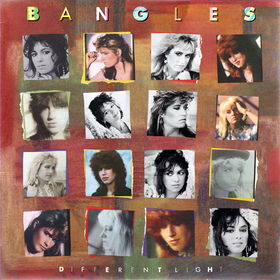
Bangles: Different Light

BANGLES: DIFFERENT LIGHT (1986)

1) Manic Monday; 2) In A Different Light; 3) Walking Down Your Street; 4) Walk Like An Egyptian; 5) Standing In The Hall­way; 6) Return Post; 7) If She Knew What She Wants; 8) Let It Go; 9) September Gurls; 10) Angels Don't Fall In Love; 11) Following; 12) Not Like You.

Almost everybody who cares about the Bangles more than about the history of MTV usually speaks of Different Light as a serious step down in overall quality for the band. However, this is «symbolically» true rather than «truly» true. The moderate success of All Over The Place had opened the doors to fame and fortune, and the girls were definitely not above trying it out — they agreed to tour with Cyndi Lauper and eventually attracted the attention of Prince himself, never the one to nonchalantly skip over such a «tasty treat». And this encounter pretty much sealed their fate: once you start taking orders (or even recommendations) from Prince, there is no turning back — besides, considering how niftily Prince managed to remain his own master while at the same time drawing in the big bucks, taking advice from the guy naturally seemed like a big win.

So we have ʽManic Mondayʼ, written by The Artist specifically for the Bangles and released as the first single from their second LP. Is it a good pop song? You bet it is. The little baroque key­board riff that functions as the main melodic hook is unforgettable, as is the vocal melody of the chorus (and if you think that "it's just another manic Monday, I wish it was Sunday, 'cause that's my fun day" is a lame lyric, you probably come from way before the era of Rebecca Black). Is it «an important, progressive development» in the history of Bangles sound? No, it isn't, since it shifts the emphasis away from the poppy, but bite-y electric guitars and the sarcastically intelli­gent atmosphere of that sound — and moves into the kind of territory inhabited by... not even so much by Prince as by Madonna: the "all of my nights..." midsection could very easily be pictured sitting somewhere in the middle of True Blue. Moreover, Susanna Hoffs does her best to sex up her vocals, developing a «bedroom voice» that does sound suspiciously close to Madonna's.

Most albums are usually judged on the strength of their lead single — in this particular case, ʽManic Mondayʼ is not very representative of the rest of the album. First, most of the songs are still originals, composed by Hoffs and the Petersons, or covers of artists you'd expect them to co­ver (Big Star, Jules Shear). Second, the guitars make a loud return on the second track already, and rarely let us down afterwards — and they are good, trusty, jangly Bangl-y guitars, not the ge­neric pop metal crap that ruled over mainstream rock releases in 1986. What does unite these songs with ʽManic Mondayʼ is (a) the production, which feels slicker and more technology-de­pendent than before, and (b) the overall feel — where All Over The Place kicked ass and felt strong and self-assured, Different Light comes across as a spiritual surrender... «...in which the ladies embrace their feminine side and purge their pretty heads of superfluous ideas».

Not totally, of course. New bass player Michael Steele, for instance, gets to contribute ʽFollo­wingʼ, a sparse acoustic ballad (which could have been even more effective, I think, without the unnecessary synthesizer hum in the background) that could serve as a blueprint for most of Ani DiFranco's career: punchy jazz/folk chords, strong, independent vocals, harsh post-breakup lyrics etc. It is not as immediately overwhelming as the big pop hits, but in time, it gets its warranted status of overlooked highlight.

But on the other side of the deal, you have ʽWalk Like An Egyptianʼ — written by Liam Stern­berg, the song is musically innovative (it sounds like a light calypso number turned into a speedy rock anthem at the last moment) and lyrically fun, yet ultimately quite light-headed and trifling: naturally, it ended up becoming one of their largest hit singles, if not the trademark song to be remembered by (particularly since everyone except for Debbi trades lead vocals across the dif­ferent verses). Great stuff for parties, but if you ain't much of a party goer, chances are you will get tired of these friendly hooks fairly quickly.

Nevertheless, far be it from me to call Different Light a «bad» album — «disappointing», yes, but if all «disappointing» albums had this kind of quality, we would have to rethink the meaning of the word itself. Frankly speaking, there are no bad songs here. The Jules Shear cover is irresis­tible, even if the main guitar riff is made to sound like ABBA and Hoffs' vocals are once again done Madonna-style. The interpretation of Big Star's ʽSeptember Gurlsʼ, once again with Steele on vocals, is respectful and well executed (and was quite instrumental, by the way, in restoring Big Star's reputation and earning the struggling Alex Chilton quite a bit in royalties). ʽStanding In The Hallwayʼ, ʽReturn Postʼ, ʽNot Like Youʼ — all of them catchy, fun, enjoyable numbers. Cal­ling them «slick» is probably justified, but if we only get to remember what was really slick in 1986, one of the worst years in mainstream pop music history, Different Light will have no choice but to, well, be seen in a different light.

In other words, the album is nowhere near close to a catastrophe on its own — it sets the girls up for a fall, indicating the inevitably downwards direction their career would take from that point, but the LP itself is well above any devastating criticism, and still a must-have for all lovers of good pop music, though probably not for the average «girl power» fan. Isn't it ironic, really, that Prince was so impressed by one of the girls' punkiest songs (ʽHero Takes A Fallʼ), that it stimula­ted him to write them one of their «girliest» songs — one that they accepted and swallowed up without a hitch? Isn't that much better proof of the man's Mephistophelian powers than whatever Tipper Gore ever spotted in his silly sexist lyrics?.. Oh well, never mind. Sexist, feminist, slutty, or punkish, or both, this is a certified thumbs up in any case.   


Check "Different Light" (CD) on Amazon
Check "Different Light" (MP3) on Amazon

Friday, May 24, 2013

Bangles: All Over The Place


BANGLES: ALL OVER THE PLACE (1984)

1) Hero Takes A Fall; 2) Live; 3) James; 4) All About You; 5) Dover Beach; 6) Tell Me; 7) Restless; 8) Going Down To Liver­pool; 9) He's Got A Secret; 10) Silent Treatment; 11) More Than Meets The Eye.

We will not be remembering them for ʽEternal Flameʼ — we will remember them for this album, one of the finest treasures to come out of the «Paisley Underground» and a fine reminder for every­one that it is possible to be retro and innovative, old-fashioned and new-fangled, style-cen­tered and catchy, formulaic and emotional at the same time. Of course, its national and interna­tional fame did not really come until Prince arrived on the scene and turned them into gilt-bronze two years later, but who's to be surprised? They don't call it underground for nothing.

All Over The Place was not the Bangles' first release: two years earlier, it was preceded by a five-song self-titled EP, which some critics predictably hail as the Bangles record to abide by — not because it still features original founding mother Annette Zilinskas on bass (soon to be repla­ced by Michael Steele), but because it is still delightfully lo-fi, released on the aptly titled indie label «Faulty Products» instead of Columbia. However, other than better production, All Over The Place does not really represent any fallbacks from the aesthetics of Bangles — both the EP and the LP even share exactly one cover of an old garage «nugget» (The La De Da's ʽHow Is The Air Up There?ʼ and the Merry Go-Rounds' ʽLiveʼ, respectively), and are best taken together, which would only bring the total length to 44 minutes anyway.

So what's good about these Bangles? First, they really love their guitars: both Susanna Hoffs on rhythm and Vicki Peterson on lead have rich, thick, powerful, and colorful power-pop tones. They like to jangle that stuff (ʽLiveʼ), but they can just as well use it for crunchy purposes (ʽRest­lessʼ), or throw in wailing pop riffs that rival their idols, Big Star (ʽGoing Down To Liverpoolʼ). The two have just enough technique to think of various interesting things to do over the instru­mental breaks (like the Nashville-influenced guitar break on ʽAll About Youʼ; or the way ʽJamesʼ starts out deceptively as a funk-rocker, only to take a completely different turn ten seconds later and never go back again) — but not enough to engage in empty flash. As light and insubstantial as most of these songs are, these ladies are musicians, not «babes with guitars».

Second and most important, they are excellent B-rate songwriters: B-rate, because all the ele­ments are familiar, and they do not even try to conceal it (ʽI'm In Lineʼ off the EP is built on the ʽTaxmanʼ riff, and God knows how many Beatles or Big Star chord sequences are less openly in­volved in the other numbers), but excellent, because it never really bothers me — the ingredients are reshuffled expertly and with feeling, the tempos are lively and exciting, and the singing is... well, always nice to hear some simple, happy, ringing, innocent-sounding tones in an era when the female intellectual ideal was defined by the likes of Kate Bush or Siouxsie Sioux — not that I have anything against either, but there is always room for a Susanna Hoffs as well.

Highlights include... just about everything. ʽHero Takes A Fallʼ and ʽJamesʼ are probably the most anthemic and easily memorizable / recognizable songs, although the album as such is more frequently identified with a cover of Katrina and The Waves' ʽGoing Down To Liverpoolʼ — a song that the Bangles took up, colored up with less distortion and more treble, made a little less angry with more melodic singing (drummer Debbi Peterson carries the lead), and they still ended up with a credible rocking attitude. ʽRest­lessʼ is more in the blues-rock idiom (with the lead vocal going to the lower-pitched Vicki Peter­son here), but pulled off quite credibly; and their janglier, or their country-western-er sides (ʽDo­ver Beachʼ; ʽTell Meʼ) are also delightful.

It all works, because there is not only unbridled love for guitar-based pop rock, expressed here so freely in an age of dance beats and synthesizers, but there is also one thing that prohibits most of to­day's bands from recreating the Bangles' success: a total lack of fear of being judged too «silly», too «lightweight», too «fluffy» — these songs are innocent and simple in mood and execution, and they have no double bottom or any other secrets to slowly unravel over repeated listenings. But neither does any of this sound like an expertly calculated retro-affair — the girls have been raised on a punk bedrock, after all, and overall, an album like this would have been impossible in the pre-Ramones, or, more accurately, the pre-Patti Smith era: as retro as it is, in terms of cha­racter toughness displayed, it clearly belongs to their time.

Actually, come to think of it, All Over The Place is simply timeless — unpretentious high-qua­lity entertainment for the ages, even topped off with a little bit of chamber pop: ʽMore Than Meets The Eyeʼ is a good title to introduce the accappella opening, the Merseybeat-style har­monies, and the modest string quartet that form the album's coda, and show an additional side to the girls' versatility — they not only know their ʽTaxmanʼ but their ʽShe's Leaving Homeʼ as well. Naturally, it's all «fluff» — no deep insights are to be gained or previously unexplored paths un­locked from listening to the Bangles even at their best — but in 1984, it took brains, brawns, and guts to produce this particular kind of fluff. Thumbs up.

Check "All Over The Place" (CD) on Amazon
Check "All Over The Place" (MP3) on Amazon