Search This Blog

Showing posts with label Bathory. Show all posts

Friday, September 13, 2013

Bathory: Nordland II

BATHORY: NORDLAND II (2003)

1) Fanfare; 2) Blooded Shore; 3) Sea Wolf; 4) Vinland; 5) The Land; 6) Death And Resurrection Of A Northern Son; 7) The Messenger; 8) Flash Of The Silver Hammer; 9) The Wheel Of Sun.

Considering how much time — around five minutes altogether — ʽThe Wheel Of Sunʼ requires to go through with its massive coda, one might have thought that Nordland II was not only de­signed to be the last Nordland installment, but was actually to be the last Bathory album ever, that last big fat chord after which Quorthon could finally retire, or remove his presence from this Christianity-soiled earth altogether. Which he actually did around June 7, 2004, allegedly dying of heart failure — so very impatient to finally honor that Valhalla reservation.

In reality, though, Quorthon himself had stated that there were to be four Nordland albums, and a third one was already in the works when misfortune fell. And, indeed, other than the grand coda to ʽWheel Of Sunʼ, there is nothing on Nordland II to suggest intentional account closure. Quite on the contrary, it sounds a wee bit disappointing as a follow-up to Nordland I: obviously, one could not expect any major stylistic changes, but a minor twist or two would have been nice. The only minor twist I see here is that the ultra-heavy, «industrial metal» vibe of Nordland I has all but disappeared, and that, consequently, the second volume made one small step away from bru­tal heaviness and towards «artsiness» — a tiny step that will make it seem a bit more visionary to some fans and a bit more boring to others.

The «fanfare» sequence that opens the album is a good illustration: three and a half minutes of stern icy synth-pomp — for my tastes, this stuff is way too crudely composed and produced to be emotionally engaging, but there will always be some Bathory fans ready to see it as a Grand Opening of the Gates to Ancient Scandinavian Consciousness. Thereupon, ʽBlooded Shoreʼ is a stately one-riff march, full of predictably martial solemnity, but it is neither heavy enough to pro­perly wake up my inner Viking, nor perfectionistic-majestic enough to disturb that old Wagnerian temptation. The song, and most of the other ones that follow, is worthy of a sleepwalking Quor­thon, not so much a Quorthon ambitious to prove that he is able to go beyond the confines of Hammerheart while playing by the rules of Hammerheart.

In fact, the album is surprisingly mild and slow all the way through to ʽDeath And Resurrection Of A Northern Sonʼ, where the old thrash instinct finally awakens and starts generating truly thunderous riffage: too bad that the «thunderous» sections of the song occupy less than half of its ten-minute duration. The major highlight comes a little later, in the form of the shortest song on the album: ʽFlash Of The Silver Hammerʼ (Paul McCartney and Maxwell dropped by to say hello, no doubt) is the first, if not the only, number to dispense with the stately majesty and simply bash it out in a «take-no-prisoners, show-no-mercy» style — none too soon, actually, or you might start wondering whether Quorthon really began to mellow out in his last years.

He did not, but overall, Nordland II is hardly an achievement to brag about: if the remaining two albums were to show the same quality, my guess is that the man would be running a serious risk of running out of fans before the saga was over, except for the usual bunch of diehards who would be happy enough if their idol released an entire album of minimal variations on ʽThe Hall Of The Mountain Kingʼ. The only saving grace of the album is the man's commitment to his mis­sion, and clear understanding of his own role in it — but it is well nigh impossible for music like this to run on commitment alone: would it have hurt too much to add some emotional variety and a slightly larger number of memorable riffs? As of today, only Odin knows the answer.

Check "Nordland II" (CD) on Amazon
Check "Norland II" (MP3) on Amazon

Friday, September 6, 2013

Bathory: Nordland I

BATHORY: NORDLAND I (2002)

1) Prelude; 2) Nordland; 3) Vinterblot; 4) Dragons Breath; 5) Ring Of Gold; 6) Foreverdark Woods; 7) Broken Sword; 8) Great Hall Awaits A Fallen Brother; 9) Mother Earth Father Thunder; 10) Heimfard.

By early 2002, the «recuperation» process was over. Time to get back to the regal / brutal majesty of Hammerheart, quoth the Quorthon, and finally make something overtly and inherently epic once again. The project to be realized had to be his most ambitious ever, spanning an astonishing four CDs worth of the vikingest music ever created by a son of Scandinavia. Unfortunately, the wicked Christian god spoiled this noble undertaking like he'd previously spoiled everything else, recalling Quorthon to his heavenly prison (or hellish torture — the pagan devotee probably would not care either way) only two albums into the project.

In a way, the transcendental divinity had his own good reason, because Nordland I, the first bunch of the projected four to see the light of day, is certainly no Hammerheart, and four major servings of this dish in a row might have caused serious aural diarrhea. More precisely, it tries very hard to be an improved-and-updated Hammerheart, and in doing that, loses much of the spontaneity, freshness, and «discovery-triggered excitement» of its ideal. Listen to the first song here and you will pretty much know 90% of what comes next: slow, plodding, monotonous riff-rockers cast in the mold of repetitive sagas. With stern medieval vocal harmonies; occasional pre­sence of, but more often, complete lack of build-ups and crescendos; a screechy, but not particu­larly «pretentious» guitar solo every now and then; and generally clean vocals singing something about snow, ice, swords, hammers, dragons, and the great hall in the sky.

Exceptions to this formula are intentionally scarce: ʽRing Of Goldʼ is a pure acoustic ballad (al­though not any less slow, plodding, or monotonous), and ʽBroken Swordʼ is a speed / power me­tal anthem that is very welcome in terms of tempo, but that's about it, and that is the way it was meant — that is the way, Quorthon must have felt, that one really goes about in honoring one's warrior ancestors, and if you don't like it, you might as well just leave it. You're not necessarily supposed to enjoy the steady, stately, «dull» flow of a medieval Icelandic poetry recital either.

However, with a little bit of tolerance, patience, and secret feelings for fantasy lore, Nordland quickly goes from «listenable» to «enjoyable» and even «respectable». The riffs are far from ge­nius, but they do a generally good job here of supplying proper atmospherics: similar to each other in that most of them precisely follow the rhythm, making fairly short use of half and quarter notes, but each one vigorous and meaningful in its own right. The riff of ʽNordlandʼ plows on with a decisive militaristic sweep; ʽVinterblotʼ is infected with almost «industrial» venom, beco­ming one of the heaviest tracks in Bathory's entire history; ʽDragons Breathʼ tries out yet another poisonous tone, no doubt, going for a symbolic recreation of the song's title; ʽGreat Hall Awaits A Fallen Brotherʼ goes for a «choo-choo train» playing style, as if the Great Hall in question could be reached by a heavenly railroad, and so on.

The downside is that, yes, most of these songs make their point over the first minute (of the song proper, discounting the noisy moody intros to some of them), and then mostly go on to reiterate these points — you really are in luck if you get to hear a brief solo, or if the song, like ʽForever­dark Woodsʼ, does indeed turn out to consist of two separate parts with two different riffs. For deep fans of Bathory's Viking style, this will be a plus; for everybody else, most likely, a minus — particularly if one starts thinking how all these vast spaces could have been filled up by some­thing much more creative. It also goes without saying that, in 2002, «art metal» bands in general were capable of immensely more creative work than this (Opeth alone would suffice, as a good example of a giant idea-generator next to Quorthon's tiny one).

But, as with Hammerheart, only on a smaller scale, there is still this strange, wond'rous feeling of how this guy, working completely on his own, is able to achieve so much with so little — even if this whole stuff does not necessarily feel «Nordic», it still feels authentic, with a real blazing fire roaring within these notes, and a real dragon's breath escaping from these licks when push comes to shove. I am not in love with the record, but I respect this kind of deep bite, and that alone is worth a thumbs up. Besides, even if it does lack the diversity and the surprise element of Destroyer Of Worlds, it also evades that record's low points — this is, after all, the kind of thing that Quorthon was really born to do, rather than generate strange thrash metal anthems about bedlam and bloodshed on the hockey field.

Check "Nordland I" (CD) on Amazon
Check "Nordland I" (MP3) on Amazon

Friday, August 30, 2013

Bathory: Destroyer Of Worlds

BATHORY: DESTROYER OF WORLDS (2001)

1) Lake Of Fire; 2) Destroyer Of Worlds; 3) Ode; 4) Bleeding; 5) Pestilence; 6) 109; 7) Death From Above; 8) Krom; 9) Liberty & Justice; 10) Kill Kill Kill; 11) Sudden Death; 12) White Bones; 13) Day Of Wrath.

For all those torn between the «epic-Viking» personality of Hammerheart-era Quorthon and the «thrash-hammer» style of his Requiem/Octagon period, here is the ultimate in gift-showering: a 65 minute-long package that gives you the best of both worlds! Bombastic Scandinavian epics and mosh heaven at (almost) the same time — could anything be better in this world for an open-minded heavy metal admirer?

Now, considering that both the latest Viking-style and the latest thrash-style offerings from Ba­thory were, at best, questionable (Blood On Ice was somewhat dull, and Octagon was somewhat horrendous), even a very open-minded metal admirer would probably think twice before putting his trust into Destroyer Of Worlds. And, sure enough, some of the problems are carried over: the «epic» compositions are long-winded and repetitive, while the thrash stuff is marred by the same old stupid vocals that are stuck somewhere in the gutter that separates «singing» from «growling» and are more likely to irritate and offend rather than impress and entertain. This I have to say: Quorthon is always Quorthon, despite his seemingly many faces, and, although you can look to Hammerheart for near-perfection, it is more typical of the guy to stick to his formulaic guns than to try and make them look more and more refined over time.

That said, with all the disclaimers in place, Destroyer Of Worlds is a surprisingly good record. We start out with three songs that could have very easily fit on Twilight Of The Gods, and with a little more squirming, even on Hammerheart, although the subject matters are a mixed bag — Quorthon seems to be jumping from his favorite Satanism schtick (ʽLake Of Fireʼ) to images of nuclear apocalypse (title track) and then to Scandinavian pagan anthems (ʽOdeʼ). This means there is no and there will be no further conceptual unity to the album, but that's okay — it was clearly designed that way, as a diverse series of vignettes, and who really cares as long as the vig­nettes in question work as planned? ʽLake Of Fireʼ adds little of interest to the Bathory canon, stately and threateningly creeping along like all those medieval procession-type songs on Twi­light, but it forms a good contrast with the ensuing sturm-und-drang of the title track — and then ʽOdeʼ comes on and blows both of them away with another medieval procession, but this time set to a belligerent, muscular, angular riff.

Then we start moving into true thrash and speed metal territory — ʽBleedingʼ («anatomy metal» with all the expected lyrical imagery), ʽ109ʼ / ʽDeath From Aboveʼ (a nice double tribute to the powers of the Luftwaffe), ʽKromʼ (a somewhat pathetic anthem to the biker tribe), ʽKill Kill Killʼ (yoohoo, anti-establishment!), ʽSudden Deathʼ... wait, is this about somebody getting clubbed to death during a frickin' hockey match? See how this guy Quorthon is dying to show you how ver­satile and unpredictable he can be if he puts his mind to it? Vikings, Satanists, necrophiliacs, nu­clear holocausts, WWII air raiders, bikers, hockey players — suddenly, the Bathory world has stretched out to an almost ridiculously huge size, sucking in almost everything in sight, like the Vacuum Cleaner Beast in Yellow Submarine.

But do we get decent music to go with all that? I'd say, rather yes than no, and that covers even the thrash numbers — suddenly, many of them turn out to be endowed with riffs far more expres­sive and colorful than anything on Octagon. ʽKromʼ, for instance, does its best to mimic a bike engine roar, turning the steel machine into an animated Godzilla. ʽ109ʼ does the same from the perspective of a Messerschmitt fighter. And ʽSudden Deathʼ does honestly try to imitate the hustle and bustle of a hockey game gone wild — okay, so it does sound a bit like an imaginary soundtrack to WrestleMania or something, but Quorthon manages to make it fun anyway.

As the album ends with two more long compositions (ʽWhite Bonesʼ starts out in generic slow-thrash mode, then suddenly becomes a bluesy / artsy instrumental epic midway through, with Quorthon picking up a psychedelic guitar tone that he never used before; ʽDay Of Wrathʼ returns us to medieval procession mode), it sort of begins to dawn on you that more work must have gone into the construction of this whole thing than on most Bathory albums put together — all the more impressive considering that the entire record was done by Quorthon alone: he is credited for everything, including the rhythm session. At the very least, Destroyer Of Worlds may be counted as the most bizarre and baffling of all Bathory oeuvres — considering that Quorthon had always been a weird person, this judgement is not to be taken lightly.

Sure enough, from a purely formal / technical point of view, other than the completely unpredictable lyrical to­pics, there is not much new here — but what matters is that, for the first time ever, Quorthon has really sewn all of his ends together, and it works much better than anybody could have expected, and in much stranger ways: for instance, it took me my third listen to actually get that something was «really happening» here, so to speak — but once it did, the in­trigue never went away again. It's still there with me, so a quick thumbs up here before the en­thusiasm wanes and I start getting angry at those dumb vocals once again (or at the lyrics, which could be even worse — other than the Viking epics, most of these verses do suck).

Check "Destroyer Of Worlds" (CD) on Amazon
Check "Destroyer Of Worlds" (MP3) on Amazon

Friday, August 23, 2013

Bathory: Blood On Ice

BATHORY: BLOOD ON ICE (1996)

1) Intro; 2) Blood On Ice; 3) Man Of Iron; 3) One Eyed Old Man; 4) The Sword; 5) The Stallion; 6) The Wood­woman; 7) The Lake; 8) Gods Of Thunder, Of Wind And Of Rain; 9) The Ravens; 10) The Revenge Of The Blood On Ice.

Apparently, the story is as follows: In between the «transitional» Blood, Fire And Death and the stylistic revolution and public success of Ham­mer­heart, Quorthon had actually recorded yet another album — one that explored his newly-acquired interest in his Scandinavian heritage even farther than Hammerheart, being sort of a highly cohesive «rock oratorio». Inside was a Nor­dic fan­tasy, loosely based on the motives of Germanic mythology, but «creatively reworked» by Quorthon, presumably in order to avoid being sued by Odin's and Thor's legal representatives for copyright in­fringement — you never know when that lightning might strike you.

Having recorded the master tapes, Quorthon, however, had second thoughts about releasing the album for public consumption — feeling, as he admitted himself, that his fanbase was not yet ready for such a radical image reinvention. The project was therefore shelved, and Quorthon started working on Hammerheart instead. Only six years later, having accidentally leaked the information and received lots of feedback from the fans (who, by that time, were not only well accustomed to his Viking schtick, but probably also felt seriously irritated by Quorthon's subse­quent move to stupid thrash territory), he returned to the old tapes — cleaned them up, remixed them based on improved technology, and finally made them available to everyone under the title of Blood On Ice, which at least sounds a little better than «King Arthur on ice», I'd say.

Frankly speaking, it is not quite clear why this album, had it been out there in 1989, could have been more of a «shock» to fans than Hammerheart. It does suffer in comparison to the latter, but not because of its storyline, or any sort of extra pomposity, or anything like that: it simply does not match Hammerheart in terms of sheer quantity of good ideas. The storyline is a little corny, as is every one-man fantasy-style reworking of any mythological tradition — elegantly shaped and steadily balanced through hundreds of years of «natural selection» — and perhaps he did feel a little shy about unfurling his story of one-eyed wise men, twin-headed Beasts, and eight-legged stallions, replacing it with the superficially more impressive pseudo-historism of Hammerheart. How­ever, Quorthon's verba­city rarely stands in the way of proper music: the real reason why Blood On Ice feels a little disappointing is that, unlike Hammerheart, this one is really envisi­oned as a «musical saga», and the one flaw that could be naturally expected of a musical saga is monotonousness and repetitiveness.

From that angle, Blood On Ice, with its emphasis on the «never-ending riff» rather than the «awe­some riff», has more in common with Twilight Of The Gods, or those particular parts of Hammerheart that pre-announce Twilight (most notably, ʽOne Rode To Asa Bayʼ). The tracks are typically long and repetitive, only occasionally jolted by vocal gimmicks (such as the deep «iron-man» spoken passage in the middle of the title track, or the «one-eyed old man» monolog on the same-titled tune) or an acoustic interlude (ʽThe Ravensʼ; ʽMan Of Ironʼ, despite its title, is actually a crudely constructed acoustic folk ballad as well).

Elsewhere, the riffs are really only there to propel the song forward — martial-wise (title track; ʽThe Stallionʼ) or, sometimes, in a more blues-rocky, almost swampy mode (ʽThe Lakeʼ — did I just say «swampy»?). This is all fine and dandy for a «saga», if we are simply supposed to take this as a heavy backing to Quorthon's story, but if the story happens to be the last thing in which we might be interested on a Bathory album, the number of memorable events on Blood On Ice will not be too large. (For some reason, the only thing that still sticks with me after several listens is the juxtaposition of thumping hooves and bleating sheep — even though I have never suspec­ted myself of anything close to a pastoralist or nomadic mindset...).

Altogether, this one is definitely for the fans, although it goes without say­ing that it does feel a lot like a gulp of fresh, methane-free air after the previous two albums — and that the story, corny elements and all, does show a deep, sincere interest in the Scandinavian pagan tradition: there are conceptual elements in Blood On Ice that may feel clumsy or poorly stated, but there is no denying the passion and the obsessive involvement. Unfortunately, this is not quite enough to properly «reward» the album with a thumbs up.

Check "Blood On Ice" (CD) on Amazon
Check "Blood On Ice" (MP3) on Amazon

Friday, August 16, 2013

Bathory: Octagon

BATHORY: OCTAGON (1995)

1) Immaculate Pinetreeroad #930; 2) Born To Die; 3) Psychopath; 4) Sociopath; 5) Grey; 6) Century; 7) 33 Some­thing; 8) War Supply; 9) Schizianity; 10) Judgement Of Posterity; 11) Deuce.

This is where we hit total rock bottom: think Requiem, but without all the good riffs. Keeping the tempos, Quorthon completely jettisons any attempts at decent songwriting — most of this stuff is headed straight for the moshing pit and nowhere else. Perhaps the idea was that Requiem did not manage to be nearly as extreme as Quorthon envisaged it, so he gave us something even more blunt, minimalistic, and «parodic» in the bad sense of the word.

If it can be any consolation, the vocals are cleaner this time, closer in execution and effect to classic early Bathory than the «gargling-one's-own-vomit» approach of Requiem. On the other hand, the lyrics have deteriorated beyond repair: ʽ33 Somethingʼ is Quorthon's «tribute» to the execution of serial killer John Wayne Gacy, about which he must have read in the papers circa 1994, and if the «song» is supposed to make one experience disgust towards the killer, it fails — by offering neither a hint at melody nor a glimpse of truly scary imagery. "Blooded hole, twisted soul, eat my shit, suck my dick", goes the refrain. Okay then.

One does not have to go much farther than the song titles — ʽPsychopathʼ, ʽSociopathʼ (back to back!), ʽSchizianityʼ — to understand what it is all about: a dumb experiment in going to sonic and verbal extremes, perhaps (who knows?) consciously aimed at offending and alienating Quor­thon's heavily expanded fanbase. In the process, lines are completely blurred between heavy me­tal and hardcore (much of this record could have very easily come from the hands of, say, Agno­stic Front), but not in a triumphant synthesis of the genres, rather in a catastrophic meltdown of both. A few of the songs slow down the tempos (ʽCenturyʼ, ʽSchizianityʼ), but then they end up sounding like derivative and cumbersome attempts to revive the old New Wave of British heavy metal — not as utterly dumb, perhaps, but just as forgettable.

Biggest surprise, and most decent entry on the album, is a cover of ʽDeuceʼ — yes, the KISS song, possibly thought of as another ironic slap in the face to the fans: Bathory's evil / brutal sound used to be as far removed from the glam-rock theater of KISS as possible, yet here is Quorthon coming out of the closet, confessing his loyalty not only to the old-school thrash masters (which could be understood), but to the make-up wearing poseurs as well. As an expectation-breaker, the gesture could actually be adorable — if not for the fact that the cover is all too faithful, yet all too per­functory, carrying over neither the caveman cockiness of Gene Simmons, nor the garage crude­ness of early KISS guitars (for that matter, cold as I usually am towards KISS, ʽDeuceʼ is one of their greatest songs, and nobody has ever played it quite like those guys).

In short, another failure — experimental failure, to be precise, not a corny «sell-out» or anything, just firm final proof that not everything Quorthon tried to do turned to gold. Black metal, yes; Viking metal, for sure; but troglodytish thrashing — no. (I almost caught myself trying to type in something like "the guy was just too intelligent to properly get this style", but then realized I have way too little knowledge about Quorthon's degree of intelligence to make this into even a purely hypo­thetical statement). Thumbs down, and it would be easy to pretend that this album never actually happened — after all, «failed experiments» do not have to be considered as a natural part of the artist's general curve.  

Check "Octagon" (CD) on Amazon
Check "Octagon" (MP3) on Amazon

Friday, August 9, 2013

Bathory: Requiem

BATHORY: REQUIEM (1994)

1) Requiem; 2) Crosstitution; 3) Necroticus; 4) War Machine; 5) Blood And Soil; 6) Pax Vobiscum; 7) Suffocate; 8) Distinguish To Kill; 9) Apocalypse.

This has got to be one of the most bizarre twists not just in Bathory history, but in the entire his­tory of heavy metal. Nobody could have expected that — all of a sudden, after one suitably tran­sitional, one fully established, and one somewhat stagnant, but still understandable stylistic fol­low-up, Quorthon completely jettisons the whole «Viking metal» angle, and puts out a bona fide thrash metal album, conforming to all the laws of the genre. Insane tempos, jackhammer riffs, growling vocals, complete disregard for variety, and a running length of 33 minutes.

Now, considering that this was Quorthon, after all, the guy that moved from speedy black-metal satanism to the sacred hammer of Thor in less than half a decade, something radical could have been predicted, but hardly this, an album that shows no traces whatsoever of anything that made Hammerheart so unique. And the really bad news is that there is nothing whatsoever that would make Requiem comparably unique. It has been reported that Quorthon's goal here was simply to pay a brief tribute to some of his early metal influences — to take a break from rolling the epic stone and do something just for the momentary fun of it. Perhaps so, but this neither explains why the trend continued on his next albums, nor makes the whole experience gain in intelligence.

Two things somewhat redeem this strange decision. One, the production continues to be miles ahead of Bathory's early stuff, and Quorthon's guitars produce meticulously differentiated strings of metallic notes rather than the thick black goo of the first three albums. Second, strange as it is, many of the thrash riffs that he knocks together for these songs are fun — slow them down a bit, paint them less black, and you can get a pretty memorable hard rock album. With everything ta­ken at the same tempo (except for the mood-setting intros, which tend to be slow and sludgy), the riffs are very similar in structure and mood, but each single song does have its own riff, with slight variations, and after a couple listens you might even start appreciating the melodic com­ponent — at any rate, these songs are not ultra-quick knock-offs, because you would have to be a musical genius to knock 'em off in a couple of minutes, and Quorthon is hardly a musical genius, but he sure was a hard worker.

So it is not the riffs (which are quite fine for a generic thrash record), nor the solos (which, I do be­lieve, show further improvement in Quorthon's technique) that irritate. Irritating factors involve (a) the drumming: «Vvornth» was fine and dandy working with the slow epic stuff, but with the fast stuff, most of the time he is just too busy trying to stay on time so as to try something intere­s­ting — a regular bane with both thrash and hardcore, making the drumming patterns sound moro­nic instead of properly aggressive; (b) the singing: gone altogether are Quorthon's clean vocals, replaced by sore-throat growling that is not even banshee-style evil like on the early records, just sounds like a freshly excavated zombie from a zombie-trash style movie.

Lyrics-wise, Quorthon moves back to images of gore, violence, and Satanism, occasionally going to such extremes that, once the lyrics sheet is finally pulled out and examined, the parodic status of the album may no longer be doubted — I mean, "the altar covered in lifegiving cum / the smell of forever running wet cunts"? that's not even close to the style of the first three albums, more like Cannibal Corpse or something. But I seriously doubt that somebody will ever want to look at those lyrics with a magnifying glass — in general, my only wish is for this album to have been presented as completely instrumental, in which case we could simply take all these riffs home and stay safe, sound, and undamaged by the expelled shards of Quorthon's Miraculously Self-Regene­rating Larynx.

Thumbs up for the brave decision for a radical change — already the second one in Bathory's his­tory, propelling Quorthon's team to further levels of uniqueness — but much as I like some of these riffs, the experience as a whole is so ridiculous that the same gesture can hardly be applied to the music. Still, nowhere near as bad, mind you, as some of Bathory's disappointed fans, year­ning for another meeting with the Scandinavian pantheon, would have you believe.


Check "Requiem" (CD) on Amazon

Friday, August 2, 2013

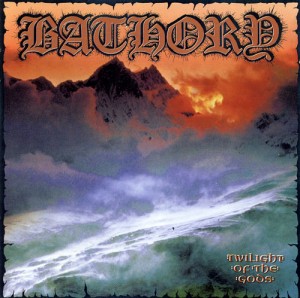
Bathory: Twilight Of The Gods

BATHORY: TWILIGHT OF THE GODS (1991)

1) Twilight Of The Gods; 2) Through Blood By Thunder; 3) Blood And Iron; 4) Under The Runes; 5) To Enter Your Mountain; 6) Bond Of Blood; 7) Hammerheart.

This thematic follow-up to Hammerheart is even more epic and ambitious in nature than its pre­decessor — starting out with the mere fact that it runs close to an hour, something that was utterly unthinkable in Bathory's early speed metal days, and even Hammerheart itself stated its point in about forty minutes. The subject matter stays the same (the album title could not be more trans­parent), but the balloon has been inflated to the limit. Lengthier, moodier intros; darker, ever more shadowy backing vocals; singalong anthemic choruses; and, most importantly — this is probably the farthest that Quorthon ever ventured away from stereotypical metal aesthetics. For­mally, this is still heavy metal («power metal», «Viking metal», whatever), but it does not feel much like heavy metal — more like a heavy rock opera with a dark folk basis.

There is nothing wrong in this per se, of course, but one big reason why Hammerheart worked so well were its undoubtedly metallic, undoubtedly killer riffs — outbalancing and justifying the relatively shallow pathos. It may or may not have given us a distinct musical vision of pre-Chris­tian Scandinavia, but at least it was a true blood-boiler. Twilight Of The Gods, in comparison, places far more faith in atmospherics — slow, leaden, repetitive, epic monsters, progressing in a regime stuck between stoner rock and snail rock. There is some sense of impending doom, yes, but it tends to quickly dissipate in the head once the tunes are over — which, it seems to me, is a sign of somewhat inefficient musicality.

The title track picks up right from where we were previously left with ʽOne Rode To Asa Bayʼ: twelve minutes of bitter ranting against the perils of monotheism (Quorthon even lashes out at «TV preachers» and such, implying that the «loss of innocence» described in Hammerheart is anything but simply ancient history, still influencing our lives on an everyday basis — and who could actually argue?), with a deeply repetitive structure, but ultimately feeling like the «smoul­de­ring ashes» sequel to the raging fire of ʽAsa Bayʼ. It is moody, and its simplistic dirge-like melody is convincing, but still overlong, not to mention the rather excessive acoustic intro and outro (with Quorthon's lack of overpowering playing technique or unpredictable inventiveness, it does not seem right for him to allocate so much space to pedestrian acoustic plucking).

Everything else follows the same formula: slow tempos, monotonous rhythms, stern Gregorian back vocals, and Quorthon himself epically wailing about what the loss of Thor's hammer and other such gadgets cost humanity in the race for survival. The best riff is probably saved for ʽBlood And Ironʼ — that particular chord sequence seems alive with the spirit of classic Black Sabbath and conveys the necessary atmosphere of sheer ravaging brutality: ʽTo Enter Your Mountainʼ, very similar in tone and structure, is already a little less efficient, and so on.

An attempt to come up with something completely different is saved for last: ʽHammerheartʼ (another of those strange cases where the would-be title track for an LP is suddenly carried over to the next LP) is nothing less than a rearrangement of Holst's Jupiter with an extra vocal part writ­ten by Quorthon and delivered in his best imitation of a «folk-operatic» voice (surprisingly tolerable for a guy who was previously known mostly for spasmodic guttural shrieking). Not par­ticularly awful for a solemn, stand-up-and-join-together coda hymn, but naturally amateurish: King Crimson might have the guts to tackle Holst, or, at least, some well-oiled, well-experienced symph metal machine like Opeth — Quorthon alone isn't quite fit to handle the weight.

Still, while it is almost inevitable that Twilight Of The Gods largely sinks under the heaviness of its titanic ambitions, the final result could have been much worse. The difference is that it is quite clear that this whole stuff really means a lot to Quorthon — the album's lack of gloss, the ela­bo­rate (if not particularly original) lyrics, the snap and snarl in Quorthon's intonations, the relentless energy expended for the repetitive punching out of the simple riffs, it all has a positive effect. It's just that you either give your listeners a heavy metal album — and in that case, Twilight Of The Gods suffers from a lack of classy riffs — or a «heavy-art» album, in which case, it suffers from extreme monotonousness and straightforwardness of approach.

For all the bravery and an overall lack of embarrassing moments (even ʽHammerheartʼ, amateu­rish as it is, does not qualify as «offensive» in my book), Twilight Of The Gods deserves a thumbs up alright. But in retrospect, it seems like a wrong move, a case of overstepping into alien territory, and, although few people can be said to have been well acquainted with the odd workings of Quorthon's mind, it may well be that the man was disappointed with the final product himself — sufficiently disappointed to plunge head first, as a misguided counteract, into the corniest phase of his lonesome career.


Check "Twilight Of The Gods" (CD) on Amazon
Check "Twilight Of The Gods" (MP3) on Amazon

Friday, July 26, 2013

Bathory: Hammerheart

BATHORY: HAMMERHEART (1990)

1) Shores In Flames; 2) Valhalla; 3) Baptised In Fire And Ice; 4) Father To Son; 5) Song To Hall Up High; 6) Home Of Once Brave; 7) One Rode To Asa Bay; 8) Outro.

Bathory's one true masterpiece. Yes, it may be a bit hard for those who are not innate fans of the formulaic «epic fantasy» genre to acknowledge this — that a pompous, thoroughly un-ironic, crudely recorded metal album about the forceful conversion of one's Viking ancestors to Chris­tianity could ever deserve being called a masterpiece. It has not been easy for me, either. But I did get over it, eventually, and now am confidently re-stating this: Bathory's Hammerheart is a masterpiece, and probably the one «Viking Metal» album to get if you only plan to get one. Un­less you have vikingophobia or something.

So what is the key to Quorthon's secret here? The key is quite simple — in fact, simple is the key. Where the general trend among power metal and progressive metal bands was to make the music more complex, by adding more and more notes to the riffs, more and more sections to the songs, more and more influences to the styles, etc., Quorthon, having temporarily jettisoned the «evil speed metal» warhorse, has retained the overall idea of keeping his melodic base as simple and repetitive as possible. Had the guy been utterly talentless, this would probably have been the end of him. But as it is, the slowing down reveals his genuine knack for «basic» heavy melodies with a strong emotional undercurrent. Be it the old pagan gods that inspired him for this one, or some other unknown factor, these here riffs work, and work admirably.

Naturally, the album is not «authentic». No matter how bloodthirsty / pure at heart / worthy of adoration / awesome in every way Quorthon's Northern ancestors might have been, they did not entertain each other with heavy distorted riffs and heavy artillery-style drumming. Nor was the process of converting to Christianity always as dramatic and tragic as Quorthon paints it to be in ʽOne Rode To Asa Bayʼ (even if violence was indeed involved in many a particular occasion). But, like most Viking metal, going all the way back to Led Zeppelin's ʽNo Quarterʼ, this is not a case of «history in music» — this is musical mythology, standing with one toe in facts and the rest in inflamed imagination, and the value of Hammerheart is not in educating the listener, but in spreading the inflammation.

ʽShores In Flamesʼ and ʽOne Rode To Asa Bayʼ are the two major epic pieces that open and close the album — the former presenting the «Viking» world at its apogee (a tale of raiding and rava­ging, of course) and the latter at its nadir, with Christianity taking its revenge and burying the old pagan pride and warpower six feet under. ʽShores In Flamesʼ has all the required scenery: sound effects (steady rowing at the beginning, burning embers at the end); eerie build-up (acoustic intro with faraway vocals, gradually unfurling into fire and fury); anthemic sing-along battle march de­livered in tandem with the riff, early Black Sabbath-style; and some of the most bloodthirsty, banshee-wailing soloing ever delivered by mortal man. Special honorable mention goes to the percussion onslaught of «Vvornth» — nothing particularly complex, but the guy was clearly pic­turing himself in the guise of a mighty fur-clad warrior, with each beat falling like a heavy blow from a mighty warhammer. Evocative!

My personal favorite number, however, is ʽBaptised In Fire And Iceʼ — this one wastes no time with no sissy intros, but plunges headfirst into one of the most beastly-brutal riffs in Bathory his­tory... wait, there are at least three different riffs here: the verses are driven by a simplistic, one-chord pattern that might as well have a punkish origin, then the bridge is turned over to one of those «deep sea metal» riffs invented by Toni Iommi, and then the "baptised in fire and ice!" cho­rus is accompanied by something in between the two extremes (and sounding fairly grungy, or alt-rockish, whichever you prefer). Against this background, Quorthon's «singing», now mostly free of growling and throaty screeching, is perfectly credible — the guy may have no range or subtlety, but neither would we expect it of an idealized duty-bound Nordic warrior, whose spirit this guy is channelling so successfully. In fact, it is a good thing that Quorthon does not have a very powerful voice: it adds a bit of realism to the proceedings — otherwise, the whole thing would have taken on a cartoonish, Manowar-style aura, and that would be the end of Hammer­heart as we know it.

Because, indeed, the most amazing thing about the album is that it does not feel «cheesy», not to me, at least. Its subject matter is anything but new, and rather banal in theory; its English lyrics, though surprisingly literate and well-articulated for a Norwegian guy with a fantasy fetish, are still nothing to write home about; its instrumentation is minimalistic, and its music repetitive (ʽOne Rode To Asa Bayʼ is like an endless droning saga, going on and on and on until you are finally forced to believe in its utmost importance through sheer length alone). But, having lost the crazy speed and the aggressive Satanism of his early years, Quorthon still preserves the essence of Bathory — an uncanny ability to substitute the boring «institutional» pathos of power metal for a snappy, snarling, attacking style of delivery, so that even at his most pompous, he is still directly kicking the listener's ass instead of roaring away pointlessly somewhere high up in the sky. The balance between mediocre production, sparse, but loud arrangements, good riffs, and genuine inspiration is pretty much unique here — so much so that, despite the superficial simpli­city of the formula, even Quorthon himself was never again able to capture it quite so well.

It goes without saying that for some of Bathory's veteran fans the stylistic change was a bit too much — those who were won over by the original trilogy could not pardon Quorthon for relea­sing a record so completely devoid of crazyass Satanic thrashing. And for others, Blood Fire Death, with its compromise mix of the old and the new, remains the definitive Bathory album for ages to come. But personally, I hold the opinion that it is only on Hammerheart that the guy achieved his purpose on Earth, and came as close to fully realising his true potential as possible, even if, technically, the album is less diverse than its predecessor — then again, was there ever a time in music history when a heavy metal band could be seriously criticized for lack of diversity? Thumbs up, Viking brothers and sisters. But don't you go burning any Christian churches — for the record, please note that Hammerheart provokes anything of that sort no more than ʽThe Night They Drove Old Dixie Downʼ provokes anti-Yankee partisan action.


Check "Hammerheart" (CD) on Amazon
Check "Hammerheart" (MP3) on Amazon

Friday, July 19, 2013

Bathory: Blood Fire Death

BATHORY: BLOOD FIRE DEATH (1988)

1) Odens Ride Over Nordland; 2) A Fine Day To Die; 3) The Golden Walls Of Heaven; 4) Pace 'Til Death; 5) Holo­caust; 6) For All Those Who Died; 7) Dies Irae; 8) Blood Fire Death.

According to false rumors, the original title was to be Wine, Women, And Loud Happy Songs, but this was ultimately deemed way too scary for Bathory's target audience, so they settled on the far more cozy and conventional Blood Fire Death instead. After all, it was just another quiet, uneventful, peaceful, friendly, sunny day in the Bathory neighborhood when Quorthon and his trusty companions with easily pronounceable names, Vvornth on drums and Kothaar on bass, set out to record what some would later call «the first true example of Viking metal».

Actually, this is a prime example of a «transition» album: predating the full turnaround of Ham­merheart, Bathory's fourth record introduces multiple new elements — epic intros, slower tem­pos, acoustic guitars, occasionally «clean» vocals — but still largely rests upon the same old vicious, «sincerely evil» thrashing style. The ideological change from «Black Metal» to «Viking Metal» does begin here, though. Maturation takes on specific forms in specific people, and for Quorthon, it meant moving away from Satanic posturing (which, no matter how sincerely he tried to get into it, still retained the status of posturing... fortunately for him and for us all) and, pre­dictably enough, embracing his mythical Scandinavian heritage.

So, instead of yet another concept album about the next coming of the Antichrist, we are now invited to look back into the past rather than the future, with a concept album about... on second thought, the most «Viking» thing about the album is the title of the opening ambient instrumental: ʽOden's Ride Over Nordlandʼ (I do presume Quorthon, whose spelling skills are not clear enough to me, means Odin, and not a Japanese winter dish consisting of several ingredients such as boiled eggs, daikon radish, konnyaku, and processed fish cakes stewed in a light, soy-flavoured dashi broth) is little more than some medieval choral harmonies mixed with very distant thunder and not so very distant vigorous horse neighing. But it does set up a better atmosphere than any other previous Bathory intro.

Then, ʽA Fine Day To Dieʼ starts out with a dark acoustic pattern — already an acknowledged instrument for «artsy» metal bands, but feeling almost like a sellout signal for Quorthon, who had never before stooped to anything softer than a viciously distorted, blacker-'n'-night guitar tone. But unlike many other metal epics, this one makes a genuine point with its acoustic intro: setting a deceptive "orgy of silence, conspiracy of peace" tone for the coming onslaught. The acoustic guitars and church harmonies will be returning later, but the bulk of the song is given over to carefully thought out and terrifiedly played «martial» black metal riffs (with a strong Metallica influence, I suspect, but it is not likely that Quorthon's proud Scandinavian nature would ever let him admit being influenced by a bunch of Californian sissies).

Barring the intro, the record is bookmarked by two epic length songs: ʽA Fine Day To Dieʼ has enough potential for eight and a half minutes, while the title track, which essentially picks up where the other one left off, clocks in at 10:29. Actually, it is not quite true that they have enough potential: each one is dominated by one riff only, and there is not enough dynamic rising and falling, particularly with Bathory's limited instrumentarium, to rise above the «mesmerism for headbangers» level. But it is also true that each of the riffs is great to headbang to, and Quorthon is also improving as a lead player — his solos are now becoming highly melodic without having to depen­d on any Van Halenesque displays of technicality.

On the other hand, Blood Fire Death is not at all free from «old-school» speedy thrash blasts: ʽGolden Walls Of Heavenʼ and pretty much everything else in between the two epics are taken at same old breakneck tempos (although some of the songs, like ʽDies Iraeʼ, consist of alternating fast and slow sections), and, considering how much the production has improved here — in fact, Blood Fire Death marks Bathory's assured transition from lo-fi to hi-fi — these songs are pro­bably your best bet if you want to hear classic Bathory speed/thrash metal in decent sound quality. Whether these tracks are good examples of thrash songwriting is another matter — as far as my ears are concerned, they are all interchangeable, with the exception of the slightly slower and even dumber-sounding ʽFor All Those Who Diedʼ (this track also has the unfortunate distinction of trying to make a «hook» of Quorthon's accappella laryngeal screaming in the chorus — not a good idea if one is aiming at a genuinely shivery atmosphere).

Moreover, even the lyrics for those «thrashers», many of which are written in the old «Satanist» manner, show that the crossover might actually have begun not prior to, but during the sessions for the album — with the two «battlefield epics», presaging the sonic scapes of Hammerheart, framing the traditionally-oriented material simply because Quorthon was just testing the waters, and still had a bunch of old unused stuff lying around. As it is, Blood Fire Death is either a good choice for a Bathory beginner — getting to know Quorthon as «Satan's sidekick» and «Epic war­rior» at the same time — or an obligatory choice for a Bathory completist, but for those people (like myself), who can really only appreciate a band like Bathory when it is at its very, very best and «quintessential», Blood Fire Death may seem like a historically important, but artistically clumsy com­promise. So, no thumbs up here, but a significant promise that will be honestly capi­talized upon in the next installment.


Check "Blood Fire Death" (CD) on Amazon
Check "Blood Fire Death" (MP3) on Amazon

Friday, July 12, 2013

Bathory: Under The Sign Of The Black Mark

BATHORY: UNDER THE SIGN OF THE BLACK MARK (1987)

1) Nocturnal Obeisance; 2) Massacre; 3) Woman Of Dark Desires; 4) Call From The Grave; 5) Equimanthorn; 6) Enter The Eternal Fire; 7) Chariots Of Fire; 8) 13 Candles; 9) Of Doom; 10) Outro.

As «good» as their second album was, it is Under The Sign Of The Black Mark that is usually extolled by fans as the absolutely quintessential and mind-blowing Bathory release from Quor­thon's hyper-aggressive youth. Frankly, I do not see much difference except for, once again, slightly improved production (or maybe I am just getting used to it), and... well, let's call it the «gradual getting into character» aspect: third time around, Quorthon feels so confident about im­personating Countess Bathory's loyal henchman that he finds the time for additional flourishes, occasional experiments with tempos, more varied lyrics, and, overall, lets us know that even the Prince of Darkness himself sometimes gets bored with the rigidity of the formula.

Light-speed thrashers do serve as both the lead-in (ʽMassacreʼ) and lead-out (ʽOf Doomʼ, special­ly addressed to the band's growing fanbase and proclaiming how the fans are really one with the band — no free Christian blood offered, though) tracks; musically, they are all but undistingui­shable from ʽChariots Of Fireʼ and ʽEquimanthornʼ — the latter does start out quite promisingly, with a poisonously cool fuzz bassline, but it almost immediately disappears under the usual on­slaught of thrash metal guitar. However, ʽWoman Of Dark Desiresʼ (an anthem to Elizabeth Ba­thory in person) is different, mainly because of the insane jackhammer drumming pattern — they make it sound a little Mötörhead-ish by saving on the beats, and somehow come out with an ab­solute black metal classic (if you disregard Quorthon's attitude towards «singing»).

But about half of the songs do not pay that much importance to the tempo — the album's central point, ʽEnter The Eternal Fireʼ, is played at least twice as slow as usual, and ʽCall From The Graveʼ also prefers to be ominous and threatening in its gradual onslaught rather than all-out psychopathic. Supposedly, these tunes now have more of a historical than any other kind of im­portance — back in 1987, few people were willing to go that far in their theatrical recreations of evil and destruction, and certainly, compared to the hair metal vaudeville of the time, these tunes, with their shitty production that only emphasized the bloody guitar distortion, and with Quor­thon's defiantly anti-musical wild beast roaring on top, could send a genuine shiver or two down yer spine. These days, it is much harder to understand just what all the fuss was about, consi­dering how many people have done the same thing since then with improved production, musi­cianship, lyrics, and vocals. But, as is the usual thing with all such pioneering efforts, the trick is in using your sixth sense to locate the «bravery angle» in this stuff — the excitement of daring to be among the first to go all the way that is somewhere in there.

That said, my opinion on the album is that it represents a bit of a stagnation point: subsequent history shows that Quorthon, unlike many of his colleagues, did worry about being stuck in the jaws of one rigid formula, and it is not by sheer coincidence that his stylistics started to change most seriously, beginning from the next album — he must have sensed, too, that Under The Sign Of The Black Mark did not manage to say much that had not already been said on the self-titled debut. As such, it may be the best-sounding record in the early trilogy (although the use of the word «best» should not offer any false hopes), but it does not even have the best riffs. Well, it may have the best attitude. But that is only if your spirit is properly prepared to tremble before the hellfire bolts of the mighty Quorthon. If — like me — you think black metal at its best is ridi­cu­lous, corny, B-movie-level fun, then attitude alone is not going to carry you through the experi­ence, safe, sound, and happy: there's got to be some plotline substance to be interested in, and the sheer music throughout Black Mark does not quite cut it.


Check "Under The Sign Of The Black Mark" (CD) on Amazon
Check "Under The Sign Of The Black Mark" (MP3) on Amazon

Friday, July 5, 2013

Bathory: The Return...

THE RETURN... (1985)

1) Revelation Of Doom / Total Destruction; 2) Born For Burning; 3) The Wind Of Mayhem; 4) Bestial Lust; 5) Possessed; 6) The Rite Of Darkness / Reap Of Evil; 7) Son Of The Damned; 8) Sadist; 9) The Return Of The Dark­ness And Evil; 10) Outro.

It would be unwise to expect a sophomore album, titled Return, to be seriously different from its predecessor. There are a few changes, though. First, the production is a little better: Quorthon's guitars no longer sound like the echo of a drilling machine three miles away — they actually sound like real guitars, if still a little farther away from the mike than would be recommendable. Second, as impossible as it sounds, the album is even more «consistent» than its predecessor — everything, apart from the dark-weathered «satanic-ambient» intro, is brutally fast (Bathory, at the very least, slowed down for ʽRaise The Deadʼ).

Unfortunately, the consistency and dedication also means that musically, this is a step down: second time around, it is clear that brutality, «darkness and evil» are far more important for Quorthon than musicality. Most of the riffs are now interchangeable — based on rather standard chord sequences, typical for hardcore and thrash artists. Quorthon's solos are, in fact, more com­mendable than the riffs: he does not indulge in them on every track (an interesting link between Bathory and the hardcore punk attitude here, rather than their metal brethren), but when he does, they are not so much empty technical feats of finger-flashing as a device to heat up the atmos­phere: he plays fast, but (as I suppose) relatively simple flurries of «angry» licks, sometimes with heavy echo effects, that have virtually no dynamics of their own (start in one place, go visit ano­ther, finally end up in a third one or where you started out, that sort of thing), but all rather sound like the musical equivalent of flashing lightning to the rhythm section's roaring thunder.

Quorthon's vocals are also clearer in the mix now, and incorporate more growling than they used to, even if it is still hardly possible to describe them as classic «growling» — more like «hoarse screeching» on the part of the protagonist whose larynx has just been shredded by the lances of all the Four Horsemen, and now Lucifer in person is doing a little tap dance on the bloody bits. Bad news — still not scary at all, Mr. Forsberg. Consistent, though.

Individual songs are hardly worth commenting upon, particularly since I have no favourite riffs on here, and vocal «melodies» are non-existent in the first place. Recurrent listens do show that the album has various influences — for instance, ʽBorn For Burningʼ is based on a very familiar «New Wave of Heavy Metal» kind of pattern, with a riff that would sound perfectly in place on a Judas Priest album. On the other hand, the basic pattern of ʽRite Of Darknessʼ is much more simple and straightforward, and with a slight tonality change most likely would have become a Ramones number. Some reviewers have, in fact, noted that, at the time, Bathory were really much more about the atmosphere than the technical accuracy and complexity normally demanded of metal bands — in fact, the limited time they had for their studio sessions leads to occasional mis­takes on the part of the rhythm section, something that would be unbelievable for a «true» metal band. But, of course, the atmosphere itself, with its carnivalesque Satanism, has nothing to do with the «hardcore» attitudes.

For some Bathory fans, The Return... and its follow-up are the quintessential Bathory albums, and I understand this: the take-no-prisoners, show-no-mercy approach is demonstrated here with 100% efficiency, if that is what you want from your grotesque genre of black metal. A compact, quickly passing thirty-six minutes of speed, thrash, and Dr. Evil riding on the coattails of The Horned One. But, of course, if you are just an innocent by-passer with a bit of curiosity to spare, any one of these songs will do for a brief taster — try the title track, for instance.


Check "The Return..." (CD) on Amazon
Check "The Return..." (MP3) on Amazon

Friday, June 28, 2013

Bathory: Bathory

BATHORY: BATHORY (1984)

1) Storm Of Damnation; 2) Hades; 3) Reaper; 4) Necromansy; 5) Sacrifice; 6) In Conspiracy With Satan; 7) Arma­geddon; 8) Raise The Dead; 9) War; 10) Outro.

Whatever you think of the whole «black metal» schtick, it has to be acknowledged that, for an 18-year old, Bathory is quite a stunning achievement. There is one thing I am not sure of, and that is the whole «lo-fi» approach. On one hand, it is quite consistent with the general ideology of this band that their output should sound as if it were recorded inside a tightly packed garbage can. On the other hand, even the Devil himself probably likes to ride in style, rather than appear in the image of Freddy Krueger, the only guy who would have probably found the production standards of Bathory completely to the liking of his charred guts.

Which is too bad, because this record, even sharing as it does most of the clichés associated with «extreme» musical genres, is genuinely innovative (for its time) and impressive (for ours). The music is basically a cross between Venom and Slayer, with the grinning hellish carnival attitude of the former set to the thrash metal punch of the latter. Venom serve as the primary inspiration: not only is the goat picture on the front sleeve conceived as a tribute to the front cover of Black Metal, but even several of the songs share the same titles (ʽSacrificeʼ, ʽRaise The Deadʼ). But the music is faster, angrier, «punkier» than Venom ever got, and clearly reflects the influence of the thrash scene — as far as Bathory's opinion is concerned, the Horsemen of the Apocalypse ride fast and hard, and the music has to reflect that fact.

Most importantly, though, the music reflects the unquestionable talents of Thomas Börje Fors­berg, usually known by the name of Quorthon, who, by the tender age of 18 years, had not only mastered the high level of guitar technique required to qualify for «metal master», but also deve­loped a taste for complex and interesting riffage. Sure, it takes time and patience to rip through the awful production barrier (the whole album was slap-dashed together in a garage, converted to a recording studio), but after a couple of listens — which go by fairly fast, as the entire album clocks in at a very wise 26:52 — the riffs come through, and they are all similar, but different enough to distinguish one part of this twenty-six minute suite of death and destruction from ano­ther. Which is all that is required of them; the rest consists of a sworn dedication to kick ass at top speed (only ʽRaise The Deadʼ slows the tempo down a little bit, probably because the dead are not accustomed to rise as quickly as the Four Horsemen are accustomed to ride).

Quorthon's vocals, at this point, are strictly locked in the «evil scream» mode — a bit less laugh­able than typical «growling» vocals, just as his lyrics are a bit less laughable than the average black metal lyric, especially considering that they come from the mind of an 18-year old Swedish guy. (Well, they are laughable, but for the most part, the words are strung together without offen­ding style or grammar). Just how serious the guy was exactly is hard to tell — as far as I know, nobody ever caught Quorthon in the act of burning down a church or feasting on the flesh of freshly baptised Christian babies, but, of course, stuff like "The lies of Christ will lose / The ways of Hell I choose / I drink the floating blood / Defy the fury of God" (ʽIn Conspiracy With Satanʼ) shows character — and helps build plenty of it.

Anyway, even though I cannot, for the life of me, award an explicit thumbs up to anything with this kind of production (if cleverly constructed riffs are your main forté, I can find no acceptable excuse to insult these riffs with cheap equipment), and, besides, Bathory would move on to much higher ground in the future, this self-titled debut is a fairly amusing listen — could even be one for open-min­ded Christians, who are not above a smirk or two at a caricaturesque, but professio­nal musical depiction of the Antichrist. Rumour has it that Quorthon expressed surprise and dis­tress when, upon the release of the album, the band started receiving blood-written letters and dead animals in the mail — then again, it only means that he managed to get into character all too well. (But a funny trivia bit: apparently, Quorthon's father was the head of a Swedish record label, and helped the kid out with recording and distribution during the early days of his career. So either we have to conclude that the band was a completely phony act from the beginning, or they got pretty liberal record label heads out there in Sweden).


Check "Bathory" (CD) on Amazon
Check "Bathory" (MP3) on Amazon