Search This Blog

Showing posts with label At The Drive-In. Show all posts

Saturday, August 26, 2017

At The Drive-In: Inter Alia

AT THE DRIVE-IN: INTER ALIA (2017)

1) No Wolf Like The Present; 2) Continuum; 3) Tilting At The Uninvendor; 4) Governed By Contagions; 5) Pen­dulum In A Peasant Dress; 6) Incurably Innocent; 7) Call Broken Arrow; 8) Holtzclaw; 9) Torrentially Cutshaw; 10) Ghost-Tape No. 9; 11) Hostage Stamps.

Never say never all over again: fifteen years of various musical projects later, Cedric Bixler-Zavala has suddenly decided that he wouldn't mind screaming his head off with At The Drive-In once again (to be more accurate, this is already the second reunion — the first one occurred in 2011-2012, but did not result in any new recording activity). With the rest of the band seemingly happy to oblige — the entire Relationship Of Command lineup minus guitarist Jim Ward, who played with them a little bit, but was then quickly replaced by Keeley Davis — the good old friends finally focused on going into the studio and knocking off another set of songs. to prove that true Texan post-hardcore still has that Texan spirit.

Unfortunately, the resulting album sounds less than Relationship Of Command, with its occa­sional quirks and self-conscious break-ups of the formula, and far more like Acrobatic Tene­ment, the record that set the formula in place. Despite the frantic energy level and the tight, pro­fessional sound (and, might I add, clearly improved production values, as the band is aided here by famed producer and mixer Rich Costey, formerly a big friend of The Mars Volta), despite all that, it is hard for me to interpet Inter Alia as anything more than a fun exercise in nostalgia. The band members did have fun recording it, if the interviews are to be believed, but if there ever was even the slightest intention to prove that the world still needs At The Drive-In, it could only be taken seriously under the condition of throwing away all the original records. (For instance, because they have a shittier sound — which, too, is a legitimate argument in some way).

Of the eleven songs populating the record, ten sound completely alike. Not in terms of melody, of course, as the twin guitar strands of Rodríguez and Davis are too complex to sound exactly the same on even two of the tracks — but in terms of tones, timbres, volumes, and attitudes. Ten post-punk rockers with two maniacal guitars, overdriven percussion, and a lead screamer spurting out incomprehensible pseudo-symbolic gibberish... sound familiar? This is what they started out like in 1996, this is what they still sound like now. And what's the use of trying to talk about individual songs when each of them fights to achieve the exact same purpose?

Of course, one might say that desperate times call for desperate measures, and that 2017, with all of its political tenseness and chaos and unpredictability, is a great year for a new At The Drive-In album; all it really needs to be is loud, aggressive, and desperate, and these guys are well known for their ability to combine aggression and desperation in one explosive package. You could even argue that ʽNo Wolf Like The Presentʼ is an anti-Trump song, run through several layers of Cedric's verbal cyphers, or that the line "church ain't over 'til they put the snakes back in the bag" (ʽHoltzclawʼ) is a heavily veiled attack on organized religion, or that all them young kids of today still trying to make energetic guitar rock need to be shown a lesson from the seasoned pros — who can still rock far harder in their forties than today's youngsters in their twenties.

But while I couldn't agree with the old statement of «guitar rock bands are on their way out» even for 2017, three listens to Inter Alia were almost enough to convince me that there might be some truth to that. This does not sound like inspired music — this sounds like a mathematically calcu­la­ted piece of product, delivered with enough professionalism and good will, but, ultimately, with the sole purpose of proving to themselves that they still have «it». When each new song begins precisely like the one before it; when each new song rings with so much hysterical desperation that its market shares crash in embarrassment; when the interlocking riffs show more complexity, but less emotional variation than the music on any given AC/DC record — well, you just know you won't be able to take the record too seriously. And yet they want you to take it seriously, or else Cedric would not be screaming "I'LL DROP A DIME ON YOU FIRST!" with all the inten­sity of a veteran gang member, or "PRAY THAT YOU NEVER FIND A PLACE TO BURY YOU!" with all the passion of a... uh, psychopathic romantic lover? Whatever.

Precisely one song stands out from the pack, but it comes so late in the game that not all listeners might live through it: ʽGhost-Tape No. 9ʼ alters the formula by slowing down, letting the bass carry the main bulk of the melody while the guitars exchange fiery siren calls in the background, and having Cedric sing in his tragic-romantic style instead of covering the microphones with spit, foam, and bits of broken teeth — in other words, doing one of those things that used to make Relation­ship Of Command be more distinguishable than any of its younger brethren. And, inscrutable as the lyrics are, we can hold on to bits like "they trained you, wire framed you / stood you upright in position to administer the want" and interpret the dark, hellish tune as a lament for the souls corrupted and demolished by The System, or The Great Satan, or Darth Vader, or gene­tically engineered pink elephants... whatever, it might just work.

But the song's very presence and serious difference from the rest is precisely what baffles me even more — if they were capable of exploring different moods and patterns, what was the point of offering us just one small teaser, and then going on in this hardcore mood? See, they no longer have youth, freshness, and originality on their side: I am not the world's biggest fan of Acrobatic Tenement, but it did offer a new perspective back in 1996, even if it was a barely comprehen­sible and (in my opinion) pretty dull perspective. Why this whole shenanigan needs to be revived in 2017 is anybody's guess. One review (in Consequence Of Sound) made the point that Relation­ship Of Command once saved rock music from its tight spot in the early 2000s (a fairly contro­versial, but at least sensible point) — and that, who knows, perhaps an album like Inter Alia could save it from its current tight spot? Thank goodness, at least they themselves answered the question in the negative, because the time has passed, and you cannot perform the same miracle twice with exactly the same means. Bottomline: for all those who adore the typical At The Drive-In formula of «two interlocked guitars, cabbalistic lyrics, and a mad screamer», Inter Alia will be a great addition to their esoteric home collection. For all those who (sometimes) tolerate this style rather than adore it, my thumbs down rating will be far more reasonable.

Saturday, July 7, 2012

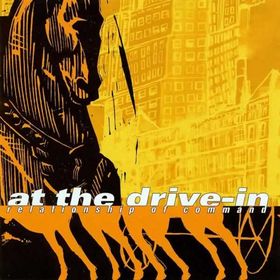
At The Drive-In: Relationship Of Command


AT THE DRIVE-IN: RELATIONSHIP OF COMMAND (2000)

1) Arcarsenal; 2) Pattern Against User; 3) One Armed Scissor; 4) Sleepwalk Capsules; 5) Invalid Litter Dept.; 6) Mannequin Republic; 7) Enfilade; 8) Rolodex Propaganda; 9) Quarantined; 10) Cosmonaut; 11) Non-Zero Possibili­ty; 12*) Catacombs.

Vaya on a larger scale — this is the record that finally made the band into a household name (at least, in that kind of households), entered all sorts of critical shortlists and rock textbooks, and gave them a chance to turn the ensuing break-up (or, rather, «indefinite hiatus») into an act of sense and purpose. Meaning that, rather than breaking up in disappointment and going back to the plough, they could break up with satisfaction and go on to become The Mars Volta.

Once again, I am not going to lie about how deeply I love and feel for the album. There is really nothing that can be done with this problem: hysterical leftism, hidden under walls of improvisa­tional lyrical metaphors and half-punk, half-math-rock-ish musical constructions, just does not happen to be one of my personal cups of tea. But on the other hand — hey, it took me at least 15 words connected in an unusual manner to attempt to describe what the band is doing here, and this means that Relationship Of Command is hardly a record that you should allow yourself to just shake off your shoulders and be done with it.

Parts of this album are still «post-hardcore», burning on mad percussion and fast guitar noise, with the artsy overdubs and convoluted, if not convulsive lyrics providing the «post» part of the deal. But there is just too much atmosphere, vocal harmonies, and sometimes even melodicity for us to simply tag Relationship Of Command as «post-hardcore» and be done with it. What has ʽInvalid Litter Dept.ʼ to do with «hardcore» at all? The backbone of the verse melody is «geo­metric rock» à la 1980's King Crimson, but humanized through the intervention of piano flouri­shes, heavenly slide guitars, and mournful angels chanting about "dancing on the corpses' ashes" (the song is said to be dedicated to the memory of the infamous Juárez murder victims). Hint: subtlety frequently, maybe even almost always, works better than straightforward anger — ʽIn­valid Litter Dept.ʼ is angry enough, but it is the soft flourishes that emphasize the eerie effect, not the "nails broke and fell into the wishing well" chorus, thrown out by Cedric in his usual manner.

And there are lots of these neat little touches on Relationship Of Command — the band here is clearly in a state where «formula», no matter how strict or trendy, does not satisfy them any lon­ger. On ʽEnfiladeʼ, for instance, guest star Iggy Pop opens the song with a hushed kidnapper phone monolog — immortalizing the line "Hello, mother leopard. I have your cub!"; the vocals are run through an «underwater» effect; no less than three guitars are interweaving different me­lodies  (a distorted heavy psychedelic pattern, a shrill set of light psychedelic trills, and I'm pretty sure there's a third part there, buried so low in the mix that I can't quite lay my finger on it); and the mid-section breaks into a... lambada? Whatever.

This is just what I'm talking about. These melodies still aren't all that memorable, but the album as a whole leaves a great aftertaste — you might not fully understand what you have just sat through, but the creativity, the wish to expand their musical world to make this confused, apoca­lyptic vision of the universe even more evocative, it's all there. Guitar World put the record as No. 94 on its list of 100 most influential guitar albums of all time — I certainly cannot verify the «in­fluential» tag, and I would definitely rate it lower on my personal list, but I do admit that there is a huge, huge, huge mélange of guitar stuff here: pop, punk, New Wave, prog, metal, everything is mixed, and frequently at the same time (ʽOne Armed Scissorʼ shuffles power chords, jazz, acid rock wah-wah soloing and God knows what else). Maybe none of these ingredients are all that in­novative, interesting, or inspiring on their own, but taken together — in the year 2000 — for a kid who never had the chance to learn the history of rock guitar — even for some grown-ups who did — this approach is a real blast of fury.

And it all ends with the band's successful attempt at a sort of a «noise requiem»: ʽNon-Zero Pos­sibilityʼ, the last song on their last LP, might be their masterpiece. "Contusion is hungry / They still eat their young / Proto-culture null and void" might be too blunt and hyperbolic, but the song's mix of mournful electric pianos, guitar-produced «bee stings», and noisy electronics in the background, is neither. This is already not so much «classic At The Drive-In» as it is «early pro­to-Mars Volta», announcing a radical shift in perspective, but who cares about the tags? Here they take our world troubles and put a unique dress on them. It may not be the most stunning dress in the world, but it is still a hell of a way to participate in the end-of-the-century «We Are Still A Very Evil Planet» festival. And a fine way to end a highly uneven, questionable, but ulti­mately self-redeeming career — thumbs up by way of listening and reasoning, if not necessarily so by way of hearing and feeling.

Check "Relationship Of Command" (CD) on Amazon
Check "Relationship Of Command" (MP3) on Amazon

Saturday, June 30, 2012

At The Drive-In: Vaya


AT THE DRIVE-IN: VAYA (1999)

1) Rascuache; 2) Proxima Centauri; 3) Ursa Minor; 4) Heliotrope; 5) Metronome Arthritis; 6) 300 MHz; 7) 198d.

Not the first, but the longest EP released by these guys, it deserves its own brief review because it is generally considered to be an important transitional step — sort of a threshold where they fi­nally stopped seeing their noisy schtick as a thing-in-itself, and started using it as a foundation upon which something bigger could eventually be built up. What would be built up is another matter, and I am still not sure that either Vaya or its lumpier full-length successor are «awesome» records in the way that they are revered by the fans, but...

...there's a change in the air, and it is a change for the good. Vaya cuts down on the straightfor­ward noisemaking of In/Casino/Out, brings back some of the twisted guitar geometry of Acro­batic Tenement, and throws in a few new ingredients, mainly, a huge emphasis on «dirge-like» bass and guitar chords. As a result, Vaya gels together as a sort of twenty-minute long punk re­qui­em — appropriate enough for a record whose last song is said to be dedicated to the drum­mer's grandmother, buried in a mass grave in Lebanon (Tony Hajjar's family actually fled to the States from the Civil War in the 1970s).

It is, in fact, only when I started looking at Vaya this way that something clicked (and I tried re­listening to the earlier albums this way, too, and it did not help). This is a carefully — much more carefully than before — constructed projection of human madness and its consequences, preten­ding to far more importance than you'd initially assume it to. The lyrics still flow in seemingly random streams of conscience, but as the music that backs them becomes loaded with a sense of purpose, the words no longer irritate at random — important signals are let out at regular intervals: "mastadon infantry radiate this frequency"... "civilization tastes so good, Nero has conquered the stars..." "they will come and get you tonight, so I guess this is goodnight..." "it's as if someone raised the price of dying to maximum vend again..." "what if forensics finds the answers, what if they stole my fingerprints?.." "amnesia proletariat, coughing up the coffins..." "you speak in ton­gues, tremors that warn us of ourselves..." ...see, it's starting to come together somehow.

As for the music, it is still anything but memorable, but now they know how to make atmosphere — by putting more fuzz on the bass and letting it roam along the premises louder and prouder than they used to, by alternating quiet and loud sections with more suspense than they were ca­pable of mustering, by bringing back the «guitar-weaving» techniques, by toying around with echoes and bits of electronics, by... well, I don't want to create the impression that these songs are very «diverse», because they are not, but the end result is a complex, intelligent, and, of course, hard-rocking grimness that warrants repeated listens until something sinks in.

Because this is so short, there are no high- or lowlights. ʽHeliotropeʼ is one of their fastest and craziest numbers; ʽMetronome Arthritisʼ is an attempt at «dark soul» that culminates in the "what if forensics..." line, the grandest gesture of paranoia in the band's career; ʽ300 Mhzʼ is the album's humble simulation of a worldwide nuclear meltdown; and ʽ198dʼ sometimes quietly, sometimes all-out loudly wails over the consequences. They do not really work apart from each other, and it takes a few listens and a bit of an effort to even make them work together, but once the effort is made, it is hard not to acknowledge that, finally, At The Drive-In managed to transform their «edu­cated brutality» into a form of, ho hum, modern art. Thumbs up, right?

Saturday, June 23, 2012

At The Drive-In: In/Casino/Out


AT THE DRIVE-IN: IN/CASINO/OUT (1998)

1) Alpha Centauri; 2) Chanbara; 3) Hulahoop Wounds; 4) Napoleon Solo; 5) Pickpocket; 6) For Now... We Toast; 7) A Devil Among The Tailors; 8) Shaking Hand Incision; 9) Lopsided; 10) Hourglass; 11) Transatlantic Foe.

Big lineup changes here: former bassist Omar Rodríguez switches to second guitar, with Paul Hi­nojos taking his place, and drummer Ryan Sawyer is replaced by Tony Hajjar. Are these shuffles responsible for a change in sound? No idea, but there is a change in sound, and not necessarily a good one, as far as my ears can tell.

The album was issued under a rather standard ideological sauce: «we want to come close to re­producing our live sound in the studio». This idea never worked for the Who, who pretty much abandoned it after several unsuccessful attempts; why it should have worked for At The Drive-In is never made clear. What it all comes down to is sacrificing the basic studio sound of Acrobatic Tene­ment — a sort of «Television updated for the 1990s» — and plunging deep into the world of loudness, distortion, power chords, screaming, and other charming attributes of noise-rock.

At this point, Cedric Bixler certainly sounds like one of the illegitimate sons of Captain Beefheart: the songs never distinguish properly between verse and chorus, the lyrics are an endless stream of consciousness that never makes literal sense but sometimes creates a «mood», the vocals are lite­rally «on the edge», and the music is intentionally ugly and non-catchy. The only problem is, In/ Casino/Out is no Trout Mask Replica. The lyrics have too few intriguing lines, and the words are mostly indiscernible anyway; Bixler's screaming is no better or worse than the acoustic waves sent out by millions of punk guys across the world; and the music...

...well, a few songs are genuinely interesting in one way or another. ʽPickpocketʼ is fast, concise, collected, and riding on a set of wobbly, quasi-psychedelic guitar lines that are at least amusing, and at best, inspirational. That is an example of an actual song with an idea behind it. Then comes ʽFor Now... We Toastʼ, where the same type of wobbly line makes an occasional appearance — but most of the time the musical background remains just a background, loud, but bland.

Many of the songs use a broken, stop-and-start structure (ʽA Devil Among The Tailorsʼ), pre­ten­ding to some sort of «avantgarde» structure — and despite the band's loyalty to the usual soft-verse-vs.-loud-chorus trick (except, as I said, there is no verse/chorus distinction here, un­less the «getting louder» part always counts as the chorus), anyway, despite that, yes, quite a few chord and rhythm changes here are relatively unpredictable. The only problem is, this group is smart, but taken together, they aren't exactly the Mothers of Invention or the Magic Band. They handle their instruments on the same level as any modestly capable punk band, no more and no less. And when you do not play your instruments in a particularly complex or unusual way, «ex­peri­men­tation» is usually a dead end.

To be fair, the album finds quite a warm reception in certain circles; I have seen terms like «ama­zing songwriting» and «unparalleled musicianship» applied to such songs as ʽAlpha Centauriʼ and ʽLopsidedʼ far more often than I'd like or even expect to. Therefore, I have a diplomatic duty to acknowledge that, perhaps, I am not «getting» something here. As far as musicianship goes, there is, at best, a bit of «nice» jangly / drony interplay between the two guitars (far less interes­ting than, for instance, the Bachmann/Johnson duets on Archers of Loaf albums), and the song­writing never advances beyond well-trodden paths of proto-punk and post-punk artists.

But my biggest concern is probably with Bixler, who is simply unbearable here — a naturally whiny guy trying to scream his lungs out is far more annoying than just a natural-born screamer. Eleven songs in a row try to convey a sharp personal tragedy of desperation and disillusionment, spat out in a schizophrenic stream of non sequiturs, and all I can discern is a sociopathic guy in bad need of professional help. (Side note for those who understand: while At The Drive-In could be seen as sort of a «Birth­day Party» prequel to the «Bad Seeds» of The Mars Volta, the compa­rison would never be secure, since Bixler never really «found himself» with his first band, where­as Nick Cave was already perfectly well within his element on the first Birthday Party albums).

Bottomline: if you like your N-O-I-S-E clumsily stuffed into a relatively conventional song for­mat, and your punky music dressed with «modern improvisational poetry», In/Casino/Out may well be for you. But not for me — I think that, unlike the first and third LP from this band, this one has almost nothing redeemable about its thumbs down.

Check "In/Casino/Out" (CD) on Amazon

Saturday, June 16, 2012

At The Drive-In: Acrobatic Tenement


AT THE DRIVE-IN: ACROBATIC TENEMENT (1996)

1) Star Slight; 2) Schaffino; 3) Ebroglio; 4) Initiation; 5) Communication Drive-In; 6) Skips On The Record; 7) Paid Vacation Time; 8) Ticklish; 9) Blue Tag; 10) Coating Of Arms; 11) Porfirio Diaz.

«Early Texan post-hardcore». Don't you just love it when it's that easy to pigeonhole? It's really the next step that is far more difficult to take. For instance, what is post-hardcore? If it really is something, is there any real need for it? Are there any generic traits of Texan post-hardcore that distinguish it from LA post-hardcore? Is this band good, or what?

So, instead of answering all these questions and drowning the review in terminology debates, let me just try to explain what the whole thing is like. Two interlocking guitars playing drones and jazz-influenced lead lines — an approach that reminds one of Television, only these guys are pre­dictably louder and wilder. A lead vocalist with a heavy nasal twang who considers singing an af­front to good taste, but is not strong enough for proper barking. Songs that are utterly unmemo­rable and often undistinguishable from each other, but still have invigorating potential. Impres­sionistic lyrics that never make the slightest sense, but still spit out the collective unconscious. And — poor, but not awful, production values (not bad for $600, I'd say).

Such is Acrobatic Tenement, an album that is usually said to capture At The Drive-In still in their formative phase. But since they eventually spent more time in the formative phase than in the fully formed one, we might just as well consider it their first «masterpiece», as far as this par­ticular style of making music is concerned.

The problem with reviewing this style is that it does nothing for me. Except for the slower, bass-heavier, moodier «ballad» ʽInitiationʼ, where Bixler's vocals occasionally try to turn to falsetto, everything else sticks together in a shapeless mess. It is not a noisy mess: the guitars favor the drone over the chainsaw buzz, and the collective effect frequently lands in the same ballpark with Velvet Underground jams or even avantgarde jazz stuff. But there is nothing particularly fresh, startling, or interesting about this drone. The guitars don't play anything that you haven't already heard from the Velvets, Television, Sonic Youth, Fugazi, or some other bunch of smelly jerks; and Bixler seems capable of one single vocal intonation, which sounds invigorating on the first track, familiar on the second, predictable on the third, annoying on the fourth, irritating on the fifth, and from then on it's just KILL KILL KILL.

If you want a good sampling of what these guys can do best when they are «weaving» their gui­tars, check out ʽSkips On The Recordʼ with its mix of drones and wobbles; or ʽTicklishʼ, which has some nice speedy picking there — but only if you already have a propensity for this kind of music, because if you are not already genetically engineered to adore «post-hardcore», Acrobatic Tene­ment will probably not convince you. If you want to see these guys at their most obviously «heartfelt», check out ʽEbroglioʼ, dedicated to a close friend who committed suicide that year: perhaps Jim Ward's and Adam Amparan's guitars will inflict catharsis, and Bixler's singing will make the stars shine bright on a cloudy day.

But if you do not want anything by yourself, I am certainly not going to insist that you rush out and hear the album at all. At best, it is better than a lot of noisy, flash-in-the-pan hardcore that it grew out of. Can that be a compliment? Nope. In reality, At The Drive-In only recorded one good LP in their brief lifetime, and this one's not it. Thumbs down.

Check "Acrobatic Tenement" (CD) on Amazon
Check "Acrobatic Tenement" (MP3) on Amazon